OPTICAL SATELLITE NETWORKING Indicative References 1 What is a - - PowerPoint PPT Presentation

optical satellite networking
SMART_READER_LITE
LIVE PREVIEW

OPTICAL SATELLITE NETWORKING Indicative References 1 What is a - - PowerPoint PPT Presentation

OPTICAL SATELLITE NETWORKING Indicative References 1 What is a network? It takes 2 nodes to have a link It takes minimum 3 nodes to have a network If the nodes are satellites and the links are optical we have an


slide-1
SLIDE 1

OPTICAL SATELLITE NETWORKING

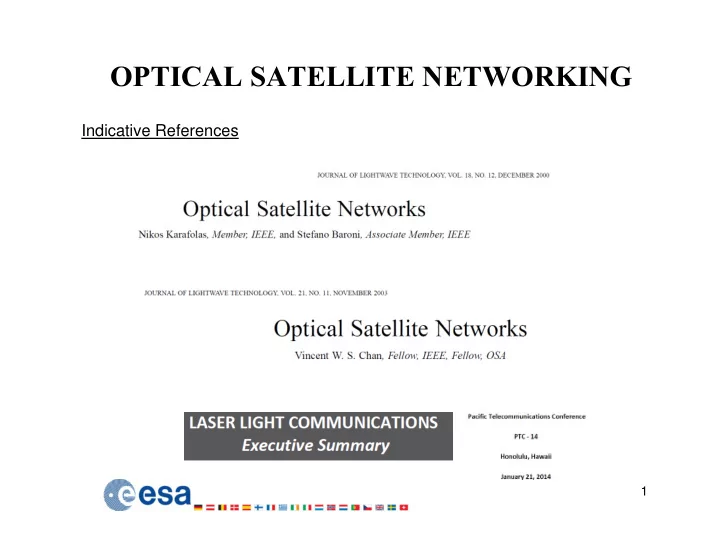
Indicative References

1
slide-2
SLIDE 2

What is a network? It takes 2 “nodes” to have a “link” It takes minimum 3 “nodes” to have a “network” If the nodes are satellites and the links are optical we have an “Optical Satellite Network”

2

slide-3
SLIDE 3

to form an Optical Satellite Network

We need:

  • A constellation of satellites ( or “nodes”)
  • Optical Inter-satellite Links
  • Satellite to Ground to Satellite Links can be either
  • RF links (access to end-users and TELCO operator’s Ground Stations)
  • r
  • Optical Links (only for TELCO operator’s Ground Stations)

3

slide-4
SLIDE 4

Satellite Constellations can be formed in different orbits: LEO-MEO-GEO

4

Latency is of great concern especially when compared to terrestrial fiber based latency for the most delay-sensitive application like voice/video-conference.

  • GEO is longer than fiber delay
  • MEO is similar to fiber delay
  • LEO is smaller to fiber delay

Remember light travels

  • at 300.000 km/sec in free space
  • at 200.000 km/sec in an optical fiber
slide-5
SLIDE 5

5

GEO the first Optical Satellite Network proposal “a global 3-nodes GEO ring topology-Clarke Network”

proposed by Arthur Clarke in October’s 1945 issue of “Wireless World”

…The stations in the chain would be linked by radio or optical beams, and thus any conceivable beam or broadcast service could be provided…”

slide-6
SLIDE 6

MEO (bent-pipe)

6

The O3B constellation (video 1.46 min) https://www.youtube.com/watch?v=ehM7FG1oB9Y

slide-7
SLIDE 7

LEO constellations (bent-pipe)

Gloablstar (video network-coverage simulation 0-1.34 min)

https://www.youtube.com/watch?v=G8VPEueequM

7

slide-8
SLIDE 8

LEO (with ISLs i.e a “Satellite Constellation Network”)

8

Constellation run (video Iridium Network run - Seam Visible 2.00 min)

https://www.youtube.com/watch?v=MGJal5uPXRA&list=PLedMFUaKH9DkwVY-q-ulAVBXWeM-Yto9F&index=8

End to end Communications (video maritime Iridium 0.58 min)

https://www.youtube.com/watch?v=AdoxXqMiwGo&list=PLedMFUaKH9DkwVY-q-ulAVBXWeM-Yto9F&index=7

slide-9
SLIDE 9

These Satellite Constellation Networks are the ones of interest to apply

  • Optical inter-satellite links
  • Optical on-board routing

and hence form an “Satellite Optical Transport Network” similar to “Terrestrial Optical Transport Network” and “Submarine Optical Transport Network”

9

slide-10
SLIDE 10

How an “optical satellite constellation network” is formed?

SATELLITE NETWORK PHYSICAL TOPOLOGY

  • Decide the orbit LEO-MEO-GEO (the lower the orbit the more satellites are needed

for global coverage – impact on elevation of ground antenna)

  • Decide number of orbital planes and inclination
  • Decide number of satellites/orbital plane
  • Decide on launching policy π or 2π and “phasing” (i.e. spacing)
  • Decide number of ISLs per satellite
  • Decide which satellites will be linked with ISLs

10

slide-11
SLIDE 11

2 main physical topologies

  • Ring
  • Mesh

11

slide-12
SLIDE 12

Example: Α ring of satellites (O3B type) can form network topology of either:

  • a Ring (2 ISLs/sat)
  • a Mesh(4 ISLs/sat)

12

slide-13
SLIDE 13

for LEO and truly global coverage a grid of tens/hundreds satellites is required

13

slide-14
SLIDE 14

14

slide-15
SLIDE 15

15

slide-16
SLIDE 16

π Mesh Constellations

6 orbital planes (space by 30 deg) 11 satellites per orbital plane 4 ISLs/per satellite with 3 at the “network seam” Altitude 781 km Orbital Period 6013 sec Inclination 86.4 16

slide-17
SLIDE 17

2π Mesh Constellations

17

slide-18
SLIDE 18

The concepts of a Satellite Optical Transport Network based Wavelength Division Multiplexed ISLs and On board Wavelength Selecive Routing

18

slide-19
SLIDE 19

Wavelength Division Multiplexing

19

slide-20
SLIDE 20

The idea of WDM Links and Wavelength routing via Wavelength Selective Optical Crossconnect

20 en.wikipedia.org/wiki/Optical_mesh_network

slide-21
SLIDE 21

The concept of “lightpath”

21

slide-22
SLIDE 22

A lightpath can link directly one satellite with another through intermediate ones

22

slide-23
SLIDE 23

a Satellite Payload WDM ISLs and W-S OXC

23

slide-24
SLIDE 24

A satellite WDM OTN

24

slide-25
SLIDE 25

Some key Networking and Communication Traffic Management considerations

25

slide-26
SLIDE 26

26

slide-27
SLIDE 27

27

slide-28
SLIDE 28

The earth by night tells us some things about tele-traffic

28

slide-29
SLIDE 29

29

slide-30
SLIDE 30

30

slide-31
SLIDE 31

31

slide-32
SLIDE 32

Technological Considerations

32

slide-33
SLIDE 33

Newly Proposed Systems

33

slide-34
SLIDE 34

34

slide-35
SLIDE 35

35

slide-36
SLIDE 36

Access OGS in various points with spatial diversity so as to increase the availability to acceptable levels

36

slide-37
SLIDE 37

37

slide-38
SLIDE 38

38

slide-39
SLIDE 39

Bloomberg Business Week 1 February 2015

39

slide-40
SLIDE 40

The 2 new proposals

X-Space

  • Google and Fidelity Investment 1 B$
  • 4000 satellites
  • LEO @ 1100 km
  • with optical links?
  • To be launched by SpaceX launchers
  • To operate by 2020

OneWeb

  • Virgin Galactic and Qualcomm
  • 648 satellites
  • LEO@1200 km
  • To be launched by Virgin Galactic Launcher One S/C
  • To operate by 2018-20

40

slide-41
SLIDE 41

and in Summary

The first RF Satellite Constellation Network, IRIDIUM, operates since 1999 in LEO The first Optical Trunk Satellite Network, LaserLight, is currently under construction and to be operational by 2017 in MEO Two proposed LEO Constellation Networks are to fly by 2020. Optical ISLs are considered which may created an Optical Internet Access Network in the Sky

slide-42
SLIDE 42

42

Thank you all for attending ! and for more information

Send me an email at : Nikos.Karafolas@esa.int and study the Proceedings of the “International Conference on Space Optics – ICSO” www.icsoproceedings.org They are accessible by everyone free of charge !