
SLIDE 1
Optical Heat Flux and Temperature Measurements on a 100 kW, Oxy-fuel Combustor
Teri Draper1, Pal Toth2, Terry Ring1, Eric Eddings, 1
1Institute for Clean and Secure Energy and Department of Chemical Engineering, University of Utah 2Department of Combustion and Thermal Energy, University of Miskolc
Abstract Optical heat flux and temperature measurements were taken on a 100 kW, oxy-fuel combustor. These measurements utilized an infrared camera, two-color pyrometry and narrow-angle radiometers. Data from these three techniques were taken simultaneously at a single operating condition in order to examine reproducibility and to compare between
- techniques. Comparable measurements were fairly stable with standard deviations within 1% of their respective
- means. The radiometer and infrared measurements were very similar (within 1%) after correcting the infrared data for
differences in background material. The two-color measurements yielded temperatures ~250 K above the other techniques; however, the two-color technique measured in the hottest part of the flame while the other techniques did
- not. Thus, this type of discrepancy is expected.
Introduction Optical measurements were taken on a larger-scale, 100 kW, oxy-fuel combustor located at the University of
- Utah. The details of the construction of the facility have
been previously described [1]. The furnace has since been modified for recycled flue gas oxy-combustion; however, for this test campaign, pure CO2 was used to dilute the
- flame. The fuel used was a bituminous, pulverized, Utah
Sufco coal. The optical measurements consisted of: a mid-wave infrared (MWIR) camera to measure radiative heat flux and temperature; a synchronized high-speed, visible camera with an image splitter and narrow-band filters to facilitate two-color pyrometry to measure temperature and soot concentration, and narrow-angle radiometers to measure incident radiative heat flux. Data from these three techniques were taken simultaneously. The purpose of this campaign was to examine the reproducibility of the measurements over time and to provide a comparison between different methods of heat flux and temperature measurement. Thus, a single
- perating condition was used and 15 separate
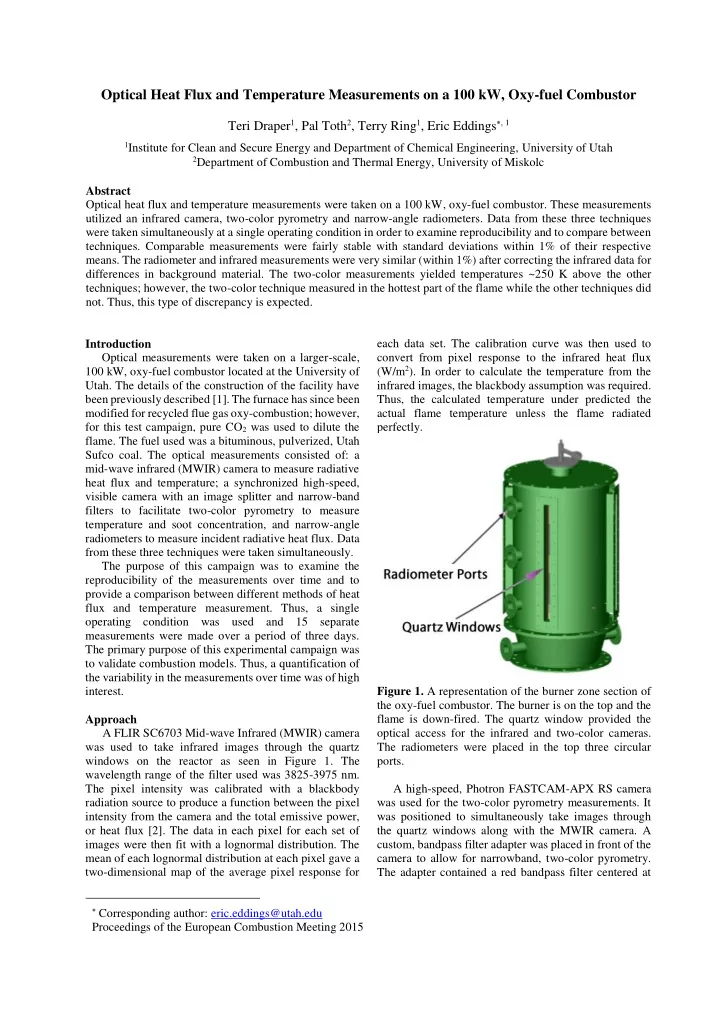
measurements were made over a period of three days. The primary purpose of this experimental campaign was to validate combustion models. Thus, a quantification of the variability in the measurements over time was of high interest. Approach A FLIR SC6703 Mid-wave Infrared (MWIR) camera was used to take infrared images through the quartz windows on the reactor as seen in Figure 1. The wavelength range of the filter used was 3825-3975 nm. The pixel intensity was calibrated with a blackbody radiation source to produce a function between the pixel intensity from the camera and the total emissive power,
- r heat flux [2]. The data in each pixel for each set of
images were then fit with a lognormal distribution. The mean of each lognormal distribution at each pixel gave a two-dimensional map of the average pixel response for
Corresponding author: c.author@myadress.com
Proceedings of the European Combustion Meeting 2015 each data set. The calibration curve was then used to convert from pixel response to the infrared heat flux (W/m2). In order to calculate the temperature from the infrared images, the blackbody assumption was required. Thus, the calculated temperature under predicted the actual flame temperature unless the flame radiated perfectly. Figure 1. A representation of the burner zone section of the oxy-fuel combustor. The burner is on the top and the flame is down-fired. The quartz window provided the
- ptical access for the infrared and two-color cameras.