) OPERATIONS AND IMPACT ON TRIALS IN THE ) SECOND JUDICIAL CIRCUIT - - PDF document

operations and impact on trials in the second judicial
SMART_READER_LITE
LIVE PREVIEW

) OPERATIONS AND IMPACT ON TRIALS IN THE ) SECOND JUDICIAL CIRCUIT - - PDF document

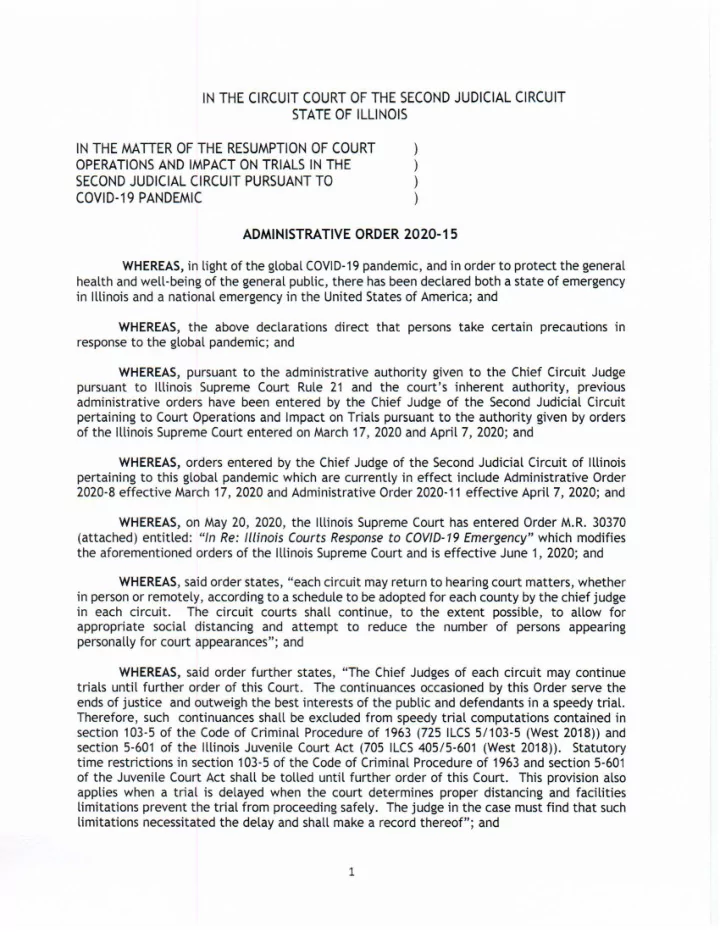
IN THE CIRCUIT COURT OF THE SECOND JUDICIAL CIRCUIT STATE OF ILLINOIS IN THE MATTER OF THE RESUMPTION OF COURT ) OPERATIONS AND IMPACT ON TRIALS IN THE ) SECOND JUDICIAL CIRCUIT PURSUANT TO ) COVID-19 PANDEMIC ) ADMINISTRATIVE ORDER 2020-15


slide-1
SLIDE 1

IN THE CIRCUIT COURT OF THE SECOND JUDICIAL CIRCUIT STATE OF ILLINOIS IN THE MATTER OF THE RESUMPTION OF COURT

)

OPERATIONS AND IMPACT ON TRIALS IN THE

)

SECOND JUDICIAL CIRCUIT PURSUANT TO

) COVID-19 PANDEMIC )

ADMINISTRATIVE ORDER 2020-15

WHEREAS, in light of the global COVID-19 pandemic, and in order to protect the general health and well-being of the general public, there has been declared both a state of emergency

in Illinois and a national emergency in the United States of America; and

WHEREAS, the above declarations direct that persons take certain precautions in response to the global pandemic; and WHEREAS, pursuant to the administrative authority given to the Chief Circuit Judge

pursuant to Illinois Supreme Court Rule 21 and the court's inherent authority, previous administrative orders have been entered by the Chief Judge of the Second Judicial Circuit pertaining to Court Operations and Impact on Trials pursuant to the authority given by orders

  • f the Illinois Supreme Court entered on March 17, 2020 and April 7, 2020; and

WHEREAS, orders entered by the Chief Judge of the Second Judicial Circuit of Illinois

pertaining to this global pandemic which are currently in effect include Administrative Order 2020-8 effective March 17, 2020 and Administrative Order 2020-11 effective April 7, 2020; and

WHEREAS, on May 20, 2020, the Illinois Supreme Court has entered Order M.R. 30370

(attached) entitled: "In Re: Illinois Courts Response to COVID-19 Emergency" which modifies the aforementioned orders of the Illinois Supreme Court and is effective June 1, 2020; and

WHEREAS, said order states, "each circuit may return to hearing court matters, whether

in person or remotely, according to a schedule to be adopted for each county by the chief judge in each circuit. The circuit courts shall continue, to the extent possible, to allow for appropriate social distancing and attempt to reduce the number of persons appearing personally for court appearances"; and

WHEREAS, said order further states, "The Chief Judges of each circuit may continue

trials until further order of this Court. The continuances occasioned by this Order serve the ends of justice and outweigh the best interests of the public and defendants in a speedy trial. Therefore, such continuances shall be excluded from speedy trial computations contained in section 103-5 of the Code of Criminal Procedure of 1963 (725 ILCS 5/ 103-5 (West 2018)) and section 5-601 of the Illinois Juvenile Court Act (705 ILCS 405/ 5-601 (West 2018)). Statutory time restrictions in section 103-5 of the Code of Criminal Procedure of 1963 and section 5-601

  • f the Juvenile Court Act shall be tolled until further order of this Court. This provision also

applies when a trial is delayed when the court determines proper distancing and facilities limitations prevent the trial from proceeding safely. The judge in the case must find that such limitations necessitated the delay and shall make a record thereof"; and

1

slide-2
SLIDE 2

IT IS THEREFORE ORDERED AS FOLLOWS:

  • 1. Administrative Order 2020-8, effective March 17, 2020 is hereby repealed.

Administrative Order 2020-11 , effective April 7, 2020, pertaining to impact upon trials is modified in part by this order and remains in effect as modified by Paragraph Six (6) of this order.

  • 2. The Resident Circuit Judges of each county within the Second Judicial Circuit of

Illinois (Crawford, Edwards, Franklin, Gallatin, Hamilton, Hardin, Jefferson, Lawrence, Richland, Wabash, Wayne, and White Counties) are authorized to set forth schedules and observe proper safety precautions with respect to the resumption of court operations on or after June 1, 2020.

  • 3. The Resident Circuit Judges of each county shall consider, but not be limited to, the

following legal related factors:

  • a. Deadlines applicable to a case or class of cases
  • b. The length of time which any applicable deadline has been suspended by
  • rder of the Supreme Court or Circuit Court
  • c. Limitations in court facilities or staffing
  • d. Anticipated prejudice to any class of cases resulting from continued delay
  • 4. The Resident Circuit Judges of each county shall also consider, but not be limited

to, the following health related factors:

  • a. Each county shall, to the extent possible, allow for appropriate social

distancing and attempt to reduce the number of persons appearing personally for court appearances

  • b. Each county shall attempt to comply with Center for Disease Control (CDC)

recommendations, local public health official recommendations, and the

Supreme Court Guidelines For Resuming Illinois Judicial Branch Operations During The COVID-19 Pandemic

  • c. Each county shall restrict entry into court facilities of persons who are

experiencing symptoms related to COVI D-19 or have been in recent close contact with an individual infected with the virus

  • d. Each county shall consider applicable information from public health

authorities

  • 5. The Resident Circuit Judge of each county is authorized to enact specific policies

and procedures to address their individual judicial facility and case needs and shall continue to promote the use of remote court hearings where appropriate.

  • 6. The Resident Circuit Judge of each county is in the best position to determine the

ability of their county to accommodate trials while balancing the interests of the parties against the state and nationally recognized public health dangers of summoning a jury and/ or conducting trials. Therefore, the Resident Circuit Judge

  • f each county is authorized to and may continue trials until further order. Pursuant

to Order M.R. 30370 entered on May 20, 2020 by the Supreme Court of Illinois, the continuances occasioned by this Order serve the ends of justice and outweigh the best interests of the public and defendants in a speedy trial. Such continuances shall be excluded from speedy trial computations contained in section 103-5 of the Code

  • f Criminal Procedure of 1963 (725 ILCS 5/1 03-5 (West 2018)) and section 5-601 of

2

slide-3
SLIDE 3

section 5-601 of the Illinois Juvenile Court Act (705 ILCS 405/5-601 (West 2018)). Statutory time restrictions in section 103-5 of the Code of Criminal Procedure of 1963 and section 5-601 of the Juvenile Court Act shall be tolled until further order

  • f this Court. This provision also applies when a trial is delayed when the court

determines proper distancing and facilities limitations prevent the trial from proceeding safely. The judge in the case must find that such limitations necessitated the delay and shall make a record thereof; THIS ORDER is effective June 1, 2020. IT IS SO ORDERED. Dated this 27th day of May, 2020.

3

Thomas J. Tedeschi Chief Judge

THOMAS J. TEDESCHI

MAY 2

7 2

20

CHIEF JUDGE

slide-4
SLIDE 4

In re: IN THE SUPREME COURT OF ILLINOIS Illinois Courts Response to COVI D-19 Emergency Order M.R. 30370 Article VI of the Illinois Constitution of 1970 vests the judicial power of our State in the Supreme Court, an Appellate Court, and the Circuit Courts. That constitutional grant of power creates a corresponding duty of service to the People of Illinois. To fulfill that duty, the judiciary's mission is to protect the rights and liberties of all by providing equal access to justice, resolving disputes, and upholding the rule of law. Those principles have always remained fundamental, even in times of crisis. Article VI also gives general administrative and supervisory authority over the judicial branch to the Supreme Court. In the exercise of that authority, this Court has issued a series

  • f
  • rders governing court functions during the COVID-19 pandemic. The March 17, 2020 order

directed Illinois courts to hear "essential court matters and proceedings." The order further authorized courts to conduct both essential and nonessential matters and proceedings remotely, subject to constitutional and practical limitations. Our concerns about the health and safety of all court users, staff, and judicial officers during these extraordinary circumstances are ongoing, and our duty to the People of Illinois is ever present. That duty requires courts to resume operations as quickly and fully as possible. Various approaches for doing so based on local public health data have emerged at the national and state levels. We have considered those approaches in charting a path forward. Pursuant to the exercise of its general administrative and supervisory authority over all Illinois courts as conferred on this Court pursuant to Article VI, Section 16 of the Illinois Constitution of 1970 (111. Const. 1970, art. VI, sec. 16), IT IS HEREBY ORDERED: Effective June 1, 2020, the Court's order of March 17, 2020, is modified so that each circuit may return to hearing court matters, whether in person or remotely, according to a schedule to be adopted for each county by the chief judge in each circuit. The circuit courts shall continue, to the extent possible, to allow for appropriate social distancing and attempt to reduce the number of persons appearing personally for court appearances. The factors which may be considered by the chief judge in determining whether matters may be safely heard include, but are not limited to, the following: deadlines which apply to a case or class of cases; the length of time any applicable deadline has been suspended by

  • rder of the Supreme Court or the Circuit Court; applicable information from public health

authorities; limitations in court facilities or staffing; and anticipated prejudice to any class of cases as a result of continued delay. Chief judges should also take into consideration the Supreme Court Guidelines for Resuming Illinois Judicial Branch Operations During the COVID

slide-5
SLIDE 5

19 pandemic. Chief circuit judges should understand that local conditions may change, and their plans should contain contingencies in that event. Local plans should continue to promote the use of remote hearings where appropriate. To the extent that the Court's order of March 17, 2020 prohibits in-person proceedings on non- essential matters, this provision is relaxed according to the plan adopted by the chief circuit judge in each circuit. Additionally, the April 7, 2020, order regarding Illinois Courts Response to COVID-19 Emergency/Impact on Trials is modified to read as follows: In the exercise of the general administrative and supervisory authority over the courts

  • f Illinois conferred on this Court pursuant to Article VI, Section 16 of the Illinois Constitution
  • f 1970 (Ill. Const. 1970, art. VI, sec. 16); in view of the state of emergency that has been

declared by the Governor of the State of Illinois in order to prevent the spread of the novel coronavirus; and in the interests of the health and safety of all court users, staff, and judicial

  • fficers during these extraordinary circumstances, and to clarify this Court's orders of March

20, 2020 and April 3, 2020, IT IS HEREBY ORDERED that the Court's orders of March 20, 2020 and April 3, 2020 are amended as follows: The Chief Judges of each circuit may continue trials until further order of this Court. The continuances occasioned by this Order serve the ends of justice and outweigh the best interests of the public and defendants in a speedy trial. Therefore, such continuances shall be excluded from speedy trial computations contained in section 103-5 of the Code of Criminal Procedure of 1963 (725 ILCS 5/103-5 (West 2018)) and section 5-601 of the Illinois Juvenile Court Act (705 ILCS 405/5-601 (West 2018)). Statutory time restrictions in section 103-5 of the Code of Criminal Procedure of 1963 and section 5-601 of the Juvenile Court Act shall be tolled until further order of this Court. This provision also applies when a trial is delayed when the court determines proper distancing and facilities limitations prevent the trial from proceeding safely. The judge in the case must find that such limitations necessitated the delay and shall make a record thereof. Order entered by the Court. IN WITNESS WHEREOF, I have hereunto subscribed my name and affixed the seal

  • f said Court, this 20th day of May, 2020.

c

(}.M~

  • r1l ~

Clerk, Supreme Court of the State of Illinois