
SLIDE 1
Open Pit Sulfide Mining on the Menominee River?
- Al Gedicks
- Dept. of Sociology
- University of
- Wisconsin-La Crosse
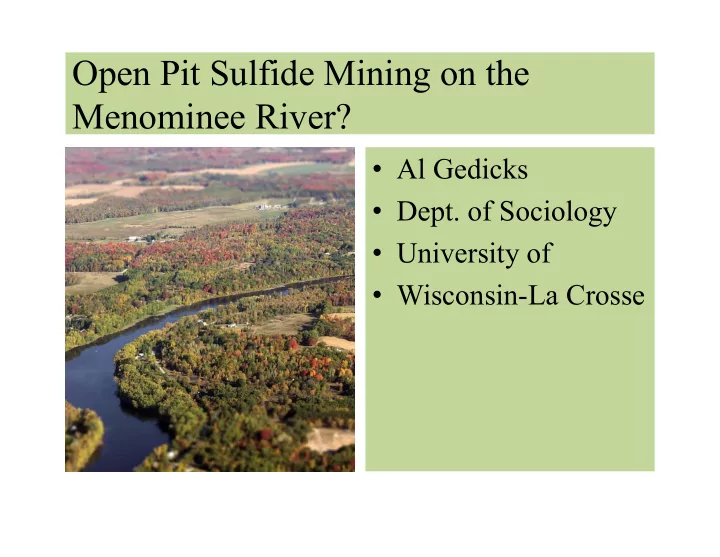
Open Pit Sulfide Mining on the Menominee River? Al Gedicks Dept. - - PowerPoint PPT Presentation
Open Pit Sulfide Mining on the Menominee River? Al Gedicks Dept. of Sociology University of Wisconsin-La Crosse Aquila Resources wants to develop an open pit (2000 ft. wide, 2500 ft. long and 800 ft. deep) massive gold-zinc
Aquila Resources wants to develop an open pit (2000 ft. wide, 2500 ft. long and 800 ft. deep) massive gold-zinc sulfide mine 150 feet from the the Menominee River, encroaching upon the
life of the mine project and increase waste and discharges and increase environmental risks.
An open records request to the Wisconsin DNR revealed that in 1989, before the mine was built, that the rock between the pit and the river was “fractured” and that contaminated groundwater leaving the mine pit would flow directly into the Flambeau River.
1997.
and 32 acres.
storage on site
181 acres.
sulfide mine (16 years)
feet deep, 83 acres (3x size)
waste rock and 11 mt of tailings; 75% of waste rock expected to generate acid.
storage on site.
4.5 the size of Flambeau
The Menominee River is the largest river system in the Upper Peninsula with a 4,000 square mile area that drains into Lake Michigan. The federal government has invested more than $41million to clean up the lower part of the river.
DNR have worked over the past decades to again make this river a viable habitat for sturgeon, now threatened by sulfide mining.
sites and other cultural resources are contained within the footprint
destroyed by any adverse impacts
water from mining disasters.”
Metallic sulfide mines in the United States will pollute up to 27 billion gallons of fresh water per year. The main reason is acid mine drainage which occurs when mineral deposits containing sulfides are exposed to air and water during excavation.
The vast majority (97%) of the rock excavated ends up as sulfide-bearing waste rock that will generate acid and that is stored in tailings dams at the mine site. The waste contains cyanide used to extract gold during processing on-site.
Poorly regulated tailings frequently discharge wastes into the environment, as in the January 2000 spill of 100 tons of cyanide contaminated water at the Aurul gold processing plant in Baia Mare on the Romanian-Hungarian border.
as a result of this accident that also destroyed the livelihood for some hundred fishermen along the Tisza River in Hungary.
towns the drinking water supply had to be shut down for some days.
cyanide in mining in 1998; the Czech Republic banned it in 2000.
a resolution opposing use of cyanide in Menominee County.
A new study reveals that catastrophic mine waste failures are increasing in frequency, severity and costs all around the world. Nearly half of all recorded serious failures happened in modern times, between 1990 and 2010.
On August 4, 2014, more than a billion gallons of mining waste spilled into rivers from a tailings dam at Imperial Metals’ Mount Polley gold and copper mine at the headwaters of the Fraser River watershed in British Columbia. Aquila’s plan only minimally addresses potential impacts of accidents or spills, dismissing potential impacts as “minimal.”
A local state of emergency was called and a ban was put on using surface and groundwater in the area. The mine was a state of the art, modern copper mine that had been touted as an example of how sulfide mining can co-exist with clean water. Scientists say it is ‘virtually impossible to clean up” the mess left behind this spill.
In April 2017 the conservation group, American Rivers listed the Menominee River as
impacts would last and whether the impacts could be reversed.
Kennecott/Rio Tinto’s Flambeau open pit copper-gold mine operated from 1993 to
Flambeau mine near Ladysmith show high levels of toxic pollutants.
In July 2012, U.S. District Court Judge Barbara Crabb ruled that the Flambeau Mining Company had violated the Clean Water Act on numerous counts by discharging toxic pollutants into a tributary of the Flambeau River on a repeated basis over the years.
In June 2014, the U.S. Environmental Protection Agency listed the Flambeau River tributary at the Mine site as “impaired waters” due to copper and zinc toxicity linked to the Flambeau mine
passive water treatment and FMC has not secured a mine reclamation certificate for this area.
Seven of the eight monitoring wells within the backfilled mine pit at the Flambeau mine site are highly contaminated with manganese, as documented on the company’s
cause the kind of nerve damage seen in Parkinson’s Disease.
If the mining industry was not able to keep the water clean and prevent long-term pollution problems at Wisconsin’s Flambeau Mine (“the newest and smallest copper mine in the world”), what can we do to protect the Menominee River at the far larger Back 40 proposed open pit mine?
Aquila Resources now has 3 of the 4 permits they need for the project. However, neither Aquila nor the Michigan DEQ has consulted the Menominee Tribe about their sacred sites. The Marinette Co. board voted 28-0 to oppose the mine. The project has no “social license to operate.”
During the legislative debate on the infamous Iron Mining bill, Aquila lobbyist Ron Kuehn pushed for repeal of Wisconsin’s Prove it First law. Aquila is exploring the Bend and Reef deposits in Marathon and Taylor Counties.