one structural behavior, systems, and design - - PowerPoint PPT Presentation

one
SMART_READER_LITE
LIVE PREVIEW

one structural behavior, systems, and design - - PowerPoint PPT Presentation

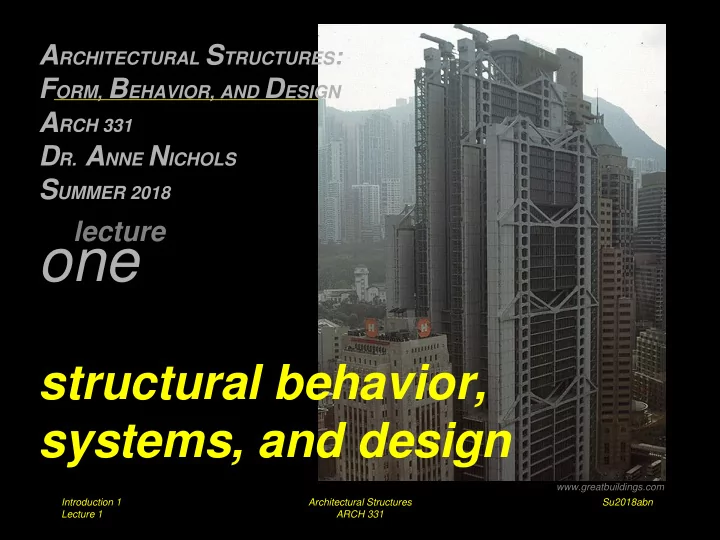
A RCHITECTURAL S TRUCTURES : F ORM, B EHAVIOR, AND D ESIGN A RCH 331 D R. A NNE N ICHOLS S UMMER 2018 lecture one structural behavior, systems, and design www.greatbuildings.com Introduction 1 Architectural Structures Su2018abn Lecture 1


slide-1
SLIDE 1

Su2018abn Introduction 1 Lecture 1 Architectural Structures ARCH 331

ARCHITECTURAL STRUCTURES: FORM, BEHAVIOR, AND DESIGN ARCH 331

  • DR. ANNE NICHOLS

SUMMER 2018

  • ne

structural behavior, systems, and design

lecture

www.greatbuildings.com

slide-2
SLIDE 2

Su2018abn Introduction 2 Lecture 1 Architectural Structures ARCH 331

Syllabus & Student Understandings

slide-3
SLIDE 3

Su2018abn Introduction 3 Lecture 1 Architectural Structures ARCH 331

Course Description

  • statics

– physics of forces and reactions on bodies and systems – equilibrium (bodies at rest)

  • structures

– something made up of interdependent parts in a definite pattern of organization

  • design

– assessing and meeting structural requirements of parts and the whole

slide-4
SLIDE 4

Su2018abn Introduction 4 Lecture 1 Architectural Structures ARCH 331

Course Description

  • mechanics of materials

– external loads and effect on deformable bodies – use it to answer question if structure meets requirements of

  • stability and equilibrium
  • strength and stiffness

– other principle building requirements

  • economy, functionality and aesthetics
slide-5
SLIDE 5

Su2018abn Introduction 5 Lecture 1 Architectural Structures ARCH 331

Structure Requirements

  • stability &

equilibrium

– STATICS

slide-6
SLIDE 6

Su2018abn Introduction 6 Lecture 1 Architectural Structures ARCH 331

Structure Requirements (cont)

  • strength &

stiffness

– concerned with stability of components

slide-7
SLIDE 7

Su2018abn Introduction 7 Lecture 1 Architectural Structures ARCH 331

Structural System Selection

  • kind & size of loads
  • building function
  • soil & topology of site
  • systems integration
  • fire rating
  • construction ($$, schedule)
  • architectural form
slide-8
SLIDE 8

Su2018abn Introduction 8 Lecture 1 Architectural Structures ARCH 331

Knowledge Required

  • external forces
  • internal forces
  • material properties
  • member cross

sections

  • ability of a material to resist breaking
  • structural elements that resist excessive

– deflection – deformation

slide-9
SLIDE 9

Su2018abn Introduction 9 Lecture 1 Architectural Structures ARCH 331

Problem Solving

  • 1. STATICS:

equilibrium of external forces, internal forces, stresses

  • 2. GEOMETRY:

cross section properties, deformations and conditions of geometric fit, strains

  • 3. MATERIAL PROPERTIES:

stress-strain relationship for each material

  • btained from testing
slide-10
SLIDE 10

Su2018abn Introduction 10 Lecture 1 Architectural Structures ARCH 331

Relation to Architecture

“The geometry and arrangement of the load-bearing members, the use of materials, and the crafting of joints all represent opportunities for buildings to express themselves. The best buildings are not designed by architects who after resolving the formal and spatial issues, simply ask the structural engineer to make sure it doesn’t fall down.” -Onouye & Kane

Statics and Strength of Materials for Architecture and Building Construction

slide-11
SLIDE 11

Su2018abn Introduction 11 Lecture 1 Architectural Structures ARCH 331

  • evolution traced to developments in

structural engineering and material technology

– stone & masonry – timber – concrete – cast iron, steel – tensile fabrics, pneumatic structures......

Architectural Space and Form

slide-12
SLIDE 12

Su2018abn Introduction 12 Lecture 1 Architectural Structures ARCH 331

  • structure is a device for channeling

loads that result from the use and/or presence of the building to the ground

– span a roof – hold up a floor – cross a river – suspend a canopy

Architectural Space and Form

www.pbs.org/wgbh/buildingbig/

slide-13
SLIDE 13

Su2018abn Introduction 13 Lecture 1 Architectural Structures ARCH 331

Structural Action

  • axial tension
  • axial compression
  • bending
slide-14
SLIDE 14

Su2018abn Introduction 14 Lecture 1 Architectural Structures ARCH 331

Structural Action

  • member breadth & depth
slide-15
SLIDE 15

Su2018abn Introduction 15 Lecture 1 Architectural Structures ARCH 331

Structural Action

  • stabilization
slide-16
SLIDE 16

Su2018abn Introduction 16 Lecture 1 Architectural Structures ARCH 331

Structural Action

  • shear & bracing
slide-17
SLIDE 17

Su2018abn Introduction 17 Lecture 1 Architectural Structures ARCH 331

Structural Action

  • lateral resistance
slide-18
SLIDE 18

Su2018abn Introduction 18 Lecture 1 Architectural Structures ARCH 331

Structural Action

  • twisting
slide-19
SLIDE 19

Su2018abn Introduction 19 Lecture 1 Architectural Structures ARCH 331

Structural Design

  • planning
  • preliminary structural

configuration

  • determination of loads
  • preliminary member

selection

  • analysis
  • evaluation
  • design revision
  • final design
slide-20
SLIDE 20

Su2018abn Introduction 20 Lecture 1 Architectural Structures ARCH 331

  • STATIC and DYNAMIC
  • dead load

– static, fixed, includes building weight, fixed equipment

  • live load

– transient and moving loads (including

  • ccupants), snowfall

Structural Loads

slide-21
SLIDE 21

Su2018abn Introduction 21 Lecture 1 Architectural Structures ARCH 331

  • wind loads

– dynamic, wind pressures treated as lateral static loads on walls, up or down loads on roofs

Structural Loads

slide-22
SLIDE 22

Su2018abn Introduction 22 Lecture 1 Architectural Structures ARCH 331

  • earthquake loads

– seismic, movement of ground

Structural Loads

slide-23
SLIDE 23

Su2018abn Introduction 23 Lecture 1 Architectural Structures ARCH 331

  • impact loads

– rapid, energy loads

Structural Loads

slide-24
SLIDE 24

Su2018abn Introduction 24 Lecture 1 Architectural Structures ARCH 331

Structural Loads

  • gravity acts on mass (F=m*g)
  • force of mass

– acts at a point

  • ie. joist on beam

– acts along a “line”

  • ie. floor on a beam

– acts over an area

  • ie. people, books,

snow on roof or floor

slide-25
SLIDE 25

Su2018abn Introduction 25 Lecture 1 Architectural Structures ARCH 331

Structural Math

  • quantify environmental loads

– how big is it?

  • evaluate geometry and angles

– where is it? – what is the scale? – what is the size in a particular direction?

  • quantify what happens in the structure

– how big are the internal forces? – how big should the beam be?

slide-26
SLIDE 26

Su2018abn Introduction 26 Lecture 1 Architectural Structures ARCH 331

Structural Math

  • physics takes observable phenomena

and relates the measurement with rules: mathematical relationships

  • need

– reference frame – measure of length, mass, time, direction, velocity, acceleration, work, heat, electricity, light – calculations & geometry

slide-27
SLIDE 27

Su2018abn

Structural Organization

  • classifications

– geometry

  • line-forming
  • surface-forming

– stiffness

  • rigid
  • flexible

– one-way or two-way

  • spatial organization and load transfer

– materials

Architectural Structures ARCH 331 Introduction 27 Lecture 1

slide-28
SLIDE 28

Su2018abn Architectural Structures ARCH 331

Structural Components

  • bearing walls
  • columns
  • beams
  • flat plates
  • trusses
  • arches
  • shells
  • cables

Introduction 28 Lecture 1

slide-29
SLIDE 29

Su2018abn Architectural Structures ARCH 331

Bearing Walls

Introduction 29 Lecture 1

slide-30
SLIDE 30

Su2018abn Architectural Structures ARCH 331

Bearing Walls

  • behavior as “deep beams”

Introduction 30 Lecture 1

slide-31
SLIDE 31

Su2018abn Architectural Structures ARCH 331

Columns & Walls

Introduction 31 Lecture 1

slide-32
SLIDE 32

Su2018abn Architectural Structures ARCH 331

Beams & Plates

Introduction 32 Lecture 1

slide-33
SLIDE 33

Su2018abn Architectural Structures ARCH 331

Beams & Plates

Introduction 33 Lecture 1

slide-34
SLIDE 34

Su2018abn Architectural Structures ARCH 331

Trusses and Shells

Introduction 34 Lecture 1

slide-35
SLIDE 35

Su2018abn Architectural Structures ARCH 331

Arches and Cables

Introduction 35 Lecture 1

slide-36
SLIDE 36

Su2018abn Architectural Structures ARCH 331

Building Framing

  • Components or Assemblages

Introduction 36 Lecture 1

slide-37
SLIDE 37

Su2018abn Architectural Structures ARCH 331

Building Framing

Introduction 37 Lecture 1

slide-38
SLIDE 38

Su2018abn Architectural Structures ARCH 331

System Selection

  • evaluation of alternatives

Introduction 38 Lecture 1

slide-39
SLIDE 39

Su2018abn Architectural Structures ARCH 331

System Selection

Introduction 39 Lecture 1

slide-40
SLIDE 40

Su2018abn Architectural Structures ARCH 331

Structural Design Criteria

  • components stay together
  • structure acts as whole to be stable

– resist sliding – resist overturning – resist twisting and distortion

  • internal stability

– interconnectedness

  • strength & stiffness

Introduction 40 Lecture 1

slide-41
SLIDE 41

Su2018abn Architectural Structures ARCH 331

Structural Design Sequences

  • first-order design

– structural type and organization – design intent – contextual or programmatic

  • second-order

– structural strategies – material choice – structural systems

  • third-order

– member shaping & sizing

Introduction 41 Lecture 1

slide-42
SLIDE 42

Su2018abn Architectural Structures ARCH 331

Systems by Materials

  • Wood
  • Steel
  • Concrete
  • Masonry
  • Composite

Introduction 42 Lecture 1

slide-43
SLIDE 43

Su2018abn Introduction 43 Lecture 1 Architectural Structures ARCH 331

Wood

  • columns
  • beams
  • trusses
slide-44
SLIDE 44

Su2018abn Architectural Structures ARCH 331

  • all-wood framing systems

– studs, beams, floor diaphragms, shearwalls – glulam arches & frames – post & beams – trusses

  • composite construction

– masonry shear walls – concrete – steel

Timber Construction

Introduction 44 Lecture 1

slide-45
SLIDE 45

Su2018abn Architectural Structures ARCH 331

Timber Construction

  • studs, beams
  • floor diaphragms & shear walls

Introduction 45 Lecture 1

slide-46
SLIDE 46

Su2018abn Architectural Structures ARCH 331

Timber Construction

  • glulam arches & frames

– manufactured or custom shapes – glue laminated – bigger members

Introduction 46 Lecture 1

slide-47
SLIDE 47

Su2018abn Architectural Structures ARCH 331

Timber Construction

  • post & beam
  • trusses

Introduction 47 Lecture 1

slide-48
SLIDE 48

Su2018abn Architectural Structures ARCH 331

Timber Construction

  • composite construction

Introduction 48 Lecture 1

slide-49
SLIDE 49

Su2018abn Architectural Structures ARCH 331

Steel

  • cast iron – wrought iron - steel
  • cables
  • columns
  • beams
  • trusses
  • frames

http:// nisee.berkeley.edu/godden Introduction 49 Lecture 1

slide-50
SLIDE 50

Su2018abn Architectural Structures ARCH 331

Steel Construction

  • standard rolled shapes
  • open web joists
  • plate girders
  • decking

Introduction 50 Lecture 1

slide-51
SLIDE 51

Su2018abn Architectural Structures ARCH 331

Steel Construction

  • welding
  • bolts

Introduction 51 Lecture 1

slide-52
SLIDE 52

Su2018abn Architectural Structures ARCH 331

Steel Construction

  • fire proofing

– cementicious spray – encasement in gypsum – intumescent – expands with heat – sprinkler system

Introduction 52 Lecture 1

slide-53
SLIDE 53

Su2018abn Architectural Structures ARCH 331

Concrete

  • columns
  • beams
  • slabs
  • domes
  • footings

http:// nisee.berkeley.edu/godden Introduction 53 Lecture 1

slide-54
SLIDE 54

Su2018abn Architectural Structures ARCH 331

Concrete Construction

  • cast-in-place
  • tilt-up
  • prestressing
  • post-tensioning

http:// nisee.berkeley.edu/godden Introduction 54 Lecture 1

slide-55
SLIDE 55

Su2018abn Architectural Structures ARCH 331

Concrete Floor Systems

  • types & spanning direction

Introduction 55 Lecture 1

slide-56
SLIDE 56

Su2018abn Architectural Structures ARCH 331

Concrete Floor Systems

Introduction 56 Lecture 1

slide-57
SLIDE 57

Su2018abn Architectural Structures ARCH 331

Masonry (& Stone)

  • columns
  • walls
  • lintels
  • beams
  • arches
  • footings

Introduction 57 Lecture 1

slide-58
SLIDE 58

Su2018abn

Grids and Patterns

  • often adopted early in design

– give order – cellular, ex.

  • vertical and horizontal
  • square and rectangular

– single-cell – aggregated bays

Architectural Structures ARCH 331 Introduction 58 Lecture 1

slide-59
SLIDE 59

Su2018abn Architectural Structures ARCH 331

Grids and Patterns

Introduction 59 Lecture 1

slide-60
SLIDE 60

Su2018abn Architectural Structures ARCH 331

Systems

  • total of components
  • behavior of whole
  • classifications

– one-way – two-way – tubes – braced – unbraced

Introduction 60 Lecture 1

slide-61
SLIDE 61

Su2018abn Architectural Structures ARCH 331

One-Way Systems

  • horizontal vs. vertical

Introduction 61 Lecture 1

slide-62
SLIDE 62

Su2018abn Architectural Structures ARCH 331

Two-Way Systems

  • spanning system less obvious
  • horizontal

– plates – slabs – space frames

  • vertical

– columns – walls

Introduction 62 Lecture 1

slide-63
SLIDE 63

Su2018abn Architectural Structures ARCH 331

Two-Way Systems

Introduction 63 Lecture 1

slide-64
SLIDE 64

Su2018abn Architectural Structures ARCH 331

Roof Shapes

  • coincide
  • within

Introduction 64 Lecture 1

slide-65
SLIDE 65

Su2018abn Architectural Structures ARCH 331

Tubes & Cores

  • stiffness

Introduction 65 Lecture 1

slide-66
SLIDE 66

Su2018abn Architectural Structures ARCH 331

Span Lengths

  • crucial in selection
  • f system
  • maximum spans
  • n charts aren’t

absolute limits, but usual maximums

  • increase L, increase depth2 required

(ex. cantilever)

  • deflections depend on L

Introduction 66 Lecture 1

slide-67
SLIDE 67

Su2018abn Architectural Structures ARCH 331

Approximate Depths

Introduction 67 Lecture 1

slide-68
SLIDE 68

Su2018abn Architectural Structures ARCH 331

Loading Type and Structure Type

  • light uniform loads

– surface forming elements – those that pick up first load dictate spacing

  • f other elements
  • heavy concentrated loads

– member design unique

  • distributed vs. concentrated structural

strategies

– large beam vs. many smaller ones

Introduction 68 Lecture 1

slide-69
SLIDE 69

Su2018abn Architectural Structures ARCH 331

Design Issues

  • lateral stability – all directions

Introduction 69 Lecture 1

slide-70
SLIDE 70

Su2018abn Architectural Structures ARCH 331

Design Issues

  • configuration

Introduction 70 Lecture 1

slide-71
SLIDE 71

Su2018abn Architectural Structures ARCH 331

Design Issues

  • vertical load resistance

walls columns

Introduction 71 Lecture 1

slide-72
SLIDE 72

Su2018abn Architectural Structures ARCH 331

Design Issues

  • lateral load resistance

Introduction 72 Lecture 1

slide-73
SLIDE 73

Su2018abn Architectural Structures ARCH 331

Design Issues

  • lateral load resistance

Introduction 73 Lecture 1

slide-74
SLIDE 74

Su2018abn Architectural Structures ARCH 331

Design Issues

  • multi-story

– cores, tubes, braced frames

Introduction 74 Lecture 1

slide-75
SLIDE 75

Su2018abn Architectural Structures ARCH 331

Design Issues

  • multi-story

– avoid discontinuities

  • vertically
  • horizontally

Introduction 75 Lecture 1

slide-76
SLIDE 76

Su2018abn Architectural Structures ARCH 331

Foundation Influence

  • type may dictate fit

– piles vs. mats vs. spread – capacity of soil to sustain loads

  • high capacity – smaller area
  • f bearing needing and can

spread out

  • low capacity – multiple

contacts and big distribution areas

Introduction 76 Lecture 1

slide-77
SLIDE 77

Su2018abn Architectural Structures ARCH 331

Grid Dependency on Floor Height

  • wide grid = deep beams

– increased building height – heavier – foundation design

  • codes and zoning

may limit

  • utilize depth for

mechanical

Introduction 77 Lecture 1

slide-78
SLIDE 78

Su2018abn Architectural Structures ARCH 331

Large Spaces

  • ex. auditoriums, gyms, ballrooms
  • choices

– separate two systems completely and connect along edges – embed in finer grid – staggered truss

Introduction 78 Lecture 1

slide-79
SLIDE 79

Su2018abn Architectural Structures ARCH 331

Meeting of Grids

  • common to use more than one grid
  • intersection important structurally
  • can use different structural materials

– need to understand their properties

  • mechanical
  • thermal

Introduction 79 Lecture 1

slide-80
SLIDE 80

Su2018abn Architectural Structures ARCH 331

Meeting of Grids

  • horizontal choices

Introduction 80 Lecture 1

slide-81
SLIDE 81

Su2018abn Architectural Structures ARCH 331

Meeting of Grids

  • vertical choices

Introduction 81 Lecture 1

slide-82
SLIDE 82

Su2018abn Architectural Structures ARCH 331

Other Conditions

  • circulation
  • building service systems

– one-way systems have space for parallel runs – trusses allow for transverse penetration – pass beneath or interstitial floors

  • for complex or extensive

services or flexibility

Introduction 82 Lecture 1

slide-83
SLIDE 83

Su2018abn Architectural Structures ARCH 331

Other Conditions

  • poking holes for member services

– horizontal

  • need to consider area

removed, where removed, and importance to shear

  • r bending

– vertical

  • requires framing at edges
  • can cluster openings to

eliminate a bay

– double systems

Introduction 83 Lecture 1

slide-84
SLIDE 84

Su2018abn Architectural Structures ARCH 331

Fire Safety & Structures

  • fire safety requirements can impact

structural selection

  • construction types

– light

  • residential
  • wood-frame or unprotected metal

– medium

  • masonry

– heavy

  • protected steel or reinforced concrete

Introduction 84 Lecture 1

slide-85
SLIDE 85

Su2018abn Architectural Structures ARCH 331

Fire Safety & Structures

  • degree of occupancy hazards
  • building heights
  • maximum floor areas between fire wall

divisions

– can impact load bearing wall location

Introduction 85 Lecture 1

slide-86
SLIDE 86

Su2018abn Architectural Structures ARCH 331

Fire Safety & Structures

  • resistance ratings by failure type

– transmission failure

  • fire or gasses move

– structural failure

  • high temperatures reduce strength

– failure when subjected to water spray

  • necessary strength
  • ratings do not pertain to usefulness of

structure after a fire

Introduction 86 Lecture 1

slide-87
SLIDE 87

Su2018abn

Project

Architectural Structures ARCH 331 Introduction 87 Lecture 1