ONE COLLECTION: BUILDING AN INTEGRATED INVENTORY & DIGITISATION - - PowerPoint PPT Presentation

one collection building an integrated inventory amp
SMART_READER_LITE
LIVE PREVIEW

ONE COLLECTION: BUILDING AN INTEGRATED INVENTORY & DIGITISATION - - PowerPoint PPT Presentation

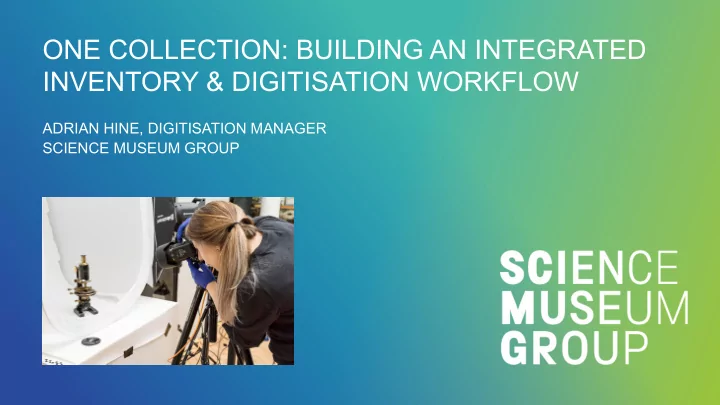
ONE COLLECTION: BUILDING AN INTEGRATED INVENTORY & DIGITISATION WORKFLOW ADRIAN HINE, DIGITISATION MANAGER SCIENCE MUSEUM GROUP ONE COLLECTION PROGRAMME In 2015 the UK Government announced SMG would leave Blythe House in London.


slide-1
SLIDE 1

ONE COLLECTION: BUILDING AN INTEGRATED INVENTORY & DIGITISATION WORKFLOW

ADRIAN HINE, DIGITISATION MANAGER SCIENCE MUSEUM GROUP

slide-2
SLIDE 2
slide-3
SLIDE 3
  • In 2015 the UK Government announced SMG would leave

Blythe House in London.

  • It provided partial funding to build and move to a new

National Collections Centre at Wroughton by 2023.

  • Immediate objective to move 300,000 objects to the

National Collections Centre.

  • However, opportunity to re-imagine how the collection is

cared for, managed and accessed:

  • Improve collections care for this world-class collection.
  • Make the collection more accessible than ever before

(public & researchers).

  • Engage new and existing audiences.
  • Radically expand our digital offer.

ONE COLLECTION PROGRAMME

slide-4
SLIDE 4
  • Holds majority of SCM collection
  • Small & medium object store
  • Labyrinth of rooms: 5 floors >100 rooms
  • >18km of racking

BLYTHE HOUSE

slide-5
SLIDE 5

EXISTING DRAWBACKS

PHYSICAL

  • Labyrinth of rooms: 6 floors, >100 rooms
  • Non-ideal environmental conditions
  • Poor access
  • Degrading building infrastructure (hangers)
  • Overcrowded collections
  • No standardisation of storage

DIGITAL

  • Incomplete catalogue (100,000 uncatalogued)
  • Only c. 5% of objects have images
  • Incomplete & inconsistent catalogue records
  • Inconsistent location control
  • Incomplete hazard assessment
slide-6
SLIDE 6

CATALYST FOR DIGITISATION

  • We wanted to make it much more than just a storage

move.

  • An opportunity to make our collection truly digital.
  • Todays online audience have limited interest unless

there is a rich digital offer.

  • Only 5% of records on Collections Online had an image

in 2018 (ca. 260,000 records).

  • We made a choice of producing quantity rather than

highest quality.

  • Main aim to make these objects discoverable In the

first instance.

  • Aimed at the broadest audience possible but with

emphasise on the public.

slide-7
SLIDE 7

INTEGRATED WORKFLOW

CONDITION CHECK HAZARD CHECK PRE-INVENTORY DIGITISATION REMEDIATION PACKING CONSERVATION INVENTORY

slide-8
SLIDE 8

Resolving issues that would otherwise disrupt the workflow:

  • Poor part numbering
  • Parts lacking numbers and/or records
  • Uncertainty over parts belonging to objects
  • Status uncertain
  • Mystery objects
  • Historic loans
  • Objects for acquiring
  • Objects for deaccessioning
  • Auxiliary items

PRE-INVENTORY CURATION/DOCUMENTATION

slide-9
SLIDE 9
  • All object have to be hazard assessed
  • Survey suggests ca. 20% of collection has a hazard
  • Only 17% of Blythe House has been hazard surveyed

HAZARD CHECK

slide-10
SLIDE 10
  • Working systematically work through collection
  • 4 minutes per object for inventory
  • Adds new Tyvek label with barcode & object number
  • Condition rating (Good, Fair, Poor, Unacceptable)
  • Uses Wireless barcode scanners to update object location in

Mimsy

INVENTORY

  • If record exists: verify record & add barcode
  • If record does not exist: add new record
slide-11
SLIDE 11

ACCELERATING DIGITSATION

  • Existing Photo Studio practice
  • Each object takes 3 hours, often with multiple shots.
  • This includes photography, manual post-processing, metadata capture and upload.
  • At that rate it would take a team of 7 photographers 64 years to Digitise 75% of the

Blythe Collection (300,000 objects)

  • Had to radically rethink approach to deliver mass Digitisation for these collections
  • One Collection approach
  • Each object takes 5 minutes, with a single shot.
  • Includes rapid photography using barcodes, batch post-processing & automatic upload

into Media Library.

  • This rate would take a team of 7 photographers 2 years to Digitise 75% of the Blythe

Collection.

slide-12
SLIDE 12

Photography

  • Good quality documentation image
  • 5 minutes per object
  • Mobile photography workstations
  • Good quality DSLR cameras & lighting
  • Scanners capture barcode directly into image metadata
  • Script renames filename with barcode

DIGITISATION

Post-processing & Upload

  • Batch post-production
  • Automated ingest pipeline of images into Media

Library

slide-13
SLIDE 13

Rapid Data App (Asset Panda & SnapLogic)

  • Used by hazards, condition, inventory and packing teams
  • Works on laptops, tablets & phones using WiFi
  • Location updates using barcodes
  • Tracks object status through workflow
  • Ability to take quick ‘ad hoc’ images using phones

Automated Image Ingest Pipeline (SnapLogic)

  • Watches for approved image
  • Embeds object metadata
  • Creates record in Media Library
  • Uses barcode to link Media Library and Mimsy records

TECHNOLOGY FOR MASS DIGITISATION

slide-14
SLIDE 14

RAPID DATA CAPTURE SYSTEM

slide-15
SLIDE 15

DIGITISED EXAMPLES

slide-16
SLIDE 16

PUBLICATION TO COLLECTIONS ONLINE

slide-17
SLIDE 17

CATALOGUING

  • Catalogue record should be rich enough to make it

discoverable through searching.

  • Aim for new records reach the SMG Cataloguing standard,

depending upon resources available.

  • Cataloguing separated from the main workflow as it would

slow it down.

  • Mostly done from the digitised record *after* inventory and

imaging completed.

  • Undertaken by collection specialists in curatorial.
  • Does not include:
  • Weight
  • Measurements
slide-18
SLIDE 18

NCC INTERNAL MOVES

  • Additionally One Collection includes the internal moves sub-project at NCC
  • Involves the relocation of collections from life-expired hangers (ca. 15,000 objects).
  • Some collections to move into Building One, other collections to other hangers.
  • Similar aims to Blythe workflow; inventory of all objects, including hazard checks, conditions

rating, barcoding and location capture. Digitisation will likely be a lower standard than at Blythe

  • Modified workflow due to very different working environment.
  • Running in parallel with Collections Review project, using same approach for inventory

process.

slide-19
SLIDE 19

TIMELINE

Workstream 2018 2019 2020

J F M A M J J A S O N D J F M A M J J A S O N D J F M A M J J A S O N D

Hazards & Inventory Photography Packing

slide-20
SLIDE 20

PROGRESS TO DATE

slide-21
SLIDE 21

COLLECTIONS BENEFITS

  • A comprehensive inventory, hazard check and digitisation leads to powerful benefits to the

collection:

  • Accurate location for all items.
  • Complete hazard assessment and condition check of collection.
  • Consistent labelling of items and opportunity to rehouse material.
  • Reliable and unique identifier for all items (barcode).
  • Opportunity to resolve objects for transfer, acquisition cases and mystery objects.
  • Barcodes allow for automated location updates in the future using barcode scanners.
  • Creates a truly Digital Collection to a diverse audience making the collections

discoverable.

  • Blythe is a one-off project large-scale project but approach is entirely applicable for smaller

scale projects.

  • SEG decant at SIM has used same approach directly into Mimsy with great success.
slide-22
SLIDE 22

VOLUNTEERING

  • Significant volunteering programme.
  • Volunteers sign up for a 12 week block for one day a week.
  • 6 weeks with inventory & 6 weeks with photography.
  • Each volunteer buddies up with a member of the inventory
  • r photography team and works in a pair.
  • Adds genuine value for museum and volunteer.
  • To be successful needs:
  • Skillset of volunteer appropriate for task.
  • Adequate resourcing of supervisors
slide-23
SLIDE 23

TEAM STRUCTURE

Dedicated Project Team

  • Programme managers and support
  • Hazards
  • Conservation
  • Inventory
  • Photography
  • Assistant curators
  • Registration
  • Documentation
  • Object handlers
  • Packing
  • Volunteers

Biggest challenge & success: integrating a large and diverse project team with SMG core teams SMG Core Teams

  • Conservation & Hazards
  • Digitisation (Photography & Documentation)
  • Curatorial
  • Archives
  • Registration
  • ICT
  • Digital
  • Collections Logistics & Access
  • P&C
  • Comms
  • Finance
  • Development
slide-24
SLIDE 24
  • Building One has a footprint of 20,000 m2 (four football pitches).
  • Holds 340,000 objects (80% of SMG object collection by number and
  • ver 50% by volume).
  • Balancing conservation requirements and accessibility.
  • Construction began Feb 2019. Completion in 2020.

NATIONAL COLLECTIONS CENTRE

slide-25
SLIDE 25

COLLECTIONS ENGAGEMENT OUTCOMES

  • Random Object Generator
  • http://collection.sciencemuseum.org.uk/random
  • Museum in a Tab
  • https://blog.sciencemuseum.org.uk/museum-in-a-tab
  • Stories from the Stores video series
  • https://www.youtube.com/user/sciencemuseum
slide-26
SLIDE 26