On the ubiquity of modular forms and Ap ery-like numbers - - PowerPoint PPT Presentation

on the ubiquity of modular forms and ap ery like numbers
SMART_READER_LITE
LIVE PREVIEW

On the ubiquity of modular forms and Ap ery-like numbers - - PowerPoint PPT Presentation

On the ubiquity of modular forms and Ap ery-like numbers Algorithmic Combinatorics Seminar RISC (Johannes Kepler University, Linz, Austria) Armin Straub October 9, 2013 University of Illinois & Max-Planck-Institut at


slide-1
SLIDE 1

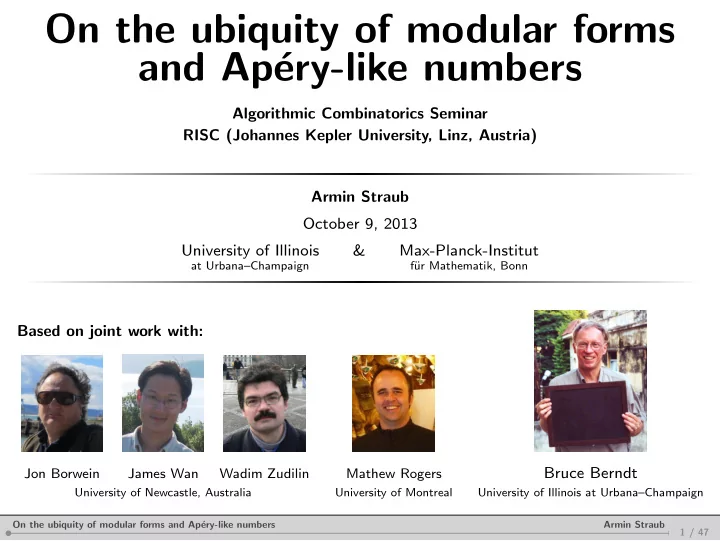
On the ubiquity of modular forms and Ap´ ery-like numbers

Algorithmic Combinatorics Seminar RISC (Johannes Kepler University, Linz, Austria) Armin Straub October 9, 2013 University of Illinois

at Urbana–Champaign

& Max-Planck-Institut

f¨ ur Mathematik, Bonn

Based on joint work with:

Jon Borwein James Wan Wadim Zudilin

University of Newcastle, Australia

Mathew Rogers

University of Montreal

Bruce Berndt

University of Illinois at Urbana–Champaign

On the ubiquity of modular forms and Ap´ ery-like numbers Armin Straub 1 / 47
slide-2
SLIDE 2

PART I

Encounters with Ap´ ery numbers and modular forms

Short random walks Binomial congruences Positivity of rational functions Series for 1/π

On the ubiquity of modular forms and Ap´ ery-like numbers Armin Straub 2 / 47
slide-3
SLIDE 3

Ap´ ery numbers and the irrationality of ζ(3)

  • The Ap´

ery numbers

1, 5, 73, 1445, . . .

A(n) =

n

  • k=0

n k 2n + k k 2 satisfy (n + 1)3un+1 − (2n + 1)(17n2 + 17n + 5)un + n3un−1 = 0.

On the ubiquity of modular forms and Ap´ ery-like numbers Armin Straub 3 / 47
slide-4
SLIDE 4

Ap´ ery numbers and the irrationality of ζ(3)

  • The Ap´

ery numbers

1, 5, 73, 1445, . . .

A(n) =

n

  • k=0

n k 2n + k k 2 satisfy (n + 1)3un+1 − (2n + 1)(17n2 + 17n + 5)un + n3un−1 = 0. ζ(3) = ∞

n=1 1 n3 is irrational.

THM

Ap´ ery ’78

The same recurrence is satisfied by the “near”-integers B(n) =

n

  • k=0

n k 2n + k k 2  

n

  • j=1

1 j3 +

k

  • m=1

(−1)m−1 2m3n

m

n+m

m

 Then, B(n)

A(n) → ζ(3). But too fast for ζ(3) to be rational.

proof

On the ubiquity of modular forms and Ap´ ery-like numbers Armin Straub 3 / 47
slide-5
SLIDE 5

Ap´ ery-like numbers

  • Recurrence for the Ap´

ery numbers is the case (a, b, c) = (17, 5, 1) of (n + 1)3un+1 − (2n + 1)(an2 + an + b)un + cn3un−1 = 0. Are there other triples for which the solution defined by u−1 = 0, u0 = 1 is integral?

Q

On the ubiquity of modular forms and Ap´ ery-like numbers Armin Straub 4 / 47
slide-6
SLIDE 6

Ap´ ery-like numbers

  • Recurrence for the Ap´

ery numbers is the case (a, b, c) = (17, 5, 1) of (n + 1)3un+1 − (2n + 1)(an2 + an + b)un + cn3un−1 = 0. Are there other triples for which the solution defined by u−1 = 0, u0 = 1 is integral?

Q

  • Almkvist and Zudilin find 14 triplets (a, b, c).

The simpler case of (n + 1)2un+1 − (an2 + an + b)un + cn2un−1 = 0 was similarly investigated by Beukers and Zagier.

  • 4 hypergeometric, 4 Legendrian and 6 sporadic solutions
On the ubiquity of modular forms and Ap´ ery-like numbers Armin Straub 4 / 47
slide-7
SLIDE 7

Ap´ ery-like numbers

  • Hypergeometric and Legendrian solutions have generating functions

3F2

1

2, α, 1 − α

1, 1

  • 4Cαz
  • ,

1 1 − Cαz 2F1 α, 1 − α 1

  • −Cαz

1 − Cαz 2 ,

with α = 1

2, 1 3, 1 4, 1 6 and Cα = 24, 33, 26, 24 · 33.

  • The six sporadic solutions are:

(a, b, c) A(n) (7, 3, 81)

  • k(−1)k3n−3k n

3k

n+k

n

(3k)!

k!3

(11, 5, 125)

  • k(−1)kn

k

3 4n−5k−1

3n

  • +

4n−5k

3n

  • (10, 4, 64)
  • k

n

k

22k

k

2(n−k)

n−k

  • (12, 4, 16)
  • k

n

k

22k

n

2 (9, 3, −27)

  • k,l

n

k

2n

l

k

l

k+l

n

  • (17, 5, 1)
  • k

n

k

2n+k

n

2

On the ubiquity of modular forms and Ap´ ery-like numbers Armin Straub 5 / 47
slide-8
SLIDE 8

Modular forms

Modular forms are functions on the complex plane that are in-

  • rdinately symmetric. They satisfy so many internal symmetries

that their mere existence seem like accidents. But they do exist.

Barry Mazur (BBC Interview, “The Proof”, 1997)

Actions of γ = a b

c d

  • ∈ SL2(Z):
  • on τ ∈ H by

γ · τ = aτ + b cτ + d,

  • on f : H → C by

(f|kγ)(τ) = (cτ + d)−kf(γ · τ).

DEF

SL2(Z) is generated by T = ( 1 1

0 1 ) and S =

0 −1

1 0

  • .

T · τ = τ + 1, S · τ = −1 τ

EG

On the ubiquity of modular forms and Ap´ ery-like numbers Armin Straub 6 / 47
slide-9
SLIDE 9

Modular forms

There’s a saying attributed to Eichler that there are five funda- mental operations of arithmetic: addition, subtraction, multipli- cation, division, and modular forms.

Andrew Wiles (BBC Interview, “The Proof”, 1997)

A function f : H → C is a modular form of weight k if

  • f|kγ = f for all γ ∈ SL2(Z),
  • f is holomorphic (including at the cusp i∞).

DEF

f(τ + 1) = f(τ), τ −kf(−1/τ) = f(τ).

EG

  • Similarly, MFs w.r.t. finite-index Γ SL2(Z)
  • Spaces of MFs finite dimensional, Hecke operators, . . .
On the ubiquity of modular forms and Ap´ ery-like numbers Armin Straub 7 / 47
slide-10
SLIDE 10

Modular forms: a prototypical example

  • The Dedekind eta function

(q = e2πiτ)

η(τ) = q1/24

n1

(1 − qn) transforms as η(τ + 1) = eπi/12η(τ), η(−1/τ) = √ −iτη(τ). ∆(τ) = (2π)12η(τ)24 is a modular form of weight 12.

EG

On the ubiquity of modular forms and Ap´ ery-like numbers Armin Straub 8 / 47
slide-11
SLIDE 11

Modular forms: Eisenstein series and L-functions

  • For k > 1, the Eisenstein series G2k(τ) is modular of weight 2k.

σk(n) =

d|n dk

G2k(τ)= ′

m,n∈Z

1 (mτ + n)2k = 2ζ(2k) + 2(2πi)2k Γ(2k)

  • n=1

σ2k−1(n)qn

On the ubiquity of modular forms and Ap´ ery-like numbers Armin Straub 9 / 47
slide-12
SLIDE 12

Modular forms: Eisenstein series and L-functions

  • For k > 1, the Eisenstein series G2k(τ) is modular of weight 2k.

σk(n) =

d|n dk

G2k(τ)= ′

m,n∈Z

1 (mτ + n)2k = 2ζ(2k) + 2(2πi)2k Γ(2k)

  • n=1

σ2k−1(n)qn

  • Any modular form for SL2(Z) is a polynomial in G4 and G6.

∆ = (60G4)3 − 27(140G6)2

EG

On the ubiquity of modular forms and Ap´ ery-like numbers Armin Straub 9 / 47
slide-13
SLIDE 13

Modular forms: Eisenstein series and L-functions

  • For k > 1, the Eisenstein series G2k(τ) is modular of weight 2k.

σk(n) =

d|n dk

G2k(τ)= ′

m,n∈Z

1 (mτ + n)2k = 2ζ(2k) + 2(2πi)2k Γ(2k)

  • n=1

σ2k−1(n)qn

  • Any modular form for SL2(Z) is a polynomial in G4 and G6.

∆ = (60G4)3 − 27(140G6)2

EG

  • The L-function of f(τ) = ∞

n=0 b(n)qn is

L(f, s) = (2π)s Γ(s) ∞ [f (iτ) − f(i∞)] τ s−1dτ =

  • n=1

b(n) ns .

L(G2k, s) = 2 (2πi)2k

Γ(2k) ζ(s)ζ(s − 2k + 1)

EG

On the ubiquity of modular forms and Ap´ ery-like numbers Armin Straub 9 / 47
slide-14
SLIDE 14

Modularity of Ap´ ery-like numbers

  • The Ap´

ery numbers

1, 5, 73, 1145, . . .

A(n) =

n

  • k=0

n k 2n + k k 2 satisfy η7(2τ)η7(3τ) η5(τ)η5(6τ)

modular form

=

  • n0

A(n) η(τ)η(6τ) η(2τ)η(3τ) 12n

modular function

.

On the ubiquity of modular forms and Ap´ ery-like numbers Armin Straub 10 / 47
slide-15
SLIDE 15

Modularity of Ap´ ery-like numbers

  • The Ap´

ery numbers

1, 5, 73, 1145, . . .

A(n) =

n

  • k=0

n k 2n + k k 2 satisfy η7(2τ)η7(3τ) η5(τ)η5(6τ)

modular form

=

  • n0

A(n) η(τ)η(6τ) η(2τ)η(3τ) 12n

modular function

. Not at all evidently, such a modular parametrization exists for all known Ap´ ery-like numbers!

FACT

On the ubiquity of modular forms and Ap´ ery-like numbers Armin Straub 10 / 47
slide-16
SLIDE 16

Personal encounter in the wild I: Random walks

  • n steps in the plane (length 1, random direction)
On the ubiquity of modular forms and Ap´ ery-like numbers Armin Straub 11 / 47
slide-17
SLIDE 17

Personal encounter in the wild I: Random walks

  • n steps in the plane (length 1, random direction)
On the ubiquity of modular forms and Ap´ ery-like numbers Armin Straub 11 / 47
slide-18
SLIDE 18

Personal encounter in the wild I: Random walks

  • n steps in the plane (length 1, random direction)
On the ubiquity of modular forms and Ap´ ery-like numbers Armin Straub 11 / 47
slide-19
SLIDE 19

Personal encounter in the wild I: Random walks

  • n steps in the plane (length 1, random direction)
On the ubiquity of modular forms and Ap´ ery-like numbers Armin Straub 11 / 47
slide-20
SLIDE 20

Personal encounter in the wild I: Random walks

  • n steps in the plane (length 1, random direction)
On the ubiquity of modular forms and Ap´ ery-like numbers Armin Straub 11 / 47
slide-21
SLIDE 21

Personal encounter in the wild I: Random walks

  • n steps in the plane (length 1, random direction)
On the ubiquity of modular forms and Ap´ ery-like numbers Armin Straub 11 / 47
slide-22
SLIDE 22

Personal encounter in the wild I: Random walks

d

  • n steps in the plane (length 1, random direction)
On the ubiquity of modular forms and Ap´ ery-like numbers Armin Straub 11 / 47
slide-23
SLIDE 23

Personal encounter in the wild I: Random walks

d

  • n steps in the plane (length 1, random direction)
  • pn(x): probability density of distance traveled
0.5 1.0 1.5 2.0 2.5 3.0 0.1 0.2 0.3 0.4 0.5 0.6 0.7

p3(x)

1 2 3 4 0.1 0.2 0.3 0.4 0.5

p4(x)

1 2 3 4 5 0.05 0.10 0.15 0.20 0.25 0.30 0.35

p5(x)

1 2 3 4 5 6 0.05 0.10 0.15 0.20 0.25 0.30 0.35

p6(x)

On the ubiquity of modular forms and Ap´ ery-like numbers Armin Straub 11 / 47
slide-24
SLIDE 24

Personal encounter in the wild I: Random walks

  • The probability moments

Wn(s) = ∞ xspn(x) dx include the Ap´ ery-like numbers W3(2k) =

k

  • j=0

k j 22j j

  • ,

W4(2k) =

k

  • j=0

k j 22j j 2(k − j) k − j

  • .
On the ubiquity of modular forms and Ap´ ery-like numbers Armin Straub 12 / 47
slide-25
SLIDE 25

Personal encounter in the wild I: Random walks

  • The probability moments

Wn(s) = ∞ xspn(x) dx include the Ap´ ery-like numbers W3(2k) =

k

  • j=0

k j 22j j

  • ,

W4(2k) =

k

  • j=0

k j 22j j 2(k − j) k − j

  • .

Wn(2k) =

  • a1+···+an=k
  • k

a1, . . . , an 2

THM

Borwein- Nuyens- S-Wan 2010

On the ubiquity of modular forms and Ap´ ery-like numbers Armin Straub 12 / 47
slide-26
SLIDE 26

Personal encounter in the wild I: Random walks

  • In particular, W2(2k) =

2k

k

  • .
  • The average distance traveled in two steps is

W2(1) = 1 1/2

  • = 4

π.

On the ubiquity of modular forms and Ap´ ery-like numbers Armin Straub 13 / 47
slide-27
SLIDE 27

Personal encounter in the wild I: Random walks

  • In particular, W2(2k) =

2k

k

  • .
  • The average distance traveled in two steps is

W2(1) = 1 1/2

  • = 4

π.

  • On the other hand,

W3(2k) =

k

  • j=0

k j 22j j

  • = 3F2

1

2, −k, −k

1, 1

  • 4
  • .
On the ubiquity of modular forms and Ap´ ery-like numbers Armin Straub 13 / 47
slide-28
SLIDE 28

Personal encounter in the wild I: Random walks

  • In particular, W2(2k) =

2k

k

  • .
  • The average distance traveled in two steps is

W2(1) = 1 1/2

  • = 4

π.

  • On the other hand,

W3(2k) =

k

  • j=0

k j 22j j

  • = 3F2

1

2, −k, −k

1, 1

  • 4
  • .

3F2

1

2, − 1 2, − 1 2

1, 1

  • 4
  • ≈ 1.574597238 − 0.126026522i
On the ubiquity of modular forms and Ap´ ery-like numbers Armin Straub 13 / 47
slide-29
SLIDE 29

Personal encounter in the wild I: Random walks

  • In particular, W2(2k) =

2k

k

  • .
  • The average distance traveled in two steps is

W2(1) = 1 1/2

  • = 4

π.

  • On the other hand,

W3(2k) =

k

  • j=0

k j 22j j

  • = 3F2

1

2, −k, −k

1, 1

  • 4
  • .

3F2

1

2, − 1 2, − 1 2

1, 1

  • 4
  • ≈ 1.574597238 − 0.126026522i

W3(1) = 3 16 21/3 π4 Γ6 1 3

  • + 27

4 22/3 π4 Γ6 2 3

  • = 1.57459723755189 . . .

THM

Borwein- Nuyens- S-Wan, 2010

On the ubiquity of modular forms and Ap´ ery-like numbers Armin Straub 13 / 47
slide-30
SLIDE 30

Personal encounter in the wild I: Random walks

0.5 1.0 1.5 2.0 0.2 0.4 0.6 0.8

p2(x)

0.5 1.0 1.5 2.0 2.5 3.0 0.1 0.2 0.3 0.4 0.5 0.6 0.7

p3(x)

1 2 3 4 0.1 0.2 0.3 0.4 0.5

p4(x) p2(x) = 2 π √ 4 − x2 easy p3(x) = 2 √ 3 π x (3 + x2) 2F1

  • 1

3, 2 3

1

  • x2

9 − x22 (3 + x2)3

  • classical

with a spin

p4(x) = 2 π2 √ 16 − x2 x Re 3F2 1

2, 1 2, 1 2 5 6, 7 6

  • 16 − x23

108x4

  • new

BSWZ 2011

On the ubiquity of modular forms and Ap´ ery-like numbers Armin Straub 14 / 47
slide-31
SLIDE 31

Personal encounter in the wild I: Random walks

1 2 3 4 0.1 0.2 0.3 0.4 0.5

p4(x)

1 2 3 4 5 0.05 0.10 0.15 0.20 0.25 0.30 0.35

p5(x) p′

5(0) = p4(1)

≈ 0.32993

On the ubiquity of modular forms and Ap´ ery-like numbers Armin Straub 15 / 47
slide-32
SLIDE 32

Personal encounter in the wild I: Random walks

1 2 3 4 0.1 0.2 0.3 0.4 0.5

p4(x)

1 2 3 4 5 0.05 0.10 0.15 0.20 0.25 0.30 0.35

p5(x) p′

5(0) = p4(1)

≈ 0.32993

For τ = −1/2 + iy and y > 0: p4

  • 8i

η(2τ)η(6τ) η(τ)η(3τ) 3

modular function

  • = 6(2τ + 1)

π η(τ)η(2τ)η(3τ)η(6τ)

modular form

THM

Borwein- S-Wan- Zudilin 2011

On the ubiquity of modular forms and Ap´ ery-like numbers Armin Straub 15 / 47
slide-33
SLIDE 33

Personal encounter in the wild I: Random walks

1 2 3 4 0.1 0.2 0.3 0.4 0.5

p4(x)

1 2 3 4 5 0.05 0.10 0.15 0.20 0.25 0.30 0.35

p5(x) p′

5(0) = p4(1)

≈ 0.32993

For τ = −1/2 + iy and y > 0: p4

  • 8i

η(2τ)η(6τ) η(τ)η(3τ) 3

modular function

  • = 6(2τ + 1)

π η(τ)η(2τ)η(3τ)η(6τ)

modular form

THM

Borwein- S-Wan- Zudilin 2011

  • When τ = − 1

2 + 1 6

√−15, one obtains p4(1) as an eta-product.

  • Modular equations and Chowla–Selberg lead to:

p4(1) = √ 5 40π4 Γ( 1

15)Γ( 2 15)Γ( 4 15)Γ( 8 15) ≈ 0.32993

On the ubiquity of modular forms and Ap´ ery-like numbers Armin Straub 15 / 47
slide-34
SLIDE 34

Personal encounter in the wild II: Binomial congruences

John Wilson (1773, Lagrange): (p − 1)! ≡ −1 mod p Charles Babbage (1819): 2p − 1 p − 1

  • ≡ 1

mod p2 Joseph Wolstenholme (1862): 2p − 1 p − 1

  • ≡ 1

mod p3 James W.L. Glaisher (1900): mp − 1 p − 1

  • ≡ 1

mod p3 Wilhelm Ljunggren (1952): ap bp

a b

  • mod p3
On the ubiquity of modular forms and Ap´ ery-like numbers Armin Straub 16 / 47
slide-35
SLIDE 35

Personal encounter in the wild II: Binomial congruences

John Wilson (1773, Lagrange): (p − 1)! ≡ −1 mod p Charles Babbage (1819): 2p − 1 p − 1

  • ≡ 1

mod p2 Joseph Wolstenholme (1862): 2p − 1 p − 1

  • ≡ 1

mod p3 James W.L. Glaisher (1900): mp − 1 p − 1

  • ≡ 1

mod p3 Wilhelm Ljunggren (1952): ap bp

a b

  • mod p3

ap bp

  • q

≡ a b

  • qp2 −
  • a

b + 1 b + 1 2 p2 − 1 12 (qp − 1)2 mod [p]3

q

THM

S 2011 p 5 On the ubiquity of modular forms and Ap´ ery-like numbers Armin Straub 16 / 47
slide-36
SLIDE 36

Personal encounter in the wild II: Binomial congruences

  • Wolstenholme’s congruence is the m = 1 case of:

The sequence A(n) = 2n

n

  • satisfies the supercongruence

(p 5)

A(pm) ≡ A(m) mod p3.

On the ubiquity of modular forms and Ap´ ery-like numbers Armin Straub 17 / 47
slide-37
SLIDE 37

Personal encounter in the wild II: Binomial congruences

  • Wolstenholme’s congruence is the m = 1 case of:

The sequence A(n) = 2n

n

  • satisfies the supercongruence

(p 5)

A(pm) ≡ A(m) mod p3.

  • The same congruence is satisfied by the Ap´

ery numbers A(n) =

n

  • k=0

n k 2n + k k 2 . Conjecturally, this extends to all Ap´ ery-like numbers.

Osburn, Sahu ’09

On the ubiquity of modular forms and Ap´ ery-like numbers Armin Straub 17 / 47
slide-38
SLIDE 38

Personal encounter in the wild II: Binomial congruences

  • Wolstenholme’s congruence is the m = 1 case of:

The sequence A(n) = 2n

n

  • satisfies the supercongruence

(p 5)

A(pm) ≡ A(m) mod p3.

  • The same congruence is satisfied by the Ap´

ery numbers A(n) =

n

  • k=0

n k 2n + k k 2 . Conjecturally, this extends to all Ap´ ery-like numbers.

Osburn, Sahu ’09

How does the q-side of supercongruences for Ap´ ery-like numbers look like?

Q

On the ubiquity of modular forms and Ap´ ery-like numbers Armin Straub 17 / 47
slide-39
SLIDE 39

Personal encounter in the wild III: Positivity

  • A rational function

F(x1, . . . , xd) =

  • n1,...,nd0

an1,...,ndxn1

1 · · · xnd d

is positive if an1,...,nd > 0 for all indices. The Askey–Gasper rational function A(x, y, z) and the Szeg˝

  • rational function S(x, y, z) are positive.

A(x, y, z) = 1 1 − (x + y + z) + 4xyz S(x, y, z) = 1 1 − (x + y + z) + 3

4(xy + yz + zx)

EG

  • Both functions are on the boundary of positivity.
On the ubiquity of modular forms and Ap´ ery-like numbers Armin Straub 18 / 47
slide-40
SLIDE 40

Personal encounter in the wild III: Positivity

  • WZ shows that the diagonal terms an of A(x, y, z) satisfy

(n + 1)2an+1 = (7n2 + 7n + 2)an + 8n2an−1. This proves that they equal the Franel numbers an =

n

  • k=0

n k 3 .

  • Using the modular parametrization of the associated Calabi–Yau

differential equation, we have

  • n=0

anzn = 1 1 − 2z 2F1 1

3, 2 3

1

  • 27z2

(1 − 2z)3

  • .
On the ubiquity of modular forms and Ap´ ery-like numbers Armin Straub 19 / 47
slide-41
SLIDE 41

Personal encounter in the wild III: Positivity

  • The Kauers–Zeilberger rational function

1 1 − (x + y + z + w) + 2(yzw + xzw + xyw + xyz) + 4xyzw is conjectured to be positive.

  • Its positivity implies the positivity of the Askey–Gasper function

1 1 − (x + y + z + w) + 2

3(xy + xz + xw + yz + yw + zw).

The Kauers–Zeilberger function has diagonal coefficients dn =

n

  • k=0

n k 22k n 2 .

PROP

S-Zudilin 2013

On the ubiquity of modular forms and Ap´ ery-like numbers Armin Straub 20 / 47
slide-42
SLIDE 42

Personal encounter in the wild III: Positivity

  • Under what condition(s) is the positivity of a rational function

h(x1, . . . , xd) = 1 d

k=0 ckek(x1, . . . , xd)

implied by the positivity of its diagonal?

  • Is the positivity of h(x1, . . . , xd−1, 0) a sufficient condition?

1 1+x+y has positive diagonal coefficients but is not positive.

EG

On the ubiquity of modular forms and Ap´ ery-like numbers Armin Straub 21 / 47
slide-43
SLIDE 43

Personal encounter in the wild III: Positivity

  • Under what condition(s) is the positivity of a rational function

h(x1, . . . , xd) = 1 d

k=0 ckek(x1, . . . , xd)

implied by the positivity of its diagonal?

  • Is the positivity of h(x1, . . . , xd−1, 0) a sufficient condition?

1 1+x+y has positive diagonal coefficients but is not positive.

EG

h(x, y) = 1 1 + c1(x + y) + c2xy is positive iff h(x, 0) and the diagonal of h(x, y) are positive.

THM

S-Zudilin 2013

On the ubiquity of modular forms and Ap´ ery-like numbers Armin Straub 21 / 47
slide-44
SLIDE 44

Personal encounter in the wild IV: Series for 1/π

2 π = 1 − 5 1 2 3 + 9 1.3 2.4 3 − 13 1.3.5 2.4.6 3 + . . . =

  • n=0

(1/2)3

n

n!3 (−1)n(4n + 1)

  • Included in first letter of Ramanujan to Hardy

but already given by Bauer in 1859 and further studied by Glaisher

On the ubiquity of modular forms and Ap´ ery-like numbers Armin Straub 22 / 47
slide-45
SLIDE 45

Personal encounter in the wild IV: Series for 1/π

2 π = 1 − 5 1 2 3 + 9 1.3 2.4 3 − 13 1.3.5 2.4.6 3 + . . . =

  • n=0

(1/2)3

n

n!3 (−1)n(4n + 1)

  • Included in first letter of Ramanujan to Hardy

but already given by Bauer in 1859 and further studied by Glaisher

  • Limiting case of the terminating

(Zeilberger, 1994)

Γ(3/2 + m) Γ(3/2)Γ(m + 1) =

  • n=0

(1/2)2

n(−m)n

n!2(3/2 + m)n (−1)n(4n + 1) which has a WZ proof

Carlson’s theorem justifies setting m = −1/2.

On the ubiquity of modular forms and Ap´ ery-like numbers Armin Straub 22 / 47
slide-46
SLIDE 46

Personal encounter in the wild IV: Series for 1/π

1 π = 2 √ 2 9801

  • n=0

(4n)! n!4 1103 + 26390n 3964n

EG

Gosper 1985

1 π = 12

  • n=0

(−1)n(6n)! (3n)!n!3 13591409 + 545140134n 6403203n+3/2

EG

Chud- novsky’s 1988

On the ubiquity of modular forms and Ap´ ery-like numbers Armin Straub 23 / 47
slide-47
SLIDE 47

Personal encounter in the wild IV: Series for 1/π

1 π = 2 √ 2 9801

  • n=0

(4n)! n!4 1103 + 26390n 3964n

EG

Gosper 1985

1 π = 12

  • n=0

(−1)n(6n)! (3n)!n!3 13591409 + 545140134n 6403203n+3/2

EG

Chud- novsky’s 1988

520 π =

  • n=0

1054n + 233 480n 2n n

  • n
  • k=0

n k 22k n

  • (−1)k82k−n

THM

Rogers-S 2012

  • By the first Strehl identity,

n

  • k=0

n k 22k n

  • =

n

  • k=0

n k 3 .

On the ubiquity of modular forms and Ap´ ery-like numbers Armin Straub 23 / 47
slide-48
SLIDE 48

Personal encounter in the wild IV: Series for 1/π

  • Suppose we have a sequence an with modular parametrization

  • n=0

an x(τ)n

modular function

= f(τ)

modular form

.

  • Then

  • n=0

an(A + Bn)x(τ)n = Af(τ) + B x(τ) x′(τ)f′(τ).

On the ubiquity of modular forms and Ap´ ery-like numbers Armin Straub 24 / 47
slide-49
SLIDE 49

Personal encounter in the wild IV: Series for 1/π

  • Suppose we have a sequence an with modular parametrization

  • n=0

an x(τ)n

modular function

= f(τ)

modular form

.

  • Then

  • n=0

an(A + Bn)x(τ)n = Af(τ) + B x(τ) x′(τ)f′(τ).

  • For τ ∈ Q[

√ −d], x(τ) is an algebraic number.

  • f′(τ) is a quasimodular form.
  • The prototypical E2(τ) satisfies

E2(τ)|2(S − 1) = 6 πiτ .

FACT

  • These are the main ingredients for series for 1/π. Mix and stir.
On the ubiquity of modular forms and Ap´ ery-like numbers Armin Straub 24 / 47
slide-50
SLIDE 50

PART II

A secant Dirichlet series and Eichler integrals of Eisenstein series ψs(τ) =

  • n=1

sec(πnτ) ns

On the ubiquity of modular forms and Ap´ ery-like numbers Armin Straub 25 / 47
slide-51
SLIDE 51

Secant zeta function

  • Lal´

ın, Rodrigue and Rogers introduce and study ψs(τ) =

  • n=1

sec(πnτ) ns .

  • Clearly, ψs(0) = ζ(s). In particular, ψ2(0) = π2

6 .

ψ2( √ 2) = −π2 3 , ψ2( √ 6) = 2π2 3

EG

LRR ’13

On the ubiquity of modular forms and Ap´ ery-like numbers Armin Straub 26 / 47
slide-52
SLIDE 52

Secant zeta function

  • Lal´

ın, Rodrigue and Rogers introduce and study ψs(τ) =

  • n=1

sec(πnτ) ns .

  • Clearly, ψs(0) = ζ(s). In particular, ψ2(0) = π2

6 .

ψ2( √ 2) = −π2 3 , ψ2( √ 6) = 2π2 3

EG

LRR ’13

For positive integers m, r, ψ2m(√r) ∈ Q · π2m.

CONJ

LRR ’13

On the ubiquity of modular forms and Ap´ ery-like numbers Armin Straub 26 / 47
slide-53
SLIDE 53

Secant zeta function: Motivation

  • Euler’s identity:

  • n=1

1 n2m = −1 2(2πi)2m B2m (2m)!

  • Half of the Clausen and Glaisher functions reduce, e.g.,

  • n=1

cos(nτ) n2m = polym(τ), poly1(τ) = τ 2 4 − πτ 2 + π2 6 .

  • Ramanujan investigated trigonometric Dirichlet series of similar type.

From his first letter to Hardy:

  • n=1

coth(πn) n7 = 19π7 56700

In fact, this was already included in a general formula by Lerch.

On the ubiquity of modular forms and Ap´ ery-like numbers Armin Straub 27 / 47
slide-54
SLIDE 54

Secant zeta function: Convergence

  • ψs(τ) = sec(πnτ)

ns

has singularity at rationals with even denominator

0.2 0.4 0.6 0.8 1.0 4 2 2 4 6

ψ2(τ) truncated to 4 and 8 terms

0.2 0.4 0.6 0.8 1.0 10 5 5 10

Re ψ2(τ + εi) with ε = 1/1000

On the ubiquity of modular forms and Ap´ ery-like numbers Armin Straub 28 / 47
slide-55
SLIDE 55

Secant zeta function: Convergence

  • ψs(τ) = sec(πnτ)

ns

has singularity at rationals with even denominator

0.2 0.4 0.6 0.8 1.0 4 2 2 4 6

ψ2(τ) truncated to 4 and 8 terms

0.2 0.4 0.6 0.8 1.0 10 5 5 10

Re ψ2(τ + εi) with ε = 1/1000

The series ψs(τ) = sec(πnτ)

ns

converges absolutely if

1 τ = p/q with q odd and s > 1, 2 τ is algebraic irrational and s 2.

THM

Lal´ ın– Rodrigue– Rogers 2013

  • Proof uses Thue–Siegel–Roth, as well as a result of Worley when

s = 2 and τ is irrational

On the ubiquity of modular forms and Ap´ ery-like numbers Armin Straub 28 / 47
slide-56
SLIDE 56

Secant zeta function: Functional equation

  • Obviously, ψs(τ) = sec(πnτ)

ns

satisfies ψs(τ + 2) = ψs(τ).

(1 + τ)2m−1ψ2m

  • τ

1 + τ

  • − (1 − τ)2m−1ψ2m
  • τ

1 − τ

  • = π2m rat(τ)

THM

LRR, BS 2013

On the ubiquity of modular forms and Ap´ ery-like numbers Armin Straub 29 / 47
slide-57
SLIDE 57

Secant zeta function: Functional equation

  • Obviously, ψs(τ) = sec(πnτ)

ns

satisfies ψs(τ + 2) = ψs(τ).

(1 + τ)2m−1ψ2m

  • τ

1 + τ

  • − (1 − τ)2m−1ψ2m
  • τ

1 − τ

  • = π2m rat(τ)

THM

LRR, BS 2013

Collect residues of the integral IC = 1 2πi

  • C

sin (πτz) sin(π(1 + τ)z) sin(π(1 − τ)z) dz zs+1 . C are appropriate circles around the origin such that IC → 0 as radius(C) → ∞.

proof

On the ubiquity of modular forms and Ap´ ery-like numbers Armin Straub 29 / 47
slide-58
SLIDE 58

Secant zeta function: Functional equation

  • Obviously, ψs(τ) = sec(πnτ)

ns

satisfies ψs(τ + 2) = ψs(τ).

(1 + τ)2m−1ψ2m

  • τ

1 + τ

  • − (1 − τ)2m−1ψ2m
  • τ

1 − τ

  • = π2m[z2m−1]

sin(τz) sin((1 − τ)z) sin((1 + τ)z)

THM

LRR, BS 2013

Collect residues of the integral IC = 1 2πi

  • C

sin (πτz) sin(π(1 + τ)z) sin(π(1 − τ)z) dz zs+1 . C are appropriate circles around the origin such that IC → 0 as radius(C) → ∞.

proof

On the ubiquity of modular forms and Ap´ ery-like numbers Armin Straub 29 / 47
slide-59
SLIDE 59

Secant zeta function: Fixed points

A = 1 2 1

  • ,

B = 1 2 1

  • .
  • In terms of the matrices A and B, the functional equations become

ψ2m|1−2m(A − 1) = 0, ψ2m|1−2m(B − 1) = π2mf2m(τ).

On the ubiquity of modular forms and Ap´ ery-like numbers Armin Straub 30 / 47
slide-60
SLIDE 60

Secant zeta function: Fixed points

A = 1 2 1

  • ,

B = 1 2 1

  • .
  • In terms of the matrices A and B, the functional equations become

ψ2m|1−2m(A − 1) = 0, ψ2m|1−2m(B − 1) = π2mf2m(τ).

  • A, B, together with −I, generate

Γ(2) = {γ ∈ SL2(Z) : γ ≡ I (mod 2)} .

  • Hence, for any γ ∈ Γ(2),

ψ2m|1−2m(γ − 1) = π2m rat(τ).

On the ubiquity of modular forms and Ap´ ery-like numbers Armin Straub 30 / 47
slide-61
SLIDE 61

Secant zeta function: Special values

For positive integers m, r, ψ2m(√r) ∈ Q · π2m.

THM

LRR, BS 2013

  • As shown by Lagrange, there are X and Y which solve

Pell’s equation X2 − rY 2 = 1.

  • Note that

X rY Y X

  • · √r = √r.

proof

On the ubiquity of modular forms and Ap´ ery-like numbers Armin Straub 31 / 47
slide-62
SLIDE 62

Secant zeta function: Special values

For positive integers m, r, ψ2m(√r) ∈ Q · π2m.

THM

LRR, BS 2013

  • As shown by Lagrange, there are X and Y which solve

Pell’s equation X2 − rY 2 = 1.

  • Note that

X rY Y X

  • · √r = √r.
  • Since

γ = X rY Y X 2 = X2 + rY 2 2rXY 2XY X2 + rY 2

  • ∈ Γ(2),

the claim follows from the evenness of ψ2m and ψ2m|1−2m(γ − 1) = π2m rat(τ).

proof

On the ubiquity of modular forms and Ap´ ery-like numbers Armin Straub 31 / 47
slide-63
SLIDE 63

Eichler integrals

For all sufficiently differentiable F and all γ ∈ SL2(Z), (Dk−1F)|kγ = Dk−1(F|2−kγ).

THM

Bol 1949

(DF)|2γ = (cτ + d)−2F ′ aτ + b cτ + d

  • = D
  • F

aτ + b cτ + d

  • EG

k = 2

On the ubiquity of modular forms and Ap´ ery-like numbers Armin Straub 32 / 47
slide-64
SLIDE 64

Eichler integrals

For all sufficiently differentiable F and all γ ∈ SL2(Z), (Dk−1F)|kγ = Dk−1(F|2−kγ).

THM

Bol 1949

(DF)|2γ = (cτ + d)−2F ′ aτ + b cτ + d

  • = D
  • F

aτ + b cτ + d

  • EG

k = 2

  • F is an Eichler integral if Dk−1F is modular of weight k.
  • Then Dk−1(F|2−kγ) = Dk−1F, and hence

F|2−k(γ − 1) = poly(τ), deg poly k − 2.

  • poly(τ) is a period polynomial of the modular form.
On the ubiquity of modular forms and Ap´ ery-like numbers Armin Straub 32 / 47
slide-65
SLIDE 65

Eichler integrals

  • For modular f(τ) = a(n)qn, weight k, define the Eichler integral

˜ f(τ) = i∞

τ

[f(z) − a(0)] (z − τ)k−2dz = (−1)kΓ(k − 1) (2πi)k−1

  • n=1

a(n) nk−1 qn.

If a(0) = 0, ˜ f is an Eichler integral in the strict sense of the previous slide.

On the ubiquity of modular forms and Ap´ ery-like numbers Armin Straub 33 / 47
slide-66
SLIDE 66

Eichler integrals

  • For modular f(τ) = a(n)qn, weight k, define the Eichler integral

˜ f(τ) = i∞

τ

[f(z) − a(0)] (z − τ)k−2dz = (−1)kΓ(k − 1) (2πi)k−1

  • n=1

a(n) nk−1 qn.

If a(0) = 0, ˜ f is an Eichler integral in the strict sense of the previous slide.

  • The period polynomial encodes L-values. For cusp forms f,

(of level 1)

˜ f|2−k(S − 1) = i∞ f(z)(z − X)k−2 dz = (−1)k

k−1

  • s=1

k − 2 s − 1 Γ(s) (2πi)s L(f, s)Xk−s−1.

On the ubiquity of modular forms and Ap´ ery-like numbers Armin Straub 33 / 47
slide-67
SLIDE 67

Eichler integrals of Eisenstein series

  • The weight 2k Eisenstein series

G2k(τ) = 2ζ(2k) + 2(2πi)2k Γ(2k)

  • n=1

σ2k−1(n)qn has Eichler integral ˜ G2k(τ) = 4πi 2k − 1

  • n=1

σ2k−1(n) n2k−1 qn = 4πi 2k − 1 ∞

  • n=1

n1−2k 1 − qn − ζ(2k − 1)

  • .
On the ubiquity of modular forms and Ap´ ery-like numbers Armin Straub 34 / 47
slide-68
SLIDE 68

Eichler integrals of Eisenstein series

  • The weight 2k Eisenstein series

G2k(τ) = 2ζ(2k) + 2(2πi)2k Γ(2k)

  • n=1

σ2k−1(n)qn has Eichler integral ˜ G2k(τ) = 4πi 2k − 1

  • n=1

σ2k−1(n) n2k−1 qn = 4πi 2k − 1 ∞

  • n=1

n1−2k 1 − qn − ζ(2k − 1)

  • .
  • The corresponding period “polynomial” is

˜ G2k|2−2k(S − 1) = (2πi)2k 2k − 1 k

  • s=0

B2s (2s)! B2k−2s (2k − 2s)!X2s−1 + ζ(2k − 1) (2πi)2k−1 (X2k−2 − 1)

  • .
On the ubiquity of modular forms and Ap´ ery-like numbers Armin Straub 34 / 47
slide-69
SLIDE 69

Ramanujan’s formula

For α, β > 0 such that αβ = π2 and m ∈ Z,

α−m

  • ζ(2m + 1)

2 +

  • n=1

n−2m−1 e2αn − 1

  • = (−β)−m
  • ζ(2m + 1)

2 +

  • n=1

n−2m−1 e2βn − 1

  • −22m

m+1

  • n=0

(−1)n B2n (2n)! B2m−2n+2 (2m − 2n + 2)!αm−n+1βn. THM

Ramanujan, Grosswald On the ubiquity of modular forms and Ap´ ery-like numbers Armin Straub 35 / 47
slide-70
SLIDE 70

Ramanujan’s formula

For α, β > 0 such that αβ = π2 and m ∈ Z,

α−m

  • ζ(2m + 1)

2 +

  • n=1

n−2m−1 e2αn − 1

  • = (−β)−m
  • ζ(2m + 1)

2 +

  • n=1

n−2m−1 e2βn − 1

  • −22m

m+1

  • n=0

(−1)n B2n (2n)! B2m−2n+2 (2m − 2n + 2)!αm−n+1βn. THM

Ramanujan, Grosswald
  • In terms of

ξs(τ) =

  • n=1

cot(πnτ) ns , Ramanujan’s formula takes the form

1 ex−1 = 1 2 cot( x 2) − 1 2

ξ2k−1|2−2k(S − 1) = (−1)k(2π)2k−1

k

  • s=0

B2s (2s)! B2k−2s (2k − 2s)!τ 2s−1.

On the ubiquity of modular forms and Ap´ ery-like numbers Armin Straub 35 / 47
slide-71
SLIDE 71

Secant zeta function

  • Let us see that ψs(τ) = sec(πnτ)

ns

is an Eichler integral as well.

Below, χ−4 = ( −4

· ) is the nonprincipal Dirichlet character modulo 4.

D2m[ψ2m(τ/2)] = (2m)! π ′

k,j∈Z

χ−4(j) (kτ + j)2m+1 − (−1)mE2mπ2m 22m+1

LEM

Berndt-S 2013

On the ubiquity of modular forms and Ap´ ery-like numbers Armin Straub 36 / 47
slide-72
SLIDE 72

Secant zeta function

  • Let us see that ψs(τ) = sec(πnτ)

ns

is an Eichler integral as well.

Below, χ−4 = ( −4

· ) is the nonprincipal Dirichlet character modulo 4.

D2m[ψ2m(τ/2)] = (2m)! π ′

k,j∈Z

χ−4(j) (kτ + j)2m+1 − (−1)mE2mπ2m 22m+1

LEM

Berndt-S 2013

Use the partial fraction expansion sec πτ 2

  • = 4

π

  • j1

χ−4(j)j j2 − τ 2 = lim

N→∞

2 π

N

  • j=−N

χ−4(j) τ + j , and take derivatives.

proof

On the ubiquity of modular forms and Ap´ ery-like numbers Armin Straub 36 / 47
slide-73
SLIDE 73

Secant zeta function

  • Let us see that ψs(τ) = sec(πnτ)

ns

is an Eichler integral as well.

Below, χ−4 = ( −4

· ) is the nonprincipal Dirichlet character modulo 4.

D2m[ψ2m(τ/2)] = (2m)! π ′

k,j∈Z

χ−4(j) (kτ + j)2m+1 − (−1)mE2mπ2m 22m+1

LEM

Berndt-S 2013

Use the partial fraction expansion sec πτ 2

  • = 4

π

  • j1

χ−4(j)j j2 − τ 2 = lim

N→∞

2 π

N

  • j=−N

χ−4(j) τ + j , and take derivatives.

proof

k,j∈Z

χ−4(j) (kτ + j)2m+1 is an Eisenstein series of weight 2m + 1

(but not for all of SL2(Z))

On the ubiquity of modular forms and Ap´ ery-like numbers Armin Straub 36 / 47
slide-74
SLIDE 74

Eisenstein series

  • More generally, we have the Eisenstein series

Ek(τ; χ, ψ) = ′

m,n∈Z

χ(m)ψ(n) (mτ + n)k , where χ and ψ are Dirichlet characters modulo L and M.

  • We assume χ(−1)ψ(−1) = (−1)k. Otherwise, Ek(τ; χ, ψ) = 0.
On the ubiquity of modular forms and Ap´ ery-like numbers Armin Straub 37 / 47
slide-75
SLIDE 75

Eisenstein series

  • More generally, we have the Eisenstein series

Ek(τ; χ, ψ) = ′

m,n∈Z

χ(m)ψ(n) (mτ + n)k , where χ and ψ are Dirichlet characters modulo L and M.

  • We assume χ(−1)ψ(−1) = (−1)k. Otherwise, Ek(τ; χ, ψ) = 0.

Modular transformations:

γ = a Mb

Lc d

  • ∈ SL2(Z)
  • Ek(τ; χ, ψ)|kγ = χ(d) ¯

ψ(d)Ek(τ; χ, ψ)

  • Ek(τ; χ, ψ)|kS = χ(−1)Ek(τ; ψ, χ)

PROP

If ψ is primitive, the L-function of E(τ) = Ek(τ; χ, ψ) is L(E, s) = const ·MsL(χ, s)L( ¯ ψ, 1 − k + s).

PROP

On the ubiquity of modular forms and Ap´ ery-like numbers Armin Straub 37 / 47
slide-76
SLIDE 76

Generalized Bernoulli numbers

ζ(2n) = −1 2(2πi)2n B2n (2n)!

EG

Euler

  • For integer n > 0 and primitive χ with χ(−1) = (−1)n,

(χ of conductor L and Gauss sum G(χ))

L(n, χ) = (−1)n−1 G(χ) 2 2πi L n Bn,¯

χ

n! , L(1 − n, χ) = −Bn,χ/n.

  • The generalized Bernoulli numbers have generating function

  • n=0

Bn,χ xn n! =

L

  • a=1

χ(a)xeax eLx − 1 .

On the ubiquity of modular forms and Ap´ ery-like numbers Armin Straub 38 / 47
slide-77
SLIDE 77

Period polynomials of Eisenstein series

For k 3 and primitive χ = 1, ψ = 1,

const = −χ(−1)G (χ) G(ψ)(2πi)k k − 1

˜ Ek(X; χ, ψ) − ψ(−1)Xk−2 ˜ Ek(−1/X; ψ, χ) = const

k

  • s=0

Bk−s,¯

χ

(k − s)!Lk−s Bs, ¯

ψ

s!Ms Xs−1.

THM

Berndt-S 2013

On the ubiquity of modular forms and Ap´ ery-like numbers Armin Straub 39 / 47
slide-78
SLIDE 78

Period polynomials of Eisenstein series

For k 3 and primitive χ = 1, ψ = 1,

const = −χ(−1)G (χ) G(ψ)(2πi)k k − 1

˜ Ek(X; χ, ψ) − ψ(−1)Xk−2 ˜ Ek(−1/X; ψ, χ) = const

k

  • s=0

Bk−s,¯

χ

(k − s)!Lk−s Bs, ¯

ψ

s!Ms Xs−1.

THM

Berndt-S 2013

For k 3, primitive χ, ψ = 1, and n such that L|n,

R = ( 1 0

1 1 )

˜ Ek(X; χ, ψ)|2−k(1 − Rn) = const

k

  • s=0

Bk−s,¯

χ

(k − s)!Lk−s Bs, ¯

ψ

s!Ms Xs−1(1 − (nX + 1)k−1−s).

COR

Berndt-S 2013

On the ubiquity of modular forms and Ap´ ery-like numbers Armin Straub 39 / 47
slide-79
SLIDE 79

Unimodular polynomials

p(x) is unimodular if all its zeros have absolute value 1.

DEF

  • Kronecker: if p(x) ∈ Z[x] is monic and unimodular, then all nonzero

roots are roots of unity. x10 + z9 − z7 − z6 − z5 − z4 − z3 + z + 1 has only the two real roots 0.850, 1.176 off the unit circle.

EG

Lehmer

x2 + 6

5x + 1 =

  • x + 3+4i

5

x + 3−4i

5

  • EG
On the ubiquity of modular forms and Ap´ ery-like numbers Armin Straub 40 / 47
slide-80
SLIDE 80

Unimodular polynomials

p(x) is unimodular if all its zeros have absolute value 1.

DEF

  • Kronecker: if p(x) ∈ Z[x] is monic and unimodular, then all nonzero

roots are roots of unity. x10 + z9 − z7 − z6 − z5 − z4 − z3 + z + 1 has only the two real roots 0.850, 1.176 off the unit circle.

EG

Lehmer

x2 + 6

5x + 1 =

  • x + 3+4i

5

x + 3−4i

5

  • EG

P(x) is unimodular if and only if

  • P(x) = a0 + a1x + . . . + anxn is self-inversive, i.e.

ak = εan−k for some |ε| = 1, and

  • P ′(x) has all its roots within the unit circle.

THM

Cohn 1922

On the ubiquity of modular forms and Ap´ ery-like numbers Armin Straub 40 / 47
slide-81
SLIDE 81

Ramanujan polynomials

  • The Ramanujan polynomials are

Rk(X) =

k

  • s=0

Bs s! Bk−s (k − s)!Xs−1. All nonreal zeros of Rk(X) lie on the unit circle.

For k 2, R2k(X) has exactly four real roots which approach ±2±1.

THM

Murty- Smyth- Wang ’11

R2k(X) + ζ(2k − 1) (2πi)2k−1 (X2k−2 − 1) is unimodular.

THM

Lal´ ın-Smyth ’13 1.0 0.5 0.0 0.5 1.0 1.0 0.5 0.0 0.5 1.0

R20(X)

1.0 0.5 0.0 0.5 1.0 1.0 0.5 0.0 0.5 1.0

Rfull

20 (X)

On the ubiquity of modular forms and Ap´ ery-like numbers Armin Straub 41 / 47
slide-82
SLIDE 82

Ramanujan polynomials

1.0 0.5 0.0 0.5 1.0 1.0 0.5 0.0 0.5 1.0

R20(X)

1.0 0.5 0.0 0.5 1.0 1.0 0.5 0.0 0.5 1.0

Rfull

20 (X)

On the ubiquity of modular forms and Ap´ ery-like numbers Armin Straub 42 / 47
slide-83
SLIDE 83

Ramanujan polynomials

1.0 0.5 0.0 0.5 1.0 1.0 0.5 0.0 0.5 1.0

R20(X)

1.0 0.5 0.0 0.5 1.0 1.0 0.5 0.0 0.5 1.0

Rfull

20 (X)

On the ubiquity of modular forms and Ap´ ery-like numbers Armin Straub 42 / 47
slide-84
SLIDE 84

Generalized Ramanujan polynomials

  • We consider two kinds of generalized Ramanujan polynomials:

Sk(X; χ, ψ) =

k

  • s=0

Bs,χ s! Bk−s,ψ (k − s)! LX M k−s−1 Rk(X; χ, ψ) =

k

  • s=0

Bs,χ s! Bk−s,ψ (k − s)! X − 1 M k−s−1 (1 − Xs−1)

  • Obviously, Sk(X; 1, 1) = Rk(X).
On the ubiquity of modular forms and Ap´ ery-like numbers Armin Straub 43 / 47
slide-85
SLIDE 85

Generalized Ramanujan polynomials

  • We consider two kinds of generalized Ramanujan polynomials:

Sk(X; χ, ψ) =

k

  • s=0

Bs,χ s! Bk−s,ψ (k − s)! LX M k−s−1 Rk(X; χ, ψ) =

k

  • s=0

Bs,χ s! Bk−s,ψ (k − s)! X − 1 M k−s−1 (1 − Xs−1)

  • Obviously, Sk(X; 1, 1) = Rk(X).
  • For k > 1, R2k(X; 1, 1) = R2k(X).
  • Rk(X; χ, ψ) is self-inversive.

PROP

Berndt-S 2013

On the ubiquity of modular forms and Ap´ ery-like numbers Armin Straub 43 / 47
slide-86
SLIDE 86

Generalized Ramanujan polynomials

  • We consider two kinds of generalized Ramanujan polynomials:

Sk(X; χ, ψ) =

k

  • s=0

Bs,χ s! Bk−s,ψ (k − s)! LX M k−s−1 Rk(X; χ, ψ) =

k

  • s=0

Bs,χ s! Bk−s,ψ (k − s)! X − 1 M k−s−1 (1 − Xs−1)

  • Obviously, Sk(X; 1, 1) = Rk(X).
  • For k > 1, R2k(X; 1, 1) = R2k(X).
  • Rk(X; χ, ψ) is self-inversive.

PROP

Berndt-S 2013

Let χ, ψ be nonprincipal real Dirichlet characters.

  • Rk(X; χ, ψ) is unimodular.
  • Sk(X; χ, χ) is unimodular (up to trivial zero roots).

CONJ

Berndt-S 2013

On the ubiquity of modular forms and Ap´ ery-like numbers Armin Straub 43 / 47
slide-87
SLIDE 87

Generalized Ramanujan polynomials

1.0 0.5 0.0 0.5 1.0 1.0 0.5 0.0 0.5 1.0

R19(X; 1, χ−4)

1.0 0.5 0.0 0.5 1.0 1.0 0.5 0.0 0.5 1.0

S20(X; χ−4, χ−4)

On the ubiquity of modular forms and Ap´ ery-like numbers Armin Straub 44 / 47
slide-88
SLIDE 88

Generalized Ramanujan polynomials

1.0 0.5 0.0 0.5 1.0 1.0 0.5 0.0 0.5 1.0

R19(X; 1, χ−4)

1.0 0.5 0.0 0.5 1.0 1.0 0.5 0.0 0.5 1.0

S20(X; χ−4, χ−4)

On the ubiquity of modular forms and Ap´ ery-like numbers Armin Straub 44 / 47
slide-89
SLIDE 89

Unimodularity of period polynomials

  • Both kinds of generalized Ramanujan polynomials are, essentially,

period polynomials:

χ, ψ primitive, nonprincipal

Sk(X; χ, ψ) = const ·

  • ˜

Ek(X; ¯ χ, ¯ ψ) − ψ(−1)Xk−2 ˜ Ek(−1/X; ¯ ψ, ¯ χ)

  • Rk(LX + 1; χ, ψ) = Sk(X; χ, ψ)|2−k(1 − RL)

= const · ˜ Ek(X; ¯ χ, ¯ ψ)|2−k(1 − RL)

On the ubiquity of modular forms and Ap´ ery-like numbers Armin Straub 45 / 47
slide-90
SLIDE 90

Unimodularity of period polynomials

  • Both kinds of generalized Ramanujan polynomials are, essentially,

period polynomials:

χ, ψ primitive, nonprincipal

Sk(X; χ, ψ) = const ·

  • ˜

Ek(X; ¯ χ, ¯ ψ) − ψ(−1)Xk−2 ˜ Ek(−1/X; ¯ ψ, ¯ χ)

  • Rk(LX + 1; χ, ψ) = Sk(X; χ, ψ)|2−k(1 − RL)

= const · ˜ Ek(X; ¯ χ, ¯ ψ)|2−k(1 − RL) For any Hecke cusp form (for SL2(Z)), the odd part of its period polynomial has

  • trivial zeros at 0, ±2, ± 1

2,

  • and all remaining zeros lie on the unit circle.

THM

Conrey- Farmer- Imamoglu 2012

For any Hecke eigenform (for SL2(Z)), the full period polynomial has all zeros on the unit circle.

THM

El-Guindy– Raji 2013 On the ubiquity of modular forms and Ap´ ery-like numbers Armin Straub 45 / 47
slide-91
SLIDE 91

Application: Grosswald-type formula for Dirichlet L-values

For α ∈ H, such that Rk(α; ¯ χ, 1) = 0 and αk−2 = 1,

(k 3, χ primitive, χ(−1) = (−1)k) L(k − 1, χ) = k − 1 2πi(1 − αk−2)

  • ˜

Ek α − 1 L ; χ, 1

  • − αk−2 ˜

Ek 1 − 1/α L ; χ, 1

  • =

2 1 − αk−2

  • n=1

χ(n) nk−1

  • 1

1 − e2πin(1−α)/L − αk−2 1 − e2πin(1/α−1)/L

  • .

THM

Berndt-S 2013

On the ubiquity of modular forms and Ap´ ery-like numbers Armin Straub 46 / 47
slide-92
SLIDE 92

Application: Grosswald-type formula for Dirichlet L-values

For α ∈ H, such that Rk(α; ¯ χ, 1) = 0 and αk−2 = 1,

(k 3, χ primitive, χ(−1) = (−1)k) L(k − 1, χ) = k − 1 2πi(1 − αk−2)

  • ˜

Ek α − 1 L ; χ, 1

  • − αk−2 ˜

Ek 1 − 1/α L ; χ, 1

  • =

2 1 − αk−2

  • n=1

χ(n) nk−1

  • 1

1 − e2πin(1−α)/L − αk−2 1 − e2πin(1/α−1)/L

  • .

THM

Berndt-S 2013

1 π

  • ˜

E2k(β; 1, 1) − β2k−2 ˜ E2k(−1/β; 1, 1)

  • is transcendental for every algebraic β ∈ H with at most 2k + δ

exceptions.

(with δ ∈ {0, 1, 2, 3} depending on gcd(k, 6)) THM

Gun– Murty– Rath 2011

  • This number vanishes, depending on k, for β = i, eπi/3, e2πi/3.

These are are the only zeros of the period polynomials which are roots of unity.

  • If other exceptional β exist, then ζ(2k + 1) ∈ ¯

Q + ¯ Qπ2k+1.

On the ubiquity of modular forms and Ap´ ery-like numbers Armin Straub 46 / 47
slide-93
SLIDE 93

THANK YOU!

Slides for this talk will be available from my website: http://arminstraub.com/talks

  • B. Berndt, A. Straub

On a secant Dirichlet series and Eichler integrals of Eisenstein series Preprint, 2013

  • A. Straub, W. Zudilin

Positivity of rational functions and their diagonals Preprint, 2013

  • M. Rogers, A. Straub

A solution of Sun’s $520 challenge concerning 520/π International Journal of Number Theory, Vol. 9, Nr. 5, 2013, p. 1273-1288

  • J. Borwein, A. Straub, J. Wan, W. Zudilin (appendix by D. Zagier)

Densities of short uniform random walks Canadian Journal of Mathematics, Vol. 64, Nr. 5, 2012, p. 961-990

  • A. Straub

A q-analog of Ljunggren’s binomial congruence DMTCS Proceedings: FPSAC 2011, p. 897-902

On the ubiquity of modular forms and Ap´ ery-like numbers Armin Straub 47 / 47