ON THE P-MEDIAN POLYTOPE AND THE INTERSECTION PROPERTY MOURAD BA - - PDF document

on the p median polytope and the intersection property
SMART_READER_LITE
LIVE PREVIEW

ON THE P-MEDIAN POLYTOPE AND THE INTERSECTION PROPERTY MOURAD BA - - PDF document

ON THE P-MEDIAN POLYTOPE AND THE INTERSECTION PROPERTY MOURAD BA IOU, FRANCISCO BARAHONA, AND JOSE CORREA Abstract. We study a prize collecting version of the uncapacitated facility location problem and of the p -median problem. We say that


slide-1
SLIDE 1

ON THE P-MEDIAN POLYTOPE AND THE INTERSECTION PROPERTY

MOURAD BA¨ IOU, FRANCISCO BARAHONA, AND JOSE CORREA

  • Abstract. We study a prize collecting version of the uncapacitated facility location

problem and of the p-median problem. We say that uncapacitated facility location polytope has the intersection property, if adding the extra equation that fixes the num- ber of opened facilities does not create any fractional extreme point. We characterize the graphs for which this polytope has the intersection property, and give a complete description of the polytope for this class of graphs.

  • 1. Introduction

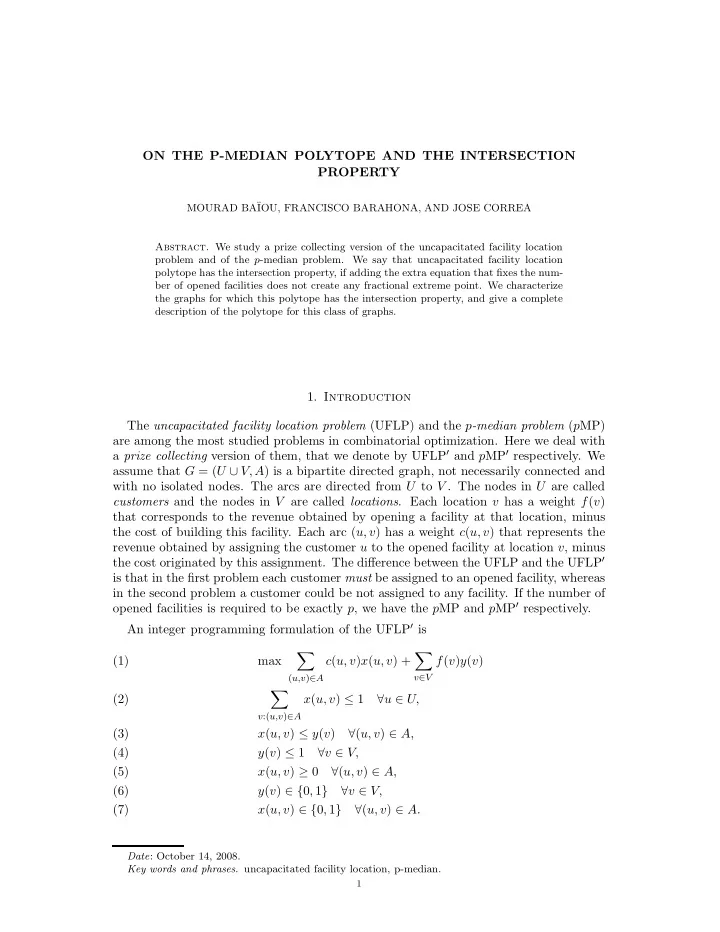
The uncapacitated facility location problem (UFLP) and the p-median problem (pMP) are among the most studied problems in combinatorial optimization. Here we deal with a prize collecting version of them, that we denote by UFLP′ and pMP′ respectively. We assume that G = (U ∪ V, A) is a bipartite directed graph, not necessarily connected and with no isolated nodes. The arcs are directed from U to V . The nodes in U are called customers and the nodes in V are called locations. Each location v has a weight f(v) that corresponds to the revenue obtained by opening a facility at that location, minus the cost of building this facility. Each arc (u, v) has a weight c(u, v) that represents the revenue obtained by assigning the customer u to the opened facility at location v, minus the cost originated by this assignment. The difference between the UFLP and the UFLP′ is that in the first problem each customer must be assigned to an opened facility, whereas in the second problem a customer could be not assigned to any facility. If the number of

  • pened facilities is required to be exactly p, we have the pMP and pMP′ respectively.

An integer programming formulation of the UFLP′ is max

  • (u,v)∈A

c(u, v)x(u, v) +

  • v∈V

f(v)y(v) (1)

  • v:(u,v)∈A

x(u, v) ≤ 1 ∀u ∈ U, (2) x(u, v) ≤ y(v) ∀(u, v) ∈ A, (3) y(v) ≤ 1 ∀v ∈ V, (4) x(u, v) ≥ 0 ∀(u, v) ∈ A, (5) y(v) ∈ {0, 1} ∀v ∈ V, (6) x(u, v) ∈ {0, 1} ∀(u, v) ∈ A. (7)

Date: October 14, 2008. Key words and phrases. uncapacitated facility location, p-median.

1

slide-2
SLIDE 2

2

  • M. BA¨

IOU, F. BARAHONA, AND J. CORREA

If inequalities (2) are set to equations, then we have a formulation of the UFLP. If we add the equation (8)

  • v∈V

y(v) = p to (1)-(7), we have a formulation of the pMP′ and if inequalities (2) are set to equations, we have the pMP. For a given bipartite graph G = (U ∪ V, A), let UFLP ′(G) be the convex hull of the solutions of (2)-(7), and pMP ′(G) be the convex hull of the solutions of (2)-(8). Anal-

  • gously we can define the polytopes UFLP(G) and pMP(G). Notice that UFLP(G)

is a face of UFLP ′(G), and pMP(G) is a face of pMP ′(G). Thus a characterization of pMP ′(G) and UFLP ′(G) yields to a characterization of pMP(G) and UFLP(G). We denote by P(G) the linear relaxation of UFLP ′(G) defined by (2)-(5), and by Pp(G) the linear relaxation of pMP ′(G) defined by (2)-(5) and (8). Let us call the graph of Figure 1 a fork, and denote it by F. By setting each variable Figure 1. A fork. associated with F to 1

2, we obtain a fractional extreme point of P2(F). In general assume

that a bipartite graph G contains a fork F. We can set to 1

2 all variables associated with

F, and set to zero the remaining variables. This is an extreme point of P2(G). Such fractional extreme points may be cutoff by using a set of valid inequalities for pMP ′(G) introduced in [15]. In this paper we will consider a set of valid inequalities for UFLP ′(G) introduced in [10]. We call them CJPR-inequalities, using the initials of the authors’ names. These inequalities are also valid for pMP ′(G) since pMP ′(G) ⊆ UFLP ′(G). We will show that the addition of these inequalities to P(G) yields an integral polytope, when G does not contain a fork. We say that UFLP ′(G) has the intersection property with respect to (8), if the in- tersection of UFLP ′(G) with the hyperplane defined by (8), is an integral polytope for every nonnegative integer p. We show that UFLP ′(G) has this property if and only if G contains no fork. Based on this we show that the addition of the CJPR-inequalities to the system defining Pp(G) gives an integral polytope for every nonnegative integer p, if and only if G does not contain a fork. This is the main result of this paper. We also give combinatorial polynomial time algorithms to solve the problems pMP ′, UFLP ′, pMP and UFLP when the underlying graph does not contain a fork. A subclass of graphs with no fork consists of the graphs for which each location has degree at most two. Here we also prove that the UFLP′ is NP-hard if the degree of each location is at most three. The facets of the uncapacitated facility location polytope have been studied in [18], [14], [10], [11], [8]. In [2] we characterized the graphs for which the natural linear re- laxation defines UFLP(G). The UFLP has also been studied from the point of view of approximation algorithms in [25], [12], [26], [6], [27] and others. Other references on this

slide-3
SLIDE 3

ON THE P-MEDIAN POLYTOPE AND THE INTERSECTION PROPERTY 3

problem are [13] and [20]. The relationship between location polytopes and the stable set polytope has been studied in [14], [10], [11], [16], and others. The facets of the pMP(G) have been studied in [1] and [15]. In [3, 4] we characterized the graphs for which the natural linear relaxation is enough to define pMP(G). This paper is organized as follows. In Section 2, we give some notations and definitions and some preliminary results that will be useful all along the paper. Section 3 gives a complete characterization of UFLP ′(G) if G has no fork. In Section 4, we discuss the intersection of the polytope UFLP ′(G) with the hyperplane defined by (8), we also establish pMP ′(G) for this class of graphs. Section 5 is devoted to the combinatorial algorithms for these problems.

  • 2. Preliminaries

2.1. Some definitions and notations. Let G = (U ∪ V, A) be a bipartite graph. Denote by β(G) the covering number of G, that is the minimum number of locations v ∈ V needed to cover all customers u ∈ U. Let F ⊆ A be a subset of arcs in A. Denote by N −(F) (resp. N +(F)) the set of nodes in U (resp. V ) incident to an arc in F. Let G(F) = (N −(F) ∪ N +(F), F) be the bipartite subgraph of G induced by F. Hence β(G(F)) is the minimum number of nodes in N +(F) necessary to cover all the nodes in N −(F) using only arcs in F. For S ⊆ U and W ⊆ V , let A(S, W) denote the set of arcs of A having one endpoint in S and the other in W. Let Γ+(S) (resp. Γ−(W)) denote the set of nodes v ∈ V (resp. u ∈ U) such that there is an arc (u, v) ∈ A with u ∈ S (resp. v ∈ W). We denote by δ+(S) the set of arcs (u, v) ∈ A with u ∈ S and by δ−(W) the set of arcs (u, v) ∈ A with v ∈ W. For a node u ∈ U (resp. v ∈ V ), we write δ+(u) (resp. δ−(v)) instead of δ+({u}) (resp. δ−({v})). Usually d(v) denotes the degree of a node v in a simple graph, that is the number of edges incident to v. We keep this notation in our case, that is d(u) = |δ+(u)| for u ∈ U and d(v) = |δ−(v)| for v ∈ V . If there is a risk of confusion we specify by dG(v) the degree of the node v with respect to a given graph G. If A′ ⊆ A and V ′ is the set of nodes incident to the arcs of A′, we say that G′ = (V ′, A′) is the subgraph spanned by A′. If G = (V, E) is an undirected graph, a node set S ⊆ V is called a stable set, if there is no edge between any pair of nodes in S. A set K ⊆ V is called a clique if there is an edge between every pair of nodes in K. We denote by Kn,m a graph with node set {u1, . . . , un} ∪ {v1, . . . , vm} and edge set {uivj : 1 ≤ i ≤ n, 1 ≤ j ≤ m}, Kn,m is a complete bipartite graph. A graph is called twoconnected if at least two nodes should be removed to disconnect it. If a and b are two nodes whose removal disconnects the graph, we say that a and b form a twovertex cutset. If S1 ⊆ V , S2 ⊆ V , and S1 ∩ S2 = ∅, we denote by δ(S1, S2) the set of edges with one endnode in S1 and the other in S2. We use δ(S) to denote δ(S, V \ S). For v ∈ V we write δ(v) instead of δ({v}). If S ⊆ V we denote by E(S) the set of edges with both endnodes in S. The graph H = (S, E(S)) is the subgraph induced by S. If C is a cycle, a chord is an edge not in C whose endnodes are in C. An odd hole of G is an odd cycle H with no chord. The set of solutions of a finite system of linear inequalities, is called a polyhedron. A polytope is a bounded polyhedron. An inequality ax ≤ α, is valid for the polytope P if P ⊆ {x : ax ≤ α}. If ax ≤ α is a valid inequality for P, then the set F = {x ∈ P : ax = α} is called a face of P. The dimension of a polytope P, denoted by dim(P) is the maximum number of affinely independent points in P minus 1. A polytope in I Rn

slide-4
SLIDE 4

4

  • M. BA¨

IOU, F. BARAHONA, AND J. CORREA

is full dimensional if it is of dimension n. A face of dimension dim(P) − 1 is called a

  • facet. A facet of a full dimensional polytope is defined by a unique linear inequality (up

to multiplication by a positive scalar). If P is a full dimensional polyhedron, then there is a unique (up to multiplication by a positive scalar) nonredundant inequality system Ax ≤ b such that P = {x : Ax ≤ b}; moreover there is a natural bijection among the facets of P and the inequalities of that system. An extreme point of P is a face of dimension 0. A polytope is integral when each of his extreme points has only integer

  • components. An empty polytope is also integral.

2.2. CPJR-inequalities. Theorem 1. [10] Let G be a bipartite directed graph, for any subgraph G(F) of G the inequality

  • (u,v)∈F

x(u, v) −

  • v∈N+(F )

y(v) ≤ |N −(F)| − k, (9) is valid for UFLP ′(G) if and only if k ≤ β(G(F)). Let G(F) be a subgraph of G induced by F ⊆ A, where each node in N +(F) has degree two. In this case β(G(F)) ≥

  • |N−(F )|

2

  • . It follows that the following inequalities:
  • (u,v)∈F

x(u, v) −

  • v∈N+(F )

y(v) ≤ |N −(F)| 2

  • ,

(10) for all F ⊆ A, where dG(F )(v) = 2 for all v ∈ N +(F), |N −(F)| ≥ 3 and odd, are of type (9). Thus inequalities (10) are valid for UFLP ′(G). We call them CJPR-inequalities. These inequalities are {0, 1

2}-Chv´

atal-Gomory cuts, cf. [9]. They can be obtained by adding some of the inequalities (2)-(5) multiplied by 1/2 and by rounding down the right hand side. An odd cycle in a bipartite graph is a cycle having 2(2k + 1) nodes, for some integer k ≥ 1. When the subgraph G(F) of G is an odd cycle, then inequalities (10) are known as the odd cycle inequalities, their separation can be done in polynomial time see [2, 9]. 2.3. A reduction to the stable set problem. Let H = (V, E) be a simple undirected graph where each node v has a weight w(v). The stable set problem (SSP) consists of finding a stable set S that maximizes

v∈S w(v). The stable set polytope, denoted by

SSP(H), is the convex hull of incidence vectors of stable sets of H. When considering a polyhedral study for the UFLP, a transformation to the stable set problem is often used. This permits to derive results for the UFLP by applying known results for the stable set problem, for instance see [10, 14]. This transformation is as follows. The variables ¯ y(v) are exchanged with 1−y(v), then the integer programming formulation (1)-(7) with respect to a bipartite graph G = (U ∪ V, A) becomes the following set packing problem: max

  • (u,v)∈A

c(u, v)x(u, v) −

  • v∈V

f(v)¯ y(v) +

  • v∈V

f(v) (11)

  • v:(u,v)∈A

x(u, v) ≤ 1 ∀u ∈ U, (12) x(u, v) + ¯ y(v) ≤ 1 ∀(u, v) ∈ A, (13) ¯ y(v), x(u, v) ∈ {0, 1} ∀v ∈ V and ∀(u, v) ∈ A. (14)

slide-5
SLIDE 5

ON THE P-MEDIAN POLYTOPE AND THE INTERSECTION PROPERTY 5

Let B be the matrix whose elements are the coefficients of the constraints (12)-(13). The matrix B is a |U| + |A| × |U| + |A| matrix with 0-1 elements. We call the columns of B, x(u, v) for all (u, v) ∈ A, and ¯ y(v) for all v ∈ V . The intersection graph of G denoted by I(G) is constructed by assigning a node to each column x(u, v) and ¯ y(v). Two nodes are adjacent if their both corresponding columns appear with coefficient 1 in some row

  • f B. Thus the nodes corresponding to the variables that appear in a constraint (12)

form a clique and each node corresponding to ¯ y(v) is adjacent to a node corresponding to x(u, v) with (u, v) ∈ A, see Figure 2. Problem (11)-(14) with respect to G is equivalent Figure 2. The graph G (on the left) with its intersection graph I(G) (on the right). to the stable set problem with respect to I(G). It follows that the stable set polytope with respect to I(G) may be defined as the convex hull of the solutions of (11)-(14). 2.4. Some properties of the stable set polytope. Let G = (V, E) be an undirected

  • graph. The polytope SSP(G) is full dimensional. The simplest facet defining inequalities
  • f SSP(G) are x(u) ≥ 0, for all u ∈ V .

Theorem 2. [21] If K ⊆ V is a maximal clique, then

  • u∈K

x(u) ≤ 1 defines a facet. Theorem 3. [12] Let G = (V, E) be a graph such that V = V1∪V2, W = V1∩V2 = ∅ where (W, E(W)) is a clique and E = E(V1) ∪ E(V2). Let G1 = (V1, E(V1)), G2 = (V2, E(V2)). Then a system of inequalities that defines SSP(G) is obtained by taking the union of the systems that define SSP(G1) and SSP(G2) and identifying the variables associated with the nodes in W. Let ax ≤ α be a facet defining inequality of SSP(G), if a contains at least two nonzero coefficients we say that ax ≤ α defines a nontrivial facet. In this case a ≥ 0 and α > 0. If ax ≤ α defines a nontrivial facet of SSP(G), we denote by Va the set Va = {u | au > 0}. The subgraph induced by Va is denoted by Ga and it is called the support of the facet. In the next two remarks and in the next two lemmas we assume that ax ≤ α defines a nontrivial facet. Remark 4. The inequality ax ≤ α also defines a facet of SSP(Ga).

slide-6
SLIDE 6

6

  • M. BA¨

IOU, F. BARAHONA, AND J. CORREA

Remark 5. If ax ≤ α defines a facet of SSP(G), it follows from Theorem 3 and the above remark that Ga is twoconnected. Lemma 6. [19] If ax ≤ α defines a facet of SSP(G), and Ga contains a path with nodes p, u, v, q, where u and v have degree two in Ga, then au = av. Lemma 7. [19] If ax ≤ α defines a facet of SSP(G), and Ga is different from an odd hole, then Ga does not contain between any two given nodes p and q, two paths such that each node of them different from p, q, has degree two in Ga. In the remainder of this subsection, G is a graph containing two nodes p and q such that between them there are two paths p, u, v, q and p, s, t, q; and the nodes u, v, s, and t have degree two. Let ¯ V = V \ {u, v, s, t}. Lemma 8. For the nontrivial facets of SSP(G), their inequalities can be classified in the following types:

  • j∈ ¯

V

aijx(j) ≤ αi, i ∈ I1 (15)

  • j∈ ¯

V

aijx(j) + x(u) + x(v) ≤ αi, i ∈ I2 (16)

  • j∈ ¯

V

aijx(j) + x(s) + x(t) ≤ αi, i ∈ I3 (17) x(p) + x(u) ≤ 1 (18) x(u) + x(v) ≤ 1 (19) x(v) + x(q) ≤ 1 (20) x(p) + x(s) ≤ 1 (21) x(s) + x(t) ≤ 1 (22) x(t) + x(q) ≤ 1. (23)

  • Proof. Inequalities (15) correspond to the nontrivial facets whose support contains only

nodes in ¯ V . Inequalities (16) and (17) appear as a consequence of Remark 5 and Lem- mas 6 and 7. Inequalities (18)-(23) appear as a consequence of Theorem 2.

  • Remark 9. If
  • j∈ ¯

V

bjx(j) + x(u) + x(v) ≤ α, defines a facet of SSP(G), then by symmetry

  • j∈ ¯

V

bjx(j) + x(s) + x(t) ≤ α, also defines a facet. Remark 10. Let ¯ G = G \ {s, t}. It follows from the above discussion that if we have all facet defining inequalities for SSP( ¯ G), then we can obtain the remaining facets defining inequalities of SSP(G) by applying Remark 9 to inequalities (16), and by adding (21)- (23), x(s) ≥ 0 and x(t) ≥ 0.

slide-7
SLIDE 7

ON THE P-MEDIAN POLYTOPE AND THE INTERSECTION PROPERTY 7

2.5. Decomposition of graphs with no fork. Let G = (U ∪V, A) be a bipartite graph with no fork. If there are two nodes u and v in U with δ+(u) = {(u, w1), (u, w2)} and δ+(v) = {(v, w1), (v, w2)}, we say that u and v are twins. This an equivalence relation. The first step of the decomposition is as follows: Step 1. For every equivalence class of U by the relation twin, leave only one node (and remove the others). The next step is as follows. Step 2. Remove every node u ∈ U with degree equal to one. Lemma 11. After applying Steps 1 and 2, we are left with a bipartite graph with no fork where each of its connected components either (i) contains exactly three locations, or (ii) the degree of each location is at most two.

  • Proof. In the remaining graph let u ∈ V be a node with |δ−(u)| ≥ 3. We should have the

arcs (s1, u), (s2, u), (s3, u), and the nodes s1, s2 and s3 have degree at least two. Since the remaining graph contains no fork, we have the following two cases: Case 1. The arcs (s1, v), (s2, v), (s3, v) exist, with v = u. Since there are no twins and no fork, there must exist two arcs (si, w) and (sj, w) with i, j ∈ {1, 2, 3}, i = j, and w is different from u and v. Now if one of the nodes s1, s2 or s3 is adjacent to a node not in {u, v, w}, then we must have a fork. Let M be the subgraph induced by {u, v, w, s1, s2, s3}. Consider the following cases.

  • If w is adjacent to a node s4 not in M, and s4 is adjacent to a node t not in M,

we would have a fork.

  • The same is true for u and v.

So if any of {u, v, w} is adjacent to a node not in M, this node is only adjacent to nodes in M. Thus the connected component containing {u, v, w}, is a bipartite graph with bipartition {s1, . . . , sk} and {u, v, w}. Case 2. The arcs (si, v), (sj, v), (sk, w) exist, where i, j, k are in {1, 2, 3} and different, and v = u, w = u, v = w. Since si and sj are not twins one of them must be adjacent to a node different from u and v. This node must be w, otherwise a fork is present. Now none

  • f the nodes s1, s2, s3 can be adjacent to a node other than u, v, w, because we would

have again a fork. An analysis similar to the one in the preceding case implies that if we take the connected component containing {u, v, w}, we obtain a bipartite graph with bipartition {s1, . . . , sk} and {u, v, w}. Therefore we are left with connected components that have three locations, or connected components where each location has degree at most two.

  • 3. The characterization of UFLP ′(G)

The main result of this section is the following. Theorem 12. Let G = (U ∪V, A) be a bipartite graph. If G has no fork, then UFLP ′(G) is described by inequalities (2)-(5) and inequalities (10). The proof of this theorem will be given in Subsection 3.3. In the following subsections we will first show that Theorem 12 holds for some subclasses of graphs with no fork. Then combining this with the results of Subsections 2.4 and 2.5 it will be shown that it also holds for graphs with no fork.

slide-8
SLIDE 8

8

  • M. BA¨

IOU, F. BARAHONA, AND J. CORREA

3.1. The case of three locations. Let G = (U ∪ V, A) be a bipartite graph. Theorem 6.1 in [10] shows that any facet defining inequality of UFLP ′(G) is among the inequalities (2)-(5) or is an odd cycle inequality, that is an inequality (10) where G(F) is an odd

  • cycle. Thus we have the following:

Theorem 13. [10] If |V | = 3, then UFLP ′(G) is defined by inequalities (2)-(5) and inequalities (10) that correspond to odd cycle inequalities. 3.2. The case where each location has degree at most two. First we show the following related NP-hardness result Theorem 14. The problem UFLP ′ is NP-hard even when the degree of each customer is at most two and the degree of each location is at most three.

  • Proof. We use a reduction from the minimum vertex cover problem when the degree of

each node is at most three. Let H = (W, E) be a graph where each node has degree at most three. From H, define the bipartite graph G = (U ∪ V, A), where U = E and V = W. We have (u, v) ∈ A, if and only if the edge u is incident to the node v in the graph H. Thus by definition, in G, the degree of each node u ∈ U is two and the degree

  • f each node v ∈ V is at most three. Consider an instance of the UFLP′ that corresponds

to the graph G, where c(u, v) = M for each arc (u, v) ∈ A, where M is a large positive scalar, and each node v ∈ V is associated with a fixed cost f(v) = −1. Then clearly the minimum vertex cover problem in H reduces to this instance of the UFLP′.

  • Below we will show that the case where each location has degree at most two reduces

to a matching problem. Let G = (U ∪ V, A) be a bipartite graph where d(v) ≤ 2 for all v ∈ V . The graph G contains no isolated node and may or not be connected. Define from G an undirected graph G′ as follows. Split each node v ∈ V into two nodes v1 and v2, call this new set of nodes V ′. If v is of degree two let (u1, v) and (u2, v) be the two arcs incident to v; build the edges u1v1, u2v2 and v1v2, denote this set by Ev. If v is of degree one, let (u, v) be the unique arc incident to v and build the edges uv1 and v1v2, denote this set by Ev. Let G′ = (W, E), where W = U ∪ V ′ and E =

v∈V Ev.

Define a cost function w associated with each edge e ∈ E as follows. For each Ev, let w(v1v2) = −f(v), w(u1v1) = c(u1, v) and w(u2v2) = c(u2, v). Notice that when v is of degree one then there is no edge u2v2. The problem UFLP′ with respect to G is equivalent to the following matching problem associated to G′ = (W, E) and w: Max

  • e∈E

w(e)x(e) +

  • v∈V

f(v) (24)

  • e∈δ(v)

x(e) ≤ 1 for all v ∈ W, (25) x(e) ∈ {0, 1} for e ∈ E. (26) For each feasible solution of (24)-(26) there is a feasible solution of (1)-(7) having the same weight and viceversa. In fact, let x∗ be a feasible solution of (24)-(26). For each v ∈ V let ¯ y(v) = 1 − x∗(v1v2). If v is of degree two and (u1, v) and (u2, v) are the arcs incident to v, let ¯ x(u1, v) = x∗(u1v1) and ¯ x(u2, v) = x∗(u2v2). If v is of degree one and (u, v) is the unique arc incident to v, let ¯ x(u, v) = x∗(uv1). It is easy to see that (¯ x, ¯ y) is a feasible solution of (1)-(7) having the same weight as x∗. The matching problem (24)-(26) can be solved in polynomial time [17]. We can also obtain equivalence with the

slide-9
SLIDE 9

ON THE P-MEDIAN POLYTOPE AND THE INTERSECTION PROPERTY 9

UFLP associated with G. We just have to set inequalities (25) to equations, for each node in W that corresponds to a node in U. This problem is also a matching problem and is polynomially solvable. Thus we have the following: Theorem 15. Both problems UFLP and UFLP′ reduce to matching problems when each location has degree at most two. Let MP(G′) denote the convex hull of the solutions of the matching problem (25)-(26). Theorem 16. [17] For the graph G′ = (W, E), MP(G′) is defined by the following linear system:

  • e∈δ(v)

x(e) ≤ 1 for v ∈ W, (27)

  • e∈E(S)

x(e) ≤ 1 2|S|

  • for all S ⊆ Wwith |S| ≥ 3 and odd,

(28) x(e) ≥ 0 for e ∈ E. (29) Remark 17. In inequalities (28) we can assume that (i) none of v1 nor v2 belong to S when their corresponding node v ∈ V is of degree

  • ne, and

(ii) if for a node v ∈ V of degree two we have one of v1 or v2 in S then both of them with their neighbors in U are in S. This remark comes from the fact that the graph induced by S must be twoconnected, this is one of the necessary conditions for inequalities (28) to define facets of MP(G′) [23, 24]. Theorem 16 is used to prove the following: Theorem 18. Let G = (U ∪ V, A) be a bipartite graph where each node in V has degree at most two. Then UFLP ′(G) is described by (2)-(5) plus inequalities (10).

  • Proof. In fact, we will see that the polytope defined by (27)-(29) and the polytope defined

by (2)-(5) and (10) are exactly the same polytopes. Rewrite inequalities (27) and (29) as follows:

  • e∈δ(v)

x(e) ≤ 1 for v ∈ U, (30) x(uv1) + x(v1v2) ≤ 1 for v ∈ V and uv1 ∈ E, with u ∈ U, (31) x(uv2) + x(v1v2) ≤ 1 for v ∈ V and uv2 ∈ E, with u ∈ U, (32) x(e) ≥ 0 for e ∈ E. (33) Let S ⊆ W the subset used in an inequality of type (28). Let S1 = S ∩ U and S2 = S \ S1. Let S′

2 the set of nodes in v ∈ V such that v1 and v2 are in S2.

By Remark 17,

v∈S′

2{v1, v2} = S2. Thus |S2| is even and |S1| ≥ 3 and odd. From this we

can rewrite an inequality (28) with respect to S as follows:

  • e∈δ(S1,S2)

x(e) +

  • v∈S′

2

x(v1v2) ≤ 1 2(|S1| + 2|S′

2|)

  • ,

(34)

slide-10
SLIDE 10

10

  • M. BA¨

IOU, F. BARAHONA, AND J. CORREA

For each v ∈ V replace the variables x(v1v2), in (27)-(29), by 1 − y(v) and each edge variable x(uvi) by x(u, v), then inequality (34) is equivalent to:

  • (u,v)∈A(S1,S′

2)

x(u, v) −

  • v∈S′

2

y(v) ≤ 1 2|S1|

  • .

(35) Inequalities (30) are equivalent to inequalities (2), inequalities (31)-(32) correspond to inequalities (3) and inequalities (33) are equivalent to inequalities (4)-(5). Finally, since any node v in V is at most of degree two, any inequality (35) is of type (10).

  • 3.3. The proof of Theorem 12. Let G = (U ∪ V, A) be a bipartite graph with no
  • fork. Perform Steps 1 and 2 of Subsection 2.5 and let ¯

G be the resulting graph. By Lemma 11, each connected component of ¯ G consists of either (i) a bipartite graph with three locations or (ii) a bipartite graph where each location has degree at most two. From Theorems 13 and 18, Theorem 12 holds for ¯

  • G. Redefine G from ¯
  • G. If we add all the

customers with degree one in G and every customer that was a twin of an existing node in ¯ G, then each connected component with three locations in ¯ G remains a connected component with three locations in G. For this type of graphs the result follows from Theorem 13. Now suppose that we have a connected component in ¯ G, where each location has degree at most two. By reformulating our problem as a set packing problem (11)-(14), proving Theorem 12 is equivalent to show that the following polytope is integral:

  • v:(u,v)∈A

x(u, v) ≤ 1 ∀u ∈ U, (36) x(u, v) + ¯ y(v) ≤ 1 ∀(u, v) ∈ A, (37) ¯ y(v) ≥ 0 ∀v ∈ V, (38) x(u, v) ≥ 0 ∀(u, v) ∈ A, (39)

  • (u,v)∈F

x(u, v) +

  • v∈N+(F )

¯ y(v) ≤ |N −(F)| 2

  • + |N +(F)|,

∀F ⊆ A, (40) where |N −(F)| ≥ 3 and odd, with dG(F )(v) = 2, ∀ v ∈ N +(F). Inequalities (40) are inequalities (10) after replacing y(v) by 1 − ¯ y(v) for each v ∈ V . We already know that the polytope above is integral when the degree of each location is at most two. Thus the polytope above is the stable set polytope SSP(I( ¯ G)). Now suppose that we add a customer u of degree one, that had been removed in Step 2. Let G′ be the new graph. The new intersection graph I(G′) is obtained by adding a new node x(u, v) to I(G), assuming that u is adjacent to the location v in G. It follows from Theorem 3 that SSP(I(G′)) is obtained by adding the variable x(u, v) and the inequalities x(u, v) + ¯ y(v) ≤ 1, x(u, v) ≥ 0. We keep using the same reasoning until all customers of degree one have been added. Now assume that we add a node u′ that was a twin of a node u in ¯

  • G. We add two

new arcs (u′, v1) and (u′, v2) to ¯ G, where (u, v1) and (u, v2) already exist in ¯

  • G. Here we

use Remark 10. So for each inequality (40) that contains x(u, v1) and x(u, v2) we write a similar inequality but using x(u′, v1) and x(u′, v2) instead. Also the following inequalities

slide-11
SLIDE 11

ON THE P-MEDIAN POLYTOPE AND THE INTERSECTION PROPERTY 11

are added. x(u′, v1) + ¯ y(v1) ≤ 1, x(u′, v2) + ¯ y(v2) ≤ 1, x(u′, v1) + x(u, v2) ≤ 1, x(u′, v1) ≥ 0, x(u′, v2) ≥ 0. We keep using the same reasoning until all twins are added. We obtain exactly the inequalities (36)-(40) with respect to G. Thus SSP(I(G)) is described by inequalities (36)-(40). This completes the proof of Theorem 12. Corollary 19. Let G = (U ∪V, A) be a bipartite graph. If G has no fork, then UFLP(G) is described by inequalities (3)-(5), inequalities (10), and by setting inequalities (2) to equations. 3.4. The separation of inequalities (10). Let G = (U ∪ V, A) be a bipartite graph. Given a vector (x∗, y∗) ∈ I R|A|+|V |, the separation problem of inequalities (10) is to decide whether (x∗, y∗) satisfies all these inequalities, or to find one of them that is violated. We show that the separation of these inequalities can be done in polynomial when the graph has no fork. We may assume that (x∗, y∗) satisfies inequalities (2)-(5). For each connected component of G with three locations the problem is easy to solve, since these inequalities are the odd cycle inequalities and may be separated in polynomial time [9, 2]. Also one can enumerate them since they correspond to odd cycles with three locations and three customers. Now consider the other components. We can remove all the customers with degree

  • ne. In fact, each inequality (10) such that N −(F) contains a node u of degree one

is redundant. Let (u, v) be the unique arc incident to u and let (u′, v) be the other arc incident to v in F. Then we can obtain this inequality by combining inequalities x(u, v) ≤ 1, x(u′, v) ≤ y(v) and the inequality (10) with respect to F ′ = F\{(u, v), (u′, v)} that is by itself redundant since |N −(F ′)| is even. In other words all such inequalities are satisfied by (x∗, y∗) and all the possible violated inequalities contain only customers with degree at least two. Now we treat this case. For each set of twins choose the twin node u with x∗(u, v1) + x∗(u, v2) maximum and remove the others. At this point we have done exactly Steps 1 and 2 of Subsection 2.5, thus from Lemma 11 we know that in the resulting graph, call it ¯ G, the degree of each location is at most 2. We have seen in the proof of Theorem 12 that inequalities (10) with respect to ¯ G are equivalent to inequalities (28), which are the blossom inequalities introduced in [17]. They can be separated in polynomial time with the algorithm of [22]. Since each inequality (10) that may define a facet contains at most one node from each set of twins, it follows that if one find a violated inequality (10) with respect to ¯ G the same inequality is also violated with respect to G. Otherwise there is no violated inequality.

  • 4. The intersection property for UFLP ′(G) and the characterization of

pMP ′(G) Let P be an integral polytope in I

  • Rn. Let q be an integer valued row vector in I

Rn such that the g.c.d. of its components is one. For an integer p let Hp = {x ∈ I Rn : qx = p}.

slide-12
SLIDE 12

12

  • M. BA¨

IOU, F. BARAHONA, AND J. CORREA

We say that P has the intersection property with respect to q, if for every integer p the polytope P ∩ Hp is integral. The following result has been shown in [7]. Theorem 20. The stable set polytope of a graph G = (V, E) has the intersection property with respect to

v∈V x(v) = p if and only if G is a clawfree graph.

A clawfree graph is a graph that does not contain the bipartite graph K1,3 as an induced

  • subgraph. Given a bipartite graph G = (U ∪ V, A), we will show, in this section, that

the polytope UFLP ′(G) has the intersection property with respect to

v∈V y(v) = p, if

and only if G has no fork. To obtain this result one cannot apply Theorem 20, since the intersection graph of a graph with no fork is not clawfree. Instead we will modify the proof given in [7] to obtain our result. Theorem 21. Let G = (U ∪ V, A) a bipartite graph. UFLP ′(G) has the intersection property with respect to

v∈V y(v) = p if and only if G has no fork.

  • Proof. Necessity. Assume that G contains a fork and let us show that Qp(G) = {(x, y) ∈

I R|A|+|V | : (x, y) ∈ UFLP ′(G),

v∈V y(v) = p} is not integral for some integer p.

Let F be a subgraph of G that is a fork. The nodes of F are u1, . . . , u3 and v1, . . . , v4, and its arcs are: (u1, v1), (u1, v3), (u2, v2), (u2, v3), (u3, v3), (u3, v4). Let (¯ x, ¯ y) ∈ I R|A|+|V | be the vector defined as follows: ¯ x(u, v) = 1

2 if (u, v) is an arc

in F and 0 otherwise; ¯ y(v) = 1

2 if v ∈ {v1, . . . , v4} and 0 if v ∈ V \ {v1, . . . , v4}. We

will show that, in fact, (¯ x, ¯ y) is an extreme point of Q2(G). Let (x1, y1) ∈ UFLP ′(G) where x1(u1, v3) = x1(u2, v3) = x1(u3, v3) = y(v3) = 1 and every other variable takes the value 0. And let (x2, y2) ∈ UFLP ′(G) where x2(u1, v1) = x2(u2, v2) = x2(u3, v4) = y2(v1) = y2(v2) = y2(v4) = 1 and every other variable takes the value 0. We have (¯ x, ¯ y) = 1

2(x1, y1) + 1 2(x2, y2). To show that (¯

x, ¯ y) is an extreme point of Q2(G) we are going to show that (x1, y1) and (x2, y2) belong to a common one dimensional face of UFLP ′(G). This face is defined as follows. x(u, v) = 0 if (u, v) is not in F, y(v) = 0 if v is not in F, x(u1, v1) + x(u1, v3) = 1, x(u2, v2) + x(u2, v3) = 1, x(u3, v4) + x(u3, v3) = 1, x(u, v) − y(v) = 0 for each arc (u, v) in F.

  • Sufficiency. Assume now that G does not contain a fork as a subgraph and let us show

that the polytope Qp(G) = {(x, y) ∈ I R|A|+|J| : (x, y) ∈ UFLP ′(G),

v∈V y(v) = p}

is integral. A pair (A′, J′), A′ ⊆ A, J′ ⊆ V , is called a solution if each node in U is incident to at most one arc in A′, and each arc in A′ is incident to a node in J′. Let (xA′, yJ′) denote the incidence vector of the solution (A′, J′). When taking the intersection of {y :

v∈V y(v) = p} with UFLP ′(G), a fractional extreme point lies in a

  • ne dimensional face of UFLP ′(G), i.e., it has the form

(¯ x, ¯ y) = λ(xA1, yJ1) + (1 − λ)(xA2, yJ2), where λ =

(p−|J2|) |J1|−|J2| and |J2| + 1 ≤ p ≤ |J1| − 1. We will prove that such a vector is a

convex combination of 0-1 vectors in Qp(G) so it is not an extreme point. Let ¯ G be the graph spanned by A1 ∪ A2, we label the nodes and arcs as follows.

slide-13
SLIDE 13

ON THE P-MEDIAN POLYTOPE AND THE INTERSECTION PROPERTY 13

  • To every arc in A1 ∩ A2 we give the label “f”, that means fixed. The same for

every node in J1 ∩ J2.

  • Now consider an arc a = (u, v) that has no label. If v has the label f, we add a

new node v′ with the label “0”, and we replace (u, v) by a′ = (u, v′). If a ∈ A1, we give the label 1 to a (or to a′), otherwise a ∈ A2 and we give the label 2. We repeat this for every arc that has not been labeled.

  • Now for every node v that has not been labeled; if v ∈ J1, we give it the label 1,
  • therwise v ∈ J2 and we give it the label 2.

After every arc and every node has been labeled, let G′ be this new graph. Now build an undirected graph M whose node set are the nodes in G′ that have the label 1 or 2. Let v1 and v2 be two nodes in M, with the label 1 and 2 respectively. If the arcs a1 = (u, v1) and a2 = (u, v2) are in G′, then a1 should have the label 1 and a2 should have the label 2. In this case we put an edge between v1 and v2 in M. All edges in M are obtained in this

  • way. Since G has no fork, the degree of each node in M is at most two. Now we can

partition the nodes in M into B1, . . . , Bk, so that:

  • Every edge in M has both endnodes in the same set Bi.
  • For every set Bi, let Ci be the set of nodes in Bi with the label 1, and Di the set
  • f nodes in Bi with the label 2. Then |Ci| = |Di| + 1. This is possible because

the degree of every node in M is at most two. Let F be the set of nodes in G′ with the label f. Also let C = ∪Ci and D = ∪Di. We have |C| = |D| + k, and |J1| = |F| + |C| = |F| + |D| + k = |J2| + k. To build a solution with p nodes from J1 ∪ J2, we can take the nodes in F, the nodes in Ci, i = 1, . . . , r, and the nodes in Dj, j = r + 1, · · · , k, where r = p − |J2|. Now we have to define the set of arcs in the solution. First we have to define what to do with the nodes in G′ that have the label 0. Let (u, v) and (u, w) be the two arcs incident to a node u that has degree equal to two in G′. We have three cases:

  • If v has the label 1 and w has the label 0, then v ∈ Ci for some index i; we add w

to Di. Notice that w has not been counted (and should not been counted) when computing the cardinality of Di above.

  • If v has the label 2 and w has the label 0, then v ∈ Di for some index i; we add

w to Ci.

  • Finally suppose that (u, v) has the label 1, (u, w) has the label 2, and both v, w

have the label 0. In this case we arbitrarily pick a set Ci, and we assign v to Ci and w to Di. Now we can describe how to pick the arcs in the solution. Every arc in G′ that has the label f should be in the solution. Let C′ = ∪i=r

i=1Ci and D′ = ∪j=k j=r+1. For every customer

u that is incident to two arcs (u, v) and (u, w) in G′ we proceed as follows. If v ∈ C′ then (u, v) is in the solution, otherwise w ∈ D′ and (u, w) is in the solution. Call F the set of all solutions (At, Jt) that may be constructed from (A1, J1) and (A2, J2) as indicated above. From the construction of the solutions in F above, we have the following:

  • (At,Jt)∈F(xAt, yJt) =
  • k − 1

p − |J2| − 1

  • (xA1, yJ1) +
  • k − 1

k − (p − |J2|) − 1

  • (xA2, yJ2)

= k p − |J2|

! (p−|J2|) k

(xA1, yJ1) + k p − |J2|

! (k−p+|J2|) k

(xA2, yJ2).

slide-14
SLIDE 14

14

  • M. BA¨

IOU, F. BARAHONA, AND J. CORREA

But recall from above that k = |J1| − |J2|, so

  • (At,Jt)∈F(xAt, yJt) =

=

|J1| − |J2|

p − |J2|

! (p−|J2|) |J1|−|J2|

(xA1, yJ1) +

|J1| − |J2|

p − |J2|

! (|J1|−p) |J1|−|J2|

(xA2, yJ2). Since (¯ x, ¯ y) =

p−|J2| |J1|−|J2|(xA1, yJ1) + |J1|−p |J1|−|J2|(xA2, yJ2), we obtain

(¯ x, ¯ y) = 1

  • |J1| − |J2|

p − |J2|

  • (At,Jt)∈F

(xAt, yJt). Notice that

  • |J1| − |J2|

p − |J2|

  • is the cardinality of the family F. Thus (¯

x, ¯ y) is a convex combination of integer vectors in Qp(G). This implies that the intersection of {y :

  • j∈V y(j) = p} with UFLP ′(G) does not have fractional extreme points.
  • From Theorems 12 and 21, we obtain the main result of this paper.

Theorem 22. Let G = (U ∪ V, A) be a bipartite graph. The polytope pMP ′(G) is described by (2)-(5), (8) and (10) if and only if G does not contain a fork as a subgraph. Corollary 23. Let G = (U ∪ V, A) a bipartite graph. If G has no fork, then pMP(G) is described by (3)-(5), inequalities (2) transformed into equations, (8) and (10). Now since the separation of inequalities (10) can be done in polynomial time for graphs with no fork, we have the following. Theorem 24. The problems UFLP ′, pMP ′, UFLP and pMP can be solved in polyno- mial time when the underlying graph does not contain a fork as a subgraph. In the next section we give combinatorial algorithms for these problems.

  • 5. A combinatorial algorithm

In this section we give a combinatorial algorithm to solve both problems pMP ′ and UFLP ′ when the underlying graph has no fork. The problems pMP and UFLP reduce to the problems pMP ′ and UFLP ′, respectively. 5.1. Solving the problem UFLP ′. Le G = (U ∪ V, A) be a bipartite graph with no fork. We are going to solve (1)-(7). We know that each connected component of G either has three locations, or after using the procedure of Subsection 2.5 we obtain a component where each location has degree at most two. The case with three locations can be solved by enumeration, so in what follows we deal with a component having four

  • r more locations.

Lemma 25. We may assume that each customer has degree at least two.

  • Proof. Let u be a customer of degree one. The node u must be adjacent to a location
  • v. If c(u, v) < 0, we just ignore u. If c(u, v) + f(v) ≥ 0, then we remove u, and give the

weight 0 to v. If γ is the optimal value with the new weights, then γ + c(u, v) + f(v) is the optimal value with the original weights. If c(u, v) + f(v) < 0, we remove u and give the weight c(u, v) + f(v) to v. Every customer of degree one is treated in the same way.

slide-15
SLIDE 15

ON THE P-MEDIAN POLYTOPE AND THE INTERSECTION PROPERTY 15

Now we assume that we have a connected component M with no fork, where each customer has degree at least two. First we are going to use the reduction to the stable set problem discussed Subsection 2.3, later this will be reduced to a matching problem. Thus our problem reduces to finding a stable set in I(M) of maximum weight, where a weight of a node x(u, v) is equal to c(u, v) and the weight of a node ¯ y(v) is equal to −f(v). Remark that for each set of twins in M, where v1 and v2 are the two locations that are adjacent to this set of twins, the corresponding nodes of v1 and v2 in I(M) form a twover- tex cutset. This permit us to use the following decomposition procedure introduced in [5]. Let G1 = (V1, E1) and G2 = (V2, E2) be two graphs such that V1 ∩ V2 = {a, b}, E1 ∩ E2 = ∅, and the edge ab does not belong neither to E1 nor to E2. Let G = (V, E) where V = V1 ∪ V2 and E = E1 ∪ E2. Assume that each node u has a weight w(u). Let Sab, S¯

a¯ b, Sa¯ b, and S¯ ab be stable sets in G1 of maximum weight among those which

contain respectively a and b, nor a nor b, a but not b, b but not a. Let sab, s¯

a¯ b, sa¯ b,

and s¯

ab be their respective weights. Now we define a graph G∗ with node-weights w∗,

  • btained from G2 as follows. Start with G∗ = G2. Let

w∗(v) = w(v) if v ∈ V2 \ {a, b}, λ(G1) = sab + s¯

a¯ b − (sa¯ b + s¯ ab).

We have two cases:

  • λ(G1) ≥ 0. In this case we add a node c to G∗ and the edges ac and cb. Let

σ = s¯

a¯ b − λ(G1)

w∗(a) = sab − s¯

ab

w∗(b) = sab − sa¯

b

w∗(c) = λ(G1).

  • λ(G1) < 0. In this case we add two nodes c and d to G∗ and the edges ac, cd,
  • db. Let

σ = s¯

a¯ b + λ(G1)

w∗(a) = sa¯

b − s¯ a¯ b

w∗(b) = s¯

ab − s¯ a¯ b

w∗(c) = w∗(d) = −λ(G1). Theorem 26. [5]. Let S2 be the restriction to G2 of a maximum weighted stable set S∗

  • f G∗ with respect to w∗, and S be defined as follows:
  • If a ∈ S2 and b ∈ S2 then S = S2 ∪ Sab.
  • If a ∈ S2 and b /

∈ S2 then S = S2 ∪ Sa¯

b.

  • If a /

∈ S2 and b ∈ S2 then S = S2 ∪ S¯

ab.

  • If a /

∈ S2 and b / ∈ S2 then S = S2 ∪ S¯

a¯ b.

S is a maximum weighted stable set of G, with respect to w, and w∗(S∗) + σ = w(S). Let us apply the above procedure to I(M). Let T be a set of twins, and a and b the two locations adjacent to the nodes in T. The set of twins gives a set of disjoint paths with three edges between a and b. This corresponds to the graph G1 described above. This set of disjoint paths is a bipartite graph, so the stable set problem can be solved in polynomial time. We have to solve four stable set problems to define the sets Sab, S¯

a¯ b,

slide-16
SLIDE 16

16

  • M. BA¨

IOU, F. BARAHONA, AND J. CORREA

Sa¯

b, S¯ ab and the value λ(G1) as in the above procedure. Then we build the graph G∗,

where between a and b we put a path with two or three edges. We repeat this procedure for each set of twins. Remark that at the end the degree of a node in G∗ that corresponds to a location is at most two. Now we have to solve the stable set problem in G∗ with respect to the weights w∗ defined by the procedure above. This reduces to a matching problem as follows:

  • Split each node v in G∗ that correspond to a location into two nodes v1 and v2;

add an edge between v1 and v2 with a weight w∗(v). – If v has degree one and uv is the edge incident to v, then add an edge between v1 and u with a weight w∗(u). – If v is of degree two and u1v and u2v are the two edges incident to v, add the edges u1v1 and u2v2 with costs w∗(u1) and w∗(u2), respectively.

  • Now consider the nodes of G∗ that do not correspond to locations in G. These

nodes form disjoint cliques. – A clique of size one corresponds to the node c added in the construction

  • f G∗ in the case where λ(G1) ≥ 0. Let v and w be the two locations in

G∗ adjacent to c. After the split operation we have v1, v2, w1 and w2. We remove the node c and add an edge between v2 and w2 of weight w∗(c). – Shrink each clique of size at least two (replace it by one node). to that node. Solving the stable set problem in G∗ with weights w∗ reduces to the maximum matching problem in the graph described above. Using Theorem 26 one can produce the optimal solution of the stable set problem in I(M). This corresponds to the optimal solution of the problem UFLP ′ in the component M of G having four or more locations. 5.2. Solving the problem pMP ′. Let G = (U ∪V, A) a bipartite graph with no fork. In this subsection we give a polynomial combinatorial algorithm to solve the problem pMP ′ defined by (1)-(8). The main ingredient for this algorithm is the intersection property of the polytope UFLP ′(G). Suppose that the polytope UFLP ′(G) is defined by the linear system (41) Ax + By ≤ b. In our case, the system above is known and is equivalent to inequalities (2)-(5) and (10), this follows from Theorem 12. We have seen in Theorem 21 that to obtain the polytope pMP ′(G), the convex hull of the solutions of the problem (1)-(8), of a graph with no fork it is enough to add the equation (42)

  • v∈V

y(v) = p. Thus the problem (1)-(8) is equivalent to max cx + fy (43) Ax + By ≤ b (44)

  • v

y(v) = p. (45) We plan to use Lagrangian relaxation to solve this linear program, i.e., we dualize equa- tion (45). For λ ∈ I R, let (46) g(λ) = max{cx + fy + λ

  • p −
  • v∈V

y(v)

  • | Ax + By ≤ b}.
slide-17
SLIDE 17

ON THE P-MEDIAN POLYTOPE AND THE INTERSECTION PROPERTY 17

The function g is convex and piecewise linear. The following Lemma is a well known property of Lagrangian relaxation. Lemma 27. Let γ be the optimal value of (43)-(45). Then

  • γ ≤ g(λ) for all λ,
  • and

min

λ g(λ) = γ.

  • Proof. The dual of (43)-(45) is

min λp + µb (47) µA = c (48) µB + λ1 = f. (49) If we fix λ = ¯ λ, then (47)-(49) becomes min µb + ¯ λp µA = c µB = f − ¯ λ1, which is the dual of max cx + (f − ¯ λ1)y + ¯ λp Ax + By ≤ b. This is g(¯ λ). So g(¯ λ) ≥ γ. If (ˆ λ, ˆ µ) is an optimal solution of (47)-(49), then g(ˆ λ) = γ.

  • In what follows we discuss how to find the minimum of g. Let M = |c(u, v)| +

|d(v)|. We set λ1 = M and λ2 = −M, and we compute g(λ1) and g(λ2). Let (x1, y1) and (x2, y2) be the corresponding solutions. If the problem is feasible, we should have y1(v) ≤ p and y2(v) ≥ p. We compute ¯ λ as the solution of cx1 + fy1 + λ(p −

  • v

y1(v)) = cx2 + fy2 + λ(p −

  • v

y2(v)) and we compute g(¯ λ). Let (¯ x, ¯ y) be the solution obtained. We have the following two cases:

  • g(¯

λ) > cx1 + fy1 + ¯ λ(p −

v y1(v)) = cx2 + fy2 + ¯

λ(p −

v y2(v)). Here we have

three subcases: – If ¯ y(v) = p we stop, then (¯ x, ¯ y) is the desired solution. – If ¯ y(v) > p we replace λ1 by ¯ λ. – If ¯ y(v) < p we replace λ2 by ¯ λ. In the last two sub-cases we repeat the above procedure.

  • g(¯

λ) = cx1 + fy1 + ¯ λ(p −

v y1(v)) = cx2 + fy2 + ¯

λ(p −

v y2(v)). Then we

stop, we have found the minimum of f. However we could have ¯ y(v) = p. We discuss this situation below. Lemma 28. Let p1 = y1(v), p2 = y2(v). And assume p1 < p < p2. Let α = (p2 − p)/(p2 − p1). Then (ˆ x, ˆ y) = α(x1, y1) + (1 − α)(x2, y2) is an optimal solution of (43)-(45).

slide-18
SLIDE 18

18

  • M. BA¨

IOU, F. BARAHONA, AND J. CORREA

  • Proof. Let γ1 = cx1 + fy1, γ2 = cx2 + fy2. Then γ1 + ¯

λ(p − p1) = γ2 + ¯ λ(p − p2), and ¯ λ = (γ2 − γ1)/(p2 − p1). Thus g(¯ λ) = γ1 p2 − p p2 − p1 + γ2 p − p1 p2 − p1 . Since cˆ x + f ˆ y = γ1 p2 − p p2 − p1 + γ2 p − p1 p2 − p1 , we have that (ˆ x, ˆ y) is optimal.

  • Remark that (ˆ

x, ˆ y) is exactly the solution (¯ x, ¯ y) defined in the sufficiency part of the proof of Theorem 21. Thus (ˆ x, ˆ y) can be written as a convex combination of the vectors in the family F, that are feasible for (43)-(45). Then any of these integer vectors is an

  • ptimal solution of (43)-(45).

5.3. Solving the problems UFLP and pMP. Recall that the problems UFLP and pMP are respectively obtained from UFLP ′ and pMP ′ by replacing inequalities (2) by

  • equalities. To ensure this we add a value “big M” to the weights c(u, v). This number

can be M = max{|f(v)| : v ∈ V } + max{|c(u, v)| : (u, v) ∈ A} + 1. This will ensure that every customer is assigned to a location with an opened facility, if the problem is feasible. Then we apply the algorithms described in this section. If γ is the optimal value with the new weights, then γ − |U|M is the optimal value with the

  • riginal weights.
  • 6. Final Remarks

We have shown that UFLP ′(G) has the intersection property if and only if G has no fork. When the graph has no odd cycle then inequalities (2)-(5) define UFLP ′(G),

  • cf. [2], this remains true if G has no fork. If G has odd cycles, but no fork, we have

to add inequalities (10), and odd cycle inequalities are not enough. This shown in the example below. Figure 3. A bipartite graph G = (U ∪ V, A). The squares (resp. circles) are the nodes in U (resp. V ). Let x(u, v) = 1

3, for each arc (u, v) ∈ A and y(v) = 1 3 for each node v ∈ V . Then (x, y)

satisfies (2)-(5) and satisfies inequalities (10) that correspond to odd cycles. However it violates an inequality (10) when F = A.

slide-19
SLIDE 19

ON THE P-MEDIAN POLYTOPE AND THE INTERSECTION PROPERTY 19

References

[1] P. Avella and A. Sassano, On the p-median polytope, Math. Program., 89 (2001), pp. 395–411. [2] M. Ba¨ ıou and F. Barahona, On the integrality of the uncapacitated facility location polytope, Technical Report RC24101, IBM Watson Research Center, 2006. [3] , On the linear relaxation p-median problem I: oriented graphs, technical report, IBM Watson Research Center, 2007. [4] , On the linear relaxation p-median problem II: directed graphs, technical report, IBM Watson Research Center, 2007. [5] M. Boulala and J.-P. Uhry, Polytope des ind´ ependants d’un graphe s´ erie-parall` ele, Discrete Math., 27 (1979), pp. 225–243. [6] J. Byrka and K. Aardal, The approximation gap for the metric facility location problem is not yet closed, Oper. Res. Lett., 35 (2007), pp. 379–384. [7] G. Calvillo, The concavity and intersection properties for integral polyhedra, Ann. Discrete Math., 8 (1980), pp. 221–228. Combinatorics 79 (Proc. Colloq., Univ. Montr´ eal, Montreal, Que., 1979), Part I. [8] L. C´ anovas, M. Landete, and A. Mar´ ın, On the facets of the simple plant location packing poly- tope, Discrete Appl. Math., 124 (2002), pp. 27–53. Workshop on Discrete Optimization (Piscataway, NJ, 1999). [9] A. Caprara and M. Fischetti, {0, 1

2}-Chv´

atal-Gomory cuts, Math. Programming, 74 (1996),

  • pp. 221–235.

[10] D. C. Cho, E. L. Johnson, M. Padberg, and M. R. Rao, On the uncapacitated plant location

  • problem. I. Valid inequalities and facets, Math. Oper. Res., 8 (1983), pp. 579–589.

[11] D. C. Cho, M. W. Padberg, and M. R. Rao, On the uncapacitated plant location problem. II. Facets and lifting theorems, Math. Oper. Res., 8 (1983), pp. 590–612. [12] F. A. Chudak and D. B. Shmoys, Improved approximation algorithms for the uncapacitated facility location problem, SIAM J. Comput., 33 (2003), pp. 1–25. [13] G. Cornuejols, M. L. Fisher, and G. L. Nemhauser, Location of bank accounts to optimize float: an analytic study of exact and approximate algorithms, Management Sci., 23 (1976/77), pp. 789–810. [14] G. Cornuejols and J.-M. Thizy, Some facets of the simple plant location polytope, Math. Pro- gramming, 23 (1982), pp. 50–74. [15] I. R. de Farias, Jr., A family of facets for the uncapacitated p-median polytope, Oper. Res. Lett., 28 (2001), pp. 161–167. [16] C. De Simone and C. Mannino, Easy instances of the plant location problem, Technical Report

  • R. 427, IASI, CNR, 1996.

[17] J. Edmonds, Maximum matching and a polyhedron with 0, 1-vertices, J. Res. Nat. Bur. Standards

  • Sect. B, 69B (1965), pp. 125–130.

[18] M. Guignard, Fractional vertices, cuts and facets of the simple plant location problem, Math. Programming Stud., (1980), pp. 150–162. Combinatorial optimization. [19] A. R. Mahjoub, On the stable set polytope of a series-parallel graph, Math. Programming, 40 (1988),

  • pp. 53–57.

[20] P. B. Mirchandani and R. L. Francis, eds., Discrete location theory, Wiley-Interscience Series in Discrete Mathematics and Optimization, John Wiley & Sons Inc., New York, 1990. [21] M. W. Padberg, On the facial structure of set packing polyhedra, Math. Programming, 5 (1973),

  • pp. 199–215.

[22] M. W. Padberg and M. R. Rao, Odd minimum cut-sets and b-matchings, Math. Oper. Res., 7 (1982), pp. 67–80. [23] W. Pulleyblank, Faces of matching polyhedra, Ph. D. Thesis, University of Waterloo, 1973. [24] W. Pulleyblank and J. Edmonds, Facets of 1-matching polyhedra, in Hypergraph Seminar (Proc. First Working Sem., Ohio State Univ., Columbus, Ohio, 1972; dedicated to Arnold Ross), Springer, Berlin, 1974, pp. 214–242. Lecture Notes in Math., Vol. 411. [25] D. B. Shmoys, ´

  • E. Tardos, and K. Aardal, Approximation algorithms for facility location prob-

lems (extended abstract), in 29th ACM Symposium on Theory of Computing, 1997, pp. 265–274. [26] M. Sviridenko, An improved approximation algorithm for the metric uncapacitated facility location problem, in Integer programming and combinatorial optimization, vol. 2337 of Lecture Notes in

  • Comput. Sci., Springer, Berlin, 2002, pp. 240–257.

[27] J. Vygen, Approximation algorithms for facility location problems, Technical Report, University of Bonn, 2005.

slide-20
SLIDE 20

20

  • M. BA¨

IOU, F. BARAHONA, AND J. CORREA

(M. Ba¨ ıou) CNRS, LIMOS Complexe scientifique des Cezeaux, 63177 Aubi` ere, FRANCE E-mail address, M. Ba¨ ıou: baiou@isima.fr (F. Barahona) IBM T. J. Watson research Center, Yorktown Heights, NY 10589, USA. E-mail address, F. Barahona: barahon@us.ibm.com (J. Correa) Department of Industrial Engineering, University of Chile E-mail address, J. Correa: joser.correa@gmail.com