SLIDE 1
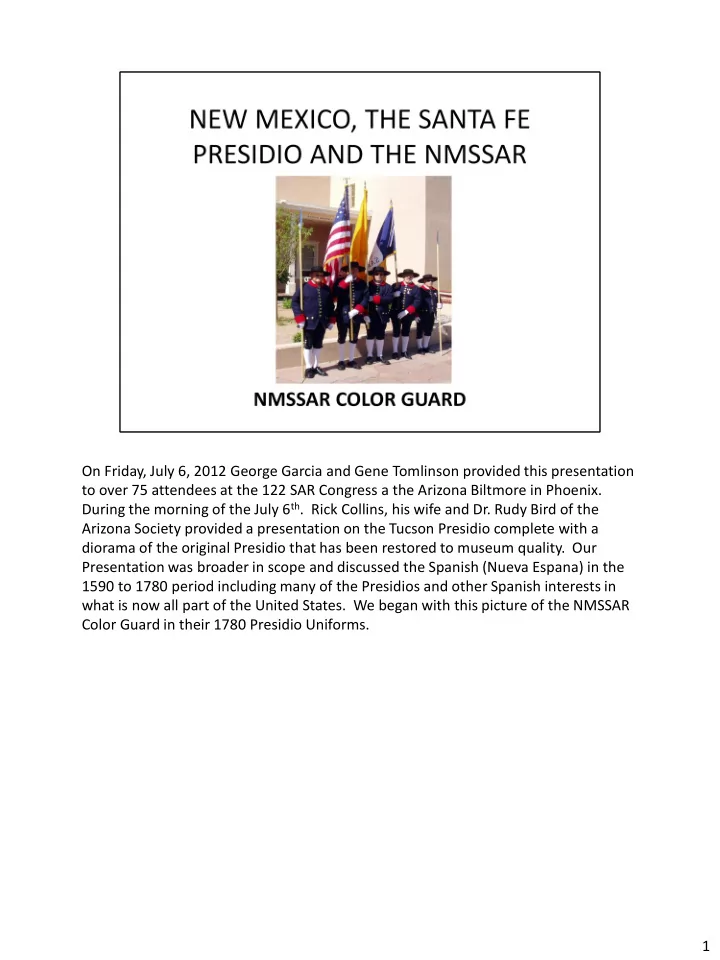
On Friday, July 6, 2012 George Garcia and Gene Tomlinson provided this presentation to over 75 attendees at the 122 SAR Congress a the Arizona Biltmore in Phoenix. During the morning of the July 6th. Rick Collins, his wife and Dr. Rudy Bird of the Arizona Society provided a presentation on the Tucson Presidio complete with a diorama of the original Presidio that has been restored to museum quality. Our Presentation was broader in scope and discussed the Spanish (Nueva Espana) in the 1590 to 1780 period including many of the Presidios and other Spanish interests in what is now all part of the United States. We began with this picture of the NMSSAR Color Guard in their 1780 Presidio Uniforms. 1
SLIDE 2
To give the attendees an overview of New Mexico we used this map of the state to show the location of Santa Fe the State’s Capitol and how it is connected to Albuquerque and Las Cruces. The map also shows the major interstate routes through the State. 2
SLIDE 3 A comparison of the two sponsoring States for the 122 Congress each entering the union 100 years ago is interesting to review. New Mexico follows Alaska, Texas, California and Montana in size, but has less population that many smaller states and
- nly one third the population of Arizona. Though the mean altitude of New Mexico is
half that of Arizona, both Albuquerque at over 5000 feet and Santa Fe just over 7.000 feet above sea level are considerably above Phoenix and Tucson. We can say that in Santa Fe we sleep, eat, and walk at an altitude where many folks jump out of an airplane to skydive. 3
SLIDE 4 Important when we look into our southwestern US history is to relate the geographic size of Spain and France to that of the States of Arizona and New Mexico. With over 20 times the population, they are infact not quite twice the size of either New Mexico
4
SLIDE 5
If we were to add our two states area together we are occupying more land that either France or Spain. We want to note that if we look at just a portion of Nuevo Espania as a land mass we can see that the holdings of France and Spain in the “New World” were more than half again the size of their two countries. No European monarch or their leadership could comprehend the vastness of the Southwestern part of North America and hence had little idea of what they really had explored and were attempting to manage in the 1700’s. 5
SLIDE 6
Though the map of New Mexico and for that matter most of the adjoining states changed continually in the mid to late 1800’s with the westward expansion and the coming of the railroads and discovery of gold, this map depicted the Territory in 1857, 55 years before it was divided into the States of New Mexico and Arizona. 6
SLIDE 7 To illustrate the problem Europeans still have with the size of the U.S. a true story about a French engineer with Renault can give a good indication of the thought
- process. John Ives wanted to take his family on a four day trip around the US going
from Detroit to Boston, New York City, Washington, Cape Canaveral, New Orleans, Hollywood, San Francisco, and St. Louis and back to Detroit bringing on Wed. evening and returning on the following Monday Evening. I told him-”not possible even if he had a potty in the car”. Oh, he said, “too far!” and I said, “yes, John way to far”. This was in 1983, can we even imagine what the King of France or Spain would be able to grasp in the 1700’s. They would think it was a long trip just to go from Paris to Madrid. 7
SLIDE 8 So to sum it up, New Mexico, the 47th State and 5th largest has a population of just
- ver 2 million – about half Hispanic (many preferring to speak only Spanish) and half
- f everybody else. The state recognized from the beginning that Spanish was the
second language and it provided for it in its constitution. Other than Hawaii, it is the
- nly state that is constitutionally bi-lingual.
8
SLIDE 9
New Mexico is the place of maxitli the Aztec God. Now the Land of Enchantment it has several interesting features that distinguish it from all others states. 9
SLIDE 10 So for all of you history “buffs” here is a one page summary of the History of New
- Mexico. If you visit Santa Fe you will be walking on the same ground in downtown
that was the Presidio of Santa Fe in 1780. The roads of old and the streets of today are essentially the same. Some of the buildings in the city date back to the early 1600’s. Yes, even before Jamestown. Santa Fe is the oldest capitol in the United States and Spanish is heard as much as English when you visit Santa Fe. 10
SLIDE 11
As the Spanish established outposts and settlements in the 1600’s and 1700’s in Nuevo Mexico they built presidios or forts. Except in Santa Fe where there was all the workings of a presidio, but it was not a walled enclave. 11
SLIDE 12 Spain built and occupied presidios from Florida the San Francisco. They even had
- utposts in the State of Washington to stop the Russians from occupying that area.
(The Straits of Juan de Fuego are not named for the English or the French, but for a Spaniard). Several of the Presidio’s, like Tucson are still maintained and can be
- visited. If you are in Florida, go to the fort in Saint Augustine. When you visit Santa
Fe, stand in the middle of the Plaza and you can imagine the troops working and parading on that very ground. 12
SLIDE 13 This map shows the location of many of the presidios that the Spanish built across all
13
SLIDE 14
Presidio La Bahia in Texas was a typical presidio. So was the Alamo in San Antonio. 14
SLIDE 15
Typical of the presidios is Presidio de Tubac shown here in a 1755 drawing. 15
SLIDE 16
The Presidio Santa Barbara (show in 1785) was a major stopping point along the west coast and provided shelter and protection to the Spanish and their native allies who converted to Christianity and worked the fields around the presidio. 16
SLIDE 17
Perhaps difficult to read, this 1780 map of New Mexico shows the El Camino Real coming up from Mexico City and going all the way up to Santa Fe and beyond. The Spanish had good map makers who documented much of the southwest as well as Florida across to and including Texas. 17
SLIDE 18 The first paragraph of this slide is the translated instructions to Don Pedro de Peralta to build a presidio and six districts (living and farming areas) around Santa Fe. The settlement of Santa Fe probably began at least two years earlier, but is not well
- documented. Since there were no walls or fortifications around the Presidio in Santa
Fe, the Pueblo Indian uprising in 1680, drove most of the Spanish back to the Rio Grande at Juarez (El Paso). They returned in force and in mass in 1690 to retake Santa Fe . You can walk through the Museum at the Palace of the Governors on the Plaza and see the building the way it was then and is now. Territorial Governor, Lew Wallace, completed the last two chapters of his book Ben Hur while sitting in the corner office of the Palace. That space is now the Palace office and you can look up your Spanish Soldier ancestor who served and supported our Revolution with his two peso’s. We have the listing of all those who gave at the request of King Carlos III to add to his war chest and support with goods and arms for our Revolution. 18
SLIDE 19 This is the Palace of the Governors and a fine Museum. Our native American friends come daily and sell their goods under the portal. They can be seen sitting their in this
- picture. Up to 103 spots are available for them and lots are draws each morning to
see who can have a place to present their work. Good jewelry and other items made by the person you will meet or by one of their family are available. 19
SLIDE 20 This is a good map of Santa Fe drawn around 1770 by Umutia. If you look closely you will see the location of the Palace of the Governors (Casa Real), the church of St Francis ( now the Cathedral), the Saint Miguel Chapel (still the Saint Miguel Chapel–
- ldest church in North America and still in operation), the living quarters for the
troops, the Plaza and the soldier’s chapel (now a store – note the plaques on the entrance to the store when you visit and shop). The Santa Fe river is shown and still exists in the same location as on the map as well as the main roads – Camino Real (now Cerrillos), the road south, (St. Francis ) and the road southeast (now the Santa Fe Trail). The acequia is the Acequia Madre or Mother ditch, still brings water down from the mountains and runs year round next to the street of the same name. 20
SLIDE 21
Recently recoated to protect it, the San Miguel Chapel sets just a block and a half from the end of the Santa Fe Trail exactly where it was built in 1610. The Santa Fe Trail ends at the Plaza . 21
SLIDE 22 The Spanish declared war on England in early 1779. It did ,however, supply General Washington from early into the Revolution through its French connection and with the support of its forces under General Galvez on the Gulf coast of the United States. The purpose of the Spanish support was to retake land and islands in the Caribbean lost to the English in the was of 1773. The Spanish did retake most of all the land lost to the English and also explored up the Mississippi and even over Lake Michigan to the Benton Harbor, Michigan area. They moved cattle from Mexico to supply Galvez’s army and sent some of the cattle up the Mississippi to Vincennes, Indiana and
- verland to Valley Forge for Washington’s troops.
22
SLIDE 23
This chart lists the material sent to General Washington and his troops by the Spanish as early as 1777. After Spain declared war on England, Thomas Jefferson thanked General Galvez for that support. This letter documented the support provided by the Spanish to our Revolutionary army. 23
SLIDE 24
There is a little known fact in the United States: “Spain was a great supporter of the 13 colonies as they fought England to become a free nation rather than be burdened by taxes as colonies of another country.” Spain wanted its territories back from England in North America. The Spanish settlers supported their King in his efforts to reclaim the lands that were lost and thus supported the American Revolution. 24
SLIDE 25
In March of 1780 King Carlos III requested the support of the Spanish settlers. This was just months after Spain had declared war on England and several years after Spain began support of the American Revolution by funneling suppliers through France to the colonies. 25
SLIDE 26
The Two Peso Coin shown here was collected from the soldiers and other Spanish settlers for the King’s war chest. Spanish coin was minted in the New World and was accepted by all nations including the colonies and United States as money that could be exchanged for goods. The United States accepted the peso as coinage until 1857. 26
SLIDE 27
The one peso coin was collected from the native population and served as legal tender as well. The United States used the Spanish peso as legal tender until 1857, well into the 19th century. 27
SLIDE 28
An early drawing of the Spanish Presidial soldier shows the basic uniform and equipment used by them. 28
SLIDE 29
This colored drawing shows the Uniform more clearly with the leather vest, leggings and the lance. The information in Spanish itemizes all the items noted. These prints are available for viewing in the Palace of the Governors in Santa Fe. 29
SLIDE 30
There are many documents in Spain that show the enlistments of the Presidio Soldier and the year that they entered service . 30
SLIDE 31 The Museum office of the New Mexico Historic Museum in Santa Fe has a listing of all the Presidio soldiers that served there and of their contribution to the Kings war
- chest. This is page one of two pages of the listing that Spanish descendants can use
to trace their ancestors back to the Presidio. 31
SLIDE 32
Of the many outposts and presidios manned by the Spanish in the new world, Santa Fe may have the best recorded documentation of their soldiers who gave the peso’s. For this reason, Santa Fe has one of the best kept records of the period. 32
SLIDE 33 If one looks at a map of the downtown of Santa Fe as it appears today and compares it to the Umutia map or 1770 period the results are that little has changed in the layout or of the location of some of the most important historic sites. The Casa Real (Palace of the Governors), the church of St. Francis (now the Cathedral), the San Miguel Mission, the Plaza and the Soldiers Chapel (now a store) are in the exact locations that they were in 1780. The Santa Fe river and the Acequia Madre (Mother ditch) still runs with water from the Santa Cristo Mountains. If short if you stand in the Plaza and look around you are on the same ground that the soldiers and people
- f Santa Fe stood 400 years ago. If you visit the Mission of San Miguel you go into the
same building that was erected in 1610. In that sense you are visiting the Santa Fe Presidio today that has existed for over four centuries. 33
SLIDE 34
Walking down the dirt street between the Plaza and the La Fonda Hotel in 1885, we see the construction of the Cathedral. Built by Italian stone mason’s for Bishop Lamy it replaced the old church of Saint Francis. That building was used inside the walls of the Cathedral until the roof was complete and then removed so the inside of the Cathedral could be finished. 34
SLIDE 35
This is the Cathedral today with the statue of Bishop Lamy visable between the two pine trees. The La Fonda hotel is seen in the picture to the right, taken from the sidewalk of the Plaza. The end of the Santa Fe Trail is at this intersection of the Santa Fe Trail and St. Francis Ave. 35
SLIDE 36
South down the Santa Fe Trail about three walking blocks is the “Round House” . The Capitol of New Mexico that was dedicated in 1966. 36
SLIDE 37
Standing on the east side of the Plaza, in front of the Palace of the Governors, and looking into the center of the Plaza we can see the lighted trees for the Holiday season and the stores open for business that surround three sides of the Plaza. On the 4th of July the Plaza is the site of our countries Independence Day celebration. It begins early in the morning with a pancake breakfast from about 6:30AM to 1:00PM. Over 12,000 people have breakfast and after the posting of the Colors (often by the NMSSAR Color Guard) listen to the Santa Fe Concert Band and other groups entertain them from the bandstand. Santa Fe has had its own Concert Band since just after the Civil war. 37
SLIDE 38 Santa Fe has always been a very religious community with all forms of worship. During the holiday season many of the homes and most of the businesses place the faralitos (luminaries) on the walls and roofs and the city glows in anticipation of
- Christmas. The burning of the Pinon wood in fireplaces across the city give the air a
sweet pungent smell that befits the season. Santa Fe is a wonderful place during the holidays and Christmas eve on Canyon Road with the faralitoes every 6 feet along the sidewalk, burning pinon fires for warmth, carolers and musicians, hot cider and cookies make the walk a wonderful way to welcome in Christmas with friends, neighbors, and visitors all enjoying the evening together. 38
SLIDE 39
The New Mexico Society was established in 1908 as described in the slide. The Society now has four Chapters, the fourth is the Three Rivers Chapter in Farmington in the northwestern corner of the state. 39
SLIDE 40 This year is the 100 anniversary of Statehood and Governor Suzanna Martinez cuts
- ur birthday cake in the rotunda of the Capitol with our Color Guard, Jimmie Fennell,
George Garcia, and Lionel Real standing by after posting the Colors. On November 13, 2011 a plaque was presented and placed on the wall of the Palace of the Governors indicating the support of the Spanish Presidio soldiers to our Revolution. The Color Guard, include from left to right are President Elect George Biles, Jim Thornton, Lionel Real, George Garcia, Vernon Casias, Jimmie Fennell, Charles Martinez, and Jim Hesse. They surround the Spanish Ambassador to the United States, George Dezcaller and his wife Treasa who came from Washington DC for this special occasion. 40
SLIDE 41
The Color Guard has participated in many parades including this one to honor the Spanish Cultural Center in Albuquerque and at the Wreaths Across America presentation of the State Wealth in the State Capitol shown at the right. 41
SLIDE 42
The Wreath as placed in the Capitol rotunda is flanked by Color Guardsmen, Charles Martinez and Gene Tomlinson during the presentation. Our uniforms are the same as those worn by the Presidio Soldiers of 1780 and the nine foot lance in similar to that used by the soldiers as part of their equipment. 42
SLIDE 43 The NMSSAR contributes to the Wreaths Across America and takes part in the laying
- f wreaths at the National Cemetery in Santa Fe. (We also are present at other
cemeteries in the southern part of the State.). In Santa Fe there are over 55,000 resting places filled with another 20,000 sites available. 43
SLIDE 44 As mentioned earlier, the Color Guard presents the Colors at the Santa Fe 4th of July
- celebration. We are shown preparing to present and saluting the flag after posting
the Colors in front of the band stand. We then are treated to our pancake breakfast and can meet friends and visitors interested in who we are and the uniforms that we wear. 44
SLIDE 45
The Color Guard for last years 4th of July was Gene Tomlinson, Jim Thornton, George Garcia, and Jimmie Fennell with our Piper. 45
SLIDE 46 The picture of the Presidio Soldier was painted from a photo of Rick Collins of the Tucson AZ Presidio. This was used to encourage our members to support the purchase of the Uniforms. The work coat and breeches are the property of the NMSSAR and each guardsmen buys his own hat, shirt, gloves, socks and garters. There are presently nine uniforms available and they are passed on to new members
- f the Color Guard as original members move on.
46
SLIDE 47 The NMSSAR is guided by the listed documents. Two stand out as important to the
- NMSSAR. One is the Handbook for Officers and Committees that guide each years
leaders as to their basic duties. The other is the Spanish History in New Mexico and how it impacted the American Revolution. These two documents give our Society guidance and a foundation to work from that is somewhat unique to New Mexico. 47
SLIDE 48
As we close out the Centennial Year for the State and look forward we are ever mindful that new members are always sought out and encouraged to get involved in their chapter and in the State Society. We encourage members to participate in various committees and to serve as part of our State Color Guard. We have been pleased and proud to be co-sponsors of the 122 SAR Congress in Phoenix along with the Arizona Society. 48
SLIDE 49
As we conclude this presentation on New Mexico, Santa Fe and the Santa Fe Presidio we wish to welcome all attendees and guests to the Arizona Biltmore and to wish you all a good afternoon and a good Congress. 49
SLIDE 50
50