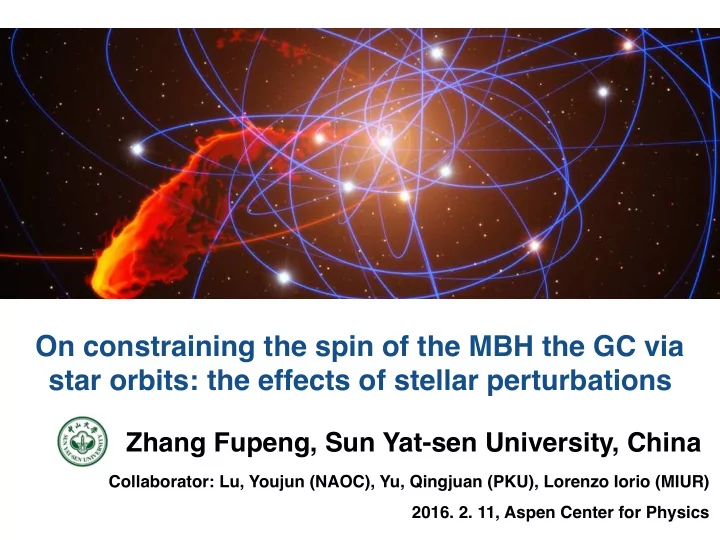
On constraining the spin of the MBH the GC via star orbits: the - - PowerPoint PPT Presentation

on constraining the spin of the mbh the gc via star
SMART_READER_LITE
LIVE PREVIEW

On constraining the spin of the MBH the GC via star orbits: the - - PowerPoint PPT Presentation

On constraining the spin of the MBH the GC via star orbits: the effects of stellar perturbations Zhang Fupeng, Sun Yat-sen University, China Collaborator: Lu, Youjun (NAOC), Yu, Qingjuan (PKU), Lorenzo Iorio (MIUR) 2016. 2. 11, Aspen Center for


slide-1
SLIDE 1

On constraining the spin of the MBH the GC via star orbits: the effects of stellar perturbations

Collaborator: Lu, Youjun (NAOC), Yu, Qingjuan (PKU), Lorenzo Iorio (MIUR)

  • 2016. 2. 11, Aspen Center for Physics

Zhang Fupeng, Sun Yat-sen University, China

slide-2
SLIDE 2

Angelil et al. 2010

Strong field GR test and the GC S-stars

  • Clusters of young stars in the GC
  • Provide a unique environment of testing GC by stellar orbits

http://www.galacticcenter.astro.ucla.edu/

slide-3
SLIDE 3
  • The constraints of the spin parameters by observing the trajectories

and the redshifts of the S-stars by future facilities (Zhang, Lu, & Yu

2015; Yu, Zhang, & Lu, submitted)

Our previous works

Spin magnitude Spin

  • rientation
  • Full GR treatment
  • MCMC fitting
  • Magnitude and direction
  • f spin, 6 orbital

elements, MBH and RGC

  • We can constraint the spin by
  • bserving the orbits of S2 or other

inner S-stars

  • But stellar perturbations are not

considered

slide-4
SLIDE 4

Perturbations

  • Distinguish
  • Gravitational perturbations from background sources
  • Spin-induced perturbations
  • Different predictions from other gravity theories(e.g., f(R) theory)
  • Stars:Early and late type stars(Bartko, et, al. 2010)
  • Stellar remnants
  • Stellar mass black holes: Mass segregation(Freitag, et, al. 2006)
  • Neutron stars, pulsars, white dwarfs: (Morris 1993)
  • Intermediate mass black hole(s):100-1000 solar mass, distance>200

AU (Yu & Tremaine 2003, Gualandris & Merritt 2009; etc)

  • Dark matter
slide-5
SLIDE 5

Previous studies

  • Post-NW approximation (Merritt et al. 2010)
  • Frame-dragging obscured beyond 0.5mpc

Angelil & Saha 2014

  • Hamiltonian perturbation (Angelil & Saha 2014)
  • Frame-Wavelet decomposition
  • Orbital perturbation theories 


Sadeghian & Will 2011; Iorio 2011; etc

Merritt et al. 2011

slide-6
SLIDE 6
  • Hamiltonian contributed by perturbation (Angelil & Saha

2014, Wisdom & Holman 1991)

target star MBH Perturber j=1,…,Np

Motion of the perturbed target star

  • Simplification
  • The multure interactions between perturber are ignored
  • The target star is a test particle (mass=0)
  • Motions of the perturbers follows the unperturbed motion equation

H=H0+Hp

slide-7
SLIDE 7

Light Tracing technique

🔮

Dec R.A.

Cunningham & Bardeen 1972

slide-8
SLIDE 8
  • Spin-induced effects:

unperturbed target star, a=0.99 unperturbed target star, a=0.0

  • Stellar perturbations:

perturbed target star, a=0.0 unperturbed target star, a=0.0

  • Total perturbations:

perturbed target star, a=0.99 unperturbed target star, a=0.0

  • Perturbations on the observational quantities
  • Positions of the star in the sky at time t
  • Redshift at time t
  • Root mean square value (in three orbits)
slide-9
SLIDE 9

Results: Single Perturber

slide-10
SLIDE 10

S2/S0-2 and S0-102

Gillessen et al. 2013

Meyer et al. 2012

  • S2/S0-2
  • Orbital period of 15 years
  • Pericenter distance of 100AU
  • S0-102
  • Orbital period of 11 years
  • e~0.68

How S0-102 affects the orbital motion of S2?

slide-11
SLIDE 11

S2 perturbed by S0-102

mp=1 M⊙

slide-12
SLIDE 12

S2 perturbed by S0-102

mp=5 M⊙

slide-13
SLIDE 13

Orbits of S2 perturbed by S0-102

  • mp=5 M⊙
  • mp=1 M⊙
slide-14
SLIDE 14

Orbits of S2 perturbed by S0-102

  • mp=1 M⊙
  • mp=5 M⊙
slide-15
SLIDE 15

Orbits of S2 perturbed by S0-102

  • Variations of the orbital elements of S2
  • The orbital period of S2 is perturbed: |dt0|~ 0.3 day after 45 years —>

~40 uas difference in sky position (> spin :10 uas)

slide-16
SLIDE 16

Inner S-stars perturbed by a single perturber

  • The stellar perturbations are dominated by perturbers inside the target star
slide-17
SLIDE 17

Results: Perturbations due to a star cluster

slide-18
SLIDE 18

Star clusters

  • Initial conditions (Merritt et al. 2011)
  • Bahcall-Wolf Cusp (Bahcall & Wolf 1976)
  • Core-like profile (Do et al. 2009)
  • Density profile
slide-19
SLIDE 19

Stellar perturbation due to a star cluster

cusp cusp cusp cusp core core

slide-20
SLIDE 20

cusp cusp cusp cusp core core

slide-21
SLIDE 21

M1 M3

Target star aorb=126AU

M6

Position difference in sky position

slide-22
SLIDE 22

Target star aorb=126AU Position difference in sky plane

M1 M3 M6

slide-23
SLIDE 23

Target star aorb=126AU Redshift difference

M1 M3 M6

slide-24
SLIDE 24

Summary and discussion

  • The spin-induced effects of S2/S0-2 are very likely obscured by the stellar

perturbations from the S0-102.

  • The stellar perturbations are dominated by perturbers inside the target

star

  • The stellar perturbations peaks around pericenter.
  • Perturbed orbital period of stars
  • The spin-induced effects dominates the signal for target stars inside

100-200AU if a clusters of stars exists around the MBH. But in principle the stellar perturbations are separable

slide-25
SLIDE 25

Thank you!~~