On a q -analog of the Ap ery numbers International conference on - - PowerPoint PPT Presentation

on a q analog of the ap ery numbers
SMART_READER_LITE
LIVE PREVIEW

On a q -analog of the Ap ery numbers International conference on - - PowerPoint PPT Presentation

On a q -analog of the Ap ery numbers International conference on orthogonal polynomials and q -series University of Central Florida celebrating Mourad E.H. Ismail Armin Straub May 12, 2015 University of Illinois at UrbanaChampaign n


slide-1
SLIDE 1

On a q-analog of the Ap´ ery numbers

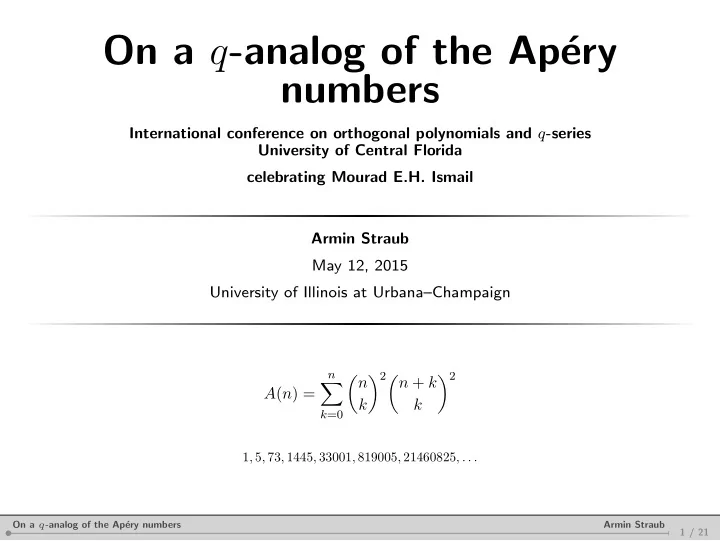
International conference on orthogonal polynomials and q-series University of Central Florida celebrating Mourad E.H. Ismail Armin Straub May 12, 2015 University of Illinois at Urbana–Champaign A(n) =

n

  • k=0

n k 2n + k k 2

1, 5, 73, 1445, 33001, 819005, 21460825, . . .

On a q-analog of the Ap´ ery numbers Armin Straub 1 / 21

slide-2
SLIDE 2

Positivity of rational functions

All Taylor coefficients of the following function are positive:

1 1 − (x + y + z + w) + 2(yzw + xzw + xyw + xyz) + 4xyzw.

CONJ

Kauers- Zeilberger 2008

  • Among those present, Askey, Ismail, Koornwinder have contributed to

understanding the positivity of (some) rational functions.

On a q-analog of the Ap´ ery numbers Armin Straub 2 / 21

slide-3
SLIDE 3

Positivity of rational functions

All Taylor coefficients of the following function are positive:

1 1 − (x + y + z + w) + 2(yzw + xzw + xyw + xyz) + 4xyzw.

CONJ

Kauers- Zeilberger 2008

  • Among those present, Askey, Ismail, Koornwinder have contributed to

understanding the positivity of (some) rational functions. The diagonal coefficients of the Kauers–Zeilberger function are

D(n) =

n

  • k=0

n k 22k n 2 .

PROP

S-Zudilin 2015

  • D(n) is an example of an Ap´

ery-like sequence.

On a q-analog of the Ap´ ery numbers Armin Straub 2 / 21

slide-4
SLIDE 4

Positivity of rational functions

All Taylor coefficients of the following function are positive:

1 1 − (x + y + z + w) + 2(yzw + xzw + xyw + xyz) + 4xyzw.

CONJ

Kauers- Zeilberger 2008

  • Among those present, Askey, Ismail, Koornwinder have contributed to

understanding the positivity of (some) rational functions. The diagonal coefficients of the Kauers–Zeilberger function are

D(n) =

n

  • k=0

n k 22k n 2 .

PROP

S-Zudilin 2015

  • D(n) is an example of an Ap´

ery-like sequence. Can we conclude the conjectured positivity from the positivity of D(n) together with the (obvious) positivity of

1 1−(x+y+z)+2xyz?

Q

S-Zudilin 2015

On a q-analog of the Ap´ ery numbers Armin Straub 2 / 21

slide-5
SLIDE 5

Ap´ ery numbers and the irrationality of ζ(3)

  • The Ap´

ery numbers

1, 5, 73, 1445, . . .

A(n) =

n

  • k=0

n k 2n + k k 2 satisfy (n + 1)3A(n + 1) = (2n + 1)(17n2 + 17n + 5)A(n) − n3A(n − 1).

On a q-analog of the Ap´ ery numbers Armin Straub 3 / 21

slide-6
SLIDE 6

Ap´ ery numbers and the irrationality of ζ(3)

  • The Ap´

ery numbers

1, 5, 73, 1445, . . .

A(n) =

n

  • k=0

n k 2n + k k 2 satisfy (n + 1)3A(n + 1) = (2n + 1)(17n2 + 17n + 5)A(n) − n3A(n − 1). ζ(3) = ∞

n=1 1 n3 is irrational.

THM

Ap´ ery ’78

The same recurrence is satisfied by the “near”-integers B(n) =

n

  • k=0

n k 2n + k k 2  

n

  • j=1

1 j3 +

k

  • m=1

(−1)m−1 2m3n

m

n+m

m

 . Then, B(n)

A(n) → ζ(3). But too fast for ζ(3) to be rational.

proof

On a q-analog of the Ap´ ery numbers Armin Straub 3 / 21

slide-7
SLIDE 7

Zagier’s search and Ap´ ery-like numbers

  • Recurrence for Ap´

ery numbers is the case (a, b, c) = (17, 5, 1) of (n + 1)3un+1 = (2n + 1)(an2 + an + b)un − cn3un−1. Are there other tuples (a, b, c) for which the solution defined by u−1 = 0, u0 = 1 is integral?

Q

Beukers, Zagier

On a q-analog of the Ap´ ery numbers Armin Straub 4 / 21

slide-8
SLIDE 8

Zagier’s search and Ap´ ery-like numbers

  • Recurrence for Ap´

ery numbers is the case (a, b, c) = (17, 5, 1) of (n + 1)3un+1 = (2n + 1)(an2 + an + b)un − cn3un−1. Are there other tuples (a, b, c) for which the solution defined by u−1 = 0, u0 = 1 is integral?

Q

Beukers, Zagier

  • Essentially, only 14 tuples (a, b, c) found.

(Almkvist–Zudilin)

  • 4 hypergeometric and 4 Legendrian solutions (with generating functions

3F2

1

2, α, 1 − α

1, 1

  • 4Cαz
  • ,

1 1 − Cαz 2F1 α, 1 − α 1

  • −Cαz

1 − Cαz 2 ,

with α = 1

2, 1 3, 1 4, 1 6 and Cα = 24, 33, 26, 24 · 33)

  • 6 sporadic solutions
  • Similar (and intertwined) story for:
  • (n + 1)2un+1 = (an2 + an + b)un − cn2un−1

(Beukers, Zagier)

  • (n + 1)3un+1 = (2n + 1)(an2 + an + b)un − n(cn2 + d)un−1

(Cooper)

On a q-analog of the Ap´ ery numbers Armin Straub 4 / 21

slide-9
SLIDE 9

The six sporadic Ap´ ery-like numbers

(a, b, c) A(n) (17, 5, 1)

Ap´ ery numbers

  • k

n k 2n + k n 2

(12, 4, 16)

  • k

n k 22k n 2

(10, 4, 64)

Domb numbers

  • k

n k 22k k 2(n − k) n − k

  • (7, 3, 81)

Almkvist–Zudilin numbers

  • k

(−1)k3n−3k n 3k n + k n (3k)! k!3

(11, 5, 125)

  • k

(−1)k n k 3 4n − 5k − 1 3n

  • +

4n − 5k 3n

  • (9, 3, −27)
  • k,l

n k 2n l k l k + l n

  • On a q-analog of the Ap´

ery numbers Armin Straub 5 / 21

slide-10
SLIDE 10

Ap´ ery-like numbers and modular forms

  • The Ap´

ery numbers A(n) satisfy

1, 5, 73, 1145, . . .

η7(2τ)η7(3τ) η5(τ)η5(6τ)

1 + 5q + 13q2 + 23q3 + O(q4)

modular form

=

  • n0

A(n) η12(τ)η12(6τ) η12(2τ)η12(3τ) n

q − 12q2 + 66q3 + O(q4) q = e2πiτ

modular function

.

On a q-analog of the Ap´ ery numbers Armin Straub 6 / 21

slide-11
SLIDE 11

Ap´ ery-like numbers and modular forms

  • The Ap´

ery numbers A(n) satisfy

1, 5, 73, 1145, . . .

η7(2τ)η7(3τ) η5(τ)η5(6τ)

1 + 5q + 13q2 + 23q3 + O(q4)

modular form

=

  • n0

A(n) η12(τ)η12(6τ) η12(2τ)η12(3τ) n

q − 12q2 + 66q3 + O(q4) q = e2πiτ

modular function

. Not at all evidently, such a modular parametrization exists for all known Ap´ ery-like numbers!

FACT

On a q-analog of the Ap´ ery numbers Armin Straub 6 / 21

slide-12
SLIDE 12

Ap´ ery-like numbers and modular forms

  • The Ap´

ery numbers A(n) satisfy

1, 5, 73, 1145, . . .

η7(2τ)η7(3τ) η5(τ)η5(6τ)

1 + 5q + 13q2 + 23q3 + O(q4)

modular form

=

  • n0

A(n) η12(τ)η12(6τ) η12(2τ)η12(3τ) n

q − 12q2 + 66q3 + O(q4) q = e2πiτ

modular function

. Not at all evidently, such a modular parametrization exists for all known Ap´ ery-like numbers!

FACT

  • As a consequence, with z =

√ 1 − 34x + x2,

  • n0

A(n)xn = 17 − x − z 4 √ 2(1 + x + z)3/2 3F2 1

2, 1 2, 1 2

1, 1

1024x (1 − x + z)4

  • .
  • Context:

f(τ) modular form of (integral) weight k x(τ) modular function y(x) such that y(x(τ)) = f(τ) Then y(x) satisfies a linear differential equation of order k + 1.

On a q-analog of the Ap´ ery numbers Armin Straub 6 / 21

slide-13
SLIDE 13

Supercongruences for Ap´ ery numbers

  • Chowla, Cowles, Cowles (1980) conjectured that, for primes p 5,

A(p) ≡ 5 (mod p3).

On a q-analog of the Ap´ ery numbers Armin Straub 7 / 21

slide-14
SLIDE 14

Supercongruences for Ap´ ery numbers

  • Chowla, Cowles, Cowles (1980) conjectured that, for primes p 5,

A(p) ≡ 5 (mod p3).

  • Gessel (1982) proved that A(mp) ≡ A(m)

(mod p3).

On a q-analog of the Ap´ ery numbers Armin Straub 7 / 21

slide-15
SLIDE 15

Supercongruences for Ap´ ery numbers

  • Chowla, Cowles, Cowles (1980) conjectured that, for primes p 5,

A(p) ≡ 5 (mod p3).

  • Gessel (1982) proved that A(mp) ≡ A(m)

(mod p3). The Ap´ ery numbers satisfy the supercongruence

(p 5)

A(mpr) ≡ A(mpr−1) (mod p3r).

THM

Beukers, Coster ’85, ’88

On a q-analog of the Ap´ ery numbers Armin Straub 7 / 21

slide-16
SLIDE 16

Supercongruences for Ap´ ery numbers

  • Chowla, Cowles, Cowles (1980) conjectured that, for primes p 5,

A(p) ≡ 5 (mod p3).

  • Gessel (1982) proved that A(mp) ≡ A(m)

(mod p3). The Ap´ ery numbers satisfy the supercongruence

(p 5)

A(mpr) ≡ A(mpr−1) (mod p3r).

THM

Beukers, Coster ’85, ’88

For primes p, simple combinatorics proves the congruence 2p p

  • =
  • k

p k

  • p

p − k

  • ≡ 1 + 1

(mod p2). For p 5, Wolstenholme’s congruence shows that, in fact, 2p p

  • ≡ 2

(mod p3).

EG

On a q-analog of the Ap´ ery numbers Armin Straub 7 / 21

slide-17
SLIDE 17

Supercongruences for Ap´ ery-like numbers

  • Conjecturally, supercongruences like

A(mpr) ≡ A(mpr−1) (mod p3r) hold for all Ap´ ery-like numbers.

Osburn–Sahu ’09

  • Current state of affairs for the six sporadic sequences from earlier:

(a, b, c) A(n) (17, 5, 1)

  • k

n

k

2n+k

n

2

Beukers, Coster ’87-’88

(12, 4, 16)

  • k

n

k

22k

n

2

Osburn–Sahu–S ’14

(10, 4, 64)

  • k

n

k

22k

k

2(n−k)

n−k

  • Osburn–Sahu ’11

(7, 3, 81)

  • k(−1)k3n−3k n

3k

n+k

n

(3k)!

k!3

  • pen!!

modulo p2 Amdeberhan ’14

(11, 5, 125)

  • k(−1)kn

k

3 4n−5k−1

3n

  • +

4n−5k

3n

  • Osburn–Sahu–S ’14

(9, 3, −27)

  • k,l

n

k

2n

l

k

l

k+l

n

  • pen

Robert Osburn Brundaban Sahu

(University of Dublin) (NISER, India) On a q-analog of the Ap´ ery numbers Armin Straub 8 / 21

slide-18
SLIDE 18

Non-super congruences are abundant

a(mpr) ≡ a(mpr−1) (mod pr) (C)

  • realizable sequences a(n), i.e., for some map T : X → X,

a(n) = #{x ∈ X : T nx = x} “points of period n”

Everest–van der Poorten–Puri–Ward ’02, Arias de Reyna ’05

On a q-analog of the Ap´ ery numbers Armin Straub 9 / 21

slide-19
SLIDE 19

Non-super congruences are abundant

a(mpr) ≡ a(mpr−1) (mod pr) (C)

  • realizable sequences a(n), i.e., for some map T : X → X,

a(n) = #{x ∈ X : T nx = x} “points of period n”

Everest–van der Poorten–Puri–Ward ’02, Arias de Reyna ’05

  • a(n) = tr An with A ∈ Zd×d

Arnold ’03, Zarelua ’04, . . .

On a q-analog of the Ap´ ery numbers Armin Straub 9 / 21

slide-20
SLIDE 20

Non-super congruences are abundant

a(mpr) ≡ a(mpr−1) (mod pr) (C)

  • realizable sequences a(n), i.e., for some map T : X → X,

a(n) = #{x ∈ X : T nx = x} “points of period n”

Everest–van der Poorten–Puri–Ward ’02, Arias de Reyna ’05

  • a(n) = tr An with A ∈ Zd×d

Arnold ’03, Zarelua ’04, . . .

  • If a(1) = 1, then (C) is equivalent to exp

  • n=1

a(n) n T n

  • ∈ Z[[T]].

This is a natural condition in formal group theory.

On a q-analog of the Ap´ ery numbers Armin Straub 9 / 21

slide-21
SLIDE 21

Cooper’s sporadic sequences

  • Cooper’s search for integral solutions to

(n + 1)3un+1 = (2n + 1)(an2 + an + b)un − n(cn2 + d)un−1 revealed three additional sporadic solutions:

s10 and supercongruence known

s7(n) =

n

  • k=0

n k 2n + k k 2k n

  • s10(n) =

n

  • k=0

n k 4 s18(n) =

[n/3]

  • k=0

(−1)k n k 2k k 2(n − k) n − k 2n − 3k − 1 n

  • +

2n − 3k n

  • On a q-analog of the Ap´

ery numbers Armin Straub 10 / 21

slide-22
SLIDE 22

Cooper’s sporadic sequences

  • Cooper’s search for integral solutions to

(n + 1)3un+1 = (2n + 1)(an2 + an + b)un − n(cn2 + d)un−1 revealed three additional sporadic solutions:

s10 and supercongruence known

s7(n) =

n

  • k=0

n k 2n + k k 2k n

  • s10(n) =

n

  • k=0

n k 4 s18(n) =

[n/3]

  • k=0

(−1)k n k 2k k 2(n − k) n − k 2n − 3k − 1 n

  • +

2n − 3k n

  • s7(mp) ≡ s7(m)

(mod p3)

p 3

s18(mp) ≡ s18(m) (mod p2)

CONJ

Cooper 2012

On a q-analog of the Ap´ ery numbers Armin Straub 10 / 21

slide-23
SLIDE 23

Cooper’s sporadic sequences

  • Cooper’s search for integral solutions to

(n + 1)3un+1 = (2n + 1)(an2 + an + b)un − n(cn2 + d)un−1 revealed three additional sporadic solutions:

s10 and supercongruence known

s7(n) =

n

  • k=0

n k 2n + k k 2k n

  • s10(n) =

n

  • k=0

n k 4 s18(n) =

[n/3]

  • k=0

(−1)k n k 2k k 2(n − k) n − k 2n − 3k − 1 n

  • +

2n − 3k n

  • s7(mp) ≡ s7(m)

(mod p3)

p 3

s18(mp) ≡ s18(m) (mod p2)

CONJ

Cooper 2012

s7(mpr) ≡ s7(mpr−1) (mod p3r)

p 5

s18(mpr) ≡ s18(mpr−1) (mod p2r)

THM

Osburn- Sahu-S 2014

On a q-analog of the Ap´ ery numbers Armin Straub 10 / 21

slide-24
SLIDE 24

Basic q-analogs

  • The natural number n has the q-analog:

[n]q = qn − 1 q − 1 = 1 + q + . . . + qn−1 In the limit q → 1 a q-analog reduces to the classical object.

On a q-analog of the Ap´ ery numbers Armin Straub 11 / 21

slide-25
SLIDE 25

Basic q-analogs

  • The natural number n has the q-analog:

[n]q = qn − 1 q − 1 = 1 + q + . . . + qn−1 In the limit q → 1 a q-analog reduces to the classical object.

  • The q-factorial:

[n]q! = [n]q [n − 1]q · · · [1]q

  • The q-binomial coefficient:

n k

  • q

= [n]q! [k]q! [n − k]q! =

  • n

n − k

  • q

On a q-analog of the Ap´ ery numbers Armin Straub 11 / 21

slide-26
SLIDE 26

A q-binomial coefficient

6 2

  • = 6 · 5

2 = 3 · 5 6 2

  • q

= (1 + q + q2 + q3 + q5)(1 + q + q2 + q3 + q4) 1 + q

EG

On a q-analog of the Ap´ ery numbers Armin Straub 12 / 21

slide-27
SLIDE 27

A q-binomial coefficient

6 2

  • = 6 · 5

2 = 3 · 5 6 2

  • q

= (1 + q + q2 + q3 + q5)(1 + q + q2 + q3 + q4) 1 + q = (1 − q + q2) (1 + q + q2)

  • =[3]q

(1 + q + q2 + q3 + q4)

  • =[5]q

EG

On a q-analog of the Ap´ ery numbers Armin Straub 12 / 21

slide-28
SLIDE 28

A q-binomial coefficient

6 2

  • = 6 · 5

2 = 3 · 5 6 2

  • q

= (1 + q + q2 + q3 + q5)(1 + q + q2 + q3 + q4) 1 + q = (1 − q + q2)

  • =Φ6(q)

(1 + q + q2)

  • =[3]q

(1 + q + q2 + q3 + q4)

  • =[5]q

EG

  • The cyclotomic polynomial Φ6(q) becomes 1 for q = 1

and hence invisible in the classical world

On a q-analog of the Ap´ ery numbers Armin Straub 12 / 21

slide-29
SLIDE 29

The coefficients of q-binomial coefficients

  • Here’s some q-binomials in expanded form:

6 2

  • q

= q8 + q7 + 2q6 + 2q5 + 3q4 + 2q3 + 2q2 + q + 1 9 3

  • q

= q18 + q17 + 2q16 + 3q15 + 4q14 + 5q13 + 7q12 + 7q11 + 8q10 + 8q9 + 8q8 + 7q7 + 7q6 + 5q5 + 4q4 + 3q3 + 2q2 + q + 1

EG

  • The degree of the q-binomial is k(n − k).
  • All coefficients are positive!
  • In fact, the coefficients are unimodal.

Sylvester, 1878

On a q-analog of the Ap´ ery numbers Armin Straub 13 / 21

slide-30
SLIDE 30

A few faces of the q-binomial coefficient

The q-binomial coefficient

n k

  • q
  • satisfies a q-version of Pascal’s rule,

n j

  • q

= n − 1 j − 1

  • q

+ qj n − 1 j

  • q,
  • counts k-subsets of an n-set weighted by their sum,
  • features in a binomial theorem for noncommuting variables,

(x + y)n =

n

  • j=0

n j

  • q

xjyn−j, if yx = qxy,

  • has a q-integral representation analogous to the beta function,
  • counts the number of k-dimensional subspaces of Fn

q .

On a q-analog of the Ap´ ery numbers Armin Straub 14 / 21

slide-31
SLIDE 31

A q-analog of Babbage’s congruence

  • Combinatorially, we again obtain:

“q-Chu-Vandermonde”

2p p

  • q

=

  • k

p k

  • q
  • p

p − k

  • q

q(p−k)2

On a q-analog of the Ap´ ery numbers Armin Straub 15 / 21

slide-32
SLIDE 32

A q-analog of Babbage’s congruence

  • Combinatorially, we again obtain:

“q-Chu-Vandermonde”

2p p

  • q

=

  • k

p k

  • q
  • p

p − k

  • q

q(p−k)2 ≡ qp2 + 1 = [2]qp2 (mod [p]2

q)

(Note that [p]q divides

p k

  • q

unless k = 0 or k = p.)

On a q-analog of the Ap´ ery numbers Armin Straub 15 / 21

slide-33
SLIDE 33

A q-analog of Babbage’s congruence

  • Combinatorially, we again obtain:

“q-Chu-Vandermonde”

2p p

  • q

=

  • k

p k

  • q
  • p

p − k

  • q

q(p−k)2 ≡ qp2 + 1 = [2]qp2 (mod [p]2

q)

(Note that [p]q divides

p k

  • q

unless k = 0 or k = p.)

  • This combinatorial argument extends to show:

ap bp

  • q

≡ a b

  • qp2

(mod [p]2

q)

THM

Clark 1995

On a q-analog of the Ap´ ery numbers Armin Straub 15 / 21

slide-34
SLIDE 34

A q-analog of Babbage’s congruence

  • Combinatorially, we again obtain:

“q-Chu-Vandermonde”

2p p

  • q

=

  • k

p k

  • q
  • p

p − k

  • q

q(p−k)2 ≡ qp2 + 1 = [2]qp2 (mod [p]2

q)

(Note that [p]q divides

p k

  • q

unless k = 0 or k = p.)

  • This combinatorial argument extends to show:

ap bp

  • q

≡ a b

  • qp2

(mod [p]2

q)

THM

Clark 1995

  • Similar results by Andrews; e.g.:

ap bp

  • q

≡ q(a−b)b(p

2)

a b

  • qp

(mod [p]2

q)

On a q-analog of the Ap´ ery numbers Armin Straub 15 / 21

slide-35
SLIDE 35

A q-analog of Ljunggren’s congruence

  • The following answers the question of Andrews to find a q-analog of

Wolstenholme’s congruence. For any prime p,

ap bp

  • q

≡ a b

  • qp2 − (a − b)b

a b p2 − 1 24 (qp − 1)2 (mod [p]3

q).

THM

S 2011

On a q-analog of the Ap´ ery numbers Armin Straub 16 / 21

slide-36
SLIDE 36

A q-analog of Ljunggren’s congruence

  • The following answers the question of Andrews to find a q-analog of

Wolstenholme’s congruence. For any prime p,

ap bp

  • q

≡ a b

  • qp2 − (a − b)b

a b p2 − 1 24 (qp − 1)2 (mod [p]3

q).

THM

S 2011

Choosing p = 13, a = 2, and b = 1, we have 26 13

  • q

= 1 + q169 − 14(q13 − 1)2 + (1 + q + . . . + q12)3f(q) where f(q) = 14 − 41q + 41q2 − . . . + q132 is an irreducible polynomial with integer coefficients.

EG

On a q-analog of the Ap´ ery numbers Armin Straub 16 / 21

slide-37
SLIDE 37

A q-analog of Ljunggren’s congruence

  • The following answers the question of Andrews to find a q-analog of

Wolstenholme’s congruence. For any prime p,

ap bp

  • q

≡ a b

  • qp2 − (a − b)b

a b p2 − 1 24 (qp − 1)2 (mod [p]3

q).

THM

S 2011

  • Note that p2−1

24

is an integer if (p, 6) = 1.

(The polynomial congruence holds for p = 2, 3 but coefficients are rational.)

On a q-analog of the Ap´ ery numbers Armin Straub 16 / 21

slide-38
SLIDE 38

A q-analog of Ljunggren’s congruence

  • The following answers the question of Andrews to find a q-analog of

Wolstenholme’s congruence. For any prime p,

ap bp

  • q

≡ a b

  • qp2 − (a − b)b

a b p2 − 1 24 (qp − 1)2 (mod [p]3

q).

THM

S 2011

  • Note that p2−1

24

is an integer if (p, 6) = 1.

(The polynomial congruence holds for p = 2, 3 but coefficients are rational.)

  • Ljunggren’s classical congruence holds modulo p3+r

with r the p-adic valuation of ab(a − b) a

b

  • .

Jacobsthal ’52

Is there a nice explanation or analog in the q-world?

On a q-analog of the Ap´ ery numbers Armin Straub 16 / 21

slide-39
SLIDE 39

A q-analog of Ljunggren’s congruence

  • The following answers the question of Andrews to find a q-analog of

Wolstenholme’s congruence. For any prime p,

ap bp

  • q

≡ a b

  • qp2 − (a − b)b

a b p2 − 1 24 (qp − 1)2 (mod [p]3

q).

THM

S 2011

  • Note that p2−1

24

is an integer if (p, 6) = 1.

(The polynomial congruence holds for p = 2, 3 but coefficients are rational.)

  • Ljunggren’s classical congruence holds modulo p3+r

with r the p-adic valuation of ab(a − b) a

b

  • .

Jacobsthal ’52

Is there a nice explanation or analog in the q-world?

  • The congruence holds mod Φn(q)3 if p is replaced by any integer n.

(No classical counterpart since Φn(1) = 1 unless n is a prime power.)

On a q-analog of the Ap´ ery numbers Armin Straub 16 / 21

slide-40
SLIDE 40

A q-version of the Ap´ ery numbers

  • A symmetric q-analog of the Ap´

ery numbers: Aq(n) =

n

  • k=0

q(n−k)2n k 2

q

n + k k 2

q

  • Appear implicitly in work of Krattenthaler–Rivoal–Zudilin ’06

On a q-analog of the Ap´ ery numbers Armin Straub 17 / 21

slide-41
SLIDE 41

A q-version of the Ap´ ery numbers

  • A symmetric q-analog of the Ap´

ery numbers: Aq(n) =

n

  • k=0

q(n−k)2n k 2

q

n + k k 2

q

  • Appear implicitly in work of Krattenthaler–Rivoal–Zudilin ’06
  • The first few values are:

A(0) = 1 Aq(0) = 1 A(1) = 5 Aq(1) = 1 + 3q + q2 A(2) = 73 Aq(2) = 1 + 3q + 9q2 + 14q3 + 19q4 + 14q5 + 9q6 + 3q7 + q8 A(3) = 1445 Aq(3) = 1 + 3q + 9q2 + 22q3 + 43q4 + 76q5 + 117q6 + . . . + 3q17 + q18

On a q-analog of the Ap´ ery numbers Armin Straub 17 / 21

slide-42
SLIDE 42

q-supercongruences for the Ap´ ery numbers

The q-Ap´ ery numbers, defined as Aq(n) =

n

  • k=0

q(n−k)2n k 2

q

n + k k 2

q

, satisfy the supercongruences Aq(pn) ≡ Aqp2(n) − p2 − 1 12 (qp − 1)2f(n) (mod [p]3

q).

THM

S 2015

in progress On a q-analog of the Ap´ ery numbers Armin Straub 18 / 21

slide-43
SLIDE 43

q-supercongruences for the Ap´ ery numbers

The q-Ap´ ery numbers, defined as Aq(n) =

n

  • k=0

q(n−k)2n k 2

q

n + k k 2

q

, satisfy the supercongruences Aq(pn) ≡ Aqp2(n) − p2 − 1 12 (qp − 1)2f(n) (mod [p]3

q).

THM

S 2015

in progress

  • The numbers f(n) can be expressed as

0, 5, 292, 13005, 528016, . . .

f(n) =

n

  • k=0

g(n, k) n k 2n + k k 2 , g(n, k) = k(2n − k) + k4 (n + k)2 .

  • Similar q-analogs and congruences for other Ap´

ery-like numbers?

On a q-analog of the Ap´ ery numbers Armin Straub 18 / 21

slide-44
SLIDE 44

The Almkvist–Zudilin numbers

  • Recall that for the Almkvist–Zudilin numbers,

Z(n) =

n

  • k=0

(−3)n−3k n 3k n + k n (3k)! k!3 ,

the supercongruences Z(mpr) ≡ Z(mpr−1) modulo p3r are still conjectural (even for r = 1).

On a q-analog of the Ap´ ery numbers Armin Straub 19 / 21

slide-45
SLIDE 45

The Almkvist–Zudilin numbers

  • Recall that for the Almkvist–Zudilin numbers,

Z(n) =

n

  • k=0

(−3)n−3k n 3k n + k n (3k)! k!3 ,

the supercongruences Z(mpr) ≡ Z(mpr−1) modulo p3r are still conjectural (even for r = 1).

  • It is not clear how to introduce a q-analog for which (at least

empirically) supercongruences hold.

  • Maybe finding such a q-analog leads to a better understanding of the

classical case, too.

On a q-analog of the Ap´ ery numbers Armin Straub 19 / 21

slide-46
SLIDE 46

The Almkvist–Zudilin numbers

  • Recall that for the Almkvist–Zudilin numbers,

Z(n) =

n

  • k=0

(−3)n−3k n 3k n + k n (3k)! k!3 ,

the supercongruences Z(mpr) ≡ Z(mpr−1) modulo p3r are still conjectural (even for r = 1).

  • It is not clear how to introduce a q-analog for which (at least

empirically) supercongruences hold.

  • Maybe finding such a q-analog leads to a better understanding of the

classical case, too. The Almkvist–Zudilin numbers are the diagonal coefficients of 1 1 − (x1 + x2 + x3 + x4) + 27x1x2x3x4 .

EG

S 2014

On a q-analog of the Ap´ ery numbers Armin Straub 19 / 21

slide-47
SLIDE 47

Some of many open problems

  • Supercongruences for all Ap´

ery-like numbers

  • proof of all the classical ones
  • uniform explanation, proofs not relying on binomial sums
  • polynomial analogs of Ap´

ery-like numbers

  • find q-analogs (e.g., for Almkvist–Zudilin sequence)
  • q-supercongruences
  • is there a geometric picture?
  • Many further questions remain.
  • is the known list complete?
  • Ap´

ery-like numbers as diagonals and multivariate supercongruences

  • higher-order analogs, Calabi–Yau DEs
  • modular supercongruences

Beukers ’87, Ahlgren–Ono ’00

A p − 1 2

  • ≡ a(p)

(mod p2),

  • n=1

a(n)qn = η4(2τ)η4(4τ)

  • . . .

On a q-analog of the Ap´ ery numbers Armin Straub 20 / 21

slide-48
SLIDE 48

THANK YOU!

Slides for this talk will be available from my website: http://arminstraub.com/talks

  • A. Straub

Multivariate Ap´ ery numbers and supercongruences of rational functions Algebra & Number Theory, Vol. 8, Nr. 8, 2014, p. 1985-2008

  • R. Osburn, B. Sahu, A. Straub

Supercongruences for sporadic sequences to appear in Proceedings of the Edinburgh Mathematical Society, 2014

  • A. Straub, W. Zudilin

Positivity of rational functions and their diagonals Journal of Approximation Theory (special issue dedicated to Richard Askey), Vol. 195, 2015, p. 57-69

  • A. Straub

A q-analog of Ljunggren’s binomial congruence DMTCS Proceedings: FPSAC 2011, p. 897-902 On a q-analog of the Ap´ ery numbers Armin Straub 21 / 21