Oklahoma University Report Childrens Medical Office April 14, 2014 - - PowerPoint PPT Presentation

oklahoma university
SMART_READER_LITE
LIVE PREVIEW

Oklahoma University Report Childrens Medical Office April 14, 2014 - - PowerPoint PPT Presentation

AE Senior Thesis Final Oklahoma University Report Childrens Medical Office April 14, 2014 Building Jonathan Ebersole Structural Option Dr. Hanagan Oklahoma City, Oklahoma Introduction Building Statistics Building Statistics


slide-1
SLIDE 1

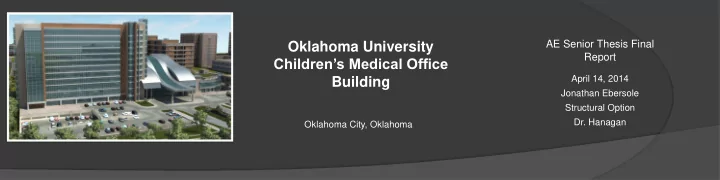
Oklahoma University Children’s Medical Office Building

Oklahoma City, Oklahoma

AE Senior Thesis Final Report

April 14, 2014 Jonathan Ebersole Structural Option

  • Dr. Hanagan
slide-2
SLIDE 2
  • Introduction
  • Building Statistics
  • Project Team
  • Existing Structure
  • Proposal
  • Structural Depth
  • Architectural Breadth
  • Construction Breadth
  • Conclusion

Building Statistics

  • Location: 1200 North Children’s Avenue, Oklahoma

City, Oklahoma

  • Occupancy: Office
  • Size: 320,000 gsf
  • Height: 12 stories for a total of 172 ft.
  • Construction Dates: February 2007- Spring 2009
  • Building Cost: $59,760,000
  • Delivery Method: Design-Bid-Build
slide-3
SLIDE 3
  • Introduction
  • Building Statistics
  • Project Team
  • Existing Structure
  • Proposal
  • Structural Depth
  • Architectural Breadth
  • Construction Breadth
  • Conclusion

Project Team

  • Owner: University Hospitals Trust
  • Construction Manager: Flintco, Inc.
  • Project Architect: Miles Associates
  • Structural Engineer: Zahl-Ford Inc.
  • MEP Engineer: ZRHD, P.C.
  • Civil Engineer: Smith, Roberts, Baldischwiler, Inc.
slide-4
SLIDE 4
  • Introduction
  • Building Statistics
  • Project Team
  • Existing Structure
  • Proposal
  • Structural Depth
  • Architectural Breadth
  • Construction Breadth
  • Conclusion

Existing Building Structure

  • Reinforced, cast-in-place concrete
  • Foundations
  • Drilled piers, spread footings, and grade beams
  • Two way flat slab system with drop panels
  • 10” slab with 4” drop panels
  • Exterior Beams

26’

Typical Bay

32’

Gravity

slide-5
SLIDE 5
  • Introduction
  • Building Statistics
  • Project Team
  • Existing Structure
  • Proposal
  • Structural Depth
  • Architectural Breadth
  • Construction Breadth
  • Conclusion

Existing Building Structure

Lateral Layout Lateral

  • Reinforced cast-in-place concrete shear

walls

  • Located in stairwells, elevator shafts, and

center of floor plan

  • Typically 12” thick
  • Moment frames located along the floor plan

perimeter

N

slide-6
SLIDE 6
  • Introduction
  • Proposal
  • Problem Statement
  • Depth Introduction
  • Breadth Introduction
  • Structural Depth
  • Architectural Breadth
  • Construction Breadth
  • Conclusion

Problem Statement

  • Reduce overall building costs
  • Reduce the schedule duration
  • Develop an economical steel system
  • Maintain a low impact on the building

architecture

http://www.metalconstructionnews.com/articles/columns/high- flying-inspiration.aspx

slide-7
SLIDE 7
  • Introduction
  • Proposal
  • Structural Depth
  • Design Loads
  • RAM Model
  • Composite Steel Redesign
  • Steel Joist Redesign
  • Lateral System Redesign
  • Drift Comparison
  • Architectural Breadth
  • Construction Breadth
  • Conclusion

Design Loads

Gravity Loads Lateral Load Base Shears

Floors

Live Load 80 psf Superimposed Dead Load 15 psf Flooring 2 psf

Roof

Roof Live Load 20 psf Snow Load 10 psf Green Roof Dead Load 30 psf Superimposed Dead Load 15 psf

Additional Loads

Helicopter Pad Dead Load 8.33 kips Ambulance Bay Live Load 60 psf

Wind Loads

Wind N-S 430 kips Wind E-W 942 kips

Seismic

Seismic N-S 447 kips Seismic E-W 447 kips

  • Wind E-W controls
slide-8
SLIDE 8
  • Introduction
  • Proposal
  • Structural Depth
  • Design Loads
  • RAM Model
  • Composite Steel Redesign
  • Steel Joist Redesign
  • Lateral System Redesign
  • Drift Comparison
  • Architectural Breadth
  • Construction Breadth
  • Conclusion

RAM Model

Model Assumptions

  • Columns are considered as pinned connections at the

base

  • Wind Loads are to be applied at the center of pressure
  • Each floor diaphragm is considered rigid

N

slide-9
SLIDE 9
  • Introduction
  • Proposal
  • Structural Depth
  • Design Loads
  • RAM Model
  • Composite Steel Redesign
  • Steel Joist Redesign
  • Lateral System Redesign
  • Drift Comparison
  • Architectural Breadth
  • Construction Breadth
  • Conclusion

Composite Steel Floor Redesign

  • Typical Bay
  • 1.5 VLR 22 gauge composite deck
  • 3 ¼” lightweight topping
  • Unshored, 3 span construction
  • Beams
  • W14x22 with 20 studs and a 1” camber
  • Girders
  • W16x31 with 38 studs and a ¾” chamber
  • Beams, girders, and columns are to be fireproofed for

a two hour fire rating

Typical Bay

N

slide-10
SLIDE 10
  • Introduction
  • Proposal
  • Structural Depth
  • Design Loads
  • RAM Model
  • Composite Steel Redesign
  • Steel Joist Redesign
  • Lateral System Redesign
  • Drift Comparison
  • Architectural Breadth
  • Construction Breadth
  • Conclusion

Steel Joist Roof Redesign

Typical Roof Bay

  • Typical Bay
  • 1.5 B 22 gauge roofing deck
  • Unshored, 3 span construction
  • Joists
  • 24K9 joists
  • Girders
  • W18x40
  • Roof deck, joists, girders, and columns

will be fireproofed for a two hour fire rating

N

slide-11
SLIDE 11
  • Introduction
  • Proposal
  • Structural Depth
  • Design Loads
  • RAM Model
  • Composite Steel Redesign
  • Steel Joist Redesign
  • Lateral System Redesign
  • Drift Comparison
  • Architectural Breadth
  • Construction Breadth
  • Conclusion

Lateral System Redesign Lateral System Layout

  • Concentric, diagonal braced frames
  • Located in existing shear wall

locations

  • Consists of square HSS steel tubes
  • Additional moment frames are needed
  • Located along the eastern wall
  • Moment frames where used to

minimize the impact on the architecture

N

Concentric Braced Frames Additional Frames

slide-12
SLIDE 12
  • Introduction
  • Proposal
  • Structural Depth
  • Design Loads
  • RAM Model
  • Composite Steel Redesign
  • Steel Joist Redesign
  • Lateral System Redesign
  • Drift Comparison
  • Architectural Breadth
  • Construction Breadth
  • Conclusion

Drift Comparison

  • Existing concrete lateral system drift: 4.77 inches
  • Proposed steel lateral system drift: 4.75 inches
  • IBC 2009 allowable building drift: 4.98 inches

Building Drift Under Controlling Case

N

slide-13
SLIDE 13
  • Introduction
  • Proposal
  • Structural Depth
  • Architectural Breadth
  • Plant selection
  • Material Selection
  • Impact on Structural System
  • Green Roof Cost Analysis
  • Construction Breadth
  • Conclusion

Plant Selection

  • Oklahoma City hardiness zone: 7a and 7b
  • Identifies the appropriate plants for a

specific environment

  • Sedum plants are used
  • Hardy plants that can survive a variety of

different environments

  • Can grow in shallow soil depths
  • Ability to resist droughts

Sedum Floriferum

http://macgardens.org /?m=201306

Sedum Oreganum

http://www.greatcity.org/

slide-14
SLIDE 14
  • Introduction
  • Proposal
  • Structural Depth
  • Architectural Breadth
  • Plant selection
  • Material Selection
  • Impact on Structural System
  • Green Roof Cost Analysis
  • Construction Breadth
  • Conclusion

Material Selection

  • Growing Medium
  • Rooflite Extensive MCL
  • Filter Fabric
  • Green Roof Solutions FF35
  • Drainage Panel
  • Green Roof Solutions GRS 32

Image obtained from http://www.vegetalid.us/green-roof- systems/green-roof-101/what-is-a-green-roof

slide-15
SLIDE 15
  • Introduction
  • Proposal
  • Structural Depth
  • Architectural Breadth
  • Plant selection
  • Material Selection
  • Impact on Structural System
  • Green Roof Cost Analysis
  • Construction Breadth
  • Conclusion

Material Selection

  • Root Barrier
  • Green Roof Solutions RB20
  • Waterproof Membrane
  • Kemper System Kempero 2K-PUR
  • Rigid Insulation
  • DOW Building Solutions Highload 60 Insulation
  • Vapor Barrier
  • Roof Aqua Guard BREA

Image obtained from http://www.vegetalid.us/green-roof- systems/green-roof-101/what-is-a-green-roof

slide-16
SLIDE 16
  • Introduction
  • Proposal
  • Structural Depth
  • Architectural Breadth
  • Plant selection
  • Material Selection
  • Impact on Structural System
  • Green Roof Cost Analysis
  • Construction Breadth
  • Conclusion

Impact on the Structural System

Material Weight

Vegetation 2 psf Growing Media 17 psf Filter Fabric 0.024 psf Drainage Panel (Including Water) 2 psf Root Barrier 0.05 psf Water Proof Membrane 0.05 psf Total 22 psf

  • Initial dead load estimation for the green roof was

30 psf.

  • The total dead load for the green roof is 22 psf
  • The estimated dead load is conservative

compared to the actual dead load

slide-17
SLIDE 17
  • Introduction
  • Proposal
  • Structural Depth
  • Architectural Breadth
  • Plant selection
  • Material Selection
  • Impact on Structural System
  • Green Roof Cost Analysis
  • Construction Breadth
  • Conclusion

Green Roof Cost Analysis

  • Green roofs have a higher initial costs compared to a

standard built up roof

  • Using RS Means Cost Construction Data, the total

additional cost for the green roof is $412,000.00

Green Roof

Unit Quantity Waste Factor Unit Price Labor Equipment Total Vegetation S.F. 22705.50 1.00 2.50 0.33 0.00 64256.57 Growing Medium S.F. 22705.50 1.00 0.25 0.53 0.41 27019.55 Filter Fabric S.F. 22705.50 1.00 0.26 3.88 0.51 105580.58 Drainage Panel S.F. 22705.50 1.00 2.70 0.67 0.00 76517.54 Root Barrier S.F. 22705.50 1.00 0.70 0.77 0.00 33377.09 Water Proof Membrane S.F. 22705.50 1.00 0.26 3.88 0.51 105580.58 Total: $412,331.88

slide-18
SLIDE 18
  • Introduction
  • Proposal
  • Structural Depth
  • Architectural Breadth
  • Construction Breadth
  • Cost Comparison
  • Schedule Comparison
  • Conclusion

Cost Comparison

  • Detailed cost analysis using RS Means for each

system

  • Original concrete design estimate: $9,055,000.00
  • Proposed steel design estimate: $5,125,000.00
  • Cost is significantly reduced

Concrete Cost Summary Cost of Concrete $2,025,000.00 Cost of Formwork $5,380,000.00 Cost of Reinforcement $1,650,000.00 Total $9,055,000.00 Steel Cost Summary Steel Beams $2,230,000.00 Steel Columns $1,170,000.00 Steel Braces $250,000.00 Steel Decking $756,000.00 Concrete Topping $365,000.00 Welded Wire Fabric $120,000.00 Steel Joists $29,000.00 Fireproofing $142,000.00 Shear Connectors $63,000.00 Total $5,125,000.00

slide-19
SLIDE 19
  • Introduction
  • Proposal
  • Structural Depth
  • Architectural Breadth
  • Construction Breadth
  • Cost Comparison
  • Schedule Comparison
  • Conclusion

Schedule Comparison

  • Schedule determined from RS Means
  • Original Concrete System
  • Assumed three crews to decrease schedule

times

  • 710 days to complete
  • Proposed Steel System
  • Assumed one crew erecting the steel
  • 189 days to complete

http://www.projsolco.com/portfolio/healthcare-imaging- solutions

slide-20
SLIDE 20
  • Introduction
  • Proposal
  • Structural Depth
  • Architectural Breadth
  • Construction Breadth
  • Conclusion
  • Design Conclusion
  • Acknowledgements
  • Questions

Design Conclusion

Goals

  • Reduce overall building costs
  • Reduce the schedule duration
  • Develop an economical steel system
  • Maintain a low impact on the

building architecture

Results

  • Redesign was more cost effective
  • The schedule time was reduced
  • Composite steel with unshored

construction

  • Steel provides an open floor plan
  • Lateral system has little impact of

exterior facade

slide-21
SLIDE 21
  • Introduction
  • Proposal
  • Structural Depth
  • Architectural Breadth
  • Construction Breadth
  • Conclusion
  • Design Conclusion
  • Acknowledgements
  • Questions

Acknowledgements

  • University Hospitals Trust
  • Miles Associates
  • Zahl-Ford Inc.
  • Department of Architectural Engineering
  • Friends and Family
slide-22
SLIDE 22
  • Introduction
  • Proposal
  • Structural Depth
  • Architectural Breadth
  • Construction Breadth
  • Conclusion
  • Design Conclusion
  • Acknowledgements
  • Questions

Questions?