
SLIDE 1
1
OFME Case for Change
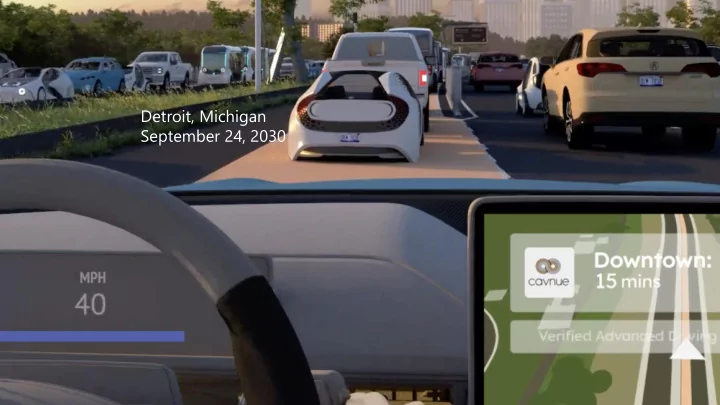
Detroit, Michigan September 24, 2030
OFME Case for Change Detroit, Michigan September 24, 2030 1 - - PowerPoint PPT Presentation
OFME Case for Change Detroit, Michigan September 24, 2030 1 Mobility refers to technologies and services that enable people and goods to move around more freely. Electrification refers to the range of technologies that use electricity to
1
Detroit, Michigan September 24, 2030
2
Mobility refers to technologies and services that enable people and goods to move around more freely. Electrification refers to the range of technologies that use electricity to propel a vehicle.
3
4
The creation of the Office of Future Mobility and Electrification is informed by five market trends.
OFME Case for Change
5
The last decade has seen new technologies disrupt the auto industry. This disruption is shifting profit pools and creating new winners and losers along Michigan’s automotive supply chain.
Emerging Profit Pool Classic Profit Pool
Electric Vehicle Technology: Michigan has an 11% share of North American EV production. This is expected to fall to 8% by 2025. Autonomous Vehicle Technology: More than 50% of Michigan’s auto industry works on projects related to autonomous vehicles in-state. Connected and Shared Technologies: Michigan suppliers have contributed most to the state’s auto employment growth since 2013. But the car is changing, and so is the content suppliers need to provide.
1st Market Trend: Industry Disruption
99% 83% 74% 60% 1% 17% 26% 40%
2017 2025 2030 2035
Profits4, billions
$226B $380B $336B $303B
1%
Boston Consulting Group Analysis, “Who Will Drive Electric Cars to the Tipping Point?” 2020 McKinsey Consulting Group, Mobility 2.0 Taskforce, Michigan Department of Labor & Economic Opportunity. 2019 Detroit Regional Partnership Research, 2019 Boston Consulting Group Analysis, “Where to Profit as Tech Transforms Mobility”. 2018 6
1st Market Trend: Industry Disruption
And, due to heavy reliance on the same foundational autonomous, connected, shared and electric technologies, many modes of transportation are converging. Future mobility will impact more than auto.
consumer goods deliveries by 2026.
200 interactions across various infrastructure assets.
$6,000 per seat, or some $230,000 per bus, over a 14-year lifespan.
Extending Global Impact: Michigan can leverage its automotive advantage to drive other transportation modes forward, like shipping and last-mile delivery Autonomous Tech will Grow to $3.3T USD by 2030 But self-driving cars are only a portion of the market
Autonomous Vehicles, $719B Maintenance and Aftermarket, $359B Fleet, traffic and Infrastructure, $1.13T Services, Systems and Data, $1.12T
Oliver Wyman, Mobility Compendium 2019, https://www.oliverwyman.com/content/dam/oliver-wyman/v2/publications/2018/november/2018_Oliver_Wyman_Mobility_Compendium.pdf PWC, “Digitisation and autonomous driving to halve costs by 2030, finds PwC Truck Study”, 2018, https://www.pwc.com/gx/en/news-room/press-releases/2018/digitisation-and-autonomous-driving-to-halve-costs-by-2030-finds-pwc-truck-study.html Morgan Stanley, “Internet, Auto and Transport Report” 2020 McKinsey Consulting Group, Commercial Drones 2020, https://www.mckinsey.com/industries/capital-projects-and-infrastructure/our-insights/commercial-drones-are-here-the-future-of-unmanned-aerial-systems Deloitte, ‘How are global shippers evolving to meet tomorrow’s demand?’ 2019, https://www2.deloitte.com/us/en/insights/focus/future-of-mobility/future-of-freight-connected-data-intelligent-automation.html 7
The jobs impact of mobility and electrification will be significant.
Boston Consulting Group, Detroit Mobility Lab. “Future Talents for Mobility”. Economic impact calculated by Michigan Mobility Institute using Economic Policy Institute employment multipliers. 2019 Excess tech jobs indicate occupations are filled by external talent, while excess graduates indicate occupations are not being filled by local talent. McKinsey Consulting Group, Mobility 2.0 Taskforce, Michigan Department of Labor & EconomicTex t
15 0.3
Texas Tennessee Michigan Alabama
Georgia Ohio Indiana Illinois
2.0
Tech jobs added (2017-2018) Tech graduates (2017-2018)
Tech Degrees Completed vs. Tech Jobs Added by State2, Thousands, 2017
2nd Market Trend: Workforce Evolution
Nationally, the mobility industry will need 45,000 new people with computer-related engineering skills by 2030. Michigan will need 12,000 people with these skills to retain its pole position as the global mobility leader.
8
Startups have enriched Michigan’s business R&D environment. Michigan is the second highest receiver of VC funds to mobility and electrification startups. However, that is still just a tenth of California. And unlike other regions, 94% of VC funds to mobility startups in Michigan are for hardware. Software startup founders often get educated here but take ideas elsewhere to get funds.
Top States Receiving VC Funds for Mobility and EV Startup Technologies, %, 2015-2019
16 94 16 34 51 60 84 6 84 66 49 40
California Michigan Washington Arizona Massachusetts Illinois
Software Hardware
Total VC spend, $ Billions, 2015-19
3rd Market Trend: More Competitive R&D and Startup Environments
1.2 0.1 0.1 0.1 0.1 12.5
6
McKinsey Consulting Group, Mobility 2.0 Taskforce, Michigan Department of Labor & Economic Opportunity. 2019 U.S Bureau of Labor and Statistics, “2019 total gross job gains”., Total Gross Job Gains in US from Startups: 7,021,550. Total Gross Jobs Gains from MI Startups: 269,184. BLS cuts this data either by company size (# of employees) or company age (# of years). “Startup" defined as private companies that are less than 10 years old. 9
Smart infrastructure is a foundational platform that drives business attraction, growth and job creation. Michigan is well-positioned as the home of the largest vehicle-to-infrastructure technology deployment in the U.S. However, to continue competing globally, a cross-departmental effort is required for integrated asset management.
the last decade. 94% due to human error. The sooner smart infrastructure is here, the more lives can be saved.
technology-enabled corridors. In turn, GM, Toyota, 3M, Bosch, Ford, Magna, Waymo, Continental test and invest on it.
4th Market Trend: Increasing Importance of Smart Infrastructure
Michigan Dept. of Transportation, CAV Strategic Plan. 2017Michigan’s Smart Infrastructure Can Create Economic Opportunity as it’s Saving Lives
10
Over the last decade, Michigan has experienced a consistent drumbeat of new investment from companies that need customer proximity and reliable manufacturing expertise as the industry changes. $41.5B in new OEM and supplier investment and 90,000 new jobs from 2010 to 2019.
*Detroit Regional Partnership, 2019
10
5th Market Trend: Regional Asset Growth
21 OEMs & EV TECHNOLOGY CENTERS 1,800 GLOBAL EV & AV SUPPLIERS NEW MOBILITY COMPANIES
Note: Not a Comprehensive List
11
$41.5 $13.8 $11.1 $9.1 $8.4 $7.2 $7.0 $5.0 $4.5 $3.8 $3.2 $2.4 $1.7 $1.5 MI OH Other Al KY TN IN NV SC MO IL TX NY CA
General Motors: $3 Billion investment to retool production for electric pickups, vans, and battery modules. Fiat Chrysler Automotive (FCA): $2.1 Billion introduce the Durango mHEV and next generation Grand Cherokee. Ford Motor Company: $700 Million to produce the all new F-150, new F-150 BEV, F-150 BEV battery build up and all new production the Raptor.
Source: Center for Automotive Research
5th Market Trend: Regional Asset Growth
Waymo (Google): $13.6 Million investment in Detroit to build world’s first factory 100% dedicated to autonomous vehicles.
Michigan: Top 2019 Mobility and Electrification Investments
Automotive Investment by State, Billions, 2009-2019
Akasol: 400-person battery technology integration center in Michigan. AKASOL’s new Michigan production facility will have a similar capacity
12
5th Market Trend: Regional Asset Growth
Michigan Economic Development Corporation/PlanetM, “Michigan Mobility Prospectus”. 2019Michigan’s unique mix of regional assets give tech clusters like Silicon Valley, Israel, and other high-growth markets many opportunities for deeper partnership.
High-Growth Tech Markets Michigan
Hardware Gap MFG Capacity Risky Supply Chain Low-Risk Supply Chain Some End-Customers End-Customer Density Standard Testing Diverse Testing Engaged Michigan Expats Mentoring and Capital Needs Non-Dilutive Capital Gap Non-Dilutive Capital Supply Lots of Startups Startup Demand from OEMs/T1s
13
But Michigan has strong competitors. So it is critical that the state’s mobility and electrification programs be resourced to keep up.
Geography Investment since 2010, $B Best Practice San Francisco & Silicon Valley (California) $31.4B Billions invested in mobility since 2010, comprises ~30% of global total. Shanghai Region (China) $24.4B Sizable government subsidies (~$10K per vehicle) and grants for EVs. Tel Aviv (Israel) $17.9B 600 startups founded and Daimler/VW have opened R&D centers as part
5th Market Trend: Regional Asset Growth
Munich Region (Germany) $1.1B Selected as German “Digital Car Hub” for proximity to OEM R&D centers and elite technical universities
McKinsey Consulting Group, Mobility 2.0 Taskforce, Michigan Department of Labor & Economic Opportunity. 2019 Michigan Economic Development Corporation 2019. 14
15
State Strategy: Vision and Objectives
Michigan’s Mobility Vision: A stronger state economy and safer, more equitable and environmentally-conscious transportation for Michigan residents.
4. Accelerate Electric Vehicle Adoption in Michigan 5. Further Enable Michigan’s Mobility Workforce 6. Bolster Michigan’s Mobility Manufacturing Core 1. Increase Mobility Investment in Michigan
3. Expand Michigan’s Smart Infrastructure Six Core Objectives:
16
State Strategy: Approach
We will take an integrated approach to drive sustained economic development. Levers To Pull: Dynamic Programming Responsive Policy
Strong talent pools attract growing companies Innovation pipelines support automakers and suppliers Companies develop new technologies
infrastructure Smarter infrastructure systems reinforce MI’s advantage Targeted training bolsters new talent pool
17
~40 Mile Dedicated Self- Driving Vehicle Lane Between Detroit and Ann Arbor. Leads: State of Michigan, Sidewalk Infrastructure Partners, Ford, UM, Local Governments $1.7 million in grants announced for direct current fast chargers along well-traveled routes. Leads: State of Michigan Ford, Bosch and Bedrock announce automated valet parking demo in downtown Detroit, designed to allow drivers to exit and have the vehicle park itself. Leads: Ford, Bosch, Bedrock, State of Michigan, City of Detroit Autonomous Shuttle deployed to help senior communities in Detroit. Leads: State of Michigan, Detroit Medical Center, NAVYA, DTE Energy, Flagstar Bank, Wayne State, City of Detroit
30 New DCFC Chargers Statewide Automated Parking Garage Autonomous Shuttle for Detroit Hospital Self-Driving Vehicle Corridor
17
Early Wins
18
Establishing and interpreting traffic laws for the sky in Wayne County. Leads: State of Michigan, Airspace Link, Wayne County (Aerotropolis) Virus mitigation technology for May Mobility shuttles in GR. Autonomous cleaning robots in GR Airport. New plastic dividers
Leads: State of Michigan, City of Grand Rapids, May Mobility, GHSP , Pratt Miller, Gerald Ford Airport (GRR), Penske, City of Detroit. Announcement of Mobility Startup Accelerator in Detroit with a diversity focus. Leads: Plug and Play, Michigan Minority Supplier Development Council, FCA, State of Michigan Testing autonomous maritime technologies in the UP that can help freight move faster and smarter. Leads: Michigan Tech, State of Michigan
COVID-19 Mobility Solutions New Accelerator in Detroit Maritime Mobility Grants in UP Building Digital Infrastructure in the Sky
18
Early Wins
19
20
Objective #1: Increase Mobility Investment in Michigan Objective #2: Engage More Mobility Startups
Year 1 and 2 Initiatives
Programming Policy
incent mobility companies to bring pilot projects and field offices to Michigan.
companies if they use Michigan testing sites and public roads over peer states.
gen mobility companies locally. Examples: New Lab (Brooklyn), Plug and Play
Targeted Economic Outcomes
connected, electric & shared mobility
software
.
R&D that targets electrification, robotics and software innovations.
21
Objective #3: Expand Michigan’s Smart Infrastructure
Year 1 and 2 Initiatives
Programming Policy
corridor as a foundational asset to unlock new economic outcomes.
through grants that help leading mobility companies develop use cases.
that launch projects that focus on issues like parking and curbside monetization.
revenue models around AVs and EVs.
FCC wireless spectrum, drones, post-pandemic transport, cybersecurity, traffic laws, etc.
Michigan.
and injuries
Targeted Economic Outcomes
22
Objective #4: Accelerate Electric Vehicle Adoption in Michigan
Year 1 and 2 Initiatives
Programming Policy
high-growth EV manufacturers/suppliers.
production by 2025
states for priority deployment of EV charging.
mechanism for investing in charging on state properties.
Targeted Economic Outcomes
23
Objective #5: Further Enable Michigan’s Mobility Workforce Objective #6: Bolster Michigan’s Mobility Manufacturing Core
Year 1 and 2 Initiatives
Programming Policy
protections that ensure high-quality mobility jobs now and into the future of mobility.
new tech jobs added
2030
programs that focus on key AV and EV skills.
and electric drivetrains.
automotive suppliers with global mobility companies needing mfg.
Targeted Economic Outcomes
24
Thank you