OFFICE OF THE ATTORNEY GENERALS SUMMARY OF THE TOBACCO MASTER - - PDF document

office of the attorney general s summary of the tobacco
SMART_READER_LITE
LIVE PREVIEW

OFFICE OF THE ATTORNEY GENERALS SUMMARY OF THE TOBACCO MASTER - - PDF document

OFFICE OF THE ATTORNEY GENERALS SUMMARY OF THE TOBACCO MASTER SETTLEMENT AGREEMENT PREPARED FOR THE TOBACCO SETTLEMENT REVENUE OVERSIGHT COMMITTEE Committee Meeting June 23, 2011 MSA History In 1994 the Mississippi Attorney General


slide-1
SLIDE 1

Page 1 of 11 Nan E. Erdman Assistant Attorney General OFFICE OF THE ATTORNEY GENERAL’S SUMMARY OF THE TOBACCO MASTER SETTLEMENT AGREEMENT PREPARED FOR THE TOBACCO SETTLEMENT REVENUE OVERSIGHT COMMITTEE Committee Meeting June 23, 2011

  • MSA History

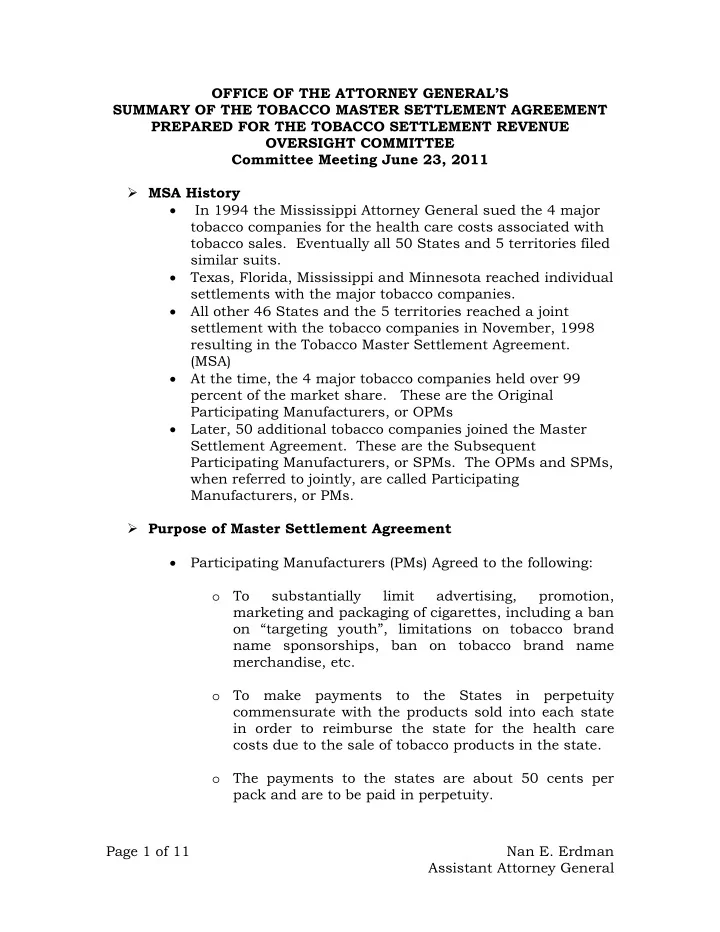
 In 1994 the Mississippi Attorney General sued the 4 major tobacco companies for the health care costs associated with tobacco sales. Eventually all 50 States and 5 territories filed similar suits.  Texas, Florida, Mississippi and Minnesota reached individual settlements with the major tobacco companies.  All other 46 States and the 5 territories reached a joint settlement with the tobacco companies in November, 1998 resulting in the Tobacco Master Settlement Agreement. (MSA)  At the time, the 4 major tobacco companies held over 99 percent of the market share. These are the Original Participating Manufacturers, or OPMs  Later, 50 additional tobacco companies joined the Master Settlement Agreement. These are the Subsequent Participating Manufacturers, or SPMs. The OPMs and SPMs, when referred to jointly, are called Participating Manufacturers, or PMs.

  • Purpose of Master Settlement Agreement

 Participating Manufacturers (PMs) Agreed to the following:

  • To

substantially limit advertising, promotion, marketing and packaging of cigarettes, including a ban

  • n “targeting youth”, limitations on tobacco brand

name sponsorships, ban on tobacco brand name merchandise, etc.

  • To make payments to the States in perpetuity

commensurate with the products sold into each state in order to reimburse the state for the health care costs due to the sale of tobacco products in the state.

  • The payments to the states are about 50 cents per

pack and are to be paid in perpetuity.

slide-2
SLIDE 2

Page 2 of 11 Nan E. Erdman Assistant Attorney General  States agreed to do the following:

  • Enact the Model Legislation, or a similar qualifying

statute, to charge an escrow payment to those tobacco manufacturers that are not participating in the MSA (NPMs).

  • Diligently enforce New Mexico’s statute enacted as 6-

4-12 and 6-4-13.

  • NEW MEXICO MSA-RELATED LEGISLATION

 In 1999, New Mexico passed the Escrows Statute, verbatim. The PMs agreed that we had “Qualifying Statute” status in

  • 1999. In this Statute, “units sold” was defined as being

determined by stamps on which excise tax is collected.  Additional MSA-related Legislation has been passed, including Complimentary Legislation (NMSA 6-4-14 thru 6- 4-24 2003). This statute provided the AG with stronger enforcement abilities.  In 2006, the Cigarette Tax Act was amended to require stamps on both excise-stamped products and exempt

  • products. A section was added to the Cigarette Tax Act that

said explicitly that “an exempt stamp is not an excise stamp, for purposes of “units sold” under the Tobacco Escrow Act, 6-4-12(j). This is now being challenged by the PMs.  In 2009, the PMs alleged that New Mexico was not collecting sufficient escrow due to tribal land sales of tobacco. New Mexico passed an exempt statute under which New Mexico could collect escrow on all sales in the state, whether they required an excise stamp or were exempt from tax.  In 2010, the Cigarette Tax Act was revised to include a Tribal Tax Credit Stamp, permitting tribes to charge a 75 cent tax

  • n all sales to non-tribal members, if they certified with the

department of Taxation and Revenue. The bill did not add the Tax Credit Stamp as a “unit sold” under the Escrow Act. It changed the language in the Cigarette Tax Act to state that neither exempt stamps nor a tribal tax credit stamps are

slide-3
SLIDE 3

Page 3 of 11 Nan E. Erdman Assistant Attorney General excise stamps, for purposes of “units sold” under the Tobacco Escrow Act, 6-4-12(j).

  • CHALLENGE TO NEW MEXICO’S QUALIFYING STATUTE

 The PMs now contend that New Mexico has not had a Qualifying Statute since 2006. We still have what is nearly an exact duplicate of the language set forth in the Model Statute proposed by the PMs in 1998. However, the PMs are claiming that changes to the Cigarette Tax Act made in 2006 to provide for exempt stamps had an impact on what New Mexico could collect escrow on. That language is the simple statement that an “exempt stamp is not an excise stamp, for purposes of “units sold”.  The New Mexico Attorney General’s Office does not agree that this language narrows the volume of cigarettes we were able to collect escrow on under the Model Statute. In fact, this language simply just affirmed the state of the Escrow Statute at the time.  We are confident that we still have a qualifying statute, but will have to expend resources to fend off this challenge. If we are found to not to have a qualifying statute, we are at much greater exposure for losing our MSA payment for 2006 forward.  If we are found to not have a Qualifying Statute, we will be subject to an NPM Adjustment, even if we diligently enforced, and no matter how well we diligently enforced. Since other states were doing much to diligently enforce by 2006, New Mexico would be one of few states who has to pay the NPM Adjustment for 2006 through the present, until we have a full calendar year with a Qualifying Statute (the soonest would be 2012, if we passed corrective legislation during the special session).

  • LEGISLATION PASSED TO SECURE THE MSA PAYMENTS WAS

VETOED BY GOVERNOR MARTINEZ.  Senate Bill 397, which passed both chambers by a comfortable margin in the 2011 session, would have made the possibility of any challenge to New Mexico’s Qualifying Statute very remote and unlikely to succeed. It also made it

slide-4
SLIDE 4

Page 4 of 11 Nan E. Erdman Assistant Attorney General substantially more likely that we could prevail in any NPM Adjustment proceeding.  Senate Bill 397 would have clearly established our ability to collect escrow on all sales that have a tribal stamp, excise stamp or an exempt stamp, as well as the legislatures intent to do so. The legislation had several advantages:

  • It would have made much clearer the State’s ability to

collect escrow from all NPMs that sell tobacco products in New Mexico, providing the state a means to repay

  • ur Medicaid system for the health care expenses

these products cost our state.

  • It would have enhanced our diligent enforcement

efforts by making it easier to collect escrow on a great portion of New Mexico sales.

  • It would have enhanced our standing in the NPM

Arbitration.

  • Payment Calculations

 Independent Auditor (PricewaterhouseCooper, or PwC) calculates and determines all payments owed under the MSA  Any dispute, controversy, etc. arising out of or relating to an Independent Auditor (IA) calculation or determination is submitted to binding arbitration.  Each year, New Mexico receives an MSA Payment based on

  • ur “Allocable Share” of the MSA payments, based on the

percentage of PM tobacco sales made into New Mexico. New Mexico’s Allocable Share of the MSA Payment is 0.5963897%

  • f the total PM payment, which on average is between $6

and $7 billion per year.  Because New Mexico took an active role in the initial 1996 litigation and subsequent settlement, we also get an extra percentage, from the “Strategic Contribution Fund.”  Each year, we receive 4 payments:

  • April 15 Allocable Share payment,
  • April 15 Strategic Contribution Fund payment
  • April 19 Allocable Share payment
  • April 19 Strategic Contribution Fund payment
  • (These payments are paid on two dates to give

the manufacturers time to confirm the correct payments amounts.

slide-5
SLIDE 5

Page 5 of 11 Nan E. Erdman Assistant Attorney General  Disputed Payment Accounting

  • If a PM wants to challenge the annual MSA payment, they

can withhold funding by either withholding the amount in dispute (subject to having to pay interest if they lose), place the funds in a Disputed Payment Account (DPA), where they get to retain some of the interest or pay the states the full amount in dispute.

  • Some PMs have chosen to pay the full amount due, and

not withhold any disputed amount. Instead, they pay the full amount, now, but have the state or states repay the disputed payment amount from future years’ MSA payments if the PM prevails in the dispute.

  • In recent years, more PMs are choosing to place disputed

funds into the disputed payment accounts. In 2011, nearly all PMs placed the optimal amount in the DPA.

  • MSA PAYMENTS NEW MEXICO HAS RECEIVED TO DATE

1999 $27,551,232.86 2000 $34,311,719.72 2001 $36,223,772.73 2002 $41,311,954.56 2003 $34,194,961.33 2004 $37,488,987.12 2005 $38,009,047.30 2006 $34,785,540.19 2007 $35,919,658.40 2008 $44,863,501.60 20091 $45,632,016.42 20102 $40,949,708.41 2011 $38,565,431.91

1 2009 was the first year Philip Morris chose to withhold funds as a

consequence of their potential diligent enforcement claim for 2009. These payments are placed in a Disputed Payment Account (DPA), in escrow, rather than made as an MSA payment

2 In 2010, the PMs made much more drastic payments into the DPA, and as a

result, our annual payment was much less than it would have been otherwise.

slide-6
SLIDE 6

Page 6 of 11 Nan E. Erdman Assistant Attorney General Total paid to NM as of 4-19-11 $489,807,532.55

  • WHY THE CONTINUING DISPUTES?

 THE NPM ADJUSTMENT  The PMs were concerned that the Master Settlement Agreement would decrease their historical 98% market share as a result of increases to cover the MSA payment.  To protect against this, they included a provision in the MSA where they would get a refund under a 4 step analysis: 1. The PMs lost over 2% in market share from 1998. 2. An independent Economics Firm determined, in a non-appealable proceeding, that the MSA was a “significant factor” in the PMs’ market share loss; If the first two factors are met, the PMs get an NPM Adjustment, unless the state meets the next two factors: 3. The State had a Qualifying Statute in place (one that fully and effectively neutralized the MSA for PM,

  • r was an exact copy of the Model Statute included in

the MSA), and

  • 4. The state “diligently enforced” that statute. Diligent

enforcement is measured by collecting escrow from the Non-Participating Manufacturers selling into the state, primarily to prevent the NPMs from gaining an unfair price advantage.  2003 NPM Adjustment National Arbitration  The PMs claim that they are entitled to an NPM Adjustment for every year from 2003 to the present.  All MSA states (except Montana) have been ordered by their State Courts to attend national arbitration to litigate the 2003 NPM Adjustment.

slide-7
SLIDE 7

Page 7 of 11 Nan E. Erdman Assistant Attorney General  For 2003 the PMs claim a market share loss of 8% as compared to 1998.  An independent Economics’ Firm made a determination that the MSA was a “significant factor” of the market share loss.  The Economics Firm also determined that the market share loss translated to approximately $500 million for 2003 alone.  Under the MSA, loss is trebled, for damages a total of $1.5 billion.  New Mexico expects the 2003 Arbitration to cost $500,000 in litigation expenses, including travel to hearings, transcripts, expert witnesses and document production costs.  We have not received an allocation from the legislature for the full costs as of this date.

  • Allocation of NPM Adjustment

 A state’s entire annual payment conceivably could be at risk depending on what other States’ annual payments are also subject to the NPM Adjustment. Thus, assuming

  • A $1.5 billion NPM Adjustment, and
  • Only 15 States are found not to have diligently

enforced,

  • The 15 States must pay the $1.5 billion, based on each

state’s market share, or up to the state’s full payment for the challenge year (2003). Those fifteen states would bear the entire NPM adjustment.

  • New Mexico’s potential exposure is $35 million

(our entire 2003 payment).

  • Future Year NPM Adjustments

 The PMs have already shown market share loss and received a “significant factor” finding for every year up to 2008 from the Economics Firm. We expect this trend to continue and for us to have to contest an NPM Adjustment in subsequent

  • arbitration. The 2003 NPM Adjustment Arbitration will set

many standards and precedent for the following years.

  • ISSUES AT STAKE IN ARBITRATION
slide-8
SLIDE 8

Page 8 of 11 Nan E. Erdman Assistant Attorney General  What is the meaning of “diligent enforcement”;  Will the standard vary from state to state?  Will states be pitted against each other?  Will enforcement efforts of one state become the “gold standard” for all states?  Will the states be able to rely on other states’ efforts or NAAG‘s enforcement efforts done on behalf of all states?  What is the meaning of “Units Sold” metric by which Escrow is assessed against NPMs:

  • Original Definition: Escrow will be collected on those

packs with state excise stamps applied, as measured by state excise tax collected.

  • State interpretation

 We claim that this should be read strictly, and that we did not have to collect escrow

  • n sales that were exempt from excise tax.

 The PMs claim we were obligated to collect escrow on every sale into the state, including exempt sales.  The PMs argue that even if we were allowed to not collect escrow on exempt sales, many exempt sales were not validly exempt, and we did not “diligently enforce” to ensure all exempt sales were on tribal property.

  • SUCCESSES:

 The New Mexico Attorney General’s Office has, for many years maintained its Tobacco Directory on its web page. Since 2008 significant improvements have been made to the directory so that it is accurate by being updated by this office immediately as changes are required, allowing for complete accuracy daily.  It is not uncommon to update more than once per day when

  • necessary. The directory can be viewed by accessing:

www.nmag.gov and then selecting “Tobacco Manufacturers Information”. In addition, all of the Attorney General’s required forms for PMs, NPMs and distributors to file are available to download from our website.

slide-9
SLIDE 9

Page 9 of 11 Nan E. Erdman Assistant Attorney General  Since 2003, this office has significantly reduced the number of non-compliant NPM sales made in New Mexico through

  • distributors. (Non-compliant sales are those cigarettes that

are not listed on our directory and therefore considered contraband). This is demonstrated by the following statistics showing the drop in non-compliant NPM sales each year. This represents the % of total NPM sales in the state that were non compliant and that were uncollectible. 2003 10.2% 2004 1.7% 2005 .2% 2006 .02% 2007

  • 0-

2008

  • 0-

2009

  • 0-

2010 .017%3 This is a big goal realized for the Attorney General’s Office.  Also since 2003, this office has filed eleven enforcement actions against manufacturers of non-compliant brands and has obtained judgments totaling approximately $2.8 million. Collection is nearly impossible due to the fact that some are no longer in business, were only in business a very short time, and most were manufacturing outside of the United States. In addition some are located in countries that are participants of the Hague Treaty and costs are exorbitant to comply with all the Treaty requirements. However, the actions themselves support our Diligent Enforcement efforts, since these suits tend to hamper other rogue manufacturers.  We previously reported the discovery of billions of cigarettes being shipped into New Mexico via various foreign trade zones. Suit is pending against the importer thought to be responsible for these sales. In addition, the same brand, along with several others, has recently been found at a tribal smoke shop, coming from another tribal entity out of state. Substantial sales of contraband cigarettes are being made to non-tribal members at the tribal store involved. The Attorney

3 One NPM failed to pay escrow in 2010 and has been sued for the unpaid amount due.

slide-10
SLIDE 10

Page 10 of 11 Nan E. Erdman Assistant Attorney General General’s Office has been working for approximately a year to confirm the source of the product. Because it is an ongoing investigation we will update the Committee at a later date.  This office continues to audit every licensed cigarette distributor’s monthly report. This encompasses the audit and review of approximately 480 returns annually. From these reports we are able to determine brand, manufacturer, retailer and tax status of all compliant brands sold in New Mexico.  It is our continued goal to provide consistent and timely responses to questions posed by distributors and manufacturers consistent with New Mexico law. We have very positive feedback from these efforts.

  • CONCERNS
  • 1. The Attorney General’s Office encourages distributors to file

their monthly reports in electronic format such as Excel so that calculations can be made more quickly than hand auditing every page. Some of our distributors’ reports are more than 100 pages of 8-pitch printed output. Currently Taxation and Revenue cannot accept electronic filing of these reports. It would be extremely helpful if the information were submitted electronically to both agencies.

  • 2. Constitutionality of HB 2 as relates to transfer of funds from the

Tobacco Permanent Fund into the unemployment compensation

  • fund. We recommend that a legislator request a formal opinion

from the Attorney General’s Office regarding this appropriation. It may be an inappropriate amendment to 6-4-9.

  • POTENTIAL SETTLEMENT

 The PMs have extended their second settlement offer in two years.  The deadline for a response to the settlement proposal is due July 1, 2011  An element of the settlement would be to pass legislation that has similar language to Senate Bill 397, and vetoed by Governor Martinez.

slide-11
SLIDE 11

Page 11 of 11 Nan E. Erdman Assistant Attorney General  The remainder of the legislation is more onerous and would impose stricter regulations associated with tribal sales.  Failure to pass the proposed legislation or to add substantial Diligent Enforcement Resources would result in very significant reductions in MSA Payments moving forward.