of the software The ultimate goal of all computer science failure - - PowerPoint PPT Presentation

of the software
SMART_READER_LITE
LIVE PREVIEW

of the software The ultimate goal of all computer science failure - - PowerPoint PPT Presentation

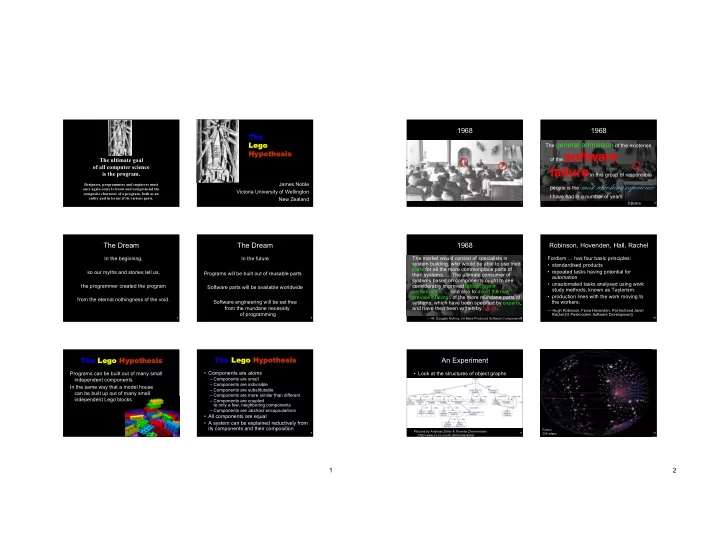
1968 1968 The Lego The general admission of the existence Hypothesis of the software The ultimate goal of all computer science failure in this group of responsible is the program. people is the most refreshing experience James Noble


slide-1
SLIDE 1

1

The ultimate goal

  • f all computer science

is the program.

Designers, programmers and engineers must

  • nce again come to know and comprehend the

composite character of a program, both as an entity and in terms of its various parts.

James Noble Victoria University of Wellington New Zealand

The Lego Hypothesis

3

The Dream

In the beginning, so our myths and stories tell us, the programmer created the program from the eternal nothingness of the void.

4

The Dream

In the future Programs will be built out of reusable parts Software parts will be available worldwide Software engineering will be set free from the mundane necessity

  • f programming
5

The Lego Hypothesis

Programs can be built out of many small independent components In the same way that a model house can be built up out of many small independent Lego blocks

6

The Lego Hypothesis

  • Components are atoms

– Components are small – Components are indivisible – Components are substitutable – Components are more similar than different – Components are coupled to only a few, neighboring components – Components are abstract encapsulations

  • All components are equal
  • A system can be explained reductively from

its components and their composition

2

7

1968

8

1968

The general admission of the existence

  • f the software

failure in this group of responsible

people is the most refreshing experience I have had in a number of years

Dijkstra

9

1968

The market would consist of specialists in system building, who would be able to use tried parts for all the more commonplace parts of their systems. … The ultimate consumer of systems based on components ought to see considerably improved reliability and performance, … and also to avoid the now prevalent failings of the more mundane parts of systems, which have been specified by experts, and have then been written by hacks.

  • -- M. Douglas McIlroy, {\it Mass Produced Software Components}
10

Robinson, Hovenden, Hall, Rachel

Fordism … has four basic principles:

  • standardised products
  • repeated tasks having potential for

automation

  • unautomated tasks analysed using work

study methods, known as Taylorism.

  • production lines with the work moving to

the workers.

  • -- Hugh Robinson, Fiona Hovenden, Pat Hall and Janet

Rachel,{\it Postmodern Software Development}

11

An Experiment

  • Look at the structures of object graphs

Pictures by Andreas Zeller & Thomas Zimmermann http://www.st.cs.uni-sb.de/memgraphs/

12

Python 20K edges

slide-2
SLIDE 2

3

13

gcc 80K edges

14

JDK 1.5 Hayden Smith, VUW

15

Work by Alex Potanin et al http://www.comp.vuw.ac.nz http://www.elvis.ac.nz

16

Power Law

  • Nk Rks
  • Highly Skewed
  • Mode
  • Median
  • Mean
  • Long Tail
  • Scale Free
17

Pascal

18

Linux & Java

Also Wheeldon+Counsell Valvarde+Solé

4

19 20 21 22

1968

There are of course many good systems, but are any of these good enough to have human life tied on-line to them, in the sense that if they fail for more than a few seconds, there is a fair chance of one or more people being

killed?

Brian Randell

23

A whole world of programs!

  • Fifty years of software
  • Thirty years of “software engineering"
  • Software is everywhere
  • But not the kind of software we imagined!
24

The Problem of Prime Numbers

“The task is to instruct a computer to print a table

  • f the first thousand prime numbers,

2 being considered the first prime number.”

E.W.Dijkstra, Notes on Structured Programming

slide-3
SLIDE 3

5

25

The Problem of Prime Numbers

“The task is to instruct a computer to print a table

  • f the first thousand prime numbers,

2 being considered the first prime number.”

E.W.Dijkstra, Notes on Structured Programming

26

The Problem of Prime Numbers How do we do this when we are not writing the first program in the world?

27 28 29 30

6

?

32

Postmodernity

. . that condition in which, for the first time, and as a result of

technologies which allow the large-

scale storage, access, and re-production of records of the past, the past appears to be included in the present.

Steven Conner, Cambridge Companion to Postmodernism

33

Lyotard

\vspace*{5mm} Recourse to grand

narratives is forbidden; …. But, as we have

seen, the “small narrative” is a form which superbly allows imaginative invention, and most of all in science.

34

Grand Narratives

  • Algorithmic computation — correctness
  • Algorithmic efficiency

ACM 2001 Computing Curriculum

  • Software that fails to meet these goals is

evidence of the moral weakness of its programmers Martin Rinard, OOPSLA Onward 2005

35

Little Narratives

How then do you make decisions? – Negotiation between various narratives – Open to the environment – Contingent, context dependent – No single correct answer Negotiation Local correctness

36

Eco

The job … is a trial and error

process, very similar to what

happens in an Oriental bazaar when you are buying a carpet. The merchant asks 100, you offer 10 and after an hour of bargaining you agree on 50.

http://www.themodernword.com/eco/eco_guardian94.html

slide-4
SLIDE 4

7

37

What does this mean for us?

Acceptability Aspects Scrap-Heap Glue Code Agile!

XP

Scripting

Wikis

Relations Patterns

Open Source

Mashup

No Big Picture

38

Extreme Programming

  • Customer and developers

negotiate over user stories

  • Iterate and Refactor
  • Build a system, not components
39

Scrap-Heap Programming

  • Programmers work bottom up…
  • From a Scrap-Heap
  • Starting with whatever they can

– Find – Scavenge – Steal – Google

  • Then work out what they can build
  • Then negotiate about requirements
40

Glue Programming

What’s at the end

  • f the power-law?

Lots of very small components Large components cannot be changed “Glue code” ties them together

41

radio.echoditto.com

http://www.yes2wind.co.nz

MASHUP

42

Perl

When I started designing Perl I lovingly reused features from many languages … from C, sh, csh, grep, sed, awk, Fortran, COBOL, PL/I, BASIC-PLUS, SNOBOL, Lisp, Ada, C++, and Python. To the extent that Perl rules rather than sucks, it's because the various features of these languages ruled rather than sucked.

Larry Wall

8

43

Design Patterns

  • Solution to a problem in a context
  • Small stories

about bits of designs

  • Patterns don’t build

complete, whole programs

44

Aspect-Oriented Design

class Lot { String designation; Section locality; MailDeliveryPostcode postcode; int incoming_mail_volume; RefuseCollection route; double refuse_load; double recycle;

45

Aspect-Oriented Design

aspect MailDelivery { MailDeliveryPostcode Lot.postcode; int Lot.incoming_mail_volume; } aspect RefuseCollection { RefuseCollection Lot.route; double Lot.refuse_load; double Lot.recycle; class Lot { String designation; }

46

Good Enough Software

“Why do you call me good?”

Good enough for what? For whom?

Software neither correct nor efficient

But “good enough” for context of use

XP - explicitly balances variables Acceptability-Orientation

End-to-end arguments

47

KLF

\item[Number One:] Every Number One song ever written is

  • nly made up from bits from other songs.

There is no lost chord. No changes untried. No extra notes to the scale or hidden beats to the bar. There is no point in searching for

  • riginality.

\\ ---Jimmy Caulty and Bill Drummond, \textit{The Manual}

48

KLF

So why don't all songs sound the same? Well, it's because although the chords, notes, harmonies, beats and words have all been used before their own soul shines through; their personality demands attention.

\\--- Jimmy Caulty and Bill Drummond, {\it The Manual}

slide-5
SLIDE 5

9

49

The Lego Hypothesis Revisited

  • Programs are built out of components

– But not Lego components – Concrete stuff, not abstractions

  • Old, new, borrowed, blue…
  • Components are not all equal
  • Interactions

interdependencies are highly complex

50

The Lego Hypothesis

In the beginning, so our myths and stories tell us, the programmer created the program from the eternal nothingness of the void.

51

The Lego Hypothesis

Today, we have a wide world of software Programs are built out of other programs Software Engineering is programming (in the widest sense) and much more besides

53

Credits

Co-conspirator Robert Biddle

Java Object Graphs Wrangler Alex Potanin & Hayden Melton Software Structure Wranglers Jerome Doleman & Nick Chapman Maths Wranglers Matt Visser & Marcus Frean Gareth Baxter