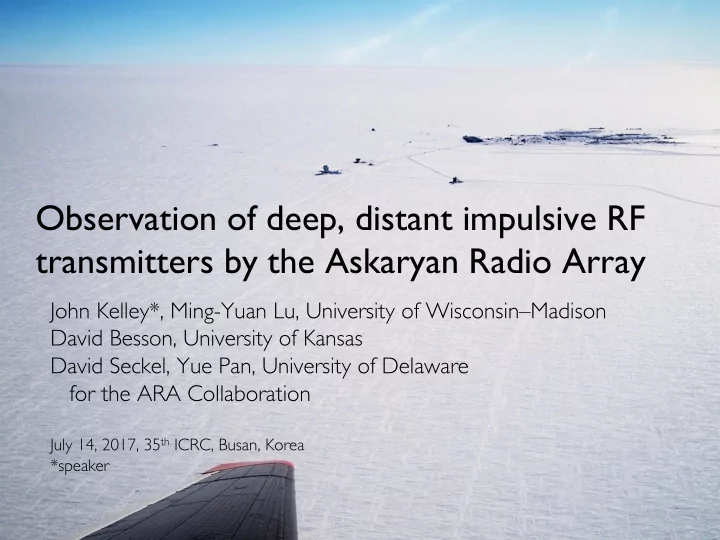
Observation of deep, distant impulsive RF transmitters by the - - PowerPoint PPT Presentation

observation of deep distant impulsive rf transmitters by
SMART_READER_LITE
LIVE PREVIEW

Observation of deep, distant impulsive RF transmitters by the - - PowerPoint PPT Presentation

Observation of deep, distant impulsive RF transmitters by the Askaryan Radio Array John Kelley*, Ming-Yuan Lu, University of WisconsinMadison David Besson, University of Kansas David Seckel, Yue Pan, University of Delaware for the ARA


slide-1
SLIDE 1

Observation of deep, distant impulsive RF transmitters by the Askaryan Radio Array

John Kelley*, Ming-Yuan Lu, University of Wisconsin–Madison David Besson, University of Kansas David Seckel, Yue Pan, University of Delaware for the ARA Collaboration

July 14, 2017, 35th ICRC, Busan, Korea *speaker

slide-2
SLIDE 2

Neutrino / Cosmic Ray Connections

  • Can neutrinos reveal origins
  • f ultra-high-energy cosmic

rays?

  • Cosmogenic neutrino flux on

CMB (Eν ~ 1018 eV)

  • Neutrinos generated in

accelerator region on photon background or in hadronic interactions (Eν ~ 1015 eV)

July 14, 2017

  • J. Kelley, 35th ICRC

2

pγ → pπ 0,nπ +

π + → µ+ + νµ µ+ → e+ + νe + νµ

slide-3
SLIDE 3

150 200 250 300 350 400

  • 1000
  • 500

500 1000

Radio Detection of Neutrinos

  • Many km2 target needed for

ultra-high-energy neutrino detection

  • Neutrino-induced showers in

dense media produce broadband radio pulses (Askaryan effect)

– detectable by radio antennas

  • Ice is RF-transparent and plentiful

in Antarctica

– O(km) attenuation lengths – ANITA (balloon), ARIANNA (Ross ice shelf), ARA (South Pole)

July 14, 2017

  • J. Kelley, 35th ICRC

3

ν

nucleus

particle cascade

bipolar pulse thermal noise

voltage (mV) time (ns) simulated 1018 eV neutrino event

slide-4
SLIDE 4

http://arxiv.org/abs/1507.08991 http://arxiv.org/abs/1404.5285 http://arxiv.org/abs/1105.2854 July 14, 2017

  • J. Kelley, 35th ICRC

4

Askaryan Radio Array (ARA)

slide-5
SLIDE 5

July 14, 2017

  • J. Kelley, 35th ICRC

5

ARA Station Layout

IceCube

Testbed

2 km

3 1 2

skiway South Pole Station South Pole

6 5 4

currently deployed 2017–18 deployment

slide-6
SLIDE 6

July 14, 2017

  • J. Kelley, 35th ICRC

6

Optics in South Pole Ice

  • Index of refraction a

function of depth (firn layer)

  • Radio waves bend away

from surface

  • Multiple paths possible

– quasi-direct (QD) – quasi-reflected (QR)

  • 500

500 1000 1500 2000 2500 1000 2000 3000 4000 5000 Depth ( Meters ) X Displacement ( Meters )

  • 500

500 1000 1500 2000 2500 Depth (meters) 1000 2000 3000 4000 5000 X Displacement (meters)

Raytrace paths (antenna at 200m depth) firn shadow

slide-7
SLIDE 7

July 14, 2017

  • J. Kelley, 35th ICRC

7

Deep Calibration Pulsers

ARA-2 top view TH TV BH BV Vpol pulsers in IceCube holes

slide-8
SLIDE 8

July 14, 2017

  • J. Kelley, 35th ICRC

8

Raytraced Radio Paths

total propagation time ~ 22 μs

IC-1 pulser ARA-2

3.6 km 1.4 km

slide-9
SLIDE 9

July 14, 2017

  • J. Kelley, 35th ICRC

9

Deep Pulser Event (IC-1 to ARA-2)

mV time (ns)

both pulses observed: QD (upgoing) and QR (downgoing)

slide-10
SLIDE 10

July 14, 2017

  • J. Kelley, 35th ICRC

10

Timing Analysis via Cross-correlation

  • Time-difference

analysis via cross- correlation of antenna signals

– four QD/QR pairs – peaks of Hilbert envelope

  • Observations

consistent with ice model raytracing

time difference (ns) cross-correlation (a.u.) top Vpol / bottom Vpol cross-correlation

slide-11
SLIDE 11

July 14, 2017

  • J. Kelley, 35th ICRC

11

Directional Reconstruction (QD only)

  • cross-correlation

reconstruction of QD pulses

– sum of CC pairs for all directions in sky – see also M.-Y. Lu NU080, JK poster

  • O(degree) directional

resolution

– distance reconstruction very difficult due to near-plane- wave timing

slide-12
SLIDE 12

July 14, 2017

  • J. Kelley, 35th ICRC

12

Distance Reconstruction with Both Pulses

  • QD+QR: stereoscopic view
  • f event allows vertex

reconstruction

  • Distance resolution of

O(100) m

  • Next step — event-by-

event reconstruction

– improvement in angular resolution also expected

pulser distance reconstruction

slide-13
SLIDE 13

July 14, 2017

  • J. Kelley, 35th ICRC

13

Hpol vs. Vpol Signals

TH TV

fraction of Hpol arrives ~30 ns early (also on-time cross-polarization)

mV time (ns)

slide-14
SLIDE 14

July 14, 2017

  • J. Kelley, 35th ICRC

14

Birefringence

  • consistent time delay across

events, antenna pairs

  • evidence of birefringence

– previously observed with near- vertical pulses in deep ice§ – order-of-magnitude of effect reasonable (~10-3)

  • next steps: fully understand

and model this effect

§Kravchenko et al., Astropart. Phys. 34, 10 (2011)

slide-15
SLIDE 15

July 14, 2017

  • J. Kelley, 35th ICRC

15

SPICE Hole Logging (2018)

  • two calibration pulsers lowered into ice core hole

to 1700m in January 2018

  • bservation by 6 ARA stations + ARIANNA-like

surface station

  • test n(z), birefringence, firn shadow model
  • layering / horizontal propagation?
slide-16
SLIDE 16

July 14, 2017

  • J. Kelley, 35th ICRC

16

Conclusions

  • Observation of deep calibration pulser events in ARA

– validates ice model, geometric optics paradigm

  • Reflected pulses allow distance reconstruction of distant event

– close events via direct ray timing (wavefront curvature)

  • Evidence of birefringence from Hpol signals

– potentially another handle on vertex distance

  • SPICE hole logging planned for this pole season

– refine model of index of refraction vs. depth – birefringence vs. depth, ice flow

slide-17
SLIDE 17

July 14, 2017

  • J. Kelley, 35th ICRC

17

Backup

slide-18
SLIDE 18

July 14, 2017

  • J. Kelley, 35th ICRC

18

Previous Measurements

slide-19
SLIDE 19

July 14, 2017

  • J. Kelley, 35th ICRC

19

Hpol/Vpol Cross-Correlations

s1:tv, s1:th, rays: {QD, QD}

  • 50

50 100 5000 10000 15000 20000 δt (ns) a.u.

Peak V-H correlation ● vs expected |
s2:tv, s2:th, rays: {QD, QD}

  • 50

50 100 1000 2000 3000 4000 5000 6000 7000 δt (ns) a.u.

Peak V-H correlation ● vs expected |

s3:tv, s3:th, rays: {QD, QD}

  • 50

50 100 5000 10000 15000 20000 δt (ns) a.u.

Peak V-H correlation ● vs expected |

s4:tv, s4:th, rays: {QD, QD}

  • 50

50 100 2000 4000 6000 8000 10000 12000 14000 δt (ns) a.u.

Peak V-H correlation ● vs expected |

s1:bv, s1:bh, rays: {QD, QD}

  • 50

50 100 5000 10000 15000 20000 25000 δt (ns) a.u.

Peak V-H correlation ● vs expected |

s2:bv, s2:bh, rays: {QD, QD}

  • 50

50 100 5000 10000 15000 δt (ns) a.u.

Peak V-H correlation ● vs expected |

s3:bv, s3:bh, rays: {QD, QD}

  • 50

50 100 5000 10000 15000 20000 δt (ns) a.u.

Peak V-H correlation ● vs expected |

s4:bv, s4:bh, rays: {QD, QD}

  • 100
  • 50

50 2000 4000 6000 8000 10000 δt (ns) a.u.

Peak V-H correlation ● vs expected |

s1:tv, s1:th, rays: {QR, QR}

  • 50

50 100 5000 10000 15000 20000 25000 δt (ns) a.u.

Peak V-H correlation ● vs expected |

s2:tv, s2:th, rays: {QR, QR}

  • 50

50 100 2000 4000 6000 8000 δt (ns) a.u.

Peak V-H correlation ● vs expected |

s3:tv, s3:th, rays: {QR, QR}

  • 500
  • 450
  • 400
  • 350
  • 1.0
  • 0.5

0.0 0.5 1.0 δt (ns) a.u.

Peak V-H correlation ● vs expected |

s4:tv, s4:th, rays: {QR, QR}

  • 50

50 100 150 5000 10000 15000 δt (ns) a.u.

Peak V-H correlation ● vs expected |

s1:bv, s1:bh, rays: {QR, QR}

  • 550
  • 500
  • 450
  • 400
  • 1.0
  • 0.5

0.0 0.5 1.0 δt (ns) a.u.

Peak V-H correlation ● vs expected |

s2:bv, s2:bh, rays: {QR, QR}

  • 100
  • 50

50 2000 4000 6000 8000 10000 12000 14000 δt (ns) a.u.

Peak V-H correlation ● vs expected |

s3:bv, s3:bh, rays: {QR, QR}

  • 250
  • 200
  • 150
  • 100
  • 1.0
  • 0.5

0.0 0.5 1.0 δt (ns) a.u.

Peak V-H correlation ● vs expected |

s4:bv, s4:bh, rays: {QR, QR}

  • 50

50 100 2000 4000 6000 8000 10000 δt (ns) a.u.

Peak V-H correlation ● vs expected |