Objectives Type Classes Describe the concept of polymorphism . Dr. - - PowerPoint PPT Presentation

objectives type classes
SMART_READER_LITE
LIVE PREVIEW

Objectives Type Classes Describe the concept of polymorphism . Dr. - - PowerPoint PPT Presentation

} int inc ( int i) { return i + 1.0; double inc ( double i) { } return i + 1; Objectives Type Classes Objectives Type Classes Objectives Type Classes Describe the concept of polymorphism . Dr. Mattox Beckman Show how to declare


slide-1
SLIDE 1

Objectives Type Classes

Type Classes

  • Dr. Mattox Beckman

University of Illinois at Urbana-Champaign Department of Computer Science

Objectives Type Classes

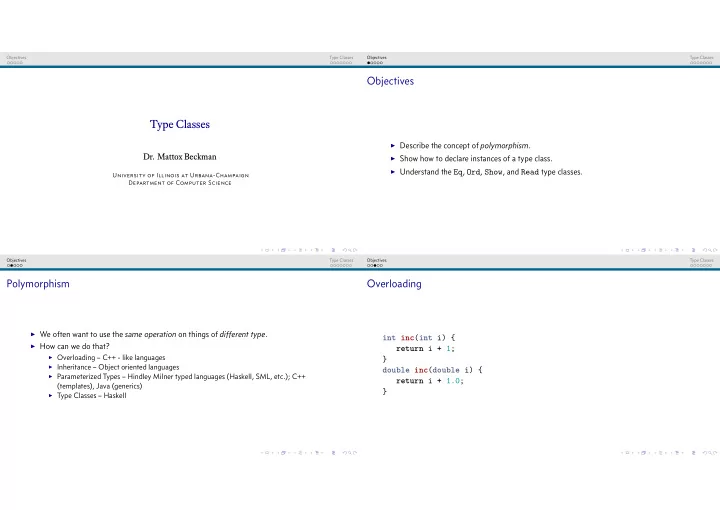
Objectives

◮ Describe the concept of polymorphism. ◮ Show how to declare instances of a type class. ◮ Understand the Eq, Ord, Show, and Read type classes.

Objectives Type Classes

Polymorphism

◮ We often want to use the same operation on things of different type. ◮ How can we do that?

◮ Overloading – C++ - like languages ◮ Inheritance – Object oriented languages ◮ Parameterized Types – Hindley Milner typed languages (Haskell, SML, etc.); C++

(templates), Java (generics)

◮ Type Classes – Haskell Objectives Type Classes

Overloading

int inc(int i) { return i + 1; } double inc(double i) { return i + 1.0; }

slide-2
SLIDE 2

Objectives Type Classes

Inheritance

public class Shape { public int loc_x,loc_y; } public class Square extends Shape { public int width,height; }

Objectives Type Classes

Parametric Polymorphism

public class List<E> { public E data; public List<E> next; } data Cons a = Cons a (Cons a) | Nil

Objectives Type Classes

The Eq Type Class

class Eq a where (==), (/=) :: a -> a -> Bool

  • - Minimal complete definition:
  • (==) or (/=)

x /= y = not (x == y) x == y = not (x /= y)

Objectives Type Classes

Using Eq

data Foo = Foo Int x = Foo 10 y = Foo 10

◮ If you try to compare these ...

*Main> x == y <interactive>:1:3: No instance for (Eq Foo) arising from a use of `==' Possible fix: add an instance declaration for (Eq Foo) In the expression: x == y In an equation for `it': it = x == y

slide-3
SLIDE 3

Objectives Type Classes

Use an Instance

instance Eq Foo where (==) (Foo i) (Foo j) = i == j

◮ Now if you try to compare these ...

*Main> let x = Foo 10 *Main> let y = Foo 10 *Main> x == y True

Objectives Type Classes

tl;dc

◮ Too long! Didn’t Code! ◮ Let Haskell do the work.

data Foo = Foo Int deriving Eq

Objectives Type Classes

The Ord Typeclass

class (Eq a) => Ord a where compare :: a -> a -> Ordering (<), (<=), (>), (>=) :: a -> a -> Bool max, min :: a -> a -> a compare x y = if x == y then EQ else if x <= y then LT else GT x < y = case compare x y of { LT -> True; _ -> False } x <= y = case compare x y of { GT -> False; _ -> True } x > y = case compare x y of { GT -> True; _ -> False } x >= y = case compare x y of { LT -> False; _ -> True } max x y = if x <= y then y else x min x y = if x <= y then x else y

Objectives Type Classes

The Show Typeclass

class Show a where show :: a

  • > String

instance Show Foo where data Foo = Foo Int

  • - one way ...

deriving (Show,Eq)

  • - other way ...

instance Show Foo where show (Foo i) = "Foo " ++ show i

slide-4
SLIDE 4

Objectives Type Classes

The Read Typeclass

{-# LANGUAGE ViewPatterns #-} import Data.List instance Read Foo where read (stripPrefix "Foo " -> Just i) = Foo (read i)

◮ Sample run ...

*Main> let x = "Foo 10" *Main> read it :: Foo Foo 10