Objectives State Describe the property of referential transparency - - PowerPoint PPT Presentation

objectives state
SMART_READER_LITE
LIVE PREVIEW

Objectives State Describe the property of referential transparency - - PowerPoint PPT Presentation

-- well, mostly Objectives Equational Reasoning References Objectives Equational Reasoning References Objectives State Describe the property of referential transparency . Dr. Mattox Beckman Explain how stateful computations


slide-1
SLIDE 1

Objectives Equational Reasoning References

State

  • Dr. Mattox Beckman

University of Illinois at Urbana-Champaign Department of Computer Science

Objectives Equational Reasoning References

Objectives

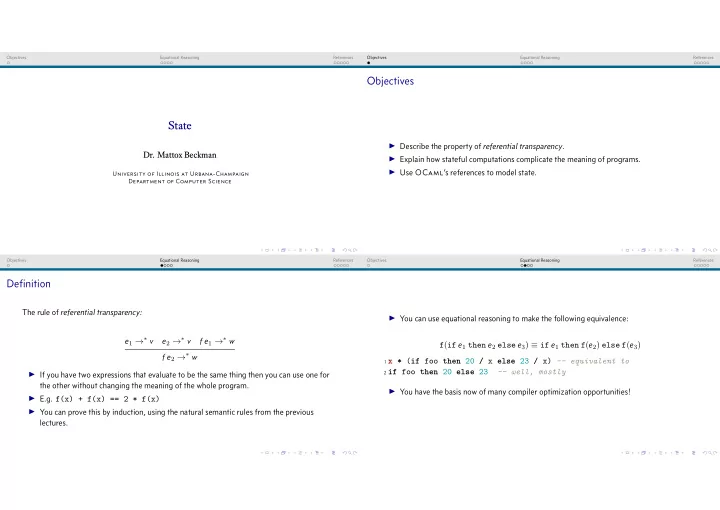
◮ Describe the property of referential transparency. ◮ Explain how stateful computations complicate the meaning of programs. ◮ Use OCaml’s references to model state.

Objectives Equational Reasoning References

Defjnition

The rule of referential transparency: e1 →∗ v e2 →∗ v f e1 →∗ w f e2 →∗ w ◮ If you have two expressions that evaluate to be the same thing then you can use one for the other without changing the meaning of the whole program. ◮ E.g. f(x) + f(x) == 2 * f(x) ◮ You can prove this by induction, using the natural semantic rules from the previous lectures.

Objectives Equational Reasoning References

◮ You can use equational reasoning to make the following equivalence: f(if e1 then e2 else e3) ≡ if e1 then f(e2) else f(e3)

1 x * (if foo then 20 / x else 23 / x) -- equivalent to 2 if foo then 20 else 23

  • - well, mostly

◮ You have the basis now of many compiler optimization opportunities!

slide-2
SLIDE 2

Objectives Equational Reasoning References

A Complication

1 # let counter = -- something 2 val counter : unit -> int = <fun> 3 # counter ();; 4 - : int = 1 5 # counter ();; 6 - : int = 2 7 # counter ();; 8 - : int = 3 9 #

◮ Can we still use equational reasoning to talk about programs now?

Objectives Equational Reasoning References

A Counterexample

◮ f(x) + f(x) == 2 * f(x)

1 # 2 * counter ();; 2 - : int = 8 3 # counter () + counter ();; 4 - : int = 11

◮ Congratulations. You just broke mathematics.

Objectives Equational Reasoning References

Reference Operator

Transition Semantics ref v → $i, where $i is a free location in the state, initialized to v. ! $i → v, if state location $i contains v. $i := v → (), and state location $i is assigned v. (); e → e Note that references are different than pointers: once created, they cannot be moved, only assigned to and read from.

Objectives Equational Reasoning References

Natural Semantics

e ⇓ v ref e ⇓ $i , where $i is a free location in the state, initialized to v. e ⇓ $i !e ⇓ v , if state location $i contains v. e1 ⇓ $i e2 ⇓ v e1 := e2 ⇓ () , and location $i is set to v. e1 ⇓ () e2 ⇓ v e1; e2 ⇓ v

slide-3
SLIDE 3

Objectives Equational Reasoning References

Counter, Method 1

1 # let ct = ref 0;; 2 val ct : int ref = {contents=0} 3 # let counter () = 4

ct := !ct + 1;

5

!ct;;

6 val counter : unit -> int = <fun> 7 # counter ();; 8 - : int = 1 9 # counter ();; 10 - : int = 2 Objectives Equational Reasoning References

Bad Things for Counter

ct is globally defjned. Two bad things could occur because of this.

  • 1. What if you already had a global variable ct defjned?

◮ Correct solution: use modules.

  • 2. The Stupid UserTM might decide to change ct just for fun.

◮ Now your counter won’t work like it’s supposed to! ◮ Now you can’t change the representation without getting tech support calls. ◮ Remember the idea of abstraction.

Objectives Equational Reasoning References

Conclusions about State

State is bad because: ◮ It breaks our ability to use equational reasoning. ◮ Users can get to our global variables and change them without permission. State is good because: ◮ Certain constructs are almost impossible without state (e.g., graphs). ◮ Our world is a stateful one.