Objectives You should be able to ... Macros and Metaprogramming - - PowerPoint PPT Presentation

objectives
SMART_READER_LITE
LIVE PREVIEW

Objectives You should be able to ... Macros and Metaprogramming - - PowerPoint PPT Presentation

" (x) (+ x " delta "))")) (concat "(defun " name ` (defun , name (x) (+ x , delta))) Introduction Macro systems Variable Capture Introduction Macro systems Variable Capture Objectives You should be able to ...


slide-1
SLIDE 1

Introduction Macro systems Variable Capture

Macros and Metaprogramming

  • Dr. Mattox Beckman

University of Illinois at Urbana-Champaign Department of Computer Science

Introduction Macro systems Variable Capture

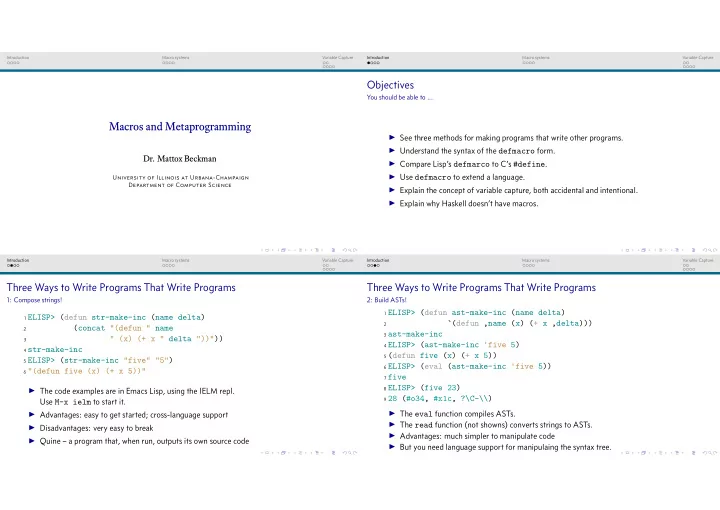
Objectives

You should be able to ...

◮ See three methods for making programs that write other programs. ◮ Understand the syntax of the defmacro form. ◮ Compare Lisp’s defmarco to C’s #define. ◮ Use defmacro to extend a language. ◮ Explain the concept of variable capture, both accidental and intentional. ◮ Explain why Haskell doesn’t have macros.

Introduction Macro systems Variable Capture

Three Ways to Write Programs That Write Programs

1: Compose strings!

1 ELISP> (defun str-make-inc (name delta) 2

(concat "(defun " name

3

" (x) (+ x " delta "))"))

4 str-make-inc 5 ELISP> (str-make-inc "five" "5") 6 "(defun five (x) (+ x 5))"

◮ The code examples are in Emacs Lisp, using the IELM repl. Use M-x ielm to start it. ◮ Advantages: easy to get started; cross-language support ◮ Disadvantages: very easy to break ◮ Quine – a program that, when run, outputs its own source code

Introduction Macro systems Variable Capture

Three Ways to Write Programs That Write Programs

2: Build ASTs!

1 ELISP> (defun ast-make-inc (name delta) 2

`(defun ,name (x) (+ x ,delta)))

3 ast-make-inc 4 ELISP> (ast-make-inc 'five 5) 5 (defun five (x) (+ x 5)) 6 ELISP> (eval (ast-make-inc 'five 5)) 7 five 8 ELISP> (five 23) 9 28 (#o34, #x1c, ?\C-\\)

◮ The eval function compiles ASTs. ◮ The read function (not showns) converts strings to ASTs. ◮ Advantages: much simpler to manipulate code ◮ But you need language support for manipulaing the syntax tree.

slide-2
SLIDE 2

Introduction Macro systems Variable Capture

Three Ways to Write Programs That Write Programs

3: Use a macro!

1 ELISP> (defmacro make-inc (name delta) 2

`(defun ,name (x) (+ x ,delta)))

3 make-inc 4 ELISP> (make-inc ten 10) 5 ten 6 ELISP> (ten 123) 7 133 (#o205, #x85, ?) 8 ELISP>

◮ This skips the eval step. ◮ But you need language support for macros.

Introduction Macro systems Variable Capture

Macros Are Lazy, Functions Are Usually Not

1 E> (defun my-if (test true false) 2

(if test true false))

3 my-if 4 E> (defun fact (n) (my-if (> n 0) (* n (fact (- n 1))) 1)) 5 fact 6 E> (fact 4) ;; Runs out of stack space

but ...

1 E> (defmacro my-if (test true false) 2

`(if ,test ,true ,false))

3 my-if 4 E> (defun fact (n) (my-if (> n 0) (* n (fact (- n 1))) 1)) 5 fact 6 E> (fact 4) 7 24 (#o30, #x18, ?\C-x) Introduction Macro systems Variable Capture

We Hate Boilerplate

1 (let ((handle (fopen "file.txt"))) 2

(try

3

... do stuff with file ...

4

(catch e (print "Yikes! and Error!"))

5

(finally (close handle)))) ◮ Most Lisps have macros to abstract this.

1 (with-open handle "file.txt" 2

... do stuff with file ...)

Introduction Macro systems Variable Capture

Domain Specifjc Languages

◮ Macros are used extensively in DSLs. ◮ Here is the html macro from Clojure’s hiccup package. ◮ Can handle

1 user> (html [:p [:a {:href "http://google.com"} "Google"] 2

"is not a verb."])

3 "<p><a href=\"http://google.com\">Google</a>is not a verb.</p>" 4 user> (html [:ul (for [i (range 3)] [:li i])]) 5 "<ul><li>0</li><li>1</li><li>2</li></ul>"

slide-3
SLIDE 3

Introduction Macro systems Variable Capture

We Like to Rewrite Code

◮ Lisp style macros are more powerful than C style macros. ◮ #define can only rearrange text. ◮ defmacro can perform arbitrary code rewrites!

1 ELISP> (subst '- '+ '(* 2 (+ 3 4))) 2 (* 2 (- 3 4)) 3 ELISP> (defmacro unplus (tr) (subst '- '+ tr)) 4 unplus 5 ELISP> (unplus (* 2 (+ 10 9))) 6 2 Introduction Macro systems Variable Capture

Unintended Capture

1 ELISP> (setq sum 10) 2 10 (#o12, #xa, ?\C-j) 3 ELISP> (defmacro mk-sum (a b) 4

`(let ((sum (+ ,a ,b)))

5

(list ,a ,b sum)))

6 mk-sum 7 ELISP> (mk-sum 2 3) 8 (2 3 5) 9 ELISP> (mk-sum 2 sum) 10 (2 12 12)

◮ We want to store the sum of the arguments, but we need a fresh variable.

Introduction Macro systems Variable Capture

Gensym

◮ gensym to the rescue!

1 ELISP> (gensym) 2 G99398 3 ELISP> (defmacro mk-sum (a b) 4

(let ((sum (gensym)))

5

`(let ((,sum (+ ,a ,b)))

6

(list ,a ,b ,sum))))

7 mk-sum 8 ELISP> (mk-sum 2 3) 9 (2 3 5) 10 ELISP> (mk-sum 2 sum) 11 (2 10 12) Introduction Macro systems Variable Capture

Anaphoric Macros

◮ Here is a pattern you see a lot.

1 ELISP> (defun open-exists (fname) 2

(if (file-exists-p fname)

3

(find-file fname)))

4 open-exists 5 ELISP> (open-exists "/asdf") 6 nil 7 ELISP> (open-exists "/tmp") 8 #<buffer tmp> 9 ELISP> (let ((the-buffer (open-exists "/tmp")) 10

(if the-buffer (buffer-name the-buffer)

11

"none")))

12 "tmp"

slide-4
SLIDE 4

Introduction Macro systems Variable Capture

Anaphoric if

1 ELISP> (defmacro a-if (cond then else) 2

`(let ((it ,cond))

3

(if it ,then ,else)))

4 ELISP> (a-if (open-exists "/tmp") 5

(buffer-name it) "nope.")

6 "tmp" 7 ELISP> (a-if (open-exists "/tm4444p") 8

(buffer-name it) "nope.")

9 "nope." Introduction Macro systems Variable Capture

Pattern Matching

◮ More frequently it’s better that we chose the variable names ourselves.

1 ELISP> x 2 (6 . 7) 3 ELISP> (defmacro match (thing pattern body) 4

`(let (( ,(car pattern) (car ,thing))

5

( ,(cdr pattern) (cdr ,thing)))

6

,body))

7 match 8 ELISP> (match x (a . b) (+ a b)) 9 13 (#o15, #xd, ?\C-m) Introduction Macro systems Variable Capture

Conclusions

◮ Most languages do not have a macro system! ◮ Haskell “doesn’t need one.”

◮ Monads / type classes wrap boilerplate. ◮ Laziness is already built in. ◮ There is a template Haskell though.

◮ Macros are diffjcult to reason about. ◮ Most programmers were never taught them. ◮ Work best in a homoiconic language.