Object-Oriented Design II - GRASP Controller Creator Indirection - - PowerPoint PPT Presentation

object oriented design ii grasp
SMART_READER_LITE
LIVE PREVIEW

Object-Oriented Design II - GRASP Controller Creator Indirection - - PowerPoint PPT Presentation

Object-Oriented Design II - GRASP Controller Creator Indirection Information expert High cohesion SWEN-610 Foundations of Low coupling Software Engineering Polymorphism Department of Software Engineering Rochester Institute of Technology


slide-1
SLIDE 1

SWEN-610 Foundations of Software Engineering

Department of Software Engineering Rochester Institute of Technology
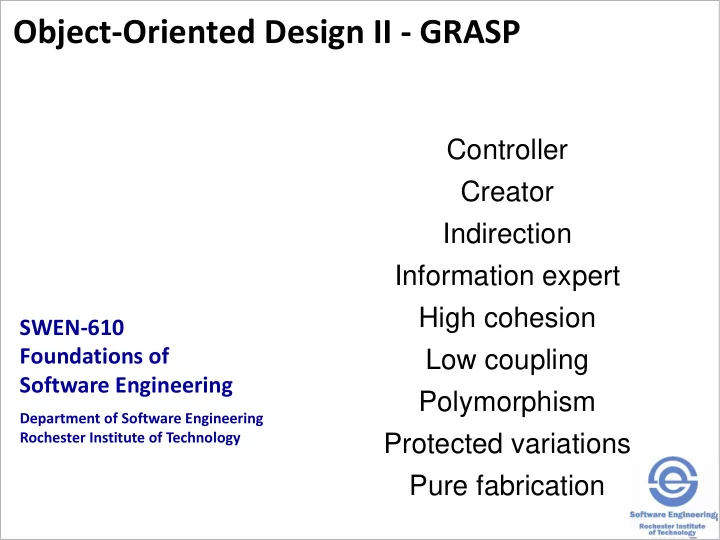
Object-Oriented Design II - GRASP

Controller Creator Indirection Information expert High cohesion Low coupling Polymorphism Protected variations Pure fabrication

slide-2
SLIDE 2

The lesson continues building your object-oriented design skills by looking at GRASP.

  • GRASP – General Responsibility Assignment

Software Patterns

  • Craig Larman, Applying UML and Patterns: An

Introduction to Object-Oriented Analysis and Design and Iterative Development

  • You can consider this set of nine design patterns

principles when designing your software systems.

2

slide-3
SLIDE 3

Some GRASP principles relate to or overlap with SOLID principles.

SOLID

  • Single Responsibility
  • Open/closed
  • Liskov substitution
  • Interface segregation
  • Dependency inversion

GRASP

  • Controller
  • Creator
  • Indirection
  • Information expert
  • High cohesion
  • Low coupling
  • Polymorphism
  • Protected variations
  • Pure fabrication

3

slide-4
SLIDE 4

This lesson will look at six GRASP principles.

GRASP

  • Controller
  • Creator
  • Indirection
  • Information expert
  • High cohesion
  • Low coupling
  • Polymorphism
  • Protected variations
  • Pure fabrication

4

slide-5
SLIDE 5

Low Coupling attempts to minimize the impact of changes in the system.

  • Note the unnecessary word. Coupling is needed in

your system.

  • Resist lowering coupling simply to reduce the

number of relationships.

  • A design with more relationships is often better than

the design with fewer relationships.

  • You need to balance all the design principles.
  • Beginning designers often place low coupling at the

top of their design principles list. It should be lower down!

5

Assign responsibility so that (unnecessary) coupling remains low.

slide-6
SLIDE 6

The Law of Demeter addresses unintended coupling within a software system.

  • Limit the range of classes that a class talks to
  • Each unit only talks to its friends; don't talk to

strangers.

  • Each unit only talks to its immediate friends; don't

talk to friends of friends

  • Chained access exposes each intermediate interface
  • From previous checkers project
  • board.getPieceAt(i,j).getType()  eliminate

violation of Law of Demeter and reduce coupling for this class, i.e. may not need to know about Piece

  • board.getPieceTypeAt(i,j)
  • If you need to talk to something "far away"
  • Get support from your friend, i.e. new method
  • Get a new friend, i.e. new direct relationship

6

slide-7
SLIDE 7

High Cohesion aims for focused, understandable, and manageable classes.

  • High cohesion leads to smaller classes with more

narrowly defined responsibilities.

  • This should be high on your list of design goals.
  • High cohesion will require coupling to more

classes to get work accomplished.

  • Do not be afraid of requiring a few more

relationships in the pursuit of improved cohesion.

7

Assign responsibility so the cohesion

  • f classes remains high.
slide-8
SLIDE 8

Information Expert looks to have behavior follow data.

  • The first place to consider placing behavior that

uses/processes attribute data is in the class that holds the attributes.

  • Instead of the client of Flight implementing this:
  • flt.getDestination().equals("JFK")
  • flt1.getOrigin().equals("ROC") && flt1.getDestination().equals("JFK")
  • flt.getArrival() < flt.getDeparture()
  • flt1.getArrival() + 60 < flt2.getDeparture()
  • Consider Flight as the Information expert
  • boolean Flight.originIs(String airportCode)
  • boolean Flight.destinationIs(String airportCode)
  • boolean Flight.itineraryIs(String originCode, String destinationCode)
  • boolean Flight.arrivesNextDay()
  • boolean Flight.canConnectWith(Flight flt, unsigned int minConnectTime)

8

Assign responsibility to the class that has the information needed to fulfill the responsibility.

Violates encapsulation and Law of Demeter.

slide-9
SLIDE 9

Polymorphism creates a hierarchy when related behavior varies by class.

  • Polymorphism is a primary object-oriented concept

and should be used whenever possible

  • Bad code smells that indicate a need for a class

hierarchy and polymorphism

  • Conditional that selects behavior based on a "type"

attribute

  • Use of instanceof or similar language constructs

9

Assign responsibility for related behavior that varies by class by using polymorphic behavior.

slide-10
SLIDE 10

Controller specifies a separation of concerns between the UI tier and other system tiers.

  • "Controller" is an overused term is software design.
  • In GRASP, this is not the view "controller" which is

firmly in the UI tier.

  • In simple systems, it may be a single object that

coordinates all system operations.

  • In more complex systems, it is often multiple
  • bjects from different classes each of which

handles a single operation.

10

Assign responsibility to receive and coordinate a system operation to a class outside of the UI tier.

slide-11
SLIDE 11

Here is how GRASP controllers fit into the software architecture.

11

UI Tier Appl Tier Model Tier Some Appl Tier class Some Model Tier class Appl Tier Model Tier View controllers work through these classes

Simple System More Complex System

UI Tier View controllers work through these classes

Operation Subsystem Operation Op1 Op2 Op3

slide-12
SLIDE 12

Pure Fabrication is sometimes needed to balance

  • ther design principles.
  • Your design should be primarily driven by the

problem domain.

  • Sometimes to maintain a cohesive design you will

need to create non-domain classes.

  • Consider the Guessing Game sample webapp
  • You could maintain the overall number of games

played and win ratio as static data in Game

  • To maintain Game as a cohesive class GameCenter

was created.

  • Operation Subsystem is another pure fabrication

12

Assign a cohesive set of responsibilities to a non-domain entity in order to support high cohesion and low coupling.