Obesity Prevention in American Children Blaire Jones | Arkansas - - PowerPoint PPT Presentation

obesity prevention in american children blaire jones
SMART_READER_LITE
LIVE PREVIEW

Obesity Prevention in American Children Blaire Jones | Arkansas - - PowerPoint PPT Presentation

Obesity Prevention in American Children Blaire Jones | Arkansas State University | blaire.jones@smail.astate.edu What is Childhood Obesity? Obesity is defined as an abnormal amount of fat accumulation that may impair a persons health.

slide-1
SLIDE 1

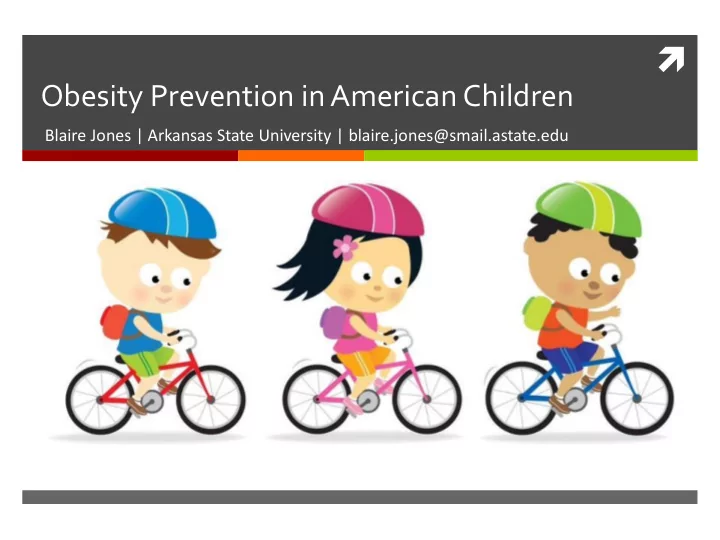
Obesity Prevention in American Children

Blaire Jones | Arkansas State University | blaire.jones@smail.astate.edu

slide-2
SLIDE 2

Obesity is defined as an abnormal amount of fat accumulation that may impair a persons health. Childhood Obesity is when a child’s Body Mass Index (BMI) is at

  • r above the 95th percentile for children of their age and sex.

When considering the child’s BMI, doctors go off of a health chart that takes in to consideration the child’s age, height and sex. When a child has a BMI that is in the 85th percentile or more, they are considered overweight. This is when actions should be taken.

What is Childhood Obesity?

slide-3
SLIDE 3

Body Mass Index Chart

slide-4
SLIDE 4

State Rankings

As of 2016, a study show that these are the top ten states who have the highest percentage of children diagnosed with obesity.

  • 1. Tennessee

37.7% overweight

  • 2. North Dakota

37.1% overweight

  • 3. Mississippi

37% overweight

  • 4. Florida

36.6% overweight

  • 5. Rhode Island

36.3% overweight

  • 6. Alabama

35.5% overweight

  • 7. West Virginia

35.1% overweight

  • 8. Louisiana

34% overweight

  • 9. Arkansas

33.9% overweight

  • 10. Indiana

33.9% overweight

slide-5
SLIDE 5

A closer look

  • Appearance
  • Oily skin
  • Excessive Acne
  • Early break outs
  • Acne on areas
  • ther than face
  • Stretch marks on skin
  • Hips
  • Legs
  • Fatty tissue deposition
  • Psychological
  • Low self-esteem
  • Depression
  • Gastrointestinal
  • Constipation
  • Acid Reflux
  • Other:
  • Early menstrual cycle in

girls

  • Before age 8
  • Delayed puberty in boys
  • Later than age 16
  • Shortness of breath
  • Flat feet
  • Sleep Apnea

Symptoms of Obesity in Children:

slide-6
SLIDE 6

Common Causes

Genetic Factors

  • Family History
  • Studies show that children of obese parents are most likely to become obese

Lack of Physical Activity

  • Advances in technology
  • Kids have phones/tablets at younger ages
  • Young boys prefer to play video games
  • Highly competitive sport teams
  • Coaches are teaching kids to win
  • Kids aren’t being taught how to have fun
  • Life Style
  • Children are not being taught how to be active
  • Children are not encouraged to go outside and play
slide-7
SLIDE 7

Common Causes

Medical Conditions

  • Hormonal Imbalances
  • Hypothyroidism
  • The child has an underactive thyroid
  • Polycystic ovary syndrome
  • Cysts on ovaries
  • Hypopituitarism
  • The pituitary gland does not make certain horomones

Unhealthy Eating Patterns

  • Busy Parents
  • Fast food
  • Parents are not taking the time to teach the importance of healthy eating
  • Children are not aware of the risks of unhealthy eating
  • They are learning habits early
slide-8
SLIDE 8

Negative Effects

  • Diabetes
  • 1/3 of obese children

have diabetes

  • Asthma
  • 1/3 of obese children

have asthma

  • Eating Disorders
  • 2/3 of obese children

have eating disorders

  • Hypertension
  • ¼ of obese children have

high blood pressure Diabetes 21% Asthma 21% Eating Disorder 42% High Blood Pressure 16%

Obesity Consequences out of 500 children

slide-9
SLIDE 9

How to prevent obesity

slide-10
SLIDE 10

Portion Control

Grains

  • 6-11 servings per day
  • About 8 ounces a day
  • 4 ounces should be

whole grain

  • Bread
  • Rice
  • Pasta

Fruits

  • 2-3 servings per day
  • About 12 ounces a day
  • Banana
  • Apple
  • Blueberry
  • Cucumbers

Vegetables

  • 2-3 servings per day
  • About 16 ounces a day
  • Spinach
  • Carrots
  • Peas
  • Corn

Protein

  • 2 servings per day
  • About 6 ounces a

day

  • Chicken
  • Turkey
  • Nuts
  • Fish

Dairy

  • 2-3 servings per day
  • About 24 ounces a day
  • Milk
  • Cheese
  • Yogurt

Sweets

  • 1 serving per day
  • 1 ounce a day
  • Cookies
  • Cakes
  • Brownies
slide-11
SLIDE 11

How to Teach Healthy Eating

Encourage Kids

  • Involve Kids in meals
  • Allow kids to help cook
  • Allow them to choose which foods to eat
  • Ask them what they would like you to cook
  • Encourage kids to play outside

Be a Role Model

  • Set a good example for kids to follow
  • If kids watch you eating unhealthy foods, they

will choose to eat unhealthy as well

  • Kids learn from watching
  • If parents are out and active daily, they will

choose to be as well

  • When parents portion meals, kids learn to

not overeat

slide-12
SLIDE 12

Childhood Obesity Foundation Food Guide for Children State Rankings Late Puberty Early Puberty Family Health Guide Symptoms and Causes Healthy Eating

Resources