Obesity in childhood Cathy Levy Public Health Programme Lead - - PowerPoint PPT Presentation

obesity in childhood
SMART_READER_LITE
LIVE PREVIEW

Obesity in childhood Cathy Levy Public Health Programme Lead - - PowerPoint PPT Presentation

Obesity in childhood Cathy Levy Public Health Programme Lead defining obesity in children defining obesity in children Body mass index (BMI) adjusted for age and gender Plotted on centile charts British 1990 Growth Reference (UK90)


slide-1
SLIDE 1

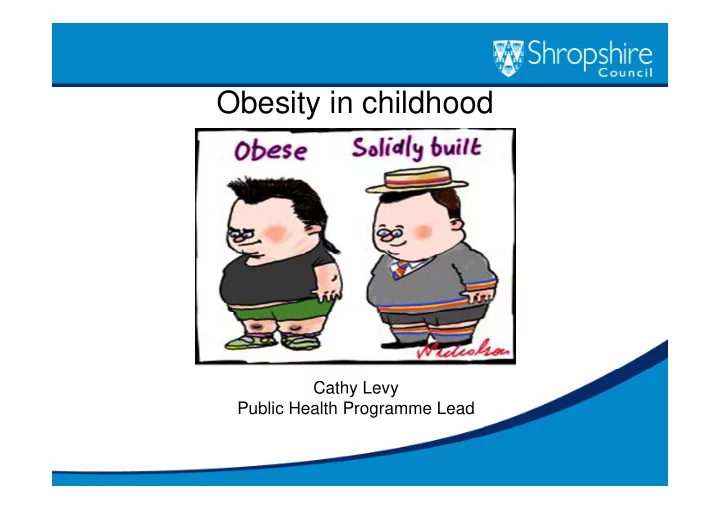
Obesity in childhood

Cathy Levy Public Health Programme Lead
slide-2
SLIDE 2

defining obesity in children defining obesity in children

  • Body mass index (BMI) adjusted for age and gender
  • Plotted on centile charts

British 1990 Growth Reference (UK90)

  • ≥91st centile = overweight
  • ≥98th centile = very overweight (obesity)
slide-3
SLIDE 3
  • besity puts children at greater risk of developing
  • besity puts children at greater risk of developing

cancer, type 2 diabetes and heart disease

  • ther health risks include early puberty, developing

eating disorders asthma teasing and discrimination eating disorders, asthma, teasing and discrimination by peers, low self-esteem, anxiety and depression 40% ‐ 70% of obese children become obese adults problems likely to develop earlier if overweight and

  • besity continue into adult hood
slide-4
SLIDE 4

National programmes

NCMP NCMP Healthy start

slide-5
SLIDE 5

NCMP

the annual measurement of the height and weight of children in reception year and Year 6 and the return of the children in reception year and Year 6, and the return of the data to the Health and Social Care Information Centre (HSCIC) ( SC C) Provides robust public health surveillance data on child weight status Provides parents with feedback on their child’s weight Provides parents with feedback on their child s weight status

slide-6
SLIDE 6

Healthy Start

UK-wide government scheme to improve the health of low-income pregnant women and families on benefits and tax credits

Healthy Start food vouchers

  • Means tested scheme for pregnant women or women with child under 4 years
  • Vouchers redeemable at local retailers against basic foods

g

  • One £3.10 voucher/week (two £3.10 vouchers/week for children under 1 year)

Healthy Start vitamins y

  • Pregnant women, women with a baby under 1 year and children from 6 months -

fourth birthday on Healthy Start receive vitamin coupons every 8 weeks

  • Vitamin tablets include Folic acid, Vitamins C and D
  • Vitamin drops include Vitamins A, C, D
slide-7
SLIDE 7

Tackling child obesity in Shropshire Shropshire

slide-8
SLIDE 8

Principles:

  • intervening and supporting children and families as early as

possible

  • targeting health inequalities
  • evidence based family centred approach to address lifestyle
  • evidence-based, family centred approach to address lifestyle

increasing physical activity reducing sedentary behaviour improving eating behaviour and quality of diet reducing energy intake improving emotional well-being improving emotional well being

  • sustainable behavioural change

through: environment change social marketing b h i h t behaviour change support

slide-9
SLIDE 9

access to support and local services that help children & th i f ili hi t i d b h i l h their families achieve sustained behavioural changes 1 t li d i i li k d t NCMP

  • 1st line advice service linked to NCMP
  • NCMP Proactive follow up
  • maternal weight
  • CYP weight management service
  • Healthy child programme
  • Eat Better Move More programme
slide-10
SLIDE 10

Healthy Weight Partnership Event Healthy Weight Partnership Event

Tuesday 26th November 2013 bringing together a wide range of stakeholders to build bringing together a wide range of stakeholders to build commitment for a healthy weight strategy for Shropshire will address the causes of obesity, impact on health, evidence for effective interventions, and opportunities for tackling obesity locally will present results of social marketing scoping work conducted locally, and the insights generated map local interventions against the evidence base

slide-11
SLIDE 11