
SLIDE 1
THE LEPTON SECTOR AS AN AXIOMATIC-LIKE CONSTRUCTION
- O. Kosmachev
O. Kosmachev INTRODUCTION Necessity of conversion to axiomatics. - - PowerPoint PPT Presentation
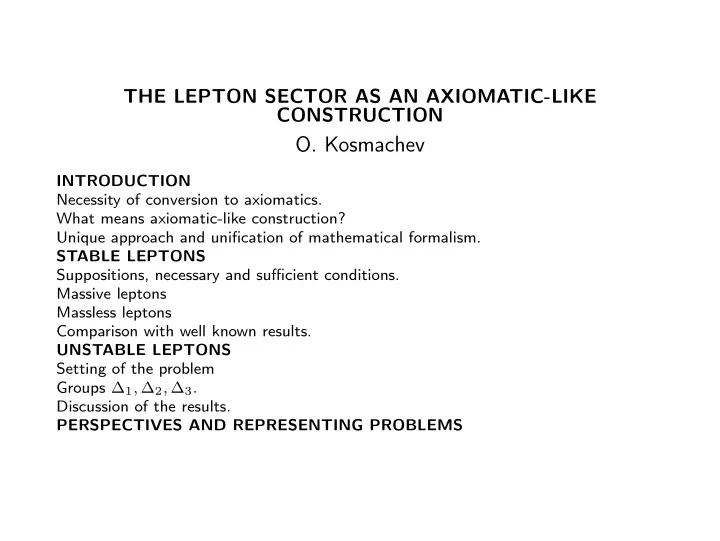
THE LEPTON SECTOR AS AN AXIOMATIC-LIKE CONSTRUCTION O. Kosmachev INTRODUCTION Necessity of conversion to axiomatics. What means axiomatic-like construction? Unique approach and unification of mathematical formalism. STABLE LEPTONS
1 the equations must be invariant and covariant under homogeneous Lorentz
2 the equations must be formulated on the base of irreducible representations of
3 conservation of four-vector of probability current must be fulfilled and fourth
4 the lepton spin is supposed equal to 1/2; 5 every lepton equation must be reduced to Klein-Gordon equation;
THE LEPTON SECTOR AS AN AXIOMATIC-LIKE CONSTRUCTIO
2]. Here a′ 2 = a2 · c,
2] = 2a′ 3,
2, a′ 3] = −2a1,
3, a1] = 2a′ 2,
3 ≡ a1a′
2] = 2a′ 3,
2, a′ 3] = −2a1,
3, a1] = 2a′ 2,
1, b′ 2] = −2a′ 3,
2, b′ 3] = 2a1,
3, b′ 1] = −2a′ 2,
1] = 0,
2, b′ 2] = 0,
3, b′ 3] = 0,
2] = 2b′ 3,
3] = −2b′ 2,
2, b′ 3] = −2b′ 1,
2, b′ 1] = −2b′ 3,
3, b′ 1] = 2b′ 2,
3, b′ 2] = 2b′ 1.
THE LEPTON SECTOR AS AN AXIOMATIC-LIKE CONSTRUCTIO
i, b′ k} = −2δik,
1, b′ 2] = 2a3,
2, b′ 3] = 2a1,
3, b′ 1] = 2a2,
1] = 0,
2] = 0,
3] = 0,
2] = 2b′ 3
3] = −2b′ 2,
3] = 2b′ 1,
1] = −2b′ 3,
1] = 2b′ 2,
2] = −2b′ 1,
THE LEPTON SECTOR AS AN AXIOMATIC-LIKE CONSTRUCTIO
1, b∗ k}pt = −2δ1k,
i , b∗ k}pt = 2δik,
2] = 2a′ 3,
2, a′ 3] = −2a1,
3, a1] = 2a′ 2,
1, b∗ 2] = 2a′ 3,
2, b∗ 3] = −2a1,
3, b∗ 1] = 2a′ 2,
1] = 0,
2, b∗ 2] = 0,
3, b∗ 3] = 0,
2] = 2b∗ 3
3] = −2b∗ 2,
2, b∗ 3] = −2b∗ 1,
2, b∗ 1] = −2b∗ 3,
3, b∗ 1] = 2b∗ 2,
3, b∗ 2] = 2b∗ 1.
THE LEPTON SECTOR AS AN AXIOMATIC-LIKE CONSTRUCTIO
k = ibk
2 = ia2.
1 The Dirac equation — Dγ(II): dγ, bγ, fγ,
2 The equation for a doublet of massive neutrinos — Dγ(I): dγ, cγ, fγ,
3 The equation for a quartet of massless neutrinos — Dγ(III): dγ, bγ, cγ, fγ,
4 The equation for a massless T-singlet — Dγ(IV ): bγ,
5 The equation for a massless P-singlet — Dγ(V ): cγ,
5 = −I.
4 = −I.
5 = −I.
ρ
Xi=1
i ) =
8 < :i ) - is a trace of i-matrix squared. In[D] — will be
4 = −1, s, t = 1, 2, 3
4 = 1, s, t = 1, 2, 3
4 = 1
1 = γ2 2 = 1, γ2 3 = −1,
4 = 1, s = 1, 2, 3.