NYSERDAs Experience with Market Based Energy and Environmental - - PowerPoint PPT Presentation

nyserda s experience with market
SMART_READER_LITE
LIVE PREVIEW

NYSERDAs Experience with Market Based Energy and Environmental - - PowerPoint PPT Presentation

NYSERDAs Experience with Market Based Energy and Environmental Policies Kevin Hale NYSERDA EMEP Conference October 14, 2009 Outline NYs Renewable Portfolio Standard Program Design and Results Regional Greenhouse Gas


slide-1
SLIDE 1

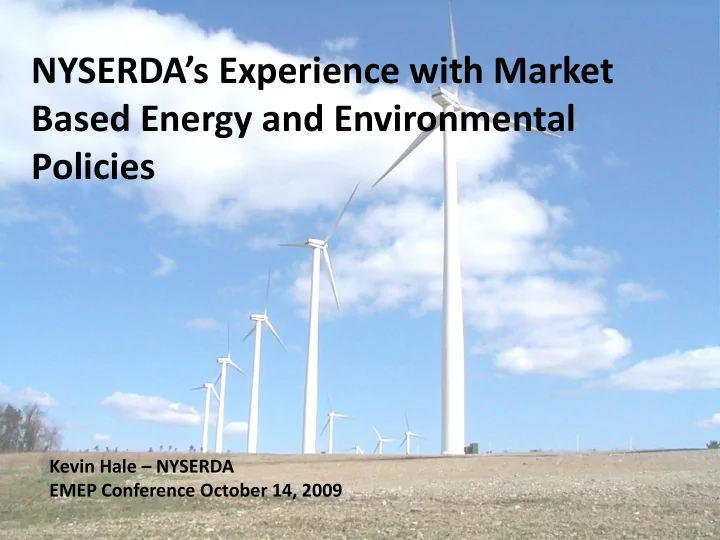
NYSERDA’s Experience with Market Based Energy and Environmental Policies

Kevin Hale – NYSERDA EMEP Conference October 14, 2009

slide-2
SLIDE 2

Outline

  • NY’s Renewable Portfolio Standard

Program

  • Design and Results
  • Regional Greenhouse Gas Initiative
  • Structure and Results
  • Summary
  • Look Forward
slide-3
SLIDE 3

Renewable Portfolio Standard

  • Goal: 25% of the power consumed in the state to come from

renewable sources by 2013

  • From the 2003 baseline of ~ 19.3%
  • NY RPS was adopted in 2004 as a policy goal to:
  • Stimulate economic development
  • Improve the environment
  • Pursue energy independence

Spier Falls Hydro

slide-4
SLIDE 4
  • Public Service Commission is responsible for program policy

and regulations

  • NYSERDA acts as central administrator of the NY RPS under a

two-tiered approach

  • Customer Tier, behind the meter applications such as

anaerobic digesters, solar and small wind

  • Main Tier, large generators that sell power to the

wholesale grid

  • Utilities are not subject to compliance

Unique RPS Design Features

slide-5
SLIDE 5

NY RPS Targets

  • Incremental 2013 requirement satisfied as follows:
  • Main Tier (NYSERDA)……………………………( 9.8 GWh )
  • Customer-Sited Tier (NYSERDA)…………….. ( .2 GWH )
  • Voluntary Green Retailing …………………….( 1.8 GWh )
  • State Agency Purchases…………………………… (3 GWh )

Total……………………………………..(12.1 GWh) Enough New Renewable Electricity to supply almost 2 million homes!

Feedstock at the Lyonsdale Biomass Plant

slide-6
SLIDE 6

RPS Main Tier Features

  • Eligibility: Projects or new fuel use after Jan. 2003, in-state

and out-of-state

  • Wind, biomass and other bio-fuels, hydroelectric upgrades
  • NYSERDA purchases renewable energy attributes (aka RECs)
  • Energy must be delivered to NYISO
  • Offer fixed-price REC contracts of up to 10 years
  • Prices are set competitively via Request for Proposals

(“RFPs”)

Maple Ridge Wind Farm

slide-7
SLIDE 7

Main Tier Results

Total New capacity (at end 2009) - approaching 1,400 MW Total available MWh annually - more than 3.5 million Facilities involved 1 - 30 projects/28 in New York Resource type 1 - 15 hydro/4 biomass/11 wind New capacity under contract - 1,164 MW RECs under contract annually -

  • approx. 2.9 million

About 1,300 MW of wind installed in New York…over 8,000 MW in pipeline … February 2009 milestone….1,000 MW of wind operating at system peak load

1 includes two maintenance resources

slide-8
SLIDE 8
slide-9
SLIDE 9
  • Estimated direct investment in New York: $2 billion

RPS Program Economic Benefits

* Over 20 year project life and do not include roll-

  • ver/multiplier effects and energy price suppression

benefits

Maple Ridge Wind Farm

slide-10
SLIDE 10
  • There is some level of fossil fuel displacement but……..

actual emissions reductions are difficult to track or quantify

  • Market prices for fuel
  • If each MWh in the RPS were to displace NY’s system mix
  • n a 1:1 basis, then NY would see estimated annual

reductions of:

  • 2,600 tons of nitrogen oxides
  • 5,200 tons of sulfur dioxides
  • 1.9 million tons of CO2

RPS Program Environmental Benefits

slide-11
SLIDE 11

Regional Greenhouse Gas Initiative (RGGI)

  • 10 states
  • Cap and reduce carbon

emissions via compliance mechanisms

  • NYS DEC
  • Focus on power sector
  • 25% of NYS’s GHG

emissions

  • First mandatory market-

based CO2 reduction program in the US

slide-12
SLIDE 12

RGGI Goals

  • Reduce CO2 emissions from the power sector
  • Provide consumers with benefits
  • Support a green economy
  • Encourage investments in low- or non-carbon emitting

technologies

  • Advancing clean energy technologies
  • Provide a template for a national program to reduce greenhouse

gases

Steel Winds Wind Farm

slide-13
SLIDE 13

RGGI Reduction Requirements

  • Compliance started in 2009
  • Stabilize CO2 emissions at current levels through 2014
  • Total reduction of 10% by 2019 compared with 2009 cap

155,000,000 160,000,000 165,000,000 170,000,000 175,000,000 180,000,000 185,000,000 190,000,000 2009 - 2014 2015 2016 2017 2018

RGGI Annual Cap 2009 - 2018 (tons)

slide-14
SLIDE 14

Structure of RGGI

RGGI, Inc. RGGI, Inc. is a private, non-profit corporation which provides technical and administrative services to implement each state’s CO2 Budget Trading Program Program Specifics  MOU: States commit to auction minimum of 25%, dedicate proceeds to consumer benefits  In Practice: Most states auction close to 100%, dedicate vast majority of proceeds to energy efficiency, renewable energy  Compliance: Emitters must possess enough allowances to cover their emissions within each three-year compliance period  Allowance Banking: Unused allowances can be carried over from one compliance period to the next  Offsets: Compliance entities can use verified

  • ffset allowances to meet 3.3 percent of their

compliance obligation CO2 Budget Trading Programs Are defined by independent state statutes and regulations and based on the Model Rule Function, in aggregate, as a single regional compliance market

slide-15
SLIDE 15

Returning the Value of Allowances to Consumers

State investments in consumer benefit programs:

  • Help consumers control energy costs
  • Drive further reductions in GHGs
  • Reduce and manage energy demand
  • Stimulate clean energy economy and create green jobs
  • Complement NY’s long-term energy and environmental

goals

  • RPS and Energy Efficiency Portfolio Standard
slide-16
SLIDE 16

Goal of the RGGI Auction Program: Ensure that all parties have access to allowances under fair & uniform terms

  • The RGGI auctions:
  • Are regional, uniform and include all ten states
  • Are held quarterly
  • Offer allowances from current and future control period vintages
  • Use a reserve price of $1.86 per ton
  • Are open to all who apply and qualify
  • Include a Notice and Qualification process that facilitates efficient

administration and ensures market oversight

About RGGI Auctions

slide-17
SLIDE 17

Auction: Auction 1 Auction 2 Auction 3 Auction 4 Auction 5 2009v Price $3.07 $3.38 $3.51 $3.23 $2.19 2012v Price __ __ $3.05 $2.06 $1.87 Potential Bidders 82 84 63 67 58 Total Proceeds (Millions) $38.6 $106.5 $117.2 $104.2 $66.3 NY Proceeds (Millions) __ $42.0 $46.0 $40.0 $27.4

RGGI Auction Results

slide-18
SLIDE 18

CO2 Allowance Auction Program 21 NYCRR Part 507

NYSERDA’s rule (Part 507.4(d)) states that proceeds from the sale of allowances will be used to: “. . . promote and implement programs for energy efficiency, renewable or non-carbon emitting technologies, and innovative carbon emissions abatement technologies with significant carbon reduction potential.”

slide-19
SLIDE 19
  • Residential, Commercial, Industrial (On-site Energy Use)
  • Power Supply and Delivery
  • Transportation
  • Agriculture, Forestry and

Waste Management

  • Multidisciplinary Initiatives
  • Climate change research and

analysis

Program Funding Target Areas

Browns Falls Hydro

slide-20
SLIDE 20

The RPS and RGGI have resulted in:

  • Approximately $2 billion in clean energy investments for

1,400 MW of new renewable capacity

  • 11 wind, 15 hydro upgrades, and 4 biomass applications
  • Five successful RGGI auctions which:
  • Have raised over $155 million for NY
  • Attracted over 100 different bidders – including electric

utilities, manufacturers, financial institutions, environmental groups, and individuals

  • Created a vibrant and active secondary market for CO

CO2 allowances

Summary

slide-21
SLIDE 21

Pending Federal Energy and Environmental Initiatives

Example: American Clean Energy and Security Act 2009

  • Increase renewable energy content from 6% of retail electric

sales in 2012 to 25% in 2025

  • Establishes cap and trade program -reduce greenhouse gas

emissions beginning in 2012 (83% of 2005 emissions by 2050). EPA to administer auction of allowances.

  • State cap and trade programs are preempted beginning in
  • 2012. RGGI allowances issued before 2012 can be exchanged

for federal allowances.

slide-22
SLIDE 22

What does all this policy action mean?

It depends on one’s perspective…

  • If you are concerned with economic development in New York…. It’s likely

less in-state renewables will be installed here under a federal RPS program

  • If you are concerned with ratepayer costs, then a federal program might

lower NY RPS obligations

  • If you are concerned with climate change, you might be indifferent to

location of renewable resources…if you are interested more in local environmental benefits, then a federal RPS might not be as desirable

  • If you were counting on carbon allowance proceeds to drive additional

investment in renewables in New York, you would need to concern yourself

  • n how EPA distributes federal cap & trade program revenues and what

qualifies for support

slide-23
SLIDE 23

Policy Outlook: Promising But is it Sufficient ?

Increased deployment of clean energy technologies faces further challenges…not insurmountable …but real nonetheless.

Technology Infrastructure Market Political

Clinton Wind Farm

slide-24
SLIDE 24

Fenner Wind Project, Madison County, NY

Contact Information: Kevin Hale New York State Energy Research and Development Authority Email: kch@nyserda.org USA phone: 518-862-1090 ext. 3266 Informational Websites: www.rggi.org www.nyserda.org www.dec.ny.gov

For More Information