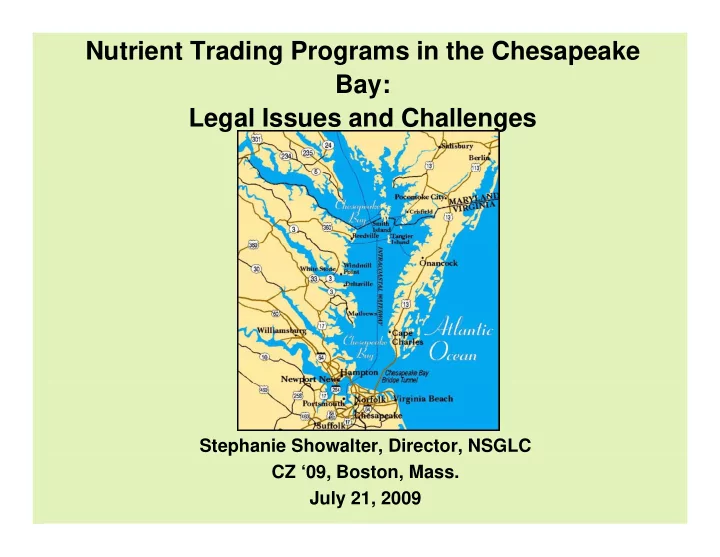
SLIDE 1 Nutrient Trading Programs in the Chesapeake Bay: Legal Issues and Challenges
Stephanie Showalter, Director, NSGLC p , , CZ ‘09, Boston, Mass. July 21, 2009
SLIDE 2
Water Quality (Nutrient) Trading y ( ) g
Market-based instruments that create a market for the buying and selling of “pollution” credits.
Primarily nitrogen and phosphorus.
Water Quality Trading Red Flags:
No clear statutory authority Unregulated sources generating majority of credits Technically challenging
SLIDE 3
CWA Basics
CWA goal is “to restore and maintain the h i l h i l d bi l i l i t it f chemical, physical, and biological integrity of the Nation’s waters.” Di h f ll t t f i t i t Discharge of pollutant from a point source into waters of the U.S without a permit is prohibited prohibited. Points sources are required to met: Technology based effluent limitations Technology-based effluent limitations Water quality-based effluent limitations, where necessary to achieve water quality where necessary to achieve water quality standards.
SLIDE 4
Role of the States Role of the States
Establish water quality standards (WQS) that include designated uses for each waterbody in the state and water quality criteria (WQC). Identify waters which are not meeting WQS on an impaired waters list For such waters, states must establish a Total Maximum Daily Load [TMDL] for each pollutant. Set “load” (max. amount of pollutant waterbody can receive) and allocate among existing so rces sources.
SLIDE 5
CWA & THE CHESAPEAKE BAY
Chesapeake 2000 Agreement
Partners agreed to clean up Bay by 2010 so it could Partners agreed to clean up Bay by 2010 so it could be removed from “impaired waters” list.
W t Q lit St d d Water Quality Standards
Water Quality Criteria and designated uses set States incorporate new WQC into WQS States incorporate new WQC into WQS
Load Allocations
Nitrogen, phosphorus, and sediment reduction goals. Target loads allocated by basin Tributary strategies developed by states
SLIDE 6 PA’s Tributary Strategy y gy
In December 2006, Pennsylvania approve a policy to allow point sources of pollution to offset pollution allow point sources of pollution to offset pollution discharges by purchasing “credits” from other facilities
Necessary reductions allocated between point and nonpoint sources within each major basin.
27 000 lb h h h tf ll ld b d b POTW 27,000 lb phosphorus shortfall would be made up by POTWs through trading program.
Concerns:
Trading Ratio 1:1 Generation of credits via land use conversion.
Legal Challenge: Borough of Bedford v. PA DEP
Summary judgment denied on Apr. 14, 2009. Case ongoing.
SLIDE 7
MD’s Policy for Nutrient Cap Management and Trading Phase Management and Trading - Phase I
Finalized April 17 2008 Finalized April 17, 2008 Trading between point sources and trading involving removal of septic tanks. involving removal of septic tanks.
Phase II (currently under development) will address point source to nonpoint source trading.
U i A t Unique Aspects:
All wastewater treatment plants must upgrade to technology capable of reducing wastewater technology capable of reducing wastewater concentrations to 4 milligrams per liter total N and .3 milligrams per liter total P. 5% retirement ratio applied to each point source 5% retirement ratio applied to each point source generated credit. Credit for retiring septic systems.
SLIDE 8 VA’s General Permit for Nutrient Trading
Effective Aug. 7, 2008 New and expanding facilities discharging 40,000 gallons or more per day must offset gallons or more per day must offset. Trading ratio for point/nonpoint trades of 1:2 (two pounds reduced for every pound discharged). p y p g )
Must achieve reductions beyond those already required or funded under federal or state law.
Credits can be obtained through payments made to Credits can be obtained through payments made to Virginia Water Quality Improvement Fund, if facility unable to acquire sufficient credits from other f iliti i t ib t facilities in same tributary.
$11.06 for lb. N and $5.04 lb. P
SLIDE 9
Does the CWA allow Offsets?
44 C.F.R. 122.4(i) prohibits the issuance of a
permit “to a new source or a new discharger, if the discharge from its construction or operation will cause or contribute to the violation of water quality standards ” quality standards. Further prohibits discharges into waters not meeting WQS unless: meeting WQS unless:
There are sufficient remaining pollutant load allocations to allow for the discharge; and g The existing dischargers into that segment are subject to compliance schedules designed to bring the segment into compliance with applicable water the segment into compliance with applicable water quality standards.
SLIDE 10 In re City of Annandale
Minnesota Supreme Court upheld permit issued to new wastewater treatment to new wastewater treatment.
MPCA determined would not “contribute” to violation
- f WQS because another plant in in area would be
- f WQS because another plant in in area would be
upgrading facility and reducing discharge. “The phrase ‘cause or contribute to the violation of p water quality standards’ leaves leeway for MPCA to make a range of policy judgments based on MPCA’s i tifi d t h i l k l d ” scientific and technical knowledge.” “Nothing in the language of the regulation or the structure of the CWA prohibits the MPCA from structure of the CWA prohibits the MPCA from considering offsets in this situation.”
SLIDE 11
Friends of Pinto Creek v. EPA
EPA issued permit authorizing discharges of copper into an impaired water. pp p Ninth Circuit vacated permit. p
“Nothing in the CWA or the regulation [] provides an exception for an offset when the waters remain impaired and the new source is discharging impaired and the new source is discharging pollution into that impaired water.” 122.4(i)(2) exception does not apply unless new source can demonstrate how water quality source can demonstrate how water quality standard will be meet if discharge is allowed.
U.S. Supreme Court denied cert Jan. 12, 2009.
SLIDE 12 Other Concerns
Anti-backsliding
CWA “bars the renewal, reissuance or modification
- f a permit which contains an effluent limitation that
is less stringent than those contained in the previous permit.”
Add i U t i t Addressing Uncertainty
Uncertainty ratios Monitoring Monitoring Reserve Credit Pools
Enforcement and Compliance
SLIDE 13
Risk Allocation
Contracts can be used to shift some legal responsibility to nonpoint sources responsibility to nonpoint sources.
Terms and conditions; Monitoring and verification procedures; g p ; Penalties for noncompliance.
Remedies for Breach of Contract
Money damages Specific Performance Rare Specific Performance - Rare “Special or unique nature” Protect public interest Public nuisance
SLIDE 14
Questions???? Q
Stephanie Sho alter Director Stephanie Showalter, Director National Sea Grant Law Center University of Mississippi University of Mississippi Kinard Hall – Wing E, Room 256 University MS 38677 University, MS 38677 (662) 915-7775 (662) 915 7775 sshowalt@olemiss.edu @