Numerical Modelling of the cloudaerosol interactions for VOCALS - - PowerPoint PPT Presentation

numerical modelling of the cloud aerosol interactions for
SMART_READER_LITE
LIVE PREVIEW

Numerical Modelling of the cloudaerosol interactions for VOCALS - - PowerPoint PPT Presentation

Numerical Modelling of the cloudaerosol interactions for VOCALS Mirek Andrejczuk, Alan Gadian & Alan Blyth Model Validation LWC profiles Also see plots on the poster for solution sensitivity to aerosol distribution and solution


slide-1
SLIDE 1

Numerical Modelling of the cloud–aerosol interactions for VOCALS

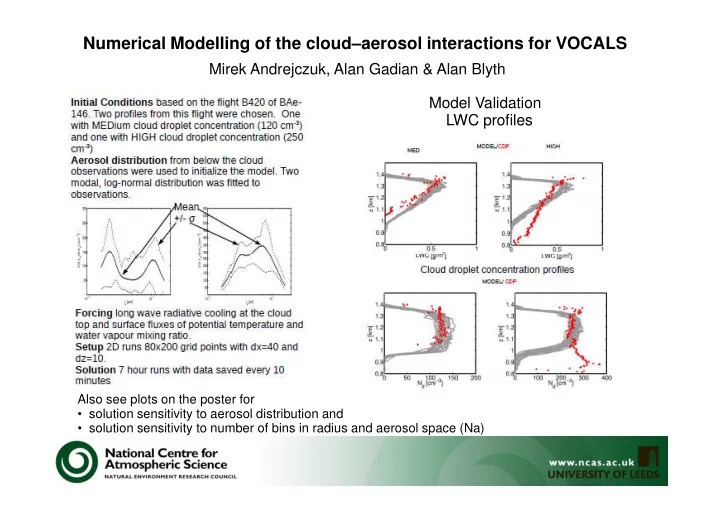
Mirek Andrejczuk, Alan Gadian & Alan Blyth Model Validation LWC profiles

Also see plots on the poster for

  • solution sensitivity to aerosol distribution and
  • solution sensitivity to number of bins in radius and aerosol space (Na)
slide-2
SLIDE 2

Numerical Modelling of the cloud – aerosol interactions for VOCALS

See: Andrejczuk et al (2008) JGR 2007JH009445 : Andrejczuk et al (2010) JGR 2010JD014248 : plus 2 in preparation

Conclusions ( some of ) :

  • Lagrangian representation of the microphysics can predict the observed LWC and

cloud droplet concentration.

  • CDN and Qc are more sensitive to the uncertainty in the initial conditions (aerosol

distribution) than to the number of bins in the Eulerian collision grid.

  • Cloud droplet spectrum depends on the number of bins used in the collision grid.
slide-3
SLIDE 3

WRF was used, initialised with GFS analyses, 00:00Z 12 Nov., and compare with B420, Nov. 13 2008. Sensitivity studies with: (a) 36,81,121 levels: (b) Resolution of 9km, outer and 3km inner: (c) Microphysics (Kessler, Thompson, Morrison) . (d) Land surface and boundary layer: (R) Plein-Xiu/Noah/ACM2: (SF1) Monin-Obukov / thermal diffusion / YSU: (SF2) Monin-Obukov (ETA) / thermal diffusion / MYJ TKE.

Numerical modelling of stratocumulus over the South-East Pacific with WRF

Mirek Andrejczuk, Alan Gadian & Ralph Burton Look at the poster to see model profiles compared with observations.

slide-4
SLIDE 4

Numerical modelling of stratocumulus over the South-East Pacific with WRF

Also vertical velocity plots shown in the poster

slide-5
SLIDE 5

Holes Formation Conclusions:

  • Holes in clouds are created as a result of mixing of the dry and warm, free

atmospheric air with the cloud, with the mixing forced by subsidence.

  • Precipitation limits the amount of water (Liquid Water Path) in the profile, but

ends ~ 2 hours before the cloud free region develops.

  • Subsidence must be strong enough (more than 3 cm/s for 9km resolution)

and last long enough to lead to a cloud free profile. Numerical modelling of stratocumulus over the South-East Pacific with WRF and last long enough to lead to a cloud free profile.

  • Holes are created for the combination of the land surface / boundary layer

parametrizations as in R only. For the SF1 ( YSU) and SF2 (MYJ TKE), the cloud free region does not form, but there is a drop in LWP near 19W, 80S. There are underlying LWP structure differences between observations and model results, and there are ni cumulus like circulations inside the cloud free region.