Nuclear localization of Cdk5 is a key determinant in the postmitotic - - PowerPoint PPT Presentation

nuclear localization of cdk5 is a key determinant in the
SMART_READER_LITE
LIVE PREVIEW

Nuclear localization of Cdk5 is a key determinant in the postmitotic - - PowerPoint PPT Presentation

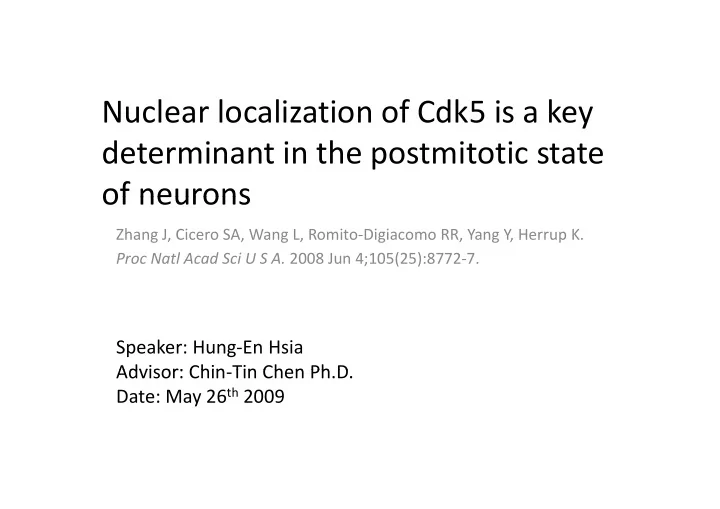
Nuclear localization of Cdk5 is a key determinant in the postmitotic state of neurons of neurons Zhang J, Cicero SA, Wang L, Romito Digiacomo RR, Yang Y, Herrup K. P Proc Natl Acad Sci U S A. 2008 Jun 4;105(25):8772 7. N tl A d S i U S A


slide-1
SLIDE 1

Nuclear localization of Cdk5 is a key determinant in the postmitotic state

  • f neurons
  • f neurons

Zhang J, Cicero SA, Wang L, Romito‐Digiacomo RR, Yang Y, Herrup K. P N tl A d S i U S A 2008 J 4 105(25) 8772 7 Proc Natl Acad Sci U S A. 2008 Jun 4;105(25):8772‐7.

Speaker: Hung‐En Hsia Advisor: Chin Tin Chen Ph D Advisor: Chin‐Tin Chen Ph.D. Date: May 26th 2009

slide-2
SLIDE 2

Postmitotic state: cell cycle arrest (p21, cdk5…)

Cell cycle related neuronal death neuronal death

  • 3. Maturation
  • 2. Migration

e.g. A

  • 1. Neurogenesis

Herrup K and Yang Y (2007) Nat Rev Neurosci.

2

SVZ, SGZ

slide-3
SLIDE 3

Loss‐of‐function of cdk5 causes problems Loss of function of cdk5 causes problems

  • Cdk5‐/‐ mice

– Can not survive after birth – Defects in neural development Cell cycle related neuronal death (CRND) – Cell cycle related neuronal death (CRND)

3

slide-4
SLIDE 4

Cyclin dependent kinase 5 (cdk5) Cyclin‐dependent kinase 5 (cdk5)

  • Cyclin‐dependent kinase (cdk)

– Promote cell cycle progression y p g – Its activation depends on binding of cyclin

Cdk5 i i b i dk f il

  • Cdk5 is an unique member in cdk family

– It does not promote cell cycle progression – Its activation does not rely on association of cyclin – It could be activated by its activator: p35 p39 It could be activated by its activator: p35, p39 – Predominately neuronal‐specific

4

slide-5
SLIDE 5

Functions of cdk5 Functions of cdk5

5

Dhavan R and Tsai LH (2001) Nat Rev Mol Cell Biol.

slide-6
SLIDE 6

CDK5

‐ +

d f dk Overactivation

  • f cdk5

Devoid of cdk5 activity

6

slide-7
SLIDE 7

Overactivation of cdk5 causes problems Overactivation of cdk5 causes problems

  • Alzheimer’s disease (AD)

Alzheimer s disease (AD)

– Lost of memory and the ability of remembering recently learned facts recently learned facts – Accumulation of beta‐amyloid (A) – Hyperphosphorylation of tau – Neural degeneration g

  • p25: generated by proteolytic cleavage of p35

A ff i i f dk b i – A more effective activator of cdk5 because its longer half‐life

7

slide-8
SLIDE 8

CDK5 CDK5

‐ +

Death of Death of Death of neurons Death of neurons

8

slide-9
SLIDE 9

Localization Localization

9

slide-10
SLIDE 10

Liver cell

PKA

10

slide-11
SLIDE 11

Cell lysate Primary neurons

Different cell cycle activity, different subcellular cdk5

Primary neurons culture

distribution

Transgene mouse modals AD patients AD patients

11

slide-12
SLIDE 12

The subcellular distribution of cdk5 changes because of different cell cycle activity

NIH 3T3 cell lysate Serum cdk5 Serum

Serum withdraw → Cell cycle arrest S dd b k → C ll l

12

Serum add‐back → Cell cycle re‐entry

slide-13
SLIDE 13

Cell cycle re‐entry is accompanied by the loss of nuclear cdk5 (1/2)

Mouse cortical neurons primary culture treated with A Cdk5 PCNA (Proliferating Cell Nuclear Antigen) PCNA (Proliferating Cell Nuclear Antigen)

13

slide-14
SLIDE 14

Cell cycle re‐entry is accompanied by the loss of nuclear cdk5 (2/2)

Cdk5

After A treatment Before A treatment

Cdk5 BrdU DAPI

14

slide-15
SLIDE 15

The quantity of cdk5 is reduced in the nucleus of neurons with cell cycle activity in AD mouse models

Alzheimer’s disease Alzheimer s disease mouse model R 1.40 mice carry the entire human beta‐amyloid precursor i ( ) ifi i l h

15

protein (APP) gene on a yeast artificial chromosome

slide-16
SLIDE 16

The localization of cdk5 is responsive to cell cycle activity induced by E2f1 deficiency

Cdk5 PCNA PCNA DAPI E2f1 works as a cell cycle suppressor in mature neurons

16

E2f1 works as a cell cycle suppressor in mature neurons.

slide-17
SLIDE 17

Cdk5 is almost exclusively cytoplasmic in proliferating neurons in AD brain

Cdk5 PCNA Age matched PCNA Age‐matched control AD patient

17

slide-18
SLIDE 18

Blockage of

Nuclear distribution

  • f cdk5 blocks cell

g nuclear export

cycle activity

Target cdk5 to nucleus

18

slide-19
SLIDE 19

Blockage of cdk5 export could block g p Ainduced cell cycle activity

Leptomycin B (LMB): A nuclear export inhibitor

19

Leptomycin B (LMB): A nuclear export inhibitor

slide-20
SLIDE 20

Nuclear cdk5 could block cell cycle activity Nuclear cdk5 could block cell cycle activity

BrdU

Cdk5‐/‐ Cdk5 /

NLS: Nuclear Localization Signal

BrdU

Cdk5 /

NES N l E t Si l

Cdk5‐/‐

20

NES: Nuclear Export Signal

slide-21
SLIDE 21

Cell lysate Cell lysate Primary neurons Primary neurons Transgene

Different cell cycle activity, different subcelluar cdk5 Nuclear localization of

Transgene mouse modals

subcelluar cdk5 distribution localization of Cdk5 is a key determinant in the postmitotic

AD patients

the postmitotic state of neurons Nuclear distribution of

Blockage of nuclear export

cdk5 blocks cell cycle activity

Target cdk5 to l

21

nucleus

slide-22
SLIDE 22

Proposed models Proposed models

Zhang J and Herrup K (2009) Cell Cycle Copani A et al., (2001) Trends Neurosci.

22

slide-23
SLIDE 23

Thanks for your attention! Thanks for your attention!

23

slide-24
SLIDE 24

A/oxidative stress…etc.

p35 p35

CDK5 CDK5 Calpain Calpain Ca2+ T1/2<20 min p25 CDK5

Microtubules

p p p p

T1/2<60 min

Microtubules

p p

Tau Tau

Cell Death

24

slide-25
SLIDE 25

25

slide-26
SLIDE 26

26

slide-27
SLIDE 27

Cdk5‐/‐ primary cortical neurons Cdk5 / primary cortical neurons

27

slide-28
SLIDE 28

28