Nu7 Neutrinos and Society Summary of Charge and Working Group - - PowerPoint PPT Presentation

nu7 neutrinos and society summary of charge and working
SMART_READER_LITE
LIVE PREVIEW

Nu7 Neutrinos and Society Summary of Charge and Working Group - - PowerPoint PPT Presentation

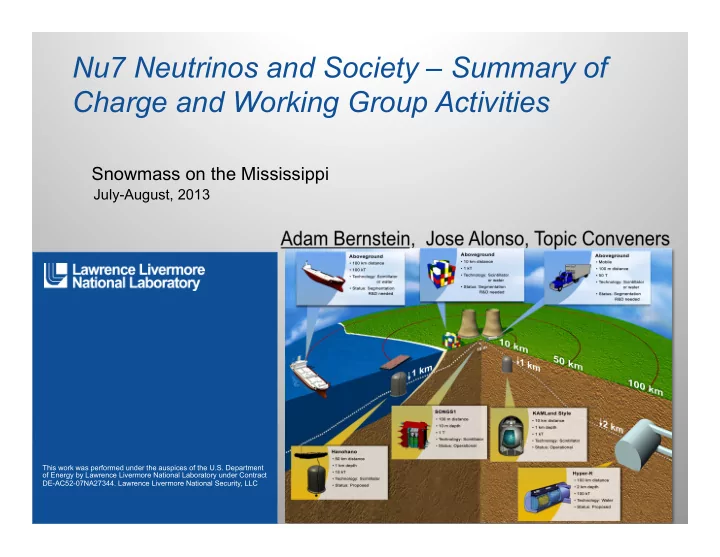
Nu7 Neutrinos and Society Summary of Charge and Working Group Activities Snowmass on the Mississippi July-August, 2013 This work was performed under the auspices of the U.S. Department of Energy by Lawrence Livermore National Laboratory


slide-1
SLIDE 1

This work was performed under the auspices of the U.S. Department

  • f Energy by Lawrence Livermore National Laboratory under Contract

DE-AC52-07NA27344. Lawrence Livermore National Security, LLC

Nu7 Neutrinos and Society – Summary of Charge and Working Group Activities

Snowmass on the Mississippi

July-August, 2013

slide-2
SLIDE 2

Lawrence Livermore National Laboratory

2

  • 1. Identify synergies between fundamental and

applied neutrino physics

— Reactor antineutrinos — Geo-antineutrinos

  • 2. Encourage physicists to learn how neutrino

detection technology applies to problems of broad social import

— Requires educating physicists in nonproliferation and geo-physics

  • 3. Effectively present the short but eventful history of

neutrino science to non-scientists

— 1 and 2 above help make the case for neutrino science

Neutrinos and Society Working Group Charge

slide-3
SLIDE 3

Lawrence Livermore National Laboratory

3

Neutrino Physics:

  • scillations and mass hierarchy

1-10 MeV antineutrinos

1 keV to 10 MeV

Neutrons and Gamma-rays

Rare neutral particle detection underlies nuclear security and fundamental nuclear science

Dark Matter and Neutrino Physics are top priorities in 21rst century physics Fissile Material Search and Monitoring are top priorities for global nuclear security

Rare Event Detection

Reactor antineutrino monitoring via inverse beta detectors Reactor monitoring via coherent scatter; improved fissile material monitoring

Dark Matter signatures: Axions and WIMPS

Nuclear Security and Nuclear Science both require improved keV to MeV- scale neutral particle rare event detectors

¯ ν ¯ ν

¯ ν + Ar → ¯ ν + Ar

Z0

slide-4
SLIDE 4

Lawrence Livermore National Laboratory

4

Accelerators used in neutrino experiments are used and/or contemplated for a wide range of industrial and medical applications

  • Current, Low energy: medical therapy, biological research, nuclear

security, environmental monitoring, semiconductor industry, oil well logging

  • Near-term, Medium energy: Isotope production
  • Longer-term, High Energy: Accelerator-driven reactors for energy

production

Example: Daedalus-like cyclotrons (M. Toups talk Anderson 250, 11:05 AM today) may be useful for accelerator driven reactors Shown: Rol Johnson, Bruce Vogelaar – accelerator for GEMSTAR reactor concept http://www.phys.vt.edu/~kimballton/gem-star/workshop/presentations/mcintyre.pdf

slide-5
SLIDE 5

Lawrence Livermore National Laboratory

5

Aside from the physics and technology connections, a sociological one

§ Like science, the nonproliferation regime is

inherently open, international, and collaborative

§ Classified work is largely irrelevant or

counterproductive for global nonproliferation

slide-6
SLIDE 6

Lawrence Livermore National Laboratory

6

§ The International Atomic Energy Agency (IAEA) is responsible for

implementing the Nuclear Nonproliferation Treaty worldwide

§ The IAEA Safeguards Regime tracks fissile material in the civil nuclear

fuel cycle

§

In 2012, an IAEA review encouraged R&D into antineutrino-based reactor monitoring for Safeguards:

1.

Near reactor deployments for detailed analysis of fissile content in known reactors – demonstrations, above-ground technology

2.

Far-reactor (10-1000 km) deployments for discovery or exclusion

  • f small unknown reactors

The IAEA and Nuclear Nonproliferation

slide-7
SLIDE 7

Lawrence Livermore National Laboratory

7

Neutrinos for Nuclear Reactor Monitoring

7

  • Several antineutrinos are produced per fission 10^21

fissions/second à lots of antineutrinos

  • Ton-scale detector ~ 5000 events/day @ 25 meters from

a power reactors (3000 MWt)

  • Megaton detector ~16 events/year @ 400 kilometers

from a small reactor (10 Mwt) Antineutrino rate and energy spectrum are sensitive to fissile content

  • Now, we can see a

70 kg switch of U for Pu assuming knowledge of reactor power

  • Spectral analysis -

increase precision, no need for independent knowledge

  • f the reactor power
slide-8
SLIDE 8

Lawrence Livermore National Laboratory

8

Research topics in Applied Antineutrino Physics that apply to Neutrino and Dark Matter Physics

Water Cerenkov detectors Coherent Scatter/ Low threshold detectors Scintillator detectors

  • Supernovae antineutrinos

Relevant to:

  • accelerator and/or reactor
  • scillation experiments
  • Geo-antineutrinos
  • Smaller detectors
  • Improved spectral

measurements*

  • neutrino directionality*
  • Precision neutrino spectra
  • Above-ground detection
  • Improved neutron/gamma 


detection

  • Long range reactor

monitoring

  • Improved neutron

detection

  • Sterile neutrinos
  • Reactor anomaly
  • WIMP or Axion searches
  • sterile neutrino search
  • Nuclear physics studies

Nonproliferation Neutrino/DM Physics

slide-9
SLIDE 9

Lawrence Livermore National Laboratory

9

Ø Phase I – 2012 start- identify site, measure

backgrounds, and develop a design envelope for the detector

1) Long Range Monitoring Test – the WATCHMAN (Water Cherenkov Antineutrino Monitoring) project

Kiloton scale detector

Research or power reactor

//

1-20 km standoff 100-2000 meters overburden Nonproliferation Goal: demonstrate sensitivity to reactor antineutrinos using a 1000-10000 ton gadolinium-doped water detector at ~2 km from a 100 MWt US research reactor, or ~20 km from a 3000 MWt US commercial power reactor

slide-10
SLIDE 10

Lawrence Livermore National Laboratory

10

How does this relate to other large water detector R&D ?

Detector EGADS WATCHMAN Hyper-K Status Ongoing 2016 start 2018-19 start Mass (ton) 200 1,000 - 10,000 560,000 Type Gd-WCD Gd-WCD Pure H2O or Gd-WCD Purpose Measure background materials,energy threshold Too small to see reactors Remotely detect reactor antineutrinos – some oscillation sensitivity Neutrino oscillations, proton decay, supernovae - WATCHMAN would demonstrate Gd option for HyperK

slide-11
SLIDE 11

Lawrence Livermore National Laboratory

11

WATCHMAN US possible deep site: the Fairport Mine

Perry Reactor Nuclear Generating Station to IMB cavern in the Fairport Salt Mine (Ohio)

  • Existing 20 m cubic cavern – other excavations

possible

  • 1570 m.w.e. – pretty deep
  • 13 km standoff
  • 3875 MWth

1. The only mine in the United States within 20 km of a reactor 2. Existing cavern ideal for this demonstration 3. Would be the only US detector sensitive to supernova antineutrinos 4. Upgraded detector physics potential for geo-antineutrinos and mass hierarchy being investigated.. 5. Nstural precursor/demonstrator for Hyper-K or other large water detectors

Antineutrinos ¡from ¡Perry ¡@ ¡12 ¡km ¡ ¡

A preliminary look at the LS antineutrino spectrum

  • 1 year of operation, systematics not incorporated

Plot courtesy Steve Dye, Hawaii Pacific Univ.
slide-12
SLIDE 12

Lawrence Livermore National Laboratory

12

WATCHMAN possible non-US deep site: the Cleveland Potash mine in Boulby, England

  • 2800 mwe depth
  • 20-25 km standoff
  • Hartlepool reactor thermal power = 1570

MWth (2 cores)

  • Some sensitivity to oscillations with LS or

WBLS upgrade

Liquid ¡ Scintillator ¡ Liquid ¡ Scintillator ¡ Pure ¡ Water ¡ A: ¡ ¡unoscillated ¡and ¡distorted ¡spectrum ¡showing ¡effects ¡due ¡to ¡"theta12" ¡oscillations ¡(overall ¡suppression) ¡ ¡and ¡theta13 ¡(small ¡wiggles). ¡Resolution ¡is ¡3%/sqrt(E). ¡Distance ¡is ¡25 ¡km. ¡ B: ¡Ratio ¡showing ¡low ¡energy ¡suppression ¡due ¡to ¡theta12. ¡Error ¡bars ¡assume ¡20 ¡kton-­‑yr ¡ exposure ¡at ¡Boulby. ¡The ¡theta12 ¡sensitivity ¡comes ¡from ¡the ¡low ¡energy ¡shape. ¡ C: ¡With ¡pure ¡water, ¡this ¡is ¡still ¡there ¡but ¡much ¡less ¡apparent ¡due ¡to ¡20%/sqrt(E) ¡resolution ¡ and ¡Cherenkov ¡threshold. ¡ A B C ¡

Potential for

  • scillation

sensitivity at 25 km

Estimated response curves courtesy R. Svoboda, UC Davis

slide-13
SLIDE 13

Lawrence Livermore National Laboratory

13

2) Near-field reactor monitoring: detector requirements nearly identical to those for a SBL reactor experiment Reactor Monitoring SBL oscillation physics – US-SBL collaboration

Minimal

  • verburden

Near reactor, high background High flash- point scint. Efficient, compact, high resolution Improved flux/spectrum knowledge

Enable oscillation experiment close to compact Research Reactor core Enable monitoring at wide variety of locations, incl. research reactors Enable tighter fissile material limits

235U spectrum

measurement

Project needs

slide-14
SLIDE 14

Lawrence Livermore National Laboratory

14

σcs G2N 2 4π E2

ν

§ An undisputed, unmeasured prediction of the Standard Model

since 1974

§ The cross section, delightfully large § The induced signal, unpardonably small § possible sterile neutrino oscillation search – e.g. Ricochet § A,Z sensitivity proposed as a probe for nuclear structure

arXiv:1207.0693 [nucl-th]

3) Coherent Elastic Neutrino-Nucleus Scattering – what is it ? A flavor blind process – the neutrino elastically scatters on a nucleus via Z0 exchange

¯ ν ¯ ν

¯ ν + Ar → ¯ ν + Ar

Z0

Er = 716 eV (Eν/MeV)2 A

slide-15
SLIDE 15

Lawrence Livermore National Laboratory

15

Who is doing it and why ?

§ Considerable effort worldwide, most often from

the Direct Dark Matter Search community

§ Nearly identical to a Dark Matter detector § Without ton-scale directional detectors (e.g. Nygren

concept), coherent scatter is the irreducible background to WIMP dark matter sensitivity and thus needs to be studied

§ It has the pleasing bonus feature that we know it

exists…

§ Nonproliferation goal is to exploit high cross section to

make smaller monitoring detectors

slide-16
SLIDE 16

Lawrence Livermore National Laboratory

16

Coherent ν Scattering at Nuclear Reactors

Reactors an attractive source for CENNS

§ High flux (Φ > 1012 cm-2s-1)

Can be turned off Energy in coherent regime

Recoil energy [eV]

Average reactor ν recoil energy on argon ~ 240 eV !!

  • Expected event rates @ 25 m

(before detection efficiencies):

– 56 events/(kg day) for CNS off Argon – 5.2 events/(kg day) for the inverse β decay reaction on CH2

  • Solar neutrinos
  • Supernovae

⟹ Neutrino beams ~30 MeV neutrinos from ORNL spallation source are a great discovery tool ⟹ Nuclear Reactors

~ 30% Simulated ionization spectrum from reactor neutrinos on Ar Number of primary electrons Fraction of recoils

Hagmann & Bernstein, TNS 51(5) (2004)

slide-17
SLIDE 17

Lawrence Livermore National Laboratory

17

§ Despite many common elements, neutrino applications differ from

fundamental science in important ways

1.

Policy context matters as much or more than the technology

2.

Detectors have to be robust, safe, and easy to deploy

3.

Outputs must be easy to interpret

§ For neutrino physics to have an impact on nonproliferation, physicists

need an education in the history and practice of nonproliferation, and the coming challenges – Nuclear Science and Security Consortium a highly effective example at UCB, UCD, UCI, USCD

  • Many schools - mostly nuclear engineering but also some

physics departments (e.g. Virginia Tech and UC Davis) provide training in nonproliferation

For the sake of both fields, neutrino/DM physicists should learn about nonproliferation

slide-18
SLIDE 18

Lawrence Livermore National Laboratory

18

§ The field’s diversity makes this a challenge to explain

compared to say particle discovery (Z0, W, charm, bottom, top, Higgs, dark matter..)

§ But we enjoy a rich record of discovery - oscillations,

neutrino mass, a galactic supernova - and a bright future – new neutrinos, CP violation, extra-galactic supernovae..

§ Simple explanations of the mysterious physics of neutrinos

have been successful in maintaining the profile of neutrino physics in the public mind

§ The overlap with applications has helped make the case for

neutrino physics that appeals to Congress and the public and can provide new funding sources

The public and Congress need to be educated and re-educated about neutrino physics

slide-19
SLIDE 19

Lawrence Livermore National Laboratory

19

Applied Antineutrino Physics – a growing global community with strong ties to Dark Matter and Neutrino Science

Vienna, Austria

slide-20
SLIDE 20

Lawrence Livermore National Laboratory

20

§ Applied antineutrino physics is a burgeoning and

exciting field

§ Current neutrino/dark matter physics – sterile neutrinos,

LBL oscillations, and dark matter detection, relate very directly to this research

§ The potential impact on nonproliferation helps

strengthen the case for fundamental neutrino physics with all stakeholders

§ The Neutrino and Dark Matter Physics communities

should self-educate, and exploit the overlap in technologies and methods - both in research and in funding requests

§ « Par ma foi ! il y a plus de quarante ans que je dis de

la prose sans que j'en susse rien. – Le Bourgeois Gentilhomme, Moliere

Summary

slide-21
SLIDE 21

Lawrence Livermore National Laboratory

21

Title for full-page image

(sub information - 20pt type)