NSWNMA Conference Future Ready NUTRITION FOR NURSES Kathryn - - PowerPoint PPT Presentation

nswnma conference future ready nutrition for nurses
SMART_READER_LITE
LIVE PREVIEW

NSWNMA Conference Future Ready NUTRITION FOR NURSES Kathryn - - PowerPoint PPT Presentation

NSWNMA Conference Future Ready NUTRITION FOR NURSES Kathryn Hawkins Accredited Practising Dietitian and Accredited Nutritionist Overview: A closer look at Healthy Eating Barriers to good nutrition that face the nursing

slide-1
SLIDE 1

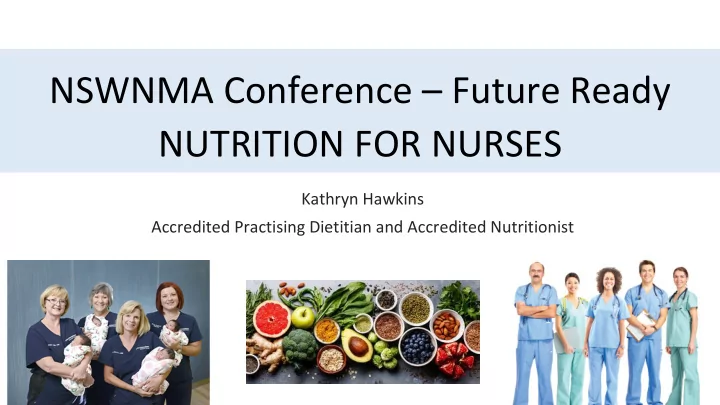
NSWNMA Conference – Future Ready NUTRITION FOR NURSES

Kathryn Hawkins Accredited Practising Dietitian and Accredited Nutritionist

slide-2
SLIDE 2

Overview:

  • A closer look at ‘Healthy Eating’
  • Barriers to good nutrition that face the nursing profession
  • STRESS and its impact on good nutrition
  • Trauma
  • Everyday stressors
  • Illness
  • Gut health
  • Top tips and types of food
  • Strategies for good nutrition
  • Mindfulness
  • Intuitive eating
  • Myth Busting
slide-3
SLIDE 3

~ A closer look at “Healthy Eating” ~

slide-4
SLIDE 4

Fruit and Vegetables

Benefits:

  • Rich in fibre, vitamins, minerals and

antioxidants

  • Higher intakes linked to more stable

body weight, better bowel health and lower risk of heart disease

slide-5
SLIDE 5

Fruit and Vegetables

How to increase your intake?

  • Add fruit to muesli/porridge/yoghurt
  • Include fruit and vegetables as a snack
  • Include salad and vegetables at lunch

and dinner – aim for ½ of the plate

slide-6
SLIDE 6

Low GI Carbohydrates

Benefits:

  • Slower release of energy
  • Keep you fuller for longer
  • Less load on body to process a

large amount of glucose at one time

  • Improved blood sugar level control
  • Higher in nutrients including fibre
slide-7
SLIDE 7

Choose Low GI Carbohydrates

Food to choose:

  • Sweet potato
  • Charisma potatoes
  • Corn
  • Legumes
  • Lentils
  • Dense grain breads or wraps
  • Basmati rice
  • Quinoa
  • Buckwheat
  • Whole meal or pulse pasta
  • Most fruit in controlled amounts - berries, passionfruit, citrus, apples, pears, bananas, nectarines,

peaches

  • Dense grain crackers (vita weats, Ryvitas)
  • Greek yoghurt
  • Milk
slide-8
SLIDE 8

Avoid Added Sugar & High GI Carbohydrates

  • Lollies
  • Chocolate
  • Cakes, muffins, pastries
  • Soft drink, cordial, iced-tea, juice
  • Sugar and jam
  • Artificial sweeteners - often found in ‘diet’ products
  • Large serves of dried fruits or high GI fruits (melons, lychees, dates)
  • Sweetened dairy such as ice-cream, custard, sweet yoghurts
  • White bread/wraps
  • White pasta
  • Short grain rice - jasmine/white/brown rice
  • White potato

Foods to avoid:

slide-9
SLIDE 9

Avoid Added Sugar & High GI Carbohydrates

Why avoid?

  • Spike blood sugar levels
  • Make the body work harder to clear

glucose in the blood

  • Can lead to an energy ‘drop’
  • More likely to be hungrier sooner
  • Generally contain minimal nutrients
  • Low in fibre
slide-10
SLIDE 10

Choose Good Quality Proteins Regularly

Food sources:

  • Meat (Lean & Grass fed where affordable)
  • Poultry (Avoid skin)
  • Oily fish
  • Beans and legumes (e.g chickpeas, kidney

beans)

  • Lentils
  • Dairy
  • Nuts and seeds
  • Eggs

Why?

  • Provide Satiety
  • Stabilise blood sugar levels
  • Provide essential nutrients
slide-11
SLIDE 11

Reduce Unhealthy Fats

Saturated fats

  • Processed and fatty cuts of

meat

  • Fast food
  • Commercially baked

cookies/cakes

  • Pastries, pies, frozen

spring rolls, fish fingers, chicken strips

  • Coconut oil and milk

Trans fat

  • Margarines
  • Fast food
  • Commercially baked

cookies/cakes

  • Popcorn
  • Pastries, pies, frozen spring

rolls, fish fingers, chicken strips

  • Vegetable oils
  • Packet cake mixes
slide-12
SLIDE 12

Reduce Unhealthy Fats

Seed oils

  • Sunflower
  • Safflower
  • Cottonseed
  • Rapeseed
  • Peanut

Damaged oils

  • Those left exposed to oxygen & light
slide-13
SLIDE 13

Previous advice to limit diary or only choose low fat dairy for Cardiovascular health is not supported by recent science - Choice should be individual.

Full Fat Dairy

  • Provides satiety
  • Can assist with blood sugar level

stabilisation

  • Higher in fat soluble vitamins (A, D,

E, K)

  • Higher in calories
  • Higher in saturated fat
  • Generally lower in sugar

Dairy Considerations

Low Fat Dairy

  • Sugar content often higher

(varies between brands)

  • Lower amounts of fat soluble

vitamins (A, D, E, K)

  • Less satiety
  • Lower in calories
  • Low in saturated fat
slide-14
SLIDE 14

Butter or Margarine

BUTTER

  • Contains mainly saturated fat which may

increase cholesterol levels if consumed in excess

  • Includes nutritious sat fat butyric acid

(involved in gut health, anti-cancer)

  • Studies show butter consumption only

poses a small risk for heart disease

  • More natural
  • High in calories
  • High in salt
  • Excellent source of vitamin A & D

MARGARINE

  • Contains more poly or monounsaturated

fat - linked to lowering bad cholesterol

  • However some varieties are high in trans

fat (although most removed by manufactures these days)

  • Processed with flavouring agents, yellow

food pigments, emulsifiers and preservatives.

  • High in calories
  • High in salt
  • Source of Vitamin A & D

Overall

  • Consume both only in moderation
  • Best spreads are pure Olive oil or avocado or hummus or nut/seed spreads
slide-15
SLIDE 15

Include Healthy Fats

Food sources:

  • Oily fish (e.g. salmon, tuna, sardines, mackerel, herring)
  • Seeds (e.g. sesame seeds, linseeds, chia seeds, pumpkin)
  • Nuts (e.g. almond, walnuts, brazil nuts, pine nuts)
  • Natural nut butters
  • Soy beans
  • Avocado
  • Extra virgin olive oil
slide-16
SLIDE 16

Increase Healthy Fats

How to increase your intake?

  • Choose avocado, hummus or tahini as a

spread

  • Include nuts and seeds as a snack, and

sprinkled on cereal and salads

  • Include oily fish 2-3 times per week

How to protect your fats?

  • Buy olive oil in a small dark glass jar
  • Keep lid on oil
slide-17
SLIDE 17

Balancing Portion Sizes

½ plate vegetables and salad ¼ plate lean protein ¼ plate sustaining carbohydrate + a serve of a healthy fat

slide-18
SLIDE 18

Reduce Salt

  • Eating too much salt can increase

the risk of high blood pressure

  • High blood pressure is a major risk

factor for heart disease

slide-19
SLIDE 19

Reduce Salt

How to reduce salt intake?

  • Avoid adding salt in cooking
  • Avoid adding salt at the table
  • Avoid high salt foods such as baked

goods, processed meats and take away foods Cutting down salt doesn’t mean cutting down on flavor

  • Use herbs and spices to add flavor

and reduce salt

slide-20
SLIDE 20

Reduce Alcohol

  • WHO Guidelines

No more than 2 standard drinks per day with 2-3 alcohol free days per week

  • WHY?
  • Alcohol causes an acute increase in blood

pressure

  • Impacts on weight management
  • Can lead to suboptimal food choices during and

after drinking

slide-21
SLIDE 21

Water

  • Aim 2-3L per day
  • Should be #1 choice of fluid

Benefits:

  • Supports hydration
  • Optimises brain function
  • Supports healthy bowel function
  • Supports immunity
slide-22
SLIDE 22

~ Barriers to good Nutrition that face the Nursing Profession ~

slide-23
SLIDE 23

Shift Work

Extended hours and shift work play a huge roll in poor nutrition and overall health. These can have long term and immediate affects. During a shift, many nurses develop:

  • Dehydration
  • Lethargy
  • Uncomfortable bowel habits
  • Dry skin

Long term issues include raised cholesterol, weight gain, nutritional deficiencies and increased cortisol.

slide-24
SLIDE 24

Managing Shift Work

Aim to Maintain a regular eating pattern regardless of your shift:

  • Aim for 3 main meals and 3-4 snacks in a 24 hour period
  • Eat according to the time of day – breakfast food in the

morning, lunch foods in the middle of the day and dinner food in the evenings.

  • Late at night and overnight, eat snacks that contain protein and avoid big meals

at a time when you would normally be sleeping.

  • Eat a small meal after your shift so you don’t go to bed hungry.
slide-25
SLIDE 25

Access to Healthy Foods

At Work:

  • Bring lots of snacks to work, portioned out and

separately packaged. (trail mix, cheese and crackers, veggie sticks, baked goods,)

  • Plan and pack the meals you will eat at work, but
  • nly pack small portions.
slide-26
SLIDE 26

At Home:

  • Bulk cook and freeze a lot of meals – Curries, bolognese sauce,

lasagne, quiche, casseroles.

  • Freeze meals in individual portions.
  • Have fresh fruit and washed, veg cut up

and ready to go for snacking.

  • Consider having groceries home delivered!

Access to Healthy Foods

slide-27
SLIDE 27

Trauma and Stress

Immediate

  • Traumatic events include the death of a patient, abuse by a patient,

upset families, very sick children and babies.

  • Working long hours, feeling depleted and feeling guilt around

leaving family can be very stressful Immediate impacts of trauma can mean that you become very distressed and don’t eat or drink properly during the event.

slide-28
SLIDE 28

Trauma and Stress

  • Long Term
  • Stress and burnout affect 10-70% of nurses.
  • Sources of long term stress can be:
  • Time constraints to get work done.
  • Conflict with leadership or co-workers.
  • A feeling of lack of control in their work environment.
  • Compassion fatigue.
slide-29
SLIDE 29

~ Stress and its Impact on Good Nutrition ~

slide-30
SLIDE 30

Stress Hormones

  • When you feel stress or overwhelm, it is your sympathetic nervous

system that kicks in.

  • When you’re operating from this place, your adrenal glands will

excrete adrenaline.

  • Adrenaline causes your blood sugars and blood pressure to rise and

produces more insulin and cortisol to regulate the rise in blood sugar.

  • You also get a rise in blood pressure and your heart rate will increase

to provide oxygen to the body.

  • As a result of this response, your digestive system will slow right

down

slide-31
SLIDE 31
  • Chronic stress and tiredness can lead to poor nutrition and, in

turn, poor decision making.

  • You may loose your appetite and skip meals.
  • Make poor nutritional decisions based on emotion
  • Crave more comfort foods or sweet foods
  • When eating poorly, energy and alertness can fluctuate during the

day… leading to poor decisions

  • It is a horrible cycle!

Decision Making

slide-32
SLIDE 32

Gut Health

  • Poor gut health has been linked to many different diseases
  • r conditions, including Crohn’s disease, irritable bowel

syndrome, non-alcoholic fatty liver disease, obesity and depression.

  • When we consider the connection between the brain and

the gut, it’s important to know that 90% of serotonin receptors are located in the gut.

slide-33
SLIDE 33
  • Eat whole foods and avoid packaged or processed foods, which

are high in unwanted food additives and preservatives that disrupt the healthy bacteria in the gut.

  • Increase your intake of fresh fruits and vegetables.
  • Eat enough fiber and include whole grains and legumes in your

diet.

  • Include probiotic-rich foods such as plain yogurt without added

sugars.

  • Add fermented foods such as kefir, sauerkraut, or kimchi to your

diet.

  • Reduce red meat intake.

Improving Gut Health

slide-34
SLIDE 34

~ Tips for Nurses ~

slide-35
SLIDE 35
  • Soup to reheat – lots of veg, lentils etc.
  • Brown rice an tuna salad.
  • Cous Cous and Chicken salad.
  • Hard boiled eggs on toast (bring the eggs already cooked and peeled

from home.

  • Falafels and salad
  • Wraps – fresh or toasted.
  • Stir fry veggies and cashews

Small Meals

slide-36
SLIDE 36

Snack List

  • Handful mixed nuts (unsalted)
  • Ryvita or Vitaweat Lunch Slice crackers with ricotta cheese and tomato
  • Slice of pumpernickel with ricotta
  • Handful chic nuts (chickpea nuts made by partner foods and available in health food section supermarket)
  • Natural greek yoghurt with small handful untoasted muesli on top
  • Natural greek yoghurt with berries on top
  • Banana smoothie
  • Mini quiches
  • Bills or Burgen fruit loaf with ricotta
  • Edgell three beans and corn mix
  • Small can of baked beans
  • Corn on cob or small can of corn kernels
  • Nut, or fruit n nut individual boxes
  • Slice multigrain toast with ricotta or peanut butter
  • Vegetable sticks (cucumber, capsicum, carrot, celery, snow peas, green beans) with hummus or tzaziki
  • Fruit – apple, 2 small apricots, handful grapes, mandarin, orange, strawberries or banana.
slide-37
SLIDE 37
  • Breakfast
  • Snack
  • Lunch
  • Snack
  • Dinner
  • Supper
  • Sleep
  • Have water with every

meal and snack!

Plan your day!

slide-38
SLIDE 38

~ Strategies for Good Nutrition ~

slide-39
SLIDE 39

Mindful Eating

Mindfulness is about being consciously aware of your feelings, thoughts and body sensations in the moment and accepting them. Being mindful is being in the present and acknowledging what’s happening right now. Mindful Eating is being able to eat when, what and how much our bodies need, and to be able to separate physical hunger and emotional/non-hungry eating.

slide-40
SLIDE 40

Mindful Eating

Strategies to trial:

  • Checking in with your mood before and after eating

can help you become aware of how your emotions impact your food choices.

  • Slowing down eating to honor fullness- this will allow

you to identify when your no longer hungry and therefore should consider stopping eating.

  • Honoring physical hunger by having a snack or

bringing forward a meal - If we don’t eat when our body is crying out that it is hungry, we often set

  • urselves up for overeating and poor choices later in

the day.

slide-41
SLIDE 41

We are not always trained to know how hungry and full feel. These feelings can be different between people. Hunger cues might be: Tummy pangs, irritable, low energy, light headed, poor concentration Fullness cues might be: Sleepy, bloated, uncomfortable, guilty, low energy

Mindful Eating

slide-42
SLIDE 42

Addressing non-hungry eating?

  • Notice ‘danger’ locations and times – Be

aware & modify or avoid the situation

  • Eat only at the table
  • If you know your not physically hungry

distract yourself with a non-food enjoyable activity (another form of self care)

  • Focus on the root cause i.e. Address boredom
  • r emotions that trigger non-hungry eating

Mindful Eating

slide-43
SLIDE 43

Addressing over-eating

  • Watch how much food you are cooking &

serving

  • Separate 1/3 of your meal at the start
  • Eat slowly & without distraction - Notice

what your eating

  • When you get to the final 1/3 stop and

assess if you actually are still hungry? If not hungry anymore you will likely be full 20mins later

slide-44
SLIDE 44

~ Myth Busting! ~

slide-45
SLIDE 45

Myth Busting

MYTH: The cholesterol found in eggs will raise blood cholesterol levels

  • Evidence shows up to 2 eggs per day has no negative impact on heart health
  • Eggs are full of micronutrients important for health
  • Eggs are a good source of protein for satiety & blood sugar control
  • Organic eggs are high in Omega 3 fatty acids

FALSE

slide-46
SLIDE 46

Myth Busting

MYTH: Dark chocolate and red wine will reduce my risk

  • f heart disease because they contain antioxidants
  • These are a source of anti-oxidant however are not daily choices due

to alcohol and fat content

  • Better sources are fruit, vegetables, nuts, seeds, fatty fish

FALSE

slide-47
SLIDE 47

Last minute tips…

  • Follow the healthy eating principles, and always ADD MORE VEGETABLES!
  • Plan, Plan, Plan…. Failing to plan is planning to fail.
  • Buy some good quality reusable containers and lunch bag.
  • Always go for the most nourishing option.
  • Understand your points of stress and your likely reaction to this.
  • Drink water on every tea break, meal break and in-between!
  • You don’t have to strive for ‘Perfect Eating’ – Aim to make better choices.
slide-48
SLIDE 48

Any Questions?