Novel Method for Gapping Rails Wayne Perrier O Scale West 2013 - - PowerPoint PPT Presentation

novel method for gapping rails
SMART_READER_LITE
LIVE PREVIEW

Novel Method for Gapping Rails Wayne Perrier O Scale West 2013 - - PowerPoint PPT Presentation

Novel Method for Gapping Rails Wayne Perrier O Scale West 2013 www.americantieandtimber.com 1 My Dad was a Real Engineer O Scale West 2013 www.americantieandtimber.com 2 Something Completely Unrelated 4-way switch its real! O


slide-1
SLIDE 1

O Scale West 2013 www.americantieandtimber.com 1
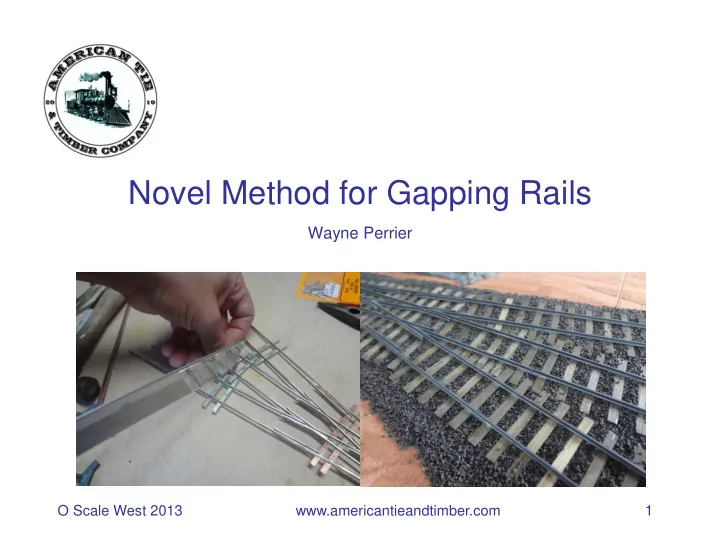
Novel Method for Gapping Rails

Wayne Perrier

slide-2
SLIDE 2

O Scale West 2013 www.americantieandtimber.com 2

My Dad was a “Real Engineer”

slide-3
SLIDE 3

O Scale West 2013 www.americantieandtimber.com 3

4-way switch it’s real!

Something Completely Unrelated

slide-4
SLIDE 4

O Scale West 2013 www.americantieandtimber.com 4

  • After all (metal) Frogs
  • Between Points and Frogs or Frogs and

Frogs (esp for DCC)

  • At Balloon Tracks and Wyes
  • Between modules (for isolation)
  • At Special Trackwork (diamond crossings,

slip switches, etc)

Where do we need to gap rails?

slide-5
SLIDE 5

O Scale West 2013 www.americantieandtimber.com 5

  • When I built my On30 module with handlaid track and

wooden ties I gapped my rails using “traditional” methods.

  • I actually built the gaps in-place out of discrete rails rather

than cutting gaps after the rail was laid.

  • Some gaps I tried to insulate with paper, others with
  • styrene. In all cases I tried to keep the gap size to a

minimum for the sake of realism.

What was the problem I was trying to solve?

slide-6
SLIDE 6

O Scale West 2013 www.americantieandtimber.com 6

  • I found that after a few years, I was having trouble with

gaps opening up and closing.

  • In some cases a direct short was happening, which was

very troublesome to debug when my modular group set up at shows (especially when I wasn’t there!).

  • I also started having some alignment issues especially on

curves.

What was the problem I was trying to solve?

slide-7
SLIDE 7

O Scale West 2013 www.americantieandtimber.com 7

Leave a gap between rail pieces

  • Simply put two separate pieces of rail down, whether flextrack
  • r handlaid (spike on both sides of the gap).
  • Potential for kinks on curves and at switches.
  • There is no relative alignment between adjacent rails. Gap can
  • pen or close as benchwork / rails expand / contract.

“Improvement” – use insulated rail joiners

  • Gap won’t close – this is good
  • Gap could open substantially
  • No lateral rigidity – gauge can change
  • Potential for kinks on curves
  • Plastic railjoiner looks terrible
  • Not practical for smaller rail sizes due to flanges hitting.

“Traditional” Methods of Rail Gapping

slide-8
SLIDE 8

O Scale West 2013 www.americantieandtimber.com 8

Leave a gap; fill with epoxy

  • No rigidity to rail alignment
  • Epoxy can detach over time
  • Messy and time-consuming

Insulate with paper or other non-conductive spacer

  • Gap generally won’t close – this is good
  • Gap could open substantially
  • No lateral rigidity – gauge can change
  • Potential for kinks on curves

“Traditional” Methods of Rail Gapping

slide-9
SLIDE 9

O Scale West 2013 www.americantieandtimber.com 9

None of these methods worked for me

slide-10
SLIDE 10

O Scale West 2013 www.americantieandtimber.com 10

I literally had a 3AM “aha!” moment !

slide-11
SLIDE 11

O Scale West 2013 www.americantieandtimber.com 11

  • Solder the rails down to a rigid substrate
  • Shape the substrate to take the place of 2 or 4 railway ties
  • Cut the gaps after soldering, to guarantee permanent

alignment in all directions.

The Solution

slide-12
SLIDE 12

O Scale West 2013 www.americantieandtimber.com 12

  • I googled, only to find that no one made

anything like this.

  • I had a friend make some units at home on his

milling machine and did some experimenting.

  • I handed some out to my modular group and

members encouraged me to make more of them, and eventually to go into business offering them to other modelers.

The Solution

slide-13
SLIDE 13

O Scale West 2013 www.americantieandtimber.com 13

  • Precise, narrow gaps
  • Rails always in perfect alignment
  • Visually unobtrusive, mechanically robust
  • Installs in minutes -- EASY

The Solution : Introducing the Gapmaster

slide-14
SLIDE 14

O Scale West 2013 www.americantieandtimber.com 14

Suggested Tools

slide-15
SLIDE 15

O Scale West 2013 www.americantieandtimber.com 15

How to Install the Gapmaster

  • Remove 2 or 4 ties
  • Clean rail underside with

#0000 steel wool

  • Place Gapmaster into

position.

  • Apply tape if desired.

1 2 3

  • HO Code 83 Flextrack shown
slide-16
SLIDE 16

O Scale West 2013 www.americantieandtimber.com 16

How to Install the Gapmaster

4 5 6

  • Heat top of railhead with

Weller soldering gun

  • Apply fine 0.025” rosin-flux

silver-bearing solder where rail base meets Gapmaster metal top.

  • Repeat for all ties
  • Strike any solder residue
  • ff of railhead with flat file.
  • HO Code 83 Flextrack shown
slide-17
SLIDE 17

O Scale West 2013 www.americantieandtimber.com 17

How to Install the Gapmaster

7 8 9

  • After soldering done.
  • Clean up soldered joints

with steel wool and or scratch brush.

  • Cut gap(s) with X-Acto

#239 razor saw, held firmly.

  • HO Code 83 Flextrack shown
slide-18
SLIDE 18

O Scale West 2013 www.americantieandtimber.com 18

How to Install the Gapmaster

  • Complete gap(s) by sawing

through rail base and slightly into composite substrate.

  • Remove any burrs using

scratch brush.

  • Complete! Install on your

roadbed.

10 11 12

  • HO Code 83 Flextrack shown
slide-19
SLIDE 19

O Scale West 2013 www.americantieandtimber.com 19

Completed Installation

  • HO Code 83 Flextrack shown
slide-20
SLIDE 20

O Scale West 2013 www.americantieandtimber.com 20

Gapping/Wiring a 3-way stub switch

  • Gaps labelled C are

required after frogs

  • Good candidate for

Gapmasters

  • Similar situation for all

switches

slide-21
SLIDE 21

O Scale West 2013 www.americantieandtimber.com 21

Gapping a 3-way stub switch

  • Place Gapmaster
  • Solder and cut

gaps as before

slide-22
SLIDE 22

O Scale West 2013 www.americantieandtimber.com 22

Gapping a 3-way stub switch

  • Lather, rinse,

repeat.

slide-23
SLIDE 23

O Scale West 2013 www.americantieandtimber.com 23

Gapping a 3-way stub switch

  • After painting and

ballasting, appearance is good.

slide-24
SLIDE 24

O Scale West 2013 www.americantieandtimber.com 24

O Versions

GM010 with 9 foot ties, shown with ME flextrack GM001 with 8 foot ties, shown with handlaid

slide-25
SLIDE 25

O Scale West 2013 www.americantieandtimber.com 25

O Narrow Gauge Versions

GM002 for Peco On30 GM004 for On3 handlaid 6 foot ties GM005 for On30 handlaid 6 foot ties

slide-26
SLIDE 26

O Scale West 2013 www.americantieandtimber.com 26

O Narrow Gauge Versions

GM006 for On30 ME flextrack GM011 for On30 handlaid 6’6” ties

slide-27
SLIDE 27

O Scale West 2013 www.americantieandtimber.com 27

O Narrow Gauge Versions

GM014 for On2. 5”x5”x5’ ties on 2’ centers GM017 for On3 handlaid or PSC flextrack 6’6” ties

slide-28
SLIDE 28

O Scale West 2013 www.americantieandtimber.com 28

S/Sn3 Versions

GM012 Sn3 shown with P-B-L flextrack GM015 S shown with Tomalco flextrack

slide-29
SLIDE 29

O Scale West 2013 www.americantieandtimber.com 29

Dual Gauge Installation

Earlier GM007 (HO) shown with HOn30 3rd rail added

slide-30
SLIDE 30

O Scale West 2013 www.americantieandtimber.com 30

  • 4 ties
  • Code 55 flextrack shown

HOn3 Version

slide-31
SLIDE 31

O Scale West 2013 www.americantieandtimber.com 31

www.americantieandtimber.com How to Obtain This Presentation

  • Then go to How-To Presentations tab