Novartis Diagnostics NVS Dx focuses on Preventive Screening - - PowerPoint PPT Presentation

novartis diagnostics
SMART_READER_LITE
LIVE PREVIEW

Novartis Diagnostics NVS Dx focuses on Preventive Screening - - PowerPoint PPT Presentation

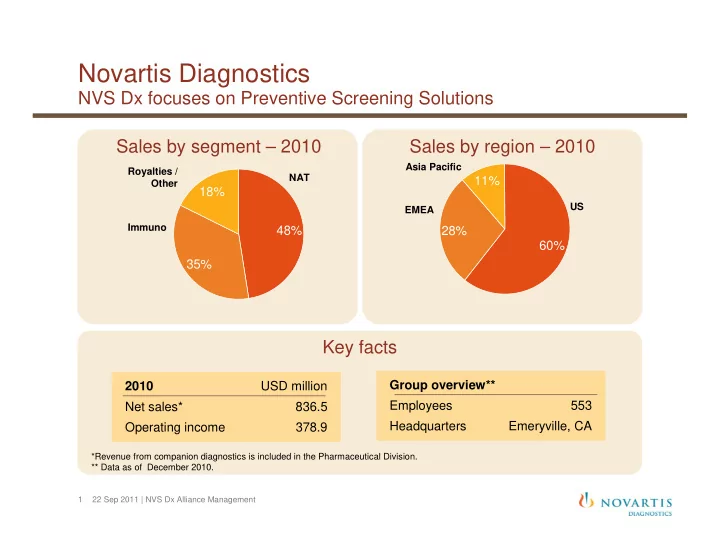
Novartis Diagnostics NVS Dx focuses on Preventive Screening Solutions Sales by segment 2010 Sales by region 2010 Asia Pacific Royalties / NAT 11% Other 18% US EMEA Immuno 48% 28% 60% 35% Key facts Group overview** 2010


slide-1
SLIDE 1

Novartis Diagnostics

NVS Dx focuses on Preventive Screening Solutions Sales by segment – 2010 Sales by region – 2010

2010 USD million Net sales* 836.5 Operating income 378.9 Group overview** Employees 553 Headquarters Emeryville, CA

Key facts

Asia Pacific US EMEA Immuno NAT Royalties / Other

18% 35% 48% 60% 28% 11%

*Revenue from companion diagnostics is included in the Pharmaceutical Division. ** Data as of December 2010.

1 22 Sep 2011 | NVS Dx Alliance Management

slide-2
SLIDE 2

Alliances are becoming increasingly complex

  • McKinsey reports >½ of pharma BD professionals interviewed anticipate changes in deal complexity
  • While deal content will become increasingly complex, so will interpersonal aspects: 1/3 of changes will

most likely relate to working relationships

  • Adding to escalating contractual costs (up-front fees, milestones, royalties), the increasing complexity
  • f alliance decision-making can slow progress & cost partners months of lost product revenue

Source: Making Pharma Alliances Work, McKinsey Quarterly, 2004.

2 22 Sep 2011 | NVS Dx Alliance Management

slide-3
SLIDE 3

And companies are unable to capture their value

  • 1. Source: Harvard Business Review. Managing Alliances with the Balanced Scorecard. 2010.
  • 2. Source: Harvard Business Review. Simple Rules for Making Alliances Work. 2007.
  • 3. Source: McKinsey & Company. Measuring Alliance Performance. 2002.
  • 4. Source: Ertel, Weiss & Visioni. Managing Alliance Relationships: Ten Key Corporate Capabilities. Vantage Partners, 2001.

3 22 Sep 2011 | NVS Dx Alliance Management

slide-4
SLIDE 4

Alliance management is important for NVS Dx Commercial Development Research

  • 1. 100% of current

sales & royalty revenues derive from products under partnerships with OCD & Gen-Probe

2.

Alliances form the foundation of our development activities (e.g. Fluidigm)

3.

Nearly 100% of NVS Dx research pipeline is under development with partners

Current Short-Term Long-Term

4 22 Sep 2011 | NVS Dx Alliance Management

slide-5
SLIDE 5

Alliance Management Blueprint

Negotiation Phase Key Considerations

  • 1. Involve alliance manager in negotiations, from term stage onwards
  • Why: An experienced AM can provide input to help ensure contract is readily operational when implemented
  • How: Seek AM input on milestone language specificity, governance, communication, JSC/JDC/JCC structure
  • 2. Determine optimal governance structure, carefully selecting JSC committee members
  • Why: JSC members must consistently participate to ensure strategic intentions remain a focus of relationship
  • How: Ensure members can commit to meeting attendance before selection; establish w/ partner what will occur when

key members can’t make meetings; discuss member replacement process; include a commercial contact on JSC (or as standing invite to JSC mtgs) to incorporate commercial interests from start of alliance; align member’s backgrounds

  • 3. Consider including JSC authority to create JCC (Jt Commercial Comm) in contract terms
  • Why: While NVS is familiar w/ progression from development to commercialization , our partners may be less

commercially-focused. It is imperative to include our partner in commercial planning efforts early & often.

  • How: Write into contract JSC’s ability to create a JCC at a specific development stage (e.g. # mths post PoC)
  • 4. Agree upon periodic meetings b/w company’s top execs to discuss strategic intentions
  • Why: As alliance develops partners’ strategic intentions often diverge, continuity of alliance leadership crucial
  • How: Consider including annual or more frequent meetings in contract, or discuss during negotiations
  • 5. Post negotiation, identify & address any residual tensions from negotiations process
  • Why: Key issues arise during negotiations which should be understood to anticipate future challenges
  • How: Knowledge transfer (via briefing doc & mtg) from BD&L Alliance Team re: tradeoffs made & sources of tension

5 22 Sep 2011 | NVS Dx Alliance Management

slide-6
SLIDE 6

Alliance Management Blueprint

Launch Phase Key Considerations

  • 1. Prior to the launch event, conduct interviews of each partners’ JSC chair & exec mgmt
  • Why: Understanding leadership’s strategic goals & success measures can guide alliance efforts & identify challenges
  • How: Using launch interview guide as resource, conduct partner & internal interviews re: business context and goals,

barriers to success, negotiation lessons learned, definition & management of working relationship, governance, etc.

  • 2. Review contract terms in “plain language” to facilitate joint implementation
  • Why: A lack of transparency & mutual understanding surrounding milestones & terms is a common alliance detractor
  • How: Conduct joint contract review session at launch. Document discussion findings & distribute post-launch.
  • 3. Review both the alliance’s and each companies’ governance, decision-making processes
  • Why: Partners’ diff. governance structures will impact alliance governance; formalized alliance governance necessary
  • How: Review each partners’ internal decision processes; create JSC charter addressing mission, objectives, priorities,

& operating processes (e.g. publications, reporting, JCC formation, communication, escalation, leadership continuity)

  • 4. Build joint alliance understanding and conduct relationship planning
  • Why: Launch should set the “tone” of relationship & enable collaborators to manage alliance effectively going forward
  • How: Have JSC co-chairs share their expectations of the partnership & strategic purpose of alliance; as a group

discuss strategic, financial, operational, & relationship challenges alliance may face & brainstorm mitigation strategies

  • 5. Include a cultural evaluation of each partner’s organization
  • Why: Cultural discordances often cause alliance failure; understanding partner’s culture helps mitigate future tensions
  • How: Share each partners’ cultural elements (history, heroes, rituals, values & behaviors, taboos, incentives) at event

6 22 Sep 2011 | NVS Dx Alliance Management
slide-7
SLIDE 7

Alliance Management Blueprint

Management & Transformation Phase Key Considerations

Management & Transformation Phase: Management Blueprint

  • 1. Monitor the health of alliance via periodic “Health Check” surveys
  • Why: Surveys can uncover improvement opportunities & are useful to track alliance progress & partner satisfaction
  • How: Agree on survey frequency w/ partner, use AM Toolkit to identify survey questions, engage external company to

conduct/collate survey if necessary, review results & agree on issues to jointly address, track improvements

  • 2. Implement operational best practices to maximize efficiency of JSC meetings
  • Why: Continuous operational improvement is necessary to create business efficiencies for NVS Dx and its alliances
  • How: Adopt common operating processes across alliances including dashboard reporting, agenda setting, mtg minutes
  • 3. Proactively manage issue escalation and conflict resolution processes
  • Why: Slow or tenuous escalation processes are key drivers of alliance failure
  • How: Agree on escalation process at launch & formalize in charter, assess partner satisfaction with issue escalation &

conflict resolution processes in each health check survey, utilize AM Toolkit for example issue tracking templates

  • 4. Set alliance team objectives for ongoing training in AM processes, tools, & skills
  • Why: Alliance members’ skill sets vary across companies and w/in teams, training & development can help bridge gaps
  • How: Utilize health checks to identify areas of alliance weaknesses and training needs; establish development
  • bjectives; attend annual NVS-sponsored AM conference, utilize AM Toolkit for specific training materials (e.g. online

simulations); consider joint training sessions to satisfy objectives using a collaborative & ongoing approach (vs. 1-time)

7 22 Sep 2011 | NVS Dx Alliance Management

slide-8
SLIDE 8

Alliance Management Blueprint

Management & Transformation Phase Key Considerations

Management & Transformation Phase: Transformation Blueprint

  • 1. Leverage renegotiations as opportunities & scan environment for renegotiation “triggers”
  • Why: Viewing renegotiations as an opportunity allows parties to redefine relationship in light of changed circumstances
  • How: Perform internal scan of triggers for need for renegotiations periodically (e.g. 2x/yr), utilize alliance experience &

acquired knowledge to redefine terms for new partnership, consider consultancies for 3rd party help

  • 2. Improve transparency by revisiting contract understanding & removing barriers
  • Why: Many partnership disputes stem from a lack of transparency over issues not specifically addressed in contract
  • How: Periodically evaluate frequency of JSC meetings, as more frequent meetings provide more communication
  • pportunities. To further improve transparency consider adding amendment to contract which includes operating

principles (e.g. supervisory board, accounting, minutes, meeting reschedule protocols if members are absent, etc.)

  • 3. Evolve AM role and outreach as alliance approaches commercialization
  • Why: Strategic priorities of the alliance, as well as each partners’ organization, change over time & often create tension
  • How: Encourage leadership communication re: strategic objectives via annual mtgs b/w company presidents to

discuss strategic direction; involve Commercial contacts at every JSC mtg, keep partner informed of progress

  • 4. Prioritize value creation by identifying & measuring $ value added by AM efforts
  • Why: An organization’s AM function can be used to identify & capture additional value beyond the day-to-do operations
  • How: Consider including value creation as a performance metric for each partners’ AM; utilize AM Toolkit for

brainstorming potential ways to add value to partnership; continually consider if contract modifications should be made

8 22 Sep 2011 | NVS Dx Alliance Management

slide-9
SLIDE 9

Case Study: Negotiation Phase

Spotlight on #5 knowledge transfer from BD&L re: key negotiation issues

Case Study Relevant Blueprint Consideration

Overview

  • At a leading CPG company the Bus Dev and Legal teams are required to compose detailed

briefing for alliance implementation teams for all alliance agreements they negotiate Actions

  • The CPG’s Bus Dev and Legal team writes briefing document in tandem with partners’

negotiating counterparts

  • Both partners’ negotiators present briefing, jointly, to alliance implementation team (e.g. alliance

project team)

  • When sharing briefing document, negotiators share key facets of contract but also discuss intent
  • f alliance in straight-forward business terms

Result

  • Reduces conflicts arising from differing interpretations of the same contract language
  • Provides opportunity for questions and answers in an open forum

Source: “Right from the Start: The Seven Virtues of A Successful Alliance Launch”. Vantage Partners , LLC 2009.

5.

Post negotiation, identify & address any residual tensions from negotiations process

9 22 Sep 2011 | NVS Dx Alliance Management

slide-10
SLIDE 10

Case Study: Management & Transformation Phase

Spotlight on Transformation consideration #3 renegotiation opportunities

Case Study Relevant Blueprint Consideration

Overview

  • An alliance b/w a small US biotech & large European pharma was mired with difficulties

including missed deadlines, employee resignations & expanded timelines. Parties decided to “re- launch” their relationship rather than dissolve alliance Actions

  • All members of project teams filled out grids delineating decision-making responsibilities as they

saw them; then each person from both partner organization reviewed others’ grids to identify areas of disagreement, gaps, etc.

  • Parties underwent joint discussion of decision making and meeting preparation policies

discussed differences in approaches and impact of these differences, and agreed to new decision making structure Result

  • Used relationship “re-launch” process to improve alliance and avoid need for alliance dissolution
  • r formal contract renegotiations
  • 1. Leverage renegotiations as opportunities & scan environment for renegotiation “triggers”

Source: “Right from the Start: The Seven Virtues of A Successful Alliance Launch”. Vantage Partners , LLC 2009.

10 22 Sep 2011 | NVS Dx Alliance Management