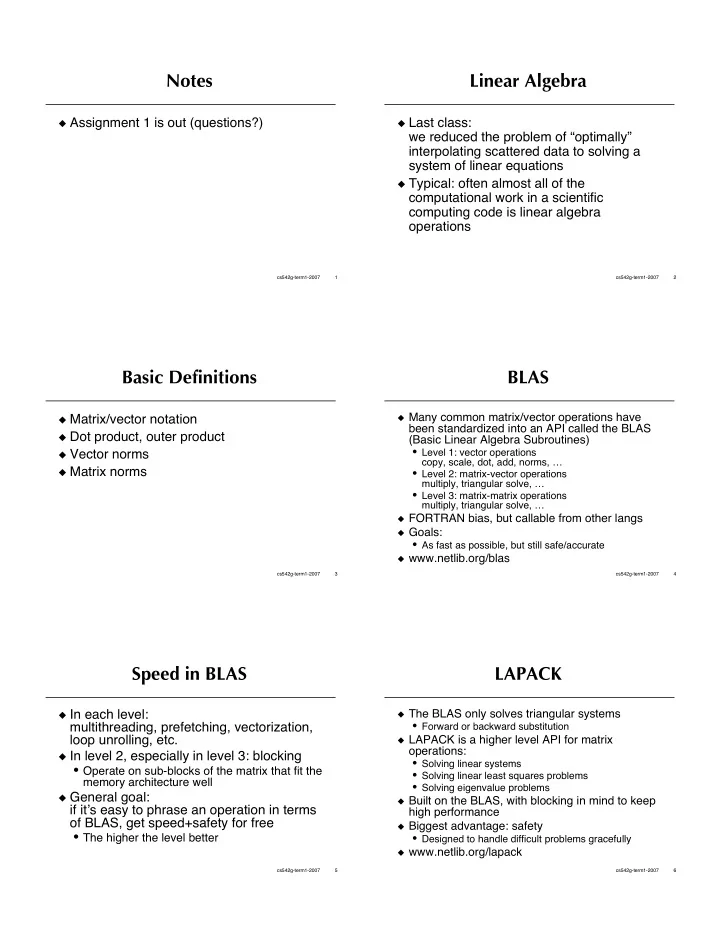

SLIDE 1
1 cs542g-term1-2007
Notes
Assignment 1 is out (questions?)
2 cs542g-term1-2007
Linear Algebra
Last class:
we reduced the problem of “optimally” interpolating scattered data to solving a system of linear equations
Typical: often almost all of the
computational work in a scientific computing code is linear algebra
- perations
3 cs542g-term1-2007
Basic Definitions
Matrix/vector notation Dot product, outer product Vector norms Matrix norms
4 cs542g-term1-2007
BLAS
Many common matrix/vector operations have
been standardized into an API called the BLAS (Basic Linear Algebra Subroutines)
- Level 1: vector operations
copy, scale, dot, add, norms, …
- Level 2: matrix-vector operations
multiply, triangular solve, …
- Level 3: matrix-matrix operations
multiply, triangular solve, …
FORTRAN bias, but callable from other langs Goals:
- As fast as possible, but still safe/accurate
www.netlib.org/blas
5 cs542g-term1-2007
Speed in BLAS
In each level:
multithreading, prefetching, vectorization, loop unrolling, etc.
In level 2, especially in level 3: blocking
- Operate on sub-blocks of the matrix that fit the
memory architecture well
General goal:
if its easy to phrase an operation in terms
- f BLAS, get speed+safety for free
- The higher the level better
6 cs542g-term1-2007
LAPACK
The BLAS only solves triangular systems
- Forward or backward substitution
LAPACK is a higher level API for matrix
- perations:
- Solving linear systems
- Solving linear least squares problems
- Solving eigenvalue problems
Built on the BLAS, with blocking in mind to keep
high performance
Biggest advantage: safety
- Designed to handle difficult problems gracefully
www.netlib.org/lapack