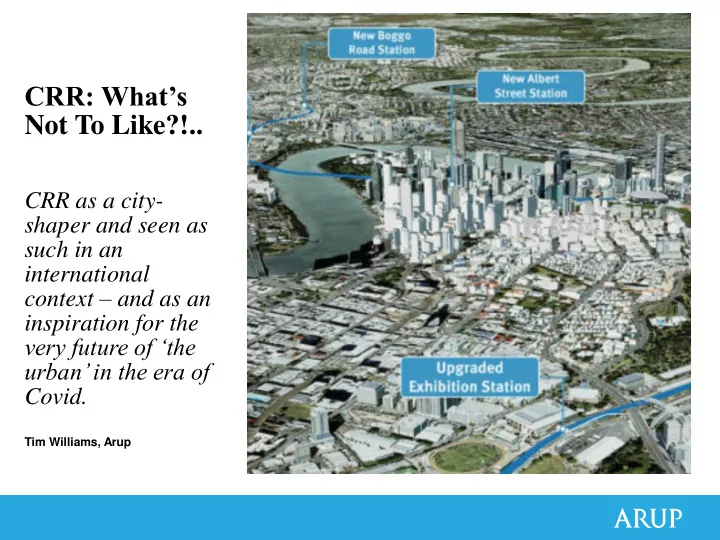
SLIDE 1 CRR: What’s Not To Like?!..
CRR as a city- shaper and seen as such in an international context – and as an inspiration for the very future of ‘the urban’ in the era of Covid.
Tim Williams, Arup
SLIDE 2 2
- What I like about CRR: indeed what’s not to like!
- Its potential importance and impact in this city and region
- But also what urbanists internationally – and the rest of
Australia can learn from it in terms of land-use and transport integration and city-shaping:
- Suggestions for adding further value to CRR: leveraging its
TODS through local collaborations
- Covid implications – locally and cities generally: CRR as an
important initiative – a confidence builder and inspiration- at a time of challenge for ‘the urban’. Density has been attacked when the failure in a NYC has been of health management.
- Supporting I suspect a more economically resilient , inclusive
and indeed public –health structured ‘city region’ beyond the year of Covid: a networked city region with a more distributed economy than we have seen
Things I will talk about
SLIDE 3 3
1st inevitably, the Covid moment: Empty cities, Mass transit with less mass…Is this Temp/Perm/Tactical/strategic: What to re-start? What to rethink? ‘Bouncing Forward’! I think despite these challenges CRR actually enables the city region to be more resilient economically and indeed in terms of public health
SLIDE 4 4
- What have we stopped doing that should remain
stopped?
- What have we stopped doing that we should bring
back?
- What have we started doing that we need to stop?
- What have we started doing that we should continue to
do
- What are we not doing now that we have never done
before, but that we might need?
I don’t know what the ‘new normal’(annoying phrase) is, I just know there will be one. These questions asked by a big city council of staff are useful
SLIDE 5 5
But: there are opportunities as well as challenges No-one would ever have thought that ‘social distancing’ would be accepted and implemented: the Covid window! Use it…
SLIDE 6
What kind of city do u want? High emissions/low density/car city when air quality may be associated with Covid impact or low emissions, medium density, PT city: What the new parameters to urban imagination? Will cities be more polycentric? How rail support that city /CRR as Covid resilient-city agenda.
6
Covid window makes you think about fundamentals: the public health driven city
SLIDE 7 Living with uncertainty all the time ….The picture
foreseen in 1900; and few notice the cars have no exhausts: these were electric cars: a future not chosen.The future I chose at the back end of the 90s was to seek to change East London via transport projects: I was lucky to be involved in CTRL, Crossrail, DLR extensions across the Thames and London Overground
AWarning about all Urban Forecasting
SLIDE 8 8
So I am going to talk about city-shaping and transport: I ended up advising this bloke on that stuff ..
SLIDE 9
And this one too: he keeps strange company!
SLIDE 10
But then it’s all relative …. so I came here with my Sydney-born wife in 2010: The Member for Manly!
SLIDE 11 And I nearly went on to do this: was on the Board
- f Compass Housing in 2015-16: Logan.
SLIDE 12 12
CTRL How I became an advisor and goes to heart of what I advise on now (WS airport line/Faster rail): Arup, councils and I – we beat Treasury! No CTRL, No Stratford, Kings Cross, Olympics: city shaper par excellence: failed BCR test…..Treasury :’it adds travel time to Paris’. Us: ‘it remakes London’
SLIDE 13
SLIDE 14
..became this I worked for Lend Lease CEO on this (slightly more EE than remembered)… and enabled…
SLIDE 15
..a reshaped East London- and bound London’s East-West closer together : helped promote Crossrail too which also binds E/W and /N/S.
SLIDE 16
So Kings Cross now has higher commercial rents than the City’s financial district: again opposed by Treasury
SLIDE 17
Treasury also rejected Jubilee +DLR to Canary Wharf
100,000 jobs at 200k per head later: I will discuss appraisal as we tend to value stuff that doesn’t happen(travel time) over stuff that does(land use transformation and econ uplift): CRR is exemplar for government appraisal process that balances the importance of travel time reduction with broader city shaping impact.
SLIDE 18 Was also involved in this:London Overground connecting across the Thames treasury opposed again: Rail makes cities
Within 250m of East London Line stations:
- Above average property price
growth
- Employment rates increased
- Educational attainment
improved
New travel patterns created. Catalyst for Shoreditch as Tech Hub.
SLIDE 19 19
Treasury didn’t then get rail or that transport benefits were wider than travel time. This research persuaded UK Parl to back X rail as providing higher job agglomeration without road congestion(induced demand avoided): this is why CRR.
SLIDE 20 20
People think it’s just the laneways that led to Melbourne’s post mid 90s boom: rail!
SLIDE 21 Jobs within 30 minutes travel time by public transport of SOP: 76,000 Residents within 30 minutes travel time by public transport of SOP: 107,000
Sydney Olympic Park Today
Current 30 minute catchment
Here’s a Sydney example of a city-shaping and trans- formational transport project (one we’ve worked
new Metro does to the centre of city
SLIDE 22 Current 30 minute catchment 30 minute catchment in 2026 with Metro and Light Rail Jobs within 30 minutes travel time by public transport of SOP: 771,000 Residents within 30 minutes travel time by public transport of SOP: 536,000
Goes from 76,000 to 750,000 job access in 30 mins:is transforming masterplan for the area but that’s not where innovation or intervention stops.
This is GPOP: where GSC has innovated PIC re place-planning and place- appraisal:Transport infrastructure needs cross government infrastructure collaboration and governance to deliver all the connectivity and place benefits. Sydney Olympic Park With the Metro and Light rail
SLIDE 23 Stations can be necessary but not sufficient to create value: further local leveraging required: like a TOD reception strategy involving precinct collaborations.
The potential success of transport investment will be maximised where transport investment is coordinated with
- ther complementary investment or policy initiatives.
Where this is not the case, the potential for rail and stations to drive these economic benefits is more limited.
SLIDE 24
For example: Quality of public realm at TOD matters to value, so who works to deliver that result in collaboration with station delivery?
SLIDE 25
CRR: will be prototype for understanding real city shaping and economic impact of rail: and shape new (better)appraisal process.
SLIDE 26
It will show I am sure that jobs rise with proximity to station as does resi:
SLIDE 27 It will show HOW TODS WORK:virtuous circle
- f investment/re-investment
SLIDE 28 28
A network of TODS: World Bank 3 Vs framework for TOD/place strategy at specific locations
SLIDE 29
It will show why rail and note health benefits too CRR an exemplar but do the base line to show!
SLIDE 30 CRR will I think spread liveability and walkability –
inner city agenda? People Walk to PT stations
Liveability: Are these awards really re inner city? areas?
SLIDE 31 The structure of Sydney is not
- nly dividing us, it is making
some communities ill. Walkability and PT issue. The West has low% of what Leinberger calls ‘Walkable Urban’ precincts and we see the results economically and in health: key policy must be to expand walkability of WS
Access to walkability unevenly distributed in Aus cities. This is WS where there is little PT to walk to. And the result isn’t just annoying or minor:
is highly deadly/unliveable: the
being met!
CRR will increases walkability via walking to stations
SLIDE 32
CRR has been telling the right story: connecting beneficiaries to funding
SLIDE 33
It will I hope feed into a new infrastructure appraisal process/business cases to value this stuff across Australia.
SLIDE 34
But the full impact of rail investment comes from leveraging other benefits around stations : need for reimagining TODS and neighbourhoods nr CRR stations. Superbia and leveraging TODS and making precincts and suburbs near them more mixed use after Covid needs planning and governance beyond a single govt department like the GSC approach at GPOP but not just that model.
SLIDE 35 We’ve been thinking of Living Stations TOPS!
movement for people: think who uses them and why
growth
- 3. As the heart of healthy
communities
distributed city economy
SLIDE 36 At the heart of mixed-use places
- Innovative governance to facilitate inclusive growth
- Integrated development strategies
- Connecting jobs to homes
- Reducing dependency on cars
- Station Improvement Districts
Stations can drive inclusive and sustainable growth
SLIDE 37 Welcome to our community
- Knowledge hubs
- Skills access hubs
- Incubation spaces
- Distance learning
- Income through educational links
- More opportunities for local communities
- Strong links to business, commerce and
innovation
Stations can drive inclusive and sustainable growth
SLIDE 38 A network of station public spaces
- Enlarged and improved public
spaces around stations
- New infrastructure promoting
active travel like cycling and walking
infrastructure
- Create sense of arrival and
pride
Stations as the healthy heart of future communities
SLIDE 39
SLIDE 40 40
An aside: I love how they are doing different TOD typologies in Denver: which also help fund the infrastructure. Value uplift: relevant to CRR?
SLIDE 41
What I think CRR actually is doing is city- shaping
Not quite the 15 minute city-region-Paris won’t be either- but on its way to being a 30 one connecting a series of walkable mixed use centres: with a stronger, more resilient structure than a radial city
SLIDE 42 42
CRR enables changed networked, more polycentric econ future via enhanced nodes:Hub AND SPOKES
SLIDE 43
A New Ecosystem of City Places will emerge: more polycentric and well connected to core: perhaps 30% fewer jobs in CBD; but increases at TODS/ neighbourhood centres :CRR enables networked city resilience.
SLIDE 44
With mixed use neighbourhoods /precincts with co-working spaces in or near TODS
SLIDE 45 45
- We need to learn from it: will be watched
internationally
- Leverage it locally at each station to create a mini
mixes use , walkable eco-system: the more distributed , networked city with Brisbane CBD as its hub
- Measure the benefits
- In so doing restore international confidence in the new
city structured by this rail system
…CRR: what’s not to like?!