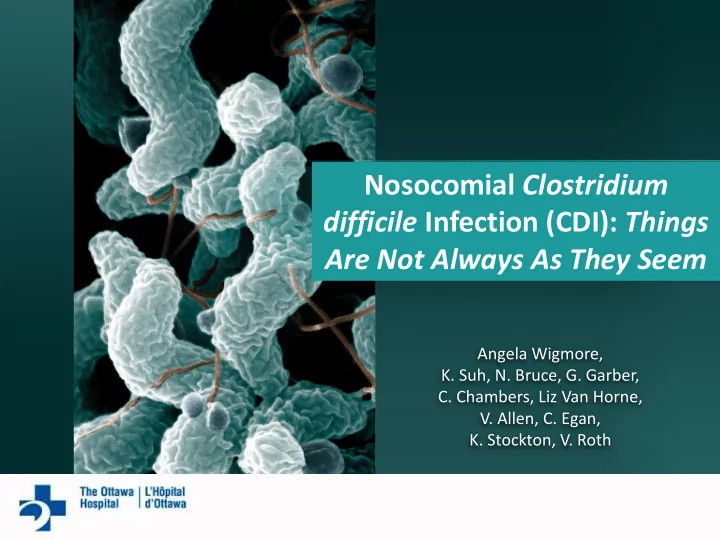
Nosocomial Clostridium difficile Infection (CDI): Things Are Not - - PowerPoint PPT Presentation

nosocomial clostridium
SMART_READER_LITE
LIVE PREVIEW

Nosocomial Clostridium difficile Infection (CDI): Things Are Not - - PowerPoint PPT Presentation

Nosocomial Clostridium difficile Infection (CDI): Things Are Not Always As They Seem Angela Wigmore, K. Suh, N. Bruce, G. Garber, C. Chambers, Liz Van Horne, V. Allen, C. Egan, K. Stockton, V. Roth Disclosure None of the authors on this


slide-1
SLIDE 1

Angela Wigmore,

  • K. Suh, N. Bruce, G. Garber,
  • C. Chambers, Liz Van Horne,
  • V. Allen, C. Egan,
  • K. Stockton, V. Roth

Nosocomial Clostridium difficile Infection (CDI): Things Are Not Always As They Seem

slide-2
SLIDE 2

Disclosure

  • None of the authors on this presentation have

anything to disclose

slide-3
SLIDE 3
  • Clostridium difficile is an anaerobic gram positive spore

forming bacterium

  • It can cause a severe inflammatory colonic disease with

a high morbidity and mortality

  • Most commonly associated with health care, occurring

in hospitals and other health care facilities

Clostridium difficile

slide-4
SLIDE 4

Setting

  • The Ottawa Hospital (TOH): A multi site tertiary care

facility with 1,200 beds

  • Most acute inpatient care is provided at 2 sites

Civic

slide-5
SLIDE 5

Background

  • CNISP CDI rates were stable between 1997- 2007

(0.66 and 0.73 per 1000 patient days, respectively)*

  • Healthcare – associated CDI is frequent and of

increasing severity

  • CDI attributable mortality increased from 1.5% in

1997 to 5.3% in 2011 per 100 HA-CDI cases*

*Public Health Agency of Canada, CNISP, Clostridium difficile Associated Disease (CDAD) Surveillance

slide-6
SLIDE 6

Issue

  • 2012-2013 we experienced several prolonged
  • utbreaks on our in patient units despite

reinforcement of:

  • routine practises
  • prompt isolation of symptomatic patient
  • enhanced environmental cleaning with bleach
  • implementation of bedpan liner waste management

transmission persisted

slide-7
SLIDE 7

Issue Continued

  • In spite the implementation of these measures as

well as the increase in resources and energy the

  • utbreaks were not terminated
  • Several units continued to have an increase in

nosocomial cases

  • Public Health Ontario was asked to conduct a

review

slide-8
SLIDE 8

Definition

  • Outbreak was defined as 3 or more geographically

clustered cases of laboratory confirmed HA-CDI on

  • ne w/u within 7 day or 5 cases within 4 weeks
  • Healthcare associated CDI was defined as onset of

symptoms >72 hours after admission or symptoms present on admission with a previous admission in the preceding 8 weeks

slide-9
SLIDE 9

Investigation

  • Public Health Laboratory performed molecular typing
  • f outbreak isolates
  • Methodology used was pulse-field gel electrophoresis

(PFGE)

  • 41 isolates from 9 different outbreaks involving 48

patients (~3-9/outbreak) were typed

slide-10
SLIDE 10

V

CDI CDI CDI CDI CDI CDI CDI CDI CDI

H NAP 4 G L M NAP 1 E NAP11 F

Floor Plan of An Outbreak Unit B

slide-11
SLIDE 11

PFGE Typing

Different Same

*Provided by Marina Lombos, Public Health Laboratory, Toronto, Ontario

slide-12
SLIDE 12

Results

  • NAP-1 strain accounted for 39% of all isolates but was

the predominant strain in only one outbreak

  • 16 different PFGE patterns were identified
  • A median of 3 PFGE patterns was identified in each
  • utbreak (range 2-6)
  • Findings suggested that isolates from our outbreaks

at TOH were polyclonal

slide-13
SLIDE 13

Outbreak Typing Results

Campus Unit No. patients

  • No. samples

typed

  • No. unique

strains Predominant Strain General A 5 4 2 none B* 12 9 9

none

C* 9 8 6

none

D 9 8 5

none

E 3 2 2

none

Civic F* 10 10 3

NAP1

TOTAL 48 41 16

NAP1

* 2 outbreaks on each of these units

slide-14
SLIDE 14

Lessons Learned

  • Things are not always as they seem. HA cases that

appear to be linked were caused by different strains of Clostridium difficile

  • In spite of our findings basic infection prevention

measures remain the cornerstone in reducing transmission of Clostridium difficile

slide-15
SLIDE 15

Conclusion

  • Prevention strategies need to shift with a greater

focus on appropriate antimicrobial use

  • Typing did not produce the results we expected

leaving many questions still unanswered

  • The epidemiology of CDI in the community also

deserves further study.

slide-16
SLIDE 16

Acknowledgements

I would also like to thank and recognize the following individuals:

  • Dr Gary Garber
  • Cathy Egan
  • Liz Van Horne
  • Vanessa Allen
  • Marina Lombos