North Bay Community Resilience Initiative: The path to energy - - PowerPoint PPT Presentation

north bay community resilience initiative
SMART_READER_LITE
LIVE PREVIEW

North Bay Community Resilience Initiative: The path to energy - - PowerPoint PPT Presentation

North Bay Community Resilience Initiative: The path to energy resilience and sustainability John Sarter Program Manager, NBCRI Clean Coalition 415-342-7199 mobile johns@clean-coalition.org Making Clean Local Energy Accessible Now Clean


slide-1
SLIDE 1

Making Clean Local Energy Accessible Now

John Sarter

Program Manager, NBCRI Clean Coalition 415-342-7199 mobile johns@clean-coalition.org
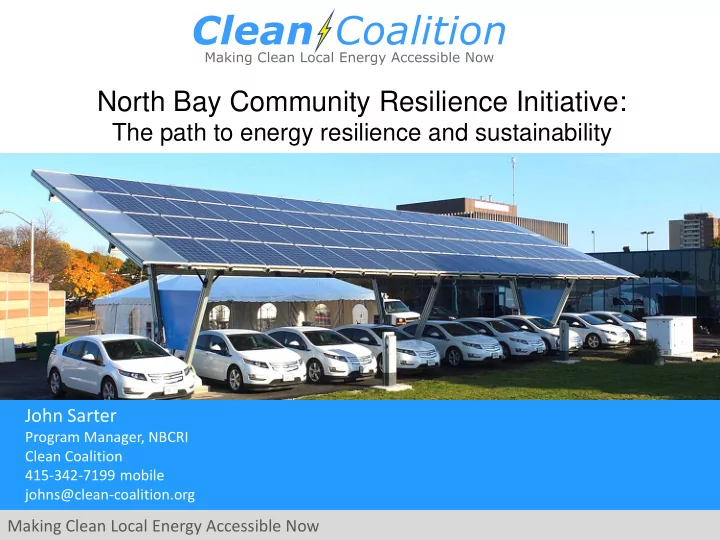
North Bay Community Resilience Initiative:

The path to energy resilience and sustainability

slide-2
SLIDE 2

Making Clean Local Energy Accessible Now

2

Clean Coalition; Areas of Expertise

Analysis & Planning Program and Policy Design Community Microgrid Projects Grid Modeling & Optimization

Powerflow modeling; DER optimization

  • PG&E
  • PSEG
  • SCE

Grid planning, procurement, and interconnection

  • LADWP, Fort Collins,

PSEG

  • City of Palo Alto (FIT

and solar canopy RFP)

  • RAM, ReMAT
  • Rule 21 & FERC

Design and implementation

  • San Francisco, CA
  • Long Island, NY
  • Montecito, CA
  • U.S. Virgin Islands

Full cost and value accounting for DER; siting analysis

  • PG&E
  • PSEG
  • SCE
slide-3
SLIDE 3

Making Clean Local Energy Accessible Now

3

Clean Coalition (501c3 nonprofit); Mission

To accelerate the transition to renewable energy and a modern grid through technical, policy, and project development expertise

slide-4
SLIDE 4

Making Clean Local Energy Accessible Now

4

Reaction vs. Resilience

Reaction to disaster is how we are operating now, by declaring

emergencies, and implementing temporary emergency measures for rapid rebuilding after catastrophic events. This is important, however…

Resilience can be created by resolving to move forward proactively

for the long term in ways that will increase our ability to strategize, rebuild in better ways, adapt, and better manage resources that stay powered and fully capable when catastrophe strikes again.

slide-5
SLIDE 5

Making Clean Local Energy Accessible Now

5

North Bay Community Resilience Initiative: Aims

  • Track, publicize, and support cutting-edge resilience-

creating energy efficiency, electrification, and microgrid incentives, plus policy advancements by SCP, MCE, BayREN, BAAQMD, and others.

  • Procure and develop a database of model structures

with “Community Microgrid-ready” designs: For new and retrofit residential, commercial, and municipal bldgs.

  • Develop “Electrification & Community Microgrid Ready”

(ECMR) document for homeowners and installers

  • Develop Community Microgrid roadmap beginning with

“Critical Facility” microgrid pilots such as fire stations, hospitals, and places of refuge.

  • Position these pilots in areas that are conducive to

expansion into Community Microgrids

  • Develop all as a model for resilience in rebuilding, and

for proactive resilience and community modernization

slide-6
SLIDE 6

Making Clean Local Energy Accessible Now

6

North Bay Community Resilience Initiative: Team

Stone Edge Farm Microgrid

slide-7
SLIDE 7

Making Clean Local Energy Accessible Now

7

Aim 1: Support and promote Advanced Energy Rebuild programs for Homes and stuctures Support for Rebuilding with Efficiency, Electrification, and Resilience

  • Sonoma Clean Power (SCP) and MCE Advanced Energy

Rebuild: SCP, MCE, Pacific Gas and Electric Company (PG&E), and Bay Area Air Quality Management District have joined efforts to help homeowners affected by the firestorms to rebuild energy-efficient, sustainable homes.

  • The SCP program offers two incentive packages tailored

to Sonoma and Mendocino Counties.

  • Each package has a flexible performance pathway or a

simple prescriptive menu. SCP offers up to $17,500 in incentives to electrify, add solar + energy storage, Connected EV’s, and upgrade to “connected” appliances

  • MCE has similar “Advanced Energy Rebuild” program for

the Napa fire rebuilding efforts.

slide-8
SLIDE 8

Making Clean Local Energy Accessible Now

8

Aim 2: Model Structures - Advanced Energy Rebuild Homes Showcase and provide case studies of homes being rebuilt utilizing the “Advanced Energy Rebuild”. Up to $17,500 incentives from Sonoma Clean Power and MCE, to go “all electric” and “microgrid ready”! Having a “microgrid” means when the power goes out, your power stays ON!!

Hirsch Solar Powered Residence Mini-split Heat Pump H.P Water Heater L.G. Chem Energy Storage Induction Cooking

slide-9
SLIDE 9

Making Clean Local Energy Accessible Now

9

Model Structures: Design Database

Developing a “Design Database” for model structures for New and retrofit residential, commercial, and municipal buildings

  • In collaboration with high “performance based” building
  • rganizations in the USA:
  • US DOE Zero Energy Ready Home Program

& US DOE “Solar Decathlon” Homes database

  • Passive House Institute US
  • USGBC / New Buildings Institute “Grid-Optimal”
  • Net Zero Energy Coalition
  • Rocky Mountain Institute
slide-10
SLIDE 10

Making Clean Local Energy Accessible Now

10

Electrification & Community Microgrid Ready (ECMR)

specifications document

  • Developed by the Clean Coalition and a team of industry experts, as a

Guideline for Homeowners and trades installers to easily install necessary wiring to be all-electric and “microgrid ready”

  • All-Electric benefits; Safer and healthier homes and communities;
  • Elimination of natural gas which is highly flamable, and produces formaldehyde

and other toxic gases within the home and community

  • EV adoption = Reduction and eventual elimination of all fossil fuels
  • EV’s can become “mobile energy” assets, saving and making money
  • Reduced reliance on outside fuel & energy sources
  • Reduction of greenhouse gases
  • REVENUE for homeowners by using your connected assets as grid assets
  • Microgrid benefits; Energy resilient homes and communities
  • Ability to stay powered in grid outages = Resilience and Security
  • Ability to use behind the meter and community energy storage as “grid assets” =

revenue stream

  • Energy produced by local renewable sources = local jobs
slide-11
SLIDE 11

Making Clean Local Energy Accessible Now

11

Microgrids and Community Microgrids

  • Microgrid: A coordinated set of behind-the-meter

(BTM) local renewable energy, energy storage, and

  • ther Distributed Energy Resources (DER) that can be

islanded (from the local grid) at the customer meter.

  • Community Microgrid: A coordinated set of local

renewables, energy storage, and other DER that can also be islanded, (from the larger grid) across a defined distribution grid area to provide indefinite renewables-driven resilience to critical community facilities, and other structures within the community.

slide-12
SLIDE 12

Making Clean Local Energy Accessible Now

12

Benefits of Microgrids

Financial and Impacts of Building or “Unit” Scale Microgrids

  • Lower operation costs (near “0” energy bills)
  • Revenue from excess energy export (HOA dividends??)
  • Renewable transportation energy – (100% R.E. EV charging)
  • All electric and “tighter” buildings = better I.A.Q. = healthier

homes

  • Energy “resilience”, and fire “resilience” (with fire resistive

materials)

  • Home is a community resilience asset / and a grid asset
  • Elimination of fossil fuels (reduced GHG emissions )
  • Safer buildings and communities

= Higher appraised property values

slide-13
SLIDE 13

Making Clean Local Energy Accessible Now

13

Critical Facility Microgrids

  • Critical Facility Microgrids; “Island” from the Grid in

the event of grid outage or disruption to power critical loads for community services, safety, and security. They include renewable energy, and energy storage assets.

  • Hospitals; Kaiser Permanente Richmond Microgrid
  • Fire Stations; City of Fremont Fire Station Microgrid
  • Places of refuge; Seattle Community Center Microgrid
  • Campus Microgrids; Stone Edge Farm Microgrid

Kaiser Permanente Richmond Microgrid Freemont Fire Station MIcrogrid Seattle Community Center Microgrid

Stone Edge Farm Microgrid

slide-14
SLIDE 14

Making Clean Local Energy Accessible Now

14

Critical Facility microgrids focus on single customers

slide-15
SLIDE 15

Making Clean Local Energy Accessible Now

15

Community Microgrids can serve up to thousands of “prosumer” and “consumer” utility customers

CRITICAL FACILITY MICROGRIDS

“PROSUMERS”

“PROSUMERS”

“Prosumers”: Utility customers that both produce energy for, and consume energy from the grid or microgrid

slide-16
SLIDE 16

Making Clean Local Energy Accessible Now

16

Community Microgrid benefits

  • Reliability and power continuity
  • Local control of energy
  • Permanent local jobs in energy,

installation, and maintenance

  • Local energy for EV transportation

systems

  • Network of “Prosumers” share the

use, generation, and revenue of and from energy.

  • No “Peaker” Power Plants
  • Reduced transmission losses
  • Enhanced safety
  • GHG reductions
  • Resilience and energy security
  • National Security
  • Reduced Global conflicts
  • Peace time infrastructure spending
  • mmunity Microgrids can serve up

to thousands of “prosumer” and “consumer” utility customers

CEC California Microgid Roadmap

slide-17
SLIDE 17

Making Clean Local Energy Accessible Now

17

Nanogids and Community Microgrids for revenue and RESILIENCE

www.solluxalpha.com Panasonic Microgrid Smart City, Japan

slide-18
SLIDE 18

Making Clean Local Energy Accessible Now

18

Sol Lux Alpha

SOL LUX ALPHA – First PH Certified multi-unit Nanogrid to US Market

  • 4 unit, 6 story, N+E using only PV within the building envelope
  • All electric – Fossil Fuel Free
  • Passive House PHIUS + US DOE Zero Energy Ready Home program

(Includes Energy Star, Indoor Air Plus, EPA “WaterSense”)

  • WINNER of the US DOE Housing Innovation Award for Multi-Family
  • WINNER of 2018 PHIUS “Best overall Project” in North America
  • US DOE ZNERH recognizes Passive House as “high bar” for efficiency
slide-19
SLIDE 19

Making Clean Local Energy Accessible Now

19

Net Positive Energy buildings

Net Positive Energy – How do you get there?

Passive House Baseline + industry best efficient systems

Passive House methodology reduces energy for HVAC by 80%

  • Passive Solar design
  • Air source heat pumps for HVAC, DHW, Clothes drying
  • 100% L.E.D. lighting
  • Automatic occupancy and vacancy sensors
  • AEK – High efficiency Induction cooktops and Bosch “Benchmark” Appliances
  • Next Gen projects - Moving to DC Appliances and systems
slide-20
SLIDE 20

Making Clean Local Energy Accessible Now

20

Sol Lux Alpha Nanogrid systems

SOL LUX ALPHA - Nanaogrid systems

  • Sunpreme GxB 380w Bifacial panels (up to 25% boost) = 475w
  • Tesla Energy Powerwall x3 (triple redundancy, 2-3 days energy)
  • Blue Planet Energy “Blue Ion” for 3 phase loads (elevator & commons)
  • VEHICLE-TO-BUILDING (V2B) ENERGY enabled
slide-21
SLIDE 21

Making Clean Local Energy Accessible Now

21

Nonogrid to Microgrids = Resilience + Revenue

Sol lux alpha N+E “Nanogrid” condominium zero carbon living + transportation

San Francisco, Ca

  • 6 story 4 unit building – generating approx. 2x energy

required from solar PV completely within the building footprint

  • Excess energy = 4056 kWh (4 Megawatts – 1 of 4 units)
  • SCP Excess Generation Tariff – 4056 kWh X Retail rate + $.01

(up to $5000 maximum annually)

  • If retail rate is avg of $.10/kWh - $.11 x 4056 = $446.16 check
  • Excess energy for approx 15,000 miles EV driving per unit

(15,000 mi. / 30mpg = 500 gallons fuel x $3.50 = $1,750.00

  • Add Energy Storage – “Load shift”; charge from solar and

during low tou rate periods, use and sell energy back at PEAK tou rates ! HIGHLY RESILIENT MICROGRID STRUCTURES = PROSUMER NETWORK

slide-22
SLIDE 22

Making Clean Local Energy Accessible Now

22

V2B Technologies

V2B

(Vehicle to Building energy transfer)

  • Enables V2G
  • EXTENDS “ENERGY” BEYOND THE BUILDING
  • Reduces need for site based ESS
  • “Mobile Energy Assets” for community

resilience

slide-23
SLIDE 23

Making Clean Local Energy Accessible Now

23

Future Trends: “Mobile Energy” Microgrids

Microgrids + bi-directional EV’s = Aggregated “Mobile” Community Microgrids

  • Solar PV can export to grid or charge EV’s at daytime when solar energy is peaking

EV’s can bring that energy “home” and use for residential power at evening/night

  • Charge EV’s when rates are low, and use in evening when rates are high (load shifting)
  • Once stationary and mobile ancillary ESS grid services are enabled at scale,

(and aggregated) fossil fuel peaker plants become unnecessary

  • More behind meter ESS + mobile ESS assets results

in reduced need for community scale solar / wind + ESS’s

  • Greater resilience is created by virtue of distributed

systems, and fewer single points of failure

  • “Mobile energy” from bi-directional EV’s

reduces need for site based ESS & transmission wires

  • Add Community Scale R.E. & (mobile) storage at

points of grid connection to provide ancillary grid and microgrid services = revenue for the microgrid

Volkswagen Announces: “Elli”