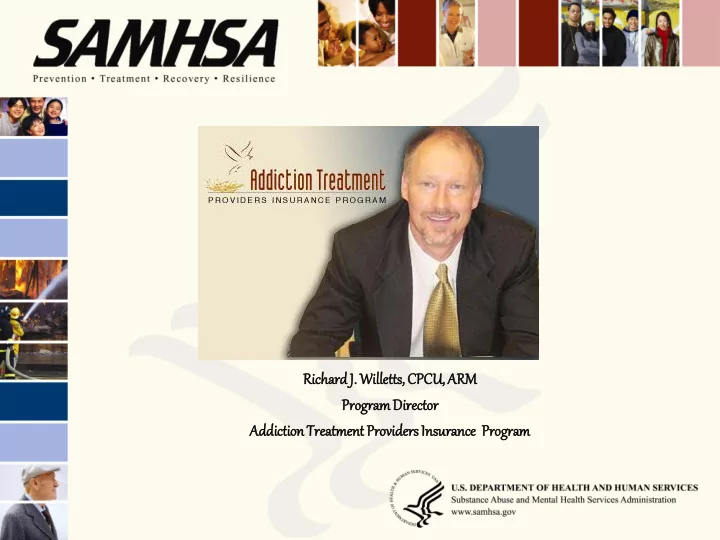
SLIDE 1 Ric Richard rd J.
illet etts, CPCU CPCU, ARM ARM Pr Prog
ram Dir Director Addi Addiction n Tr Treatmen ent t Pr Provider ers Insu Insura rance e Pr Prog
ram
SLIDE 2
ADVERSE DRUG EVENT LIABILITY AND INSURANCE CLAIM TRENDS IN OTPs
SLIDE 3
Malpractice Claims and Lawsuits are almost always settled out of court Very few methadone-related suits have been tried in the U.S. ---- outcomes have not been favorable for OTPs.
SLIDE 4
Adverse drug event claims in OTPs are a growing concern for insurers. Two general aspects of the industry are bringing increased scrutiny to OTPs: Significant increases in the overall number of methadone-related deaths (incl. pain clinics) Public information and news articles about methadone increasingly negative about OTPs and the safety of the medication`
SLIDE 5 Two overriding trends in OTP claims involving adverse drug events:
- 1. Increased FREQUENCY of reported incidents and
claims made.
- 2. Increased SEVERITY of outcomes and settlements.
SLIDE 6
Observations about Increased Frequency trend: Reduced stigma-----emboldened claimants. Greater availability of information-----the internet. More attorney involvement-----lots of hungry lawyers. New causes of action-----cardiac, impaired drivers.
SLIDE 7
Observations about Increased Severity trend: More attorney involvement-----driving up claim costs. Greater availability of information-----the internet. Patient demographic shift-----greater economic value of lives of patients.
SLIDE 8 The Insurance Market Cycle
Insurance pricing and availability experiences cyclical swings primarily based on the level of capital or surplus in the market that is available to pay claims. Surplus can be depleted slowly by a general increase in
- verall claims and loss costs versus premiums collected, or it
can be depleted rapidly by a catastrophic event(s). “Hard Market” is characterized by decreased competition among carriers, higher rates, more stringent coverage terms and conditions. “Soft Market” is characterized by increased competition among carriers, lower rates, and broader coverage terms and conditions.
SLIDE 9 This graph highlights the last 3 “hard market” cycles, and shows that we have been in a soft market since 2002. The 2009 results are expected to continue lower.
SLIDE 10 This graph shows the sharp drop in ROE (return on equity) for insurance carriers in 2008. The 2009 results are expected to continue to worsen. How long will carriers lose money until the overall market starts to swing from soft to hard?
SLIDE 11
OTPs are considered “sub prime” risks by insurance carriers primarily due to the increase frequency and severity trends, which cannot be offset by higher rates during a soft market. OTPs and other sub-prime risks will be the first industries to feel the effect of the insurance market turn as some carriers abandon the segment, remaining carriers increase rates and limit coverage.
SLIDE 12 Individual OTPs have no control over the insurance market cycle, but they can and should deploy risk management strategies now to make themselves more attractive to insurance carriers when the market hardens. By implementing RM strategies now, an OTP can secure even better pricing and terms during the remainder of the soft
- market. They can also expect to have a better track record of
loss experience and be in best possible position to withstand the inevitable hard market.
SLIDE 13
INSURANCE CLAIM EXPERIENCE WITH OTPs AND HEALTHCARE PROVIDERS IN GENERAL, CLEARLY SHOWS THAT PROVIDING QUALITY CLINICAL CARE IS THE MOST EFFECTIVE WAY TO MANAGE YOUR LIABILITY EXPOSURE.
SLIDE 14
The Basic Tenets of Risk Management in a Healthcare Provider (the four “C”s)
SLIDE 15
- 1. Stay CURRENT with scientific
and clinical information about methadone and best practices in OTPs.
SLIDE 16
- 2. Thoroughly COLLECT patient
info before and during treatment.
SLIDE 17
3 COMMUNICATE with patients (e.g. informed consent), family members, and other healthcare providers.
SLIDE 18
patient’s records.
SLIDE 19
A good Risk Management Culture starts at the top and permeates an organization from top to bottom. Consider putting a key employee in charge of risk management for your OTP---provide top level support for this person. Continuous training and reinforcement of the rules and guidelines of your organization are critical for all clinical staff.
SLIDE 20 Strive to provide top quality clinical care and pay close attention to the basic risk management tenets
- utlined. Make this a source of pride in your
- peration.
You can’t avoid risk completely, But you can manage it.