SLIDE 1
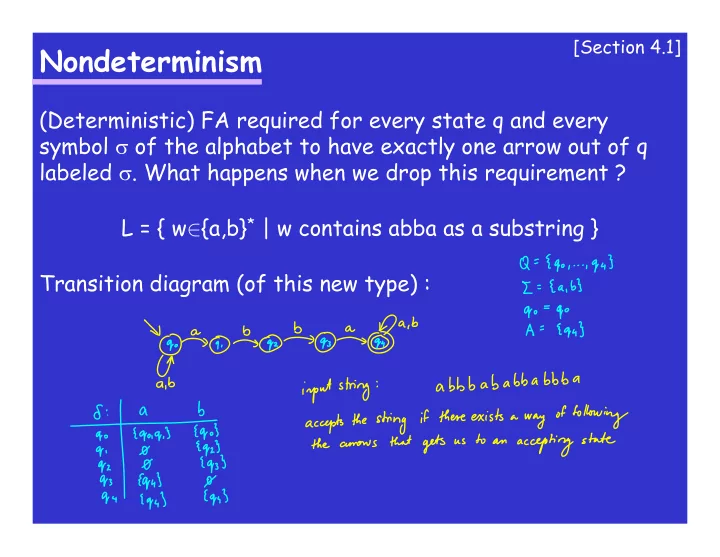
Nondeterminism
(Deterministic) FA required for every state q and every symbol σ of the alphabet to have exactly one arrow out of q labeled σ. What happens when we drop this requirement ? L = { w∈{a,b}* | w contains abba as a substring } Transition diagram (of this new type) :
[Section 4.1]
SLIDE 2 Formal definition of an NFA
[Section 4.1]
A nondeterministic finite automaton (NFA) is a 5-tuple (Q,Σ,q0,A,δ) where
- Q is a finite set of states
- Σ
is a finite alphabet (input symbols)
- qo ∈ Q is the initial state
- A ⊆ Q is a set of accepting states
- δ : Q×Σ → ___ is the transition function
Give a formal definition of the NFA from the previous slide.
SLIDE 3
Defining the computation of an NFA M=(Q,Σ,q0,A,δ). Extended transition function δ* : Q×Σ* → ____ : 1) For every q ∈ Q, let δ*(q,Λ) = 2) For every q ∈ Q, y ∈ Σ*, and σ ∈ Σ, let δ*(q,yσ) = We say that a string x ∈ Σ* is accepted by M if ________ . A string which is not accepted by M is rejected by M. The language accepted by M, denoted by L(M) is the set of all strings accepted by M.
Formal definition of an NFA
[Section 4.1]
SLIDE 4
Is the following statement true ? For every FA M = (Q,Σ,q0,A,δ) there exists an NFA M1 = (Q1,Σ,q1,A1,δ1) such that L(M) = L(M1).
NFA’s vs. FA’s
[Section 4.1]
SLIDE 5
Is the following statement true ? For every NFA M = (Q,Σ,q0,A,δ) there exists an FA M1 = (Q1,Σ,q1,A1,δ1) such that L(M) = L(M1). Example :
NFA’s vs. FA’s
[Section 4.1]
a a,b b b b a
SLIDE 6
Thm : For every NFA M = (Q,Σ,q0,A,δ) there exists an FA M1 = (Q1,Σ,q1,A1,δ1) such that L(M) = L(M1). Construction of M1 :
NFA’s vs. FA’s
[Section 4.1]
SLIDE 7
Thm : For every NFA M = (Q,Σ,q0,A,δ) there exists an FA M1 = (Q1,Σ,q1,A1,δ1) such that L(M) = L(M1). Proof that L(M) = L(M1) :
NFA’s vs. FA’s
[Section 4.1]
SLIDE 8
Example : NFA accepting a*b*c*.
NFA’s with Λ
[Section 4.2]
SLIDE 9 Formal definition of an NFA-Λ
[Section 4.2]
A nondeterministic finite automaton with Λ-transitions (NFA-Λ) is a 5-tuple (Q,Σ,q0,A,δ) where
- Q is a finite set of states
- Σ
is a finite alphabet (input symbols)
- qo ∈ Q is the initial state
- A ⊆ Q is a set of accepting states
- δ : ______ → ___ is the transition function
Give a formal definition of the NFA-Λ from the previous slide.
SLIDE 10
Defining the computation of an NFA-Λ M=(Q,Σ,q0,A,δ). Extended transition function δ* : ____ → ____ : 1) For every q ∈ Q, let δ*(q,Λ) = 2) For every q ∈ Q, y ∈ Σ*, and σ ∈ Σ, let δ*(q,yσ) =
Formal definition of an NFA-Λ
[Section 4.2]
SLIDE 11
Defining the computation of an NFA-Λ M=(Q,Σ,q0,A,δ). Extended transition function δ* : Q×Σ* → 2Q : 1) For every q ∈ Q, let δ*(q,Λ) = 2) For every q ∈ Q, y ∈ Σ*, and σ ∈ Σ, let δ*(q,yσ) =
Formal definition of an NFA-Λ
[Section 4.2]
Λ-closure of a set S ⊆ Q, denoted Λ(S), is the set of all states reachable from S by a sequence of Λ-transitions. Define Λ(S) :
SLIDE 12
Defining the computation of an NFA-Λ M=(Q,Σ,q0,A,δ). Extended transition function δ* : Q×Σ* → 2Q : 1) For every q ∈ Q, let δ*(q,Λ) = Λ( { q } ) 2) For every q ∈ Q, y ∈ Σ*, and σ ∈ Σ, let δ*(q,yσ) = Λ( ∪p∈δ*(q,y) δ(p,σ) ) We say that a string x ∈ Σ* is accepted by M if __________. A string which is not accepted by M is rejected by M. The language accepted by M, denoted by L(M) is the set of all strings accepted by M.
Formal definition of an NFA-Λ
[Section 4.2]
SLIDE 13
Is the following statement true ? For every NFA M = (Q,Σ,q0,A,δ) there exists an NFA-Λ M1 = (Q1,Σ,q1,A1,δ1) such that L(M) = L(M1).
NFA-Λ’s vs. NFA’s
[Section 4.2]
SLIDE 14
Is the following statement true ? For every NFA-Λ M = (Q,Σ,q0,A,δ) there exists an NFA M1 = (Q1,Σ,q1,A1,δ1) such that L(M) = L(M1).
NFA-Λ’s vs. NFA’s
[Section 4.2]
SLIDE 15
Is the following statement true ? For every NFA-Λ M = (Q,Σ,q0,A,δ) there exists an NFA M1 = (Q1,Σ,q1,A1,δ1) such that L(M) = L(M1).
NFA-Λ’s vs. NFA’s
[Section 4.2]
SLIDE 16
Proof of Kleene’s Thm
[Section 4.3]
Kleene’s Thm: A language L over Σ is regular iff there exists a finite automaton that accepts L. Part 1 : For every regular language there exists an NFA-Λ accepting it.
SLIDE 17
Proof of Kleene’s Thm
[Section 4.3]
Kleene’s Thm: A language L over Σ is regular iff there exists a finite automaton that accepts L. Part 1 : For every regular language there exists an NFA-Λ accepting it.
SLIDE 18
Proof of Kleene’s Thm
[Section 4.3]
Part 2 : Any language accepted by an FA is regular. Let M=({1,2,3,…,k},Σ,q0,A,δ) be an FA. We will show that for every p,q,r ∈ Q, the following language is regular : L(p,q,r) = { x∈Σ* | δ*(p,x)=q and for every prefix y of x other than Λ and x we have δ*(p,y) ≤ r } Can we then conclude that L(M) is regular ?
SLIDE 19
Proof of Kleene’s Thm
[Section 4.3]
Claim : Let M=({1,2,3,…,k},Σ,q0,A,δ) be an FA. For every p,q,r ∈ Q, the following language is regular : L(p,q,r) = { x∈Σ* | δ*(p,x)=q and for every prefix y of x other than Λ and x we have δ*(p,y) ≤ r }
SLIDE 20
Proof of Kleene’s Thm
[Section 4.3]
Claim : Let M=({1,2,3,…,k},Σ,q0,A,δ) be an FA. For every p,q,r ∈ Q, the following language is regular : L(p,q,r) = { x∈Σ* | δ*(p,x)=q and for every prefix y of x other than Λ and x we have δ*(p,y) ≤ r }
SLIDE 21
Proof of Kleene’s Thm
[Section 4.3]
Claim : Let M=({1,2,3,…,k},Σ,q0,A,δ) be an FA. For every p,q,r ∈ Q, the following language is regular : L(p,q,r) = { x∈Σ* | δ*(p,x)=q and for every prefix y of x other than Λ and x we have δ*(p,y) ≤ r }
SLIDE 22
Proof of Kleene’s Thm
[Section 4.3]
Claim : Let M=({1,2,3,…,k},Σ,q0,A,δ) be an FA. For every p,q,r ∈ Q, the following language is regular : L(p,q,r) = { x∈Σ* | δ*(p,x)=q and for every prefix y of x other than Λ and x we have δ*(p,y) ≤ r }