Non-equilibrium Thermodynamics of Driven Disordered Materials Eran - - PowerPoint PPT Presentation

non equilibrium thermodynamics of driven disordered
SMART_READER_LITE
LIVE PREVIEW

Non-equilibrium Thermodynamics of Driven Disordered Materials Eran - - PowerPoint PPT Presentation

Non-equilibrium Thermodynamics of Driven Disordered Materials Eran Bouchbinder Weizmann Institute of Science Dennin s group, UCI (2011) Murali et al., PRL 107, 215501 (2011) Lowhaphandu and Lewandowski Work with: James Langer (UCSB) Scripta


slide-1
SLIDE 1

Non-equilibrium Thermodynamics of Driven Disordered Materials

Eran Bouchbinder Weizmann Institute of Science

Work with: James Langer (UCSB) Chris Rycroft (UC Berkeley)

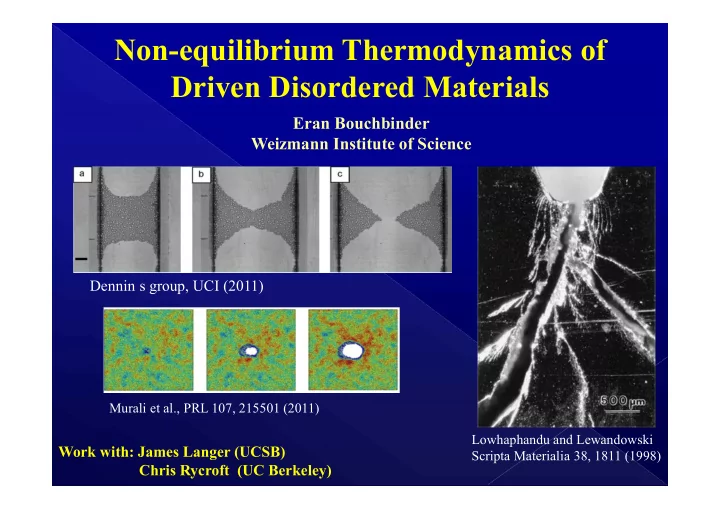
Lowhaphandu and Lewandowski Scripta Materialia 38, 1811 (1998) Murali et al., PRL 107, 215501 (2011)

Dennin s group, UCI (2011)

slide-2
SLIDE 2
  • N. Bailey et. al. PRB 69, 144205 (2004)

Simulation of Cu-Mg Metallic Glass

Microscopic picture

Devincre 3-D dislocation dynamics simulation

slide-3
SLIDE 3

The basic question

Can one develop a continuum thermodynamic framework that allows an effective macroscopic description of the collective dynamics of such microscopic objects? Fundamental properties shared by these systems:

These are all driven, strongly dissipative, systems, whose dynamics involve configurational changes that are weakly coupled to thermal fluctuations

We need concepts and theoretical tools to bridge over the widely separated scales.

slide-4
SLIDE 4

Weak coupling between these two subsystems, Timescales separation, Quasi-ergodicity due to external driving forces

EB & JS Langer, Physical Review E 80, 031131 (2009) EB & JS Langer, Physical Review E 80, 031132 (2009)

Basic idea 1: Separable Configurational + Kinetic/Vibrational Subsystems

Focus on two configurations Slow, Non-Equilibrated, Configurational rearrangements Fast, Equilibrated, Vibrational motion Mechanically stable configurations

Our approach

Total internal energy:

K C total

U U U  

Total entropy:

K C total

S S S  

slide-5
SLIDE 5

Basic idea 2: The non-equilibrium state of the system can be characterized by coarse-grained internal variables

The elastic part of the deformation A small number of coarse-grained internal variables (order parameters), describe internal degrees of freedom that may be out of equilibrium A constrained measure of the number of configurations

EB & JS Langer, Physical Review E 80, 031131 (2009) EB & JS Langer, Physical Review E 80, 031132 (2009)

}) { , , (

 E S U

C C

}) { , , (

 E U S

C C

Non-equilibrium entropy

}) { , , ( ln }) { , , (

 

    E U E U S

C C C C

When

} { } {

eq  

   ) , ( }) { , , ( E U S E U S

C C C C

 

in the thermodynamic limit

slide-6
SLIDE 6

Basic idea 2: The non-equilibrium state of the system can be (cont d) characterized by coarse-grained internal variables

Define two different temperatures:

Ordinary, equilibrium temperature Effective temperature, non-equilibrium degrees of freedom

EB & JS Langer, Physical Review E 80, 031131 (2009) EB & JS Langer, Physical Review E 80, 031132 (2009)

) , ( }) { , , ( E S U E S U U

K K C C total

  

 E K K E C C

S U S U                      

 

 }

{ ,

is a true thermodynamic temperature, e.g. it appears in equations of state, it controls the probability of configurational fluctuations etc. Early ideas in the glass/granular materials community: Edwards, Cugliandolo, Kurchan, Coniglio, Barrat, Berthier, Lemaitre and others

slide-7
SLIDE 7

The Laws of Thermodynamics

  

              

     

C K C pl tot

U S S V U V : :

The 1st law:

pl el

       

Using and E U V

C

   1 

   

   

         

 

  

C pl pl

U : V , W define

 

. ,     A A W S

K K

    

   

    , W

pl

 

         A W S C

C C eff V

 

Configurational heat equation:

 

K C

S S  

The 2nd law:

Sollich & Cates, arXiv:1201.3275 (2012)

1 ,   

C K C K

   

slide-8
SLIDE 8

Constitutive Laws: The Physics that comes after Thermodynamics Two steps: Step 1

Identify internal state variables and associate with them energy and entropy

Step 2

Develop equations of motion consistent with the laws of thermodynamics Example: Amorphous Plasticity

  • F. Spaepen, Acta Metall. 25, 407 (1977), AS Argon, Acta Metall. 27, 47 (1979)

ML Falk & JS Langer, Physical Review E 57, 7192 (1998) EB & JS Langer, Physical Review E 80, 031133 (2009) ML Falk & JS Langer, Annu. Rev. Condens. Matter Phys. 2, 353 (2011)

Density of zones (STZ)  Averaged orientation

m

( magnetization )

           

) ( ln ; , , m S S U S m S S m S S U e N S U e N U

m z z C z C z z C

                   

slide-9
SLIDE 9

Amorphous plasticity

 

   n s R n s R

pl

) , ( ) , (     

 

            

    

  n n s n s R n s R n 2 ) ( ) ( ) , ( ) , (     

Plug in the 1st and 2nd laws The upshot of the analysis: Step 2

Derive equations of motion consistent with the laws of thermodynamics

     

      n n n n m n n , R(s,θ)

(+) state (-) state

   

    , W

pl

slide-10
SLIDE 10

The final equations

slide-11
SLIDE 11

Properties of the model The yielding transition Entropic interpretation

  • f the yielding transition
slide-12
SLIDE 12

Properties of the model (cont d) Stress-strain curves and history dependence

0.1 0.2 0.3 0.4 0.5 0.6 0.5 1 1.5 2 2.5 3 3.5 4

 s (GPa)

Slow quench Fast quench

 

z

e ) ( 

1174,1237,1392,1572K 1.3eV

Demkowicz & Argon, PRL 93, 025505 (2004)

slide-13
SLIDE 13

Application: The necking instability

Dennin s group (2011)

CH Rycroft and F Gibou, J. Comp. Phys. 231 (2012) 2155

slide-14
SLIDE 14

Necking (cont d)

CH Rycroft and F Gibou, J. Comp. Phys. 231 (2012) 2155

slide-15
SLIDE 15

Application: Crack initiation (fracture toughness)

CH Rycroft & EB, work in progress (2012)

slide-16
SLIDE 16

Fracture toughness (cont d)

CH Rycroft & EB, work in progress (2012)

slide-17
SLIDE 17

More applications

slide-18
SLIDE 18

Summary and prospects A non-equilibrium thermodynamics framework for driven disordered systems was developed Many problems can be addressed within this framework (we focused here on amorphous plasticity) Open questions: Limitations? Range of validity of the adopted approximations? What roles play the mechanical noise associated with in activated dynamics? diffusion?

 