No-stakes quiz (5 minutes, 0 points, pieces, were they there? What - - PowerPoint PPT Presentation

no stakes quiz 5 minutes 0 points
SMART_READER_LITE
LIVE PREVIEW

No-stakes quiz (5 minutes, 0 points, pieces, were they there? What - - PowerPoint PPT Presentation

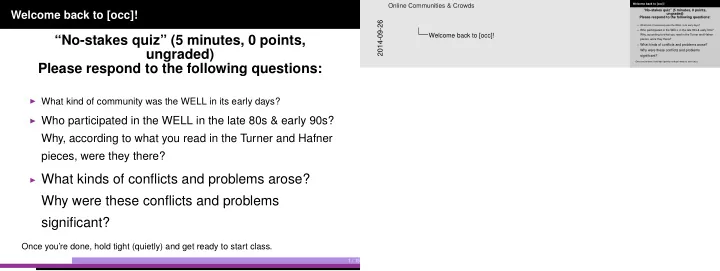
Welcome back to [occ]! Online Communities & Crowds No-stakes quiz (5 minutes, 0 points, Welcome back to [occ]! ungraded) Please respond to the following questions: 2014-09-26 What kind of community was the WELL in its early days?


slide-1
SLIDE 1

Welcome back to [occ]!

“No-stakes quiz” (5 minutes, 0 points, ungraded) Please respond to the following questions:

◮ What kind of community was the WELL in its early days? ◮ Who participated in the WELL in the late 80s & early 90s?

Why, according to what you read in the Turner and Hafner pieces, were they there?

◮ What kinds of conflicts and problems arose?

Why were these conflicts and problems significant?

Once you’re done, hold tight (quietly) and get ready to start class.

1 / 15

Welcome back to [occ]!

“No-stakes quiz” (5 minutes, 0 points, ungraded) Please respond to the following questions:

◮ What kind of community was the WELL in its early days? ◮ Who participated in the WELL in the late 80s & early 90s?

Why, according to what you read in the Turner and Hafner pieces, were they there?

◮ What kinds of conflicts and problems arose?

Why were these conflicts and problems significant?

Once you’re done, hold tight (quietly) and get ready to start class.

2014-09-26

Online Communities & Crowds Welcome back to [occ]!

slide-2
SLIDE 2

2014-09-26

Online Communities & Crowds

For today’s class we are going to travel back in time in order to understand the roots of digital utopianism and the cultural foundations of some of the most important online communities. This is really a class about “futures past” and the importance of utopias and how particular utopian visions can orient people towards a set of beliefs and actions that truly transform the world. At the same time, it is also about the ways in which particular utopias can also contain contradictions and problems that their creators and early adopters neither anticipate nor understand in a critical way. And how those contradictions and problems can become “baked into” their creations in a way that persists for a long time.

slide-3
SLIDE 3

Itinerary: (four dimensions!)

◮ Foundations: Digital Utopianism & the Electronic Frontier. ◮ Dynamic: Community culture & ideals. ◮ Case: the WELL (Hafner and Turner readings). ◮ Challenge: Conflict, rules, and power within communities (to-be-continued).

3 / 15

Itinerary: (four dimensions!)

◮ Foundations: Digital Utopianism & the Electronic Frontier. ◮ Dynamic: Community culture & ideals. ◮ Case: the WELL (Hafner and Turner readings). ◮ Challenge: Conflict, rules, and power within communities (to-be-continued).

2014-09-26

Online Communities & Crowds Itinerary: (four dimensions!)

We’re going to talk about the Whole Early ’Lectronic Link (WELL), one of the earliest and most influential online communities which you read about in the Hafner and Turner pieces. Roots in 60s counterculture and The Whole Earth Catalogue. Rise of what Turner calls “Digital Utopianism,” what that’s about & its relationship to what would be called “cyberspace,” “cyberculture,” and (my favorite) the “Electronic Frontier.” Develop the idea of community and virtual community. And finally, we’ll start to talk a little bit about conflict and power within communities. That conversation will really continue on Monday after you’ve read part of an important book by Lawrence Lessig.

slide-4
SLIDE 4

What were your initial reactions to these readings about the WELL?

What were your initial reactions to these readings about the WELL?

2014-09-26

Online Communities & Crowds

Elicit responses from 3-5 people. Ask: To what extent does the descriptions of the culture of the WELL resonate with your experiences and contexts? Can you recognize yourselves or people you know in any of it? Conclude: Key to understanding the WELL and why it’s important in the context of this course has to do with its historical and cultural origins. Understanding a little bit of this history can help you understand how the ideals that gave rise to the WELL continue to inhabit the cultural zeitgeist of subsequent online endeavors including nearly all of the major online communities and crowds we’ll discuss throughout the rest of this class.

slide-5
SLIDE 5

2014-09-26

Online Communities & Crowds

slide-6
SLIDE 6

Stephen Gaskin, founder of “The Farm” in Tennessee.

Stephen Gaskin, founder of “The Farm” in Tennessee.

2014-09-26

Online Communities & Crowds

slide-7
SLIDE 7

2014-09-26

Online Communities & Crowds

slide-8
SLIDE 8

2014-09-26

Online Communities & Crowds

slide-9
SLIDE 9

Digital Utopianism

Key components of Digital Utopianism included belief in... See: Turner, Fred. 2006. From Counterculture to Cyberculture: Steward Brand, the Whole Earth Network, and the Rise of Digital Utopianism. Chicago: U of Chicago Press.

9 / 15

Digital Utopianism

Key components of Digital Utopianism included belief in... See: Turner, Fred. 2006. From Counterculture to Cyberculture: Steward Brand, the Whole Earth Network, and the Rise of Digital Utopianism. Chicago: U of Chicago Press.

2014-09-26

Online Communities & Crowds Digital Utopianism

slide-10
SLIDE 10

Digital Utopianism

Key components of Digital Utopianism included belief in...

◮ The liberating power of technology.

See: Turner, Fred. 2006. From Counterculture to Cyberculture: Steward Brand, the Whole Earth Network, and the Rise of Digital Utopianism. Chicago: U of Chicago Press.

9 / 15

Digital Utopianism

Key components of Digital Utopianism included belief in... ◮ The liberating power of technology. See: Turner, Fred. 2006. From Counterculture to Cyberculture: Steward Brand, the Whole Earth Network, and the Rise of Digital Utopianism. Chicago: U of Chicago Press.

2014-09-26

Online Communities & Crowds Digital Utopianism

slide-11
SLIDE 11

Digital Utopianism

Key components of Digital Utopianism included belief in...

◮ The liberating power of technology. ◮ Communal or collaborative social practices & ideals.

See: Turner, Fred. 2006. From Counterculture to Cyberculture: Steward Brand, the Whole Earth Network, and the Rise of Digital Utopianism. Chicago: U of Chicago Press.

9 / 15

Digital Utopianism

Key components of Digital Utopianism included belief in... ◮ The liberating power of technology. ◮ Communal or collaborative social practices & ideals. See: Turner, Fred. 2006. From Counterculture to Cyberculture: Steward Brand, the Whole Earth Network, and the Rise of Digital Utopianism. Chicago: U of Chicago Press.

2014-09-26

Online Communities & Crowds Digital Utopianism

slide-12
SLIDE 12

Digital Utopianism

Key components of Digital Utopianism included belief in...

◮ The liberating power of technology. ◮ Communal or collaborative social practices & ideals. ◮ The value of military-industrial networks, innovation, &

progress.

See: Turner, Fred. 2006. From Counterculture to Cyberculture: Steward Brand, the Whole Earth Network, and the Rise of Digital Utopianism. Chicago: U of Chicago Press.

9 / 15

Digital Utopianism

Key components of Digital Utopianism included belief in... ◮ The liberating power of technology. ◮ Communal or collaborative social practices & ideals. ◮ The value of military-industrial networks, innovation, &

progress.

See: Turner, Fred. 2006. From Counterculture to Cyberculture: Steward Brand, the Whole Earth Network, and the Rise of Digital Utopianism. Chicago: U of Chicago Press.

2014-09-26

Online Communities & Crowds Digital Utopianism

slide-13
SLIDE 13

Who participated on the WELL?

Who participated on the WELL?

2014-09-26

Online Communities & Crowds

Elicit responses. Key points:

  • Bay Area
  • Technologists, journalists, entrepreneurs.
  • Textual interactions and long discussions. Basically, a big bulletin board/forum.
  • Shared values, connections.
  • “Sociality” & “communitas” (intense solidarity and togetherness).
slide-14
SLIDE 14

Who participated on the WELL? What did participation consist of?

Who participated on the WELL? What did participation consist of?

2014-09-26

Online Communities & Crowds

Elicit responses. Key points:

  • Bay Area
  • Technologists, journalists, entrepreneurs.
  • Textual interactions and long discussions. Basically, a big bulletin board/forum.
  • Shared values, connections.
  • “Sociality” & “communitas” (intense solidarity and togetherness).
slide-15
SLIDE 15

Who participated on the WELL? What did participation consist of? Why did people participate?

Who participated on the WELL? What did participation consist of? Why did people participate?

2014-09-26

Online Communities & Crowds

Elicit responses. Key points:

  • Bay Area
  • Technologists, journalists, entrepreneurs.
  • Textual interactions and long discussions. Basically, a big bulletin board/forum.
  • Shared values, connections.
  • “Sociality” & “communitas” (intense solidarity and togetherness).
slide-16
SLIDE 16

Who participated on the WELL? What did participation consist of? Why did people participate? Sociality & Communitas

Who participated on the WELL? What did participation consist of? Why did people participate? Sociality & Communitas

2014-09-26

Online Communities & Crowds

Elicit responses. Key points:

  • Bay Area
  • Technologists, journalists, entrepreneurs.
  • Textual interactions and long discussions. Basically, a big bulletin board/forum.
  • Shared values, connections.
  • “Sociality” & “communitas” (intense solidarity and togetherness).
slide-17
SLIDE 17

Who participated on the WELL? Three Examples

11 / 15

Who participated on the WELL? Three Examples

2014-09-26

Online Communities & Crowds Who participated on the WELL? Three Examples

slide-18
SLIDE 18

Who participated on the WELL? Three Examples

Mitch Kapor (programmer, entrepreneur)

11 / 15

Who participated on the WELL? Three Examples

Mitch Kapor (programmer, entrepreneur)

2014-09-26

Online Communities & Crowds Who participated on the WELL? Three Examples

slide-19
SLIDE 19

Who participated on the WELL? Three Examples

Mitch Kapor (programmer, entrepreneur) Katie Hafner (journalist)

11 / 15

Who participated on the WELL? Three Examples

Mitch Kapor (programmer, entrepreneur) Katie Hafner (journalist)

2014-09-26

Online Communities & Crowds Who participated on the WELL? Three Examples

slide-20
SLIDE 20

Who participated on the WELL? Three Examples

Mitch Kapor (programmer, entrepreneur) Katie Hafner (journalist) John Perry Barlow (rancher, lyricist, author)

11 / 15

Who participated on the WELL? Three Examples

Mitch Kapor (programmer, entrepreneur) Katie Hafner (journalist) John Perry Barlow (rancher, lyricist, author)

2014-09-26

Online Communities & Crowds Who participated on the WELL? Three Examples

slide-21
SLIDE 21

What sorts of conflicts arose on WELL?

What sorts of conflicts arose on WELL?

2014-09-26

Online Communities & Crowds

Elicit responses. Key points:

  • Arguments. Endless arguments.
  • Ideals, personal & professional.
  • Boundaries between public & private; “virtual” & “real” life.
  • What were the rules; who could enforce them; and how could they do so?
  • Burning disputes, sometimes resolved & sometimes not. Community politics.
slide-22
SLIDE 22

What sorts of conflicts arose on WELL? Which (if any) of these conflicts seem particularly likely online? Why (not)?

What sorts of conflicts arose on WELL? Which (if any) of these conflicts seem particularly likely online? Why (not)?

2014-09-26

Online Communities & Crowds

Elicit responses. Key points:

  • Arguments. Endless arguments.
  • Ideals, personal & professional.
  • Boundaries between public & private; “virtual” & “real” life.
  • What were the rules; who could enforce them; and how could they do so?
  • Burning disputes, sometimes resolved & sometimes not. Community politics.
slide-23
SLIDE 23

What sorts of conflicts arose on WELL? Which (if any) of these conflicts seem particularly likely online? Why (not)? What sorts of resolutions were reached?

What sorts of conflicts arose on WELL? Which (if any) of these conflicts seem particularly likely online? Why (not)? What sorts of resolutions were reached?

2014-09-26

Online Communities & Crowds

Elicit responses. Key points:

  • Arguments. Endless arguments.
  • Ideals, personal & professional.
  • Boundaries between public & private; “virtual” & “real” life.
  • What were the rules; who could enforce them; and how could they do so?
  • Burning disputes, sometimes resolved & sometimes not. Community politics.
slide-24
SLIDE 24

Is this real life or is this just fantasy?

13 / 15

Is this real life or is this just fantasy?

2014-09-26

Online Communities & Crowds Is this real life or is this just fantasy?

The WELL still exists and you can visit it. It’s not so active. Definitely not at the cutting edge or the forefront of contentious debates or transformational online communities.

slide-25
SLIDE 25

Futures past or present?

14 / 15

Futures past or present?

2014-09-26

Online Communities & Crowds Futures past or present?

Appropriate because the vast majority of the people and ideas and problems of the Whole Earth Catalogue & WELL are also still with us. Their peculiar brand of digital utopianism (communalist ideals; technological progress; military-industrial innovation) is also very much still with us. Product of a place, a time, a group of people. Likewise, the concerns and issues (such as rules, enforcement, cultural conflict) raised by the WELL are still concerns in online communities & crowds. We’ll talk more about these over the course of the quarter.

slide-26
SLIDE 26

For Monday:

◮ Visit the course website! http://aaronshaw.org/teaching/2014/occ ◮ Reading: Selections from Lessig’s Code and other Laws of Cyberspace (and anything you missed from this week!). ◮ Arrive and start on time. ◮ Contact the teaching team if you have any questions, issues, or concerns.

For Monday:

◮ Visit the course website! http://aaronshaw.org/teaching/2014/occ ◮ Reading: Selections from Lessig’s Code and other Laws of Cyberspace (and anything you missed from this week!). ◮ Arrive and start on time. ◮ Contact the teaching team if you have any questions, issues, or concerns.

2014-09-26

Online Communities & Crowds

slide-27
SLIDE 27

For Monday:

◮ Visit the course website! http://aaronshaw.org/teaching/2014/occ ◮ Reading: Selections from Lessig’s Code and other Laws of Cyberspace (and anything you missed from this week!). ◮ Arrive and start on time. ◮ Contact the teaching team if you have any questions, issues, or concerns.

Thanks and see you soon!

For Monday:

◮ Visit the course website! http://aaronshaw.org/teaching/2014/occ ◮ Reading: Selections from Lessig’s Code and other Laws of Cyberspace (and anything you missed from this week!). ◮ Arrive and start on time. ◮ Contact the teaching team if you have any questions, issues, or concerns.

Thanks and see you soon!

2014-09-26

Online Communities & Crowds