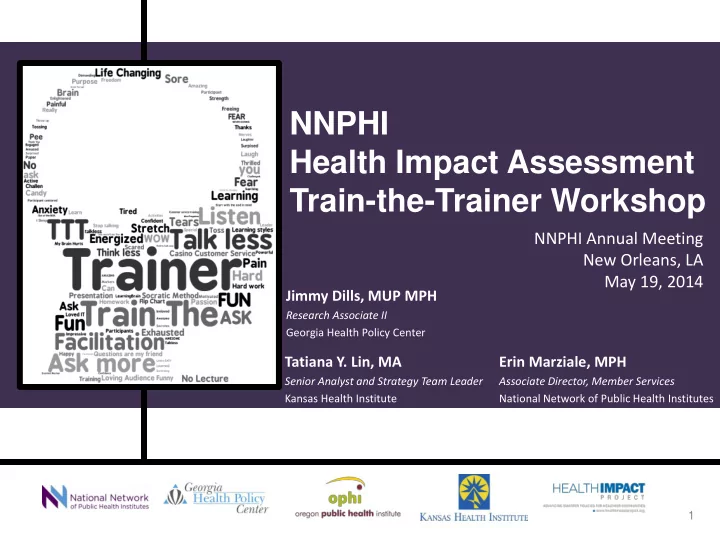
NNPHI Health Impact Assessment Train-the-Trainer Workshop NNPHI - - PowerPoint PPT Presentation

nnphi
SMART_READER_LITE
LIVE PREVIEW

NNPHI Health Impact Assessment Train-the-Trainer Workshop NNPHI - - PowerPoint PPT Presentation

NNPHI Health Impact Assessment Train-the-Trainer Workshop NNPHI Annual Meeting New Orleans, LA May 19, 2014 Jimmy Dills, MUP MPH Research Associate II Georgia Health Policy Center Tatiana Y. Lin, MA Erin Marziale, MPH Senior Analyst and


slide-1
SLIDE 1

NNPHI Health Impact Assessment Train-the-Trainer Workshop

NNPHI Annual Meeting New Orleans, LA May 19, 2014

1

Tatiana Y. Lin, MA

Senior Analyst and Strategy Team Leader Kansas Health Institute

Erin Marziale, MPH

Associate Director, Member Services National Network of Public Health Institutes

Jimmy Dills, MUP MPH

Research Associate II Georgia Health Policy Center

slide-2
SLIDE 2

Welcome

Thank you to NNPHI and Health Impact Project for Supporting this Workshop

2

slide-3
SLIDE 3

Amazing Fashionable Struggle Snow Bicycle Interested Coincidence Garden Caution Initiative Foundation Hot Bagel Smooth Wink System Heavy Dream

slide-4
SLIDE 4

TODAY’S SESSION WILL COVER

  • Introductions
  • State of HIA within NNPHI
  • Adult Learning Principles and Other

Skills

  • Strategic Planning for HIA
  • Types of HIA Trainings
  • The KHI Experience
  • Design an HIA Training/Workshop
  • Evaluation of HIA Trainings
slide-5
SLIDE 5

TODAY’S GOALS

  • Translate existing training

and facilitation skills to an HIA training context

  • Characterize your
  • rganization's possible

role(s) in future HIA practice

  • Learn about and prepare

for potential challenges that arise during HIA trainings

slide-6
SLIDE 6

INTRODUCTIONS

  • Name
  • Organization
  • Experience with

HIA

  • What would

you like to learn this afternoon?

slide-7
SLIDE 7

“EMPTY THE CUP”

slide-8
SLIDE 8

When I think of health… To be “healthy” means…

slide-9
SLIDE 9

STATE OF HIA PRACTICE AMONG PUBLIC HEALTH INSTITUTES

9

slide-10
SLIDE 10

ADULT LEARNING PRINCIPLES AND PRACTICES

10

slide-11
SLIDE 11

Adult education occurs best when…

11

slide-12
SLIDE 12

Adult Learning Resources:

12

slide-13
SLIDE 13

13

slide-14
SLIDE 14

Fills an immediate need

  • Motivation to learn is the greatest when it meets the immediate needs of the learner.

Is participative

  • Participation in the learning process is active, not passive.

Is experiential

  • The most effective learning is from shared experience; learners learn from each other,

and the trainer often learns from the learners.

Is self-directed

  • Adults can share responsibility for their own learning because they know their own

needs

Is reflexive

  • Maximum learning from a particular experience occurs when a person takes the time

to reflect back on it, draw conclusions, and derive principles for application to similar experiences in the future.

Adult education occurs best when it…

14

slide-15
SLIDE 15

Adult education occurs best when it…

Provides feedback

  • Effective learning requires feedback that is corrective but supportive.

Shows respect for the learner

  • Mutual respect and trust between trainer and learner help the learning

process.

Provides a safe atmosphere

  • A cheerful, relaxed person learns more easily than one who is fearful,

embarrassed, or angry.

Occurs in a comfortable environment

  • A person who is hungry, tired, cold, ill, or otherwise physically

uncomfortable cannot learn with maximum effectiveness.

Source: “Training Trainers for Development”, Centre for Development and Population Activities

15

slide-16
SLIDE 16

Immediate Participative + Experiential ENGAGING

16

Adult education occurs best when it…

slide-17
SLIDE 17

Common HIA Training Activity Formats

  • Presentation/lecture
  • Presentation with Q & A
  • Panel discussions/fishbowl

interviews

  • Individual exercises
  • Trainer-led group exercises
  • Participant-led group exercises
  • Pre/post meetings or webinars

Trainer led; less participatory; less experiential Participant led; more participatory; more experiential

17

slide-18
SLIDE 18

Your Experience?

  • How would you

characterize trainings you have done in the past?

  • What did you learn?
  • What existing skills

do you bring to the table for an HIA training?

18

slide-19
SLIDE 19

STRATEGIC PLANNING FOR HIA

19

What is your HIA landscape?

slide-20
SLIDE 20

What’s Your HIA Landscape?

  • Describe the landscape of

HIA practitioners and trainers in your region.

  • What audiences or sectors

will be key to moving HIA forward in your region?

  • How are HIAs and HIA

trainings funded?

20

slide-21
SLIDE 21

What’s Your HIA Landscape?

21

slide-22
SLIDE 22

What’s Your HIA Landscape?

22

Organizations engaged in HIA GHPC

slide-23
SLIDE 23

What’s Your HIA Landscape?

23

Organizations engaged in HIA Geographic scope of each

  • rg.

GHPC

slide-24
SLIDE 24

What’s Your HIA Landscape?

24

Organizations engaged in HIA Geographic scope of each

  • rg.

Does the org. focus on practice, training, evaluation, or a combination GHPC

slide-25
SLIDE 25

What’s Your HIA Landscape?

25

Organizations engaged in HIA Geographic scope of each

  • rg.

Does the org. focus on practice, training, evaluation, or a combination Specific strengths of each org. relative to HIA steps or practice GHPC

slide-26
SLIDE 26

What’s Your HIA Landscape?

26

Organizations engaged in HIA Geographic scope of each

  • rg.

Does the org. focus on practice, training, evaluation, or a combination Specific strengths of each org. relative to HIA steps or practice

slide-27
SLIDE 27

What’s Your HIA Landscape?

27

slide-28
SLIDE 28

TYPES OF HIA TRAININGS

28

slide-29
SLIDE 29

Trainings work best when they occur in fertile soil!

  • Interest
  • Opportunity
  • (and resources!)

Why (and when) to do an HIA training

29

slide-30
SLIDE 30
  • HIA training gets results
  • 20% of participants go on to conduct an HIA
  • Relationships forged during trainings serve as basis for many future

collaborations (HIA/HiAP)

(via Joe Schucter, UC Berkeley)

  • HIA practitioners who have attended a training...
  • scored higher on readiness criteria
  • selected HIAs with better screening results
  • more likely to meet HIA minimum elements and practice standards

(via Kim Gilhuly, Human Impact Partners)

  • Successful training & TA is participant-focused
  • Customized content and activities
  • Addresses unique needs related to project, experience level, goals

(via Noelle Dobson, OPHI)

30

Value of Training

slide-31
SLIDE 31

Why consider the training context?

Training evaluation:

  • Participants arrive with differing motivating factors
  • Participants from different sectors have different objectives,

worldview, language...

  • Relationships formed between participants key to long term

training outcomes

  • Participant satisfaction (and subsequent application of

training experience) depends on their expectations

  • Participants need significantly different messaging relative to

their primary job purpose

31

slide-32
SLIDE 32

Trainer experiences:

  • Participants may sidetrack

the training if it is not meeting their expectations

  • Interaction between

participants may affect the learning environment

  • Subsequent HIA

performance and TA needs strongly affected by relevance of training to likely upcoming activities

32

Why consider the training context?

slide-33
SLIDE 33

How they vary: Purpose

  • Project-specific vs. general
  • Designated mentor or technical

assistance recipient

  • Most critical outcome:
  • New to the concept: building relationships
  • First or upcoming HIA: building capacity
  • Making the most of an HIA: building buy-in

33

slide-34
SLIDE 34

How they vary: Audience

  • Practitioner
  • Project management
  • Analysis or subject matter expert
  • Decision-maker
  • Community stakeholder or team

member

  • Students
  • Sector(s): public health, medical, other

technician, community organizer, etc.

  • Mixed or paired
  • Unknown – nested events etc.

34

slide-35
SLIDE 35

How they vary: Content

  • HiAP-focused
  • Equity-focused
  • Industry-specific
  • Integrated
  • Phase-specific (screening, scoping

workshop, assessment methods)

35

slide-36
SLIDE 36

How they vary: Scope

  • Format/Depth
  • 101
  • Webinar
  • Classroom
  • Hands-on/ learning

by doing

  • Duration
  • Number of

participants

36

slide-37
SLIDE 37

THE KANSAS EXPERIENCE

37

slide-38
SLIDE 38

DEVELOPING AN HIA TRAINING

38

slide-39
SLIDE 39

KEY TOPICS TO CONSIDER

  • Type
  • Audience
  • Time-frame
  • Goals
  • Sketch Agenda

39

slide-40
SLIDE 40

EVALUATING & IMPROVING YOUR HIA TRAININGS

40

slide-41
SLIDE 41

Value of HIA Training

  • 20% of participants go on to conduct an HIA
  • Relationships forged during trainings serve as

basis for many future collaborations (HIA/HiAP)

(via Joe Schucter, UC Berkeley)

  • HIA practitioners who have attended a training:

– scored higher on readiness criteria – selected HIAs with better screening results – more likely to meet HIA minimum elements and practice standards

(via Kim Gilhuly, Human Impact Partners)

41

slide-42
SLIDE 42

Methods for Evaluating Your HIA Training

  • One method of evaluation of meetings/trainings

is “on the spot” group analysis of the evaluation forms.

  • Warning: This method often leads to late night

meetings for trainers as next day schedule is reworked

  • Feedback we have received about this is that it

indicates that the trainee’s concerns were listened to AND addressed.

(GHPC)

42

slide-43
SLIDE 43

Using Evaluation Form as Business Tool

  • Along with receiving standard feedback (which

session was most helpful, was there anything you found confusing etc..), you can also add a question about whether the participant would be interested in additional, in depth training

  • n a specific element of HIA.
  • Use the evaluation form to forge new business

connections and create opportunities

(OPHI)

43

slide-44
SLIDE 44

WRAP-UP AND NEXT STEPS

44

slide-45
SLIDE 45

THANK YOU!

45