NLP: Going for low-hanging fruit 1 Introduction NL o ff ers many hard - - PowerPoint PPT Presentation

nlp going for low hanging fruit
SMART_READER_LITE
LIVE PREVIEW

NLP: Going for low-hanging fruit 1 Introduction NL o ff ers many hard - - PowerPoint PPT Presentation

Introduction Introduction Some low-hanging fruit in computational discourse Some low-hanging fruit in computational discourse Conclusion Conclusion NLP: Going for low-hanging fruit 1 Introduction NL o ff ers many hard problems But NL features


slide-1
SLIDE 1

Introduction Some low-hanging fruit in computational discourse Conclusion

NLP: Going for low-hanging fruit

Bonnie Webber (University of Edinburgh) June 19, 2012

NLP: Going for low-hanging fruit 1 Introduction Some low-hanging fruit in computational discourse Conclusion

1 Introduction

NL offers many hard problems But NL features mean low-hanging fruit as well

2 Some low-hanging fruit in computational discourse

Text segmentation Recognizing coherence relations

3 Conclusion

NLP: Going for low-hanging fruit 2 Introduction Some low-hanging fruit in computational discourse Conclusion NL offers many hard problems But NL features mean low-hanging fruit as well

Hard problems in NL: Pragmatic inference

Pragmatic inference aims to account for what the speaker is saying or asking.

NLP: Going for low-hanging fruit 3 Introduction Some low-hanging fruit in computational discourse Conclusion NL offers many hard problems But NL features mean low-hanging fruit as well

Hard problems in NLP: Pragmatic inference

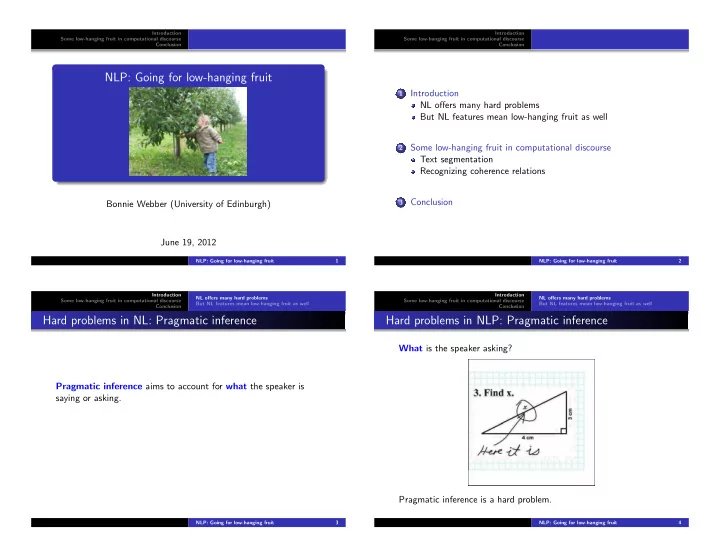
What is the speaker asking? Pragmatic inference is a hard problem.

NLP: Going for low-hanging fruit 4

slide-2
SLIDE 2

Introduction Some low-hanging fruit in computational discourse Conclusion NL offers many hard problems But NL features mean low-hanging fruit as well

Hard problems in NLP: Intention recognition

Intention recognition aims to identify why the speaker is telling

  • r asking something of the listener.

NLP: Going for low-hanging fruit 5 Introduction Some low-hanging fruit in computational discourse Conclusion NL offers many hard problems But NL features mean low-hanging fruit as well

Hard problems in NLP: Intention recognition

Intention recognition aims to identify why the speaker is telling

  • r asking something of the listener.

Why are you telling me?

NLP: Going for low-hanging fruit 6 Introduction Some low-hanging fruit in computational discourse Conclusion NL offers many hard problems But NL features mean low-hanging fruit as well

Hard problems in NLP: Intention recognition

Intention recognition aims to identify why the speaker is telling

  • r asking something of the listener.

Why are you telling me? “My New Philosophy” From You’re a Good Man, Charlie Brown Intention recognition is a hard problem.

NLP: Going for low-hanging fruit 7 Introduction Some low-hanging fruit in computational discourse Conclusion NL offers many hard problems But NL features mean low-hanging fruit as well

Hard problems in NLP: Recognizing coherence relations

Coherence relation recognition aims to identify the connection between two sentences. (1) Don’t worry about the world coming to an end today.

NLP: Going for low-hanging fruit 8

slide-3
SLIDE 3

Introduction Some low-hanging fruit in computational discourse Conclusion NL offers many hard problems But NL features mean low-hanging fruit as well

Hard problems in NLP: Recognizing coherence relations

Coherence relation recognition aims to identify the connection between two sentences. (2) Don’t worry about the world coming to an end today. It is already tomorrow in Australia. [Charles Schulz]

NLP: Going for low-hanging fruit 9 Introduction Some low-hanging fruit in computational discourse Conclusion NL offers many hard problems But NL features mean low-hanging fruit as well

Hard problems in NLP: Recognizing coherence relations

Coherence relation recognition aims to identify the connection between two sentences. (3) Don’t worry about the world coming to an end today. [reason] It is already tomorrow in Australia. [Charles Schulz] (4) I don’t make jokes. I just watch the government and report the facts. [Will Rogers]

NLP: Going for low-hanging fruit 10 Introduction Some low-hanging fruit in computational discourse Conclusion NL offers many hard problems But NL features mean low-hanging fruit as well

Hard problems in NLP: Recognizing coherence relations

Coherence relation recognition aims to identify the connection between two sentences or clauses. (5) Don’t worry about the world coming to an end today. [reason] It is already tomorrow in Australia. [Charles Schulz] (6) I don’t make jokes. [alternative] I just watch the government and report the facts. [Will Rogers] When not explicitly marked, recognizing coherence relations is a hard problem.

NLP: Going for low-hanging fruit 11 Introduction Some low-hanging fruit in computational discourse Conclusion NL offers many hard problems But NL features mean low-hanging fruit as well

Hard problems in NLP: Script-based inference

Script-based inference aims to identify aspects of events that the speaker hasn’t made explicit. (7) Four elderly Texans were sitting together in a Ft. Worth cafe. When the conversation moved on their spouses, one man turned and asked, “Roy, aren’t you and your bride celebrating your 50th wedding anniversary soon?” “Yup, we sure are,” Roy replied. “Well, are you gonna do anything special to celebrate?” The old gentleman pondered for a moment, then replied, “For

  • ur 25th anniversary, I took the misses to San Antonio.”

NLP: Going for low-hanging fruit 12

slide-4
SLIDE 4

Introduction Some low-hanging fruit in computational discourse Conclusion NL offers many hard problems But NL features mean low-hanging fruit as well

Hard problems in NLP: Script-based inference

Script-based inference aims to identify aspects of events that the speaker hasn’t made explicit. (8) Four elderly Texans were sitting together in a Ft. Worth cafe. When the conversation moved on their spouses, one man turned and asked, “Roy, aren’t you and your bride celebrating your 50th wedding anniversary soon?” “Yup, we sure are,” Roy replied. “Well, are you gonna do anything special to celebrate?” The old gentleman pondered for a moment, then replied, “For

  • ur 25th anniversary, I took the misses to San Antonio.

For our 50th, I’m thinking ’bout going down there again to pick her up.” Script-based inference is a hard problem.

NLP: Going for low-hanging fruit 13 Introduction Some low-hanging fruit in computational discourse Conclusion NL offers many hard problems But NL features mean low-hanging fruit as well

Understanding Natural Language isn’t easy: Negation

My own hard problem in NL is any sentence with >1 negation or quantifier. (9) To: Mr. Clayton Yeutter, Secretary of Agriculture, Washington, D.C.

Dear sir: My friends over in Wichita Falls TX, received a check the

  • ther day for $1,000 from the government for not raising hogs. So,

I want to go into the “not raising hogs” business myself. What I want to know is what is the best type of farm not to raise hogs on, and what is the best breed of hogs not to raise? I would prefer not to raise Razor Back hogs, but if that is not a good breed not to raise, then I can just as easily not raise Yorkshires or Durocs. Now another thing: These hogs I will not raise will not eat 100,000 bushels of corn. I understand that you also pay farmers for not raising corn and wheat. Will I qualify for payments for not raising wheat and corn not to feed the 4,000 hogs I am not going to raise?

NLP: Going for low-hanging fruit 14 Introduction Some low-hanging fruit in computational discourse Conclusion NL offers many hard problems But NL features mean low-hanging fruit as well

Understanding Natural Language isn’t easy

But if every problem in NL were hard, computational linguists and researchers in Language Technology would have quit long ago. They haven’t because NL also offers low-hanging fruit, that’s easier to pick. Where does low-hanging fruit come from?

NLP: Going for low-hanging fruit 15 Introduction Some low-hanging fruit in computational discourse Conclusion NL offers many hard problems But NL features mean low-hanging fruit as well

Sources of low-hanging fruit in NLP

At least three (maybe four) sources of low-hanging fruit in NLP: Phenomena with Zipfian distributions; Availability of low-cost proxies; Acceptability of a less than perfect solutions; High value of recall. N.B. Low-hanging doesn’t mean computationally trivial: Complex algorithmic and/or statistical calculations are often involved.

NLP: Going for low-hanging fruit 16

slide-5
SLIDE 5

Introduction Some low-hanging fruit in computational discourse Conclusion NL offers many hard problems But NL features mean low-hanging fruit as well

Sources of low-hanging fruit (I)

In a Zipfian distribution, frequency varies inversely with rank. ⇓ This was first noticed with respect to word tokens in text. The 1M-word Brown Corpus contains tokens of 39440 words. The top 135 words account for half the tokens (∼ 500k). A large proportion of the 39,300 words in the long tail occur

  • nly once.

NLP: Going for low-hanging fruit 17 Introduction Some low-hanging fruit in computational discourse Conclusion NL offers many hard problems But NL features mean low-hanging fruit as well

Sources of low-hanging fruit (I)

  • Also Zipfian is the distribution of discourse connectives

(conjunctions, discourse adverbials) in the Penn Discourse TreeBank [Prasad et al, 2008], annotation over the 1M-word Penn WSJ Corpus.

Explicit Conn

  • No. of tokens

Explicit Conn

  • No. of tokens

but 3308 therefore 26 and 3000

  • therwise

24 if 1223 as soon as 20 because 858 accordingly 5 while 781 if and when 3 however 465 conversely 2 ... ... ... ...

NLP: Going for low-hanging fruit 18 Introduction Some low-hanging fruit in computational discourse Conclusion NL offers many hard problems But NL features mean low-hanging fruit as well

Sources of low-hanging fruit (I)

  • Probably Zipfian is the distribution of syntactic constructions

in text, although the ranking of different constructions may be genre-specific. Zipfian distributions are a source of low-hanging fruit whenever the mass at the front can be handled (relatively) easily; the long tail can be ignored without dire consequences.

NLP: Going for low-hanging fruit 19 Introduction Some low-hanging fruit in computational discourse Conclusion NL offers many hard problems But NL features mean low-hanging fruit as well

Sources of low-hanging fruit (I)

N.B. Zipfian distributions can only hold of phenomena whose tokens can be classified into discrete categories, whose frequency can then be counted. That’s not always possible — e.g., animacy — suggesting that animacy-based decisions may not be low-hanging fruit.

NLP: Going for low-hanging fruit 20

slide-6
SLIDE 6

Introduction Some low-hanging fruit in computational discourse Conclusion NL offers many hard problems But NL features mean low-hanging fruit as well

Sources of low-hanging fruit (II)

NL often offers proxies that are simpler than the full blown phenomenon: Word stems, as proxies for words. Bag of words, as a proxy for a sentence or a text. Bag of sentences, as a proxy for a text. (Probabilistic) CFG, as a proxy for a NL grammar. Relative web/corpus frequency, as a proxy for (relative) correctness. Being able to exploit a good proxy, rather than the phenomenon itself, makes for low-hanging fruit.

NLP: Going for low-hanging fruit 21 Introduction Some low-hanging fruit in computational discourse Conclusion NL offers many hard problems But NL features mean low-hanging fruit as well

Sources of low-hanging fruit (III)

Other sources of low-hanging fruit are task-specific — e.g., there’s low-hanging fruit when a less-than-perfect solution is acceptable. Automated PoS-taggers have been used for years, even though The set of PoS-tags used in tagging is less-than-perfect. In the commonly used Penn Tag Set (45 tags), titles (Mr., Ms., Dr.) are lumped together with singular proper nouns (NNP):

the Texas Rangers the/DT Texas/NNP Rangers/NNPS

  • Prof. David Beaver

Prof./NNP David/NNP Beaver/NNP

even though titles clearly have a different distribution. When it doesn’t matter, a task can be low-hanging fruit.

NLP: Going for low-hanging fruit 22 Introduction Some low-hanging fruit in computational discourse Conclusion NL offers many hard problems But NL features mean low-hanging fruit as well

Sources of low-hanging fruit (IV)

Selection tasks can be low-hanging fruit if recall is valued at least as much as precision. Recall: The proportion of relevant items that are selected (TP/TP+FN) Precision: The proportion of selected items that are relevant (TP/TP+FP) Such tasks leave the real decision to the user who sees the output. Modern search engines exploit this, in some cases ranking items by their likelihood of relevance.

NLP: Going for low-hanging fruit 23 Introduction Some low-hanging fruit in computational discourse Conclusion Text segmentation Recognizing coherence relations

Some low-hanging fruit in Computational Discourse

I want to turn now to some low-hanging fruit in my own area of Computational Discourse. Text segmentation Coherence relation recognition in order to show that: Even discourse has low-hanging fruit.

NLP: Going for low-hanging fruit 24

slide-7
SLIDE 7

Introduction Some low-hanging fruit in computational discourse Conclusion Text segmentation Recognizing coherence relations

Text structure and segmentation

Texts often have an underlying high-level structure: encyclopedia articles news reports scientific papers transcripts of speech events (meetings, lectures, etc.) . . . This is what text segmentation aims to make explicit.

NLP: Going for low-hanging fruit 25 Introduction Some low-hanging fruit in computational discourse Conclusion Text segmentation Recognizing coherence relations

High-level structure of encyclopedia articles

Wisconsin Louisiana Vermont 1 Etymology Etymology Geography 2 History Geography History 3 Geography History Demographics 4 Demographics Demographics Economy 5 Law and government Economy Transportation 6 Economy Law and government Media 7 Municipalities Education Utilities 8 Education Sports Law and government 9 Culture Culture Public Health 10 ... ... ... Wikipedia articles about US states

NLP: Going for low-hanging fruit 26 Introduction Some low-hanging fruit in computational discourse Conclusion Text segmentation Recognizing coherence relations

High-level structure of news reports

News reports have an inverted pyramid structure: Headline Lede paragraph, conveying who is involved, what happened, when it happened, where it happened, why it happened, and (optionally) how it happened Body, providing more detail about who, what, when, . . . Tail, containing less important information

NLP: Going for low-hanging fruit 27 Introduction Some low-hanging fruit in computational discourse Conclusion Text segmentation Recognizing coherence relations

High-level structure of scientific papers

Scientific papers (and, more recently, their abstracts) have a high-level structure, comprising: Objective (aka Introduction, Background, Aim, Hypothesis) Methods (aka Method, Study Design, Methodology, etc.) Results or Outcomes Discussion Optionally, Conclusions

NLP: Going for low-hanging fruit 28

slide-8
SLIDE 8

Introduction Some low-hanging fruit in computational discourse Conclusion Text segmentation Recognizing coherence relations

High-level structure of meetings

3 A: Good morning everybody. 4 A: Um I’m glad you could all come. 5 A: I’m really excited to start this team. 6 A: Um I’m just gonna have a little PowerPoint presentation for us, for our kick-off meeting. 7 A: My name is Rose [Anonymized]. 8 A: I I’ll be the Project Manager. 9 A: Um our agenda today is we are gonna do a little opening 10 A: and then I’m gonna talk a little bit about the project, 11 A: then we’ll move into acquaintance such as getting to know each other a little bit, including a tool training exercise. 12 A: And then we’ll move into the project plan, 13 A: do a little discussion 14 A: and close, 15 A: since we only have twenty five minutes.

NLP: Going for low-hanging fruit 29 Introduction Some low-hanging fruit in computational discourse Conclusion Text segmentation Recognizing coherence relations

16 A: First of all our project aim. 17 A: Um we are creating a new remote control which we have three goals about, 18 A: it needs to be original, trendy and user-friendly. 19 A: I’m hoping that we can all work together to achieve all three of those. 20 A: Um so we’re gonna divide us up into three compa three parts. 21 A: First the functional design 22 A: which will be uh first we’ll do individual work, 23 A: come into a meeting, 24 A: the conceptional design, individual work and a meeting, 25 A: and then the detailed design, individual work and a meeting. 26 A: So that we’ll each be doing our own ideas 27 A: and then coming together 28 A: and um collaborating. 29 A: Okay, 30 A: we’re gonna get to know each other a little bit.

NLP: Going for low-hanging fruit 30 Introduction Some low-hanging fruit in computational discourse Conclusion Text segmentation Recognizing coherence relations

31 A: So um, 32 A: what we’re gonna do is start off with um let’s start off with Amina. 33 A: Um Alima, 34 B: Alima. 35 A: sorry, 36 A: Alima. 37 A: Um we’re gonna do a little tool training, 38 A: so we are gonna work with that whiteboard behind you. 39 A: Um introduce yourself, 40 A: um say one thing about yourself 41 A: and then draw your favourite animal 42 A: and tell us about it. 43 B: Okay. 44 B: Um I don’t know which one of these I have to bring with me. 45 A: Probably both. 46 B: Right, so, 47 B: I’m supposed to draw my favourite animal. 48 B: I have no drawing skills whatsoever.

NLP: Going for low-hanging fruit 31 Introduction Some low-hanging fruit in computational discourse Conclusion Text segmentation Recognizing coherence relations

49 B: But uh let’s see, introduce myself. 50 B: My name is Alima [Anonymized]. 51 B: Um I’m from the state of [Anonymized] in the US. 52 B: I’m doing nationalism studies, 53 B: blah, blah, blah, 54 B: and I have no artistic talents. 55 . . .

[Transcript from AMI Corpus]

NLP: Going for low-hanging fruit 32

slide-9
SLIDE 9

Introduction Some low-hanging fruit in computational discourse Conclusion Text segmentation Recognizing coherence relations

Text segmentation

As noted, text segmentation aims to make this high-level linear structure more explicit. Why bother? Information can be found more effectively, which benefits tasks such as IR, IE, and QA; The properties of each type of segment can allow better summaries to be produced; One can develop more accurate segment-specific models of text that capture properties shared by all segments of a given type, which can benefits tasks such as MT [Foster, Isabelle & Kuhn, 2010].

NLP: Going for low-hanging fruit 33 Introduction Some low-hanging fruit in computational discourse Conclusion Text segmentation Recognizing coherence relations

Text segmentation

Text segmentation can be considered low-hanging fruit because decisions can be based on proxies; a less than perfect solution is acceptable, since even people produce only roughly similar segmentations.

NLP: Going for low-hanging fruit 34 Introduction Some low-hanging fruit in computational discourse Conclusion Text segmentation Recognizing coherence relations

Text segmentation

Proxies used in segmentation include: taking a segment to be a bag and/or string of tokens (words

  • r word stems);

using properties of bags or strings as evidence for segmentation decisions; using lexical or phrasal cues as additional evidence of the start

  • r end of a segment.

NLP: Going for low-hanging fruit 35 Introduction Some low-hanging fruit in computational discourse Conclusion Text segmentation Recognizing coherence relations

Text segmentation

Fiction (BNC) News (WSJ) Parliament (Hansard) Yes In New York To ask the No For the nine The Prime Minister What do you In composite trading My hon Friend Oh In early trading Mr Speaker What are you In addition to The hon Gentlemen Of course At the same Order Ah One of the Interruption What’s the The White House Does my right hon

[Sporleder & Lapata, 2006]

NLP: Going for low-hanging fruit 36

slide-10
SLIDE 10

Introduction Some low-hanging fruit in computational discourse Conclusion Text segmentation Recognizing coherence relations

Text segmentation

Not all text segmentation is low-hanging fruit: hierarchical text segmentation; segmentation of texts whose high-level structure mirrors the speaker’s own communicative intentions (intentional structure); segmentation of narrative text. Nevertheless, enough is low-hanging for it to be a practical enterprise. See [Purver, 2011] for more on topic-based segmentation, and [Webber et al, 2012] for more on genre-based segmentation.

NLP: Going for low-hanging fruit 37 Introduction Some low-hanging fruit in computational discourse Conclusion Text segmentation Recognizing coherence relations

Coherence relation recognition

Texts also have a low-level structure based on coherence relations between sentences and/or clauses. Coherence relation recognition aims to identify what is connected and how. Sometimes, the connection is explicitly marked: inter-sententially, by coordinating conjunctions or discourse adverbials, inter alia, intra-sententially, by coordinating or subordinating conjunctions, discourse adverbials, coordinators, inter alia Sometimes, it is conveyed implicitly, via adjacency. What in CRR are low-hanging fruit?

NLP: Going for low-hanging fruit 38 Introduction Some low-hanging fruit in computational discourse Conclusion Text segmentation Recognizing coherence relations

Coherence relation recognition

To answer this, need to understand the two main approaches to recognizing coherence relations: text-centric approach; relation-centric approach.

NLP: Going for low-hanging fruit 39 Introduction Some low-hanging fruit in computational discourse Conclusion Text segmentation Recognizing coherence relations

Coherence relation recognition

Text-centric approaches:

1 Divide a text into a sequence of adjacent discourse units; 2 Identify whether a relation holds between a pair of adjacent

units and if so, what sense it conveys;

3 Add the result in as a derived discourse unit; 4 Continue until a tree structure of discourse units covers the

text. This is the approach taken in Rhetorical Structure Theory [Mann and Thompson, 1988] and automated approaches based on RST [Marcu, 2000; Sagae, 2009; Soricut & Marcu, 2003; Subba et al, 2006].

NLP: Going for low-hanging fruit 40
slide-11
SLIDE 11

Introduction Some low-hanging fruit in computational discourse Conclusion Text segmentation Recognizing coherence relations

Coherence relation recognition

Relation-centric approaches:

1 Identify elements that could signal a coherence relation in a

text and then check whether they actually do so.

2 Identify what each element relates (its arguments); 3 Identifying what sense it conveys.

This is the approach taken in the Penn Discourse TreeBank [Prasad et al., 2008] and similar discourse resources being developed for other languages (Arabic, Chinese, Italian, Turkish) and genres (journal papers in biomedicine, conversations).

NLP: Going for low-hanging fruit 41 Introduction Some low-hanging fruit in computational discourse Conclusion Text segmentation Recognizing coherence relations

Coherence relation recognition

Relation-centric approaches admit low-hanging fruit, since they can concentrate on frequent, easy-to-identify coherence relations. This takes advantage of the Zipfian distribution of explicit discourse connectives. Relation-centric approaches can also provide a partial solutions to coherence relation recognition by: Identifying an argument only in terms of its head [Wellner & Pustejovsky, 2007] or its matrix sentence [Prasad, Joshi & Webber, 2010]; Identifying the sense of a relation only in terms of its high-level sense class [Pitler & Nenkova, 2009].

NLP: Going for low-hanging fruit 42 Introduction Some low-hanging fruit in computational discourse Conclusion Text segmentation Recognizing coherence relations

Coherence relation recognition

(10) Men have a tragic genetic flaw. As a result, they cannot see dirt until there is enough of it to support agriculture. [Paraphrasing Dave Barry, The Miami Herald - Nov. 23, 2003]

NLP: Going for low-hanging fruit 43 Introduction Some low-hanging fruit in computational discourse Conclusion Text segmentation Recognizing coherence relations

Coherence relation recognition

(11) Men have a tragic genetic flaw. As a result, they cannot see dirt until there is enough of it to support agriculture.

NLP: Going for low-hanging fruit 44

slide-12
SLIDE 12

Introduction Some low-hanging fruit in computational discourse Conclusion Text segmentation Recognizing coherence relations

Coherence relation recognition

(12) Men have a tragic genetic flaw. As a result [Contingency.result], they cannot see dirt until there is enough of it to support agriculture. (13) Men have a tragic genetic flaw. As a result, they cannot see dirt until [Temporal.precedence] there is enough

  • f it to support agriculture.

NLP: Going for low-hanging fruit 45 Introduction Some low-hanging fruit in computational discourse Conclusion

Conclusion

  • Research in NLP and LT starts by targetting low-hanging fruit

made possible by Zipfian distributions, the availability of simpler (task-specific) proxies, the acceptability of approximate solutions, high-value recall.

  • To understand distributions, it helps to have annotated corpora,

which also allow us to test possible solutions.

  • Once the low-hanging fruit is picked, one can go on to solve the

challenging and often very informative problems raised by the long tail.

NLP: Going for low-hanging fruit 46 Introduction Some low-hanging fruit in computational discourse Conclusion

References

  • George Foster, Pierre Isabelle & Roland Kuhn (2010). Translating structured
  • documents. Proceedings of AMTA.
  • William Mann & Sandra Thompson (1988). Rhetorical Structure Theory:

Toward a Functional Theory of Text Organization. Text, 8(3), 243–281.

  • Daniel Marcu (2000). The Rhetorical Parsing of Unrestricted Texts: A

Surface-based Approach. Computational Linguistics, 26, 395–448.

  • Emily Pitler and Ani Nenkova (2009). Using Syntax to Disambiguate Explicit

Discourse Connectives in Text. Proc. 47th Meeting of the Assoc. for Computational Linguistics and the 4th Int’l Joint Conf. on Natural Language

  • Processing. Singapore.
  • Rashmi Prasad, Nikhil Dinesh, Alan Lee, Eleni Miltsakaki, Livio Robaldo,

Aravind Joshi, and Bonnie Webber (2008). The Penn Discourse TreeBank 2.0.

  • Proc. 6th LREC, Valletta, Malta.
  • Rashmi Prasad, Aravind Joshi and Bonnie Webber (2010). Exploiting Scope

for Shallow Discourse Parsing. Proc. 7th Int’l Conference on Language Resources and Evaluation (LREC 2010).

NLP: Going for low-hanging fruit 47 Introduction Some low-hanging fruit in computational discourse Conclusion

References

  • Matthew Purver (2011). Topic Segmentation. In Gokhan Tur and Renato de

Mori (eds.), Spoken Language Understanding, Wiley, 2011.

  • Kenji Sagae (2009). Analysis of Discourse Structure with Syntactic

Dependencies and Data-Driven Shift-Reduce Parsing. In Proceedings of IWPT 2009.

  • Radu Soricut & Daniel Marcu (2003). Sentence Level Discourse Parsing using

Syntactic and Lexical Information. Proceedings of HLT/NAACL.

  • Caroline Sporleder and Mirella Lapata (2006). Broad coverage paragraph

segmentation across languages and domains. ACM Trans. Speech and Language Processing 3(2), pp. 1–35.

  • Rajen Subba, Barbara Di Eugenio and Su Nam Kim (2006). Discourse

Parsing: Learning FOL Rules based on Rich Verb Semantic Representations to automatically label Rhetorical Relations. In Proc. EACL Workshop on Learning Structured Information in Natural Language Applications.

  • Bonnie Webber, Markus Egg and Valia Kordoni (2012). Discourse Structure

and Language Technology. Natural Language Engineering, 54 pages, doi:10.1017/S1351324911000337.

NLP: Going for low-hanging fruit 48

slide-13
SLIDE 13

Introduction Some low-hanging fruit in computational discourse Conclusion

References

  • Ben Wellner and James Pustejovsky (2007). Automatically Identifying the

Arguments of Discourse Connectives. Proc. Conf on Empirical Methods in Natural Language Processing.

NLP: Going for low-hanging fruit 49