
SLIDE 1
1
NIPS Feature Selection Challenge: Details On Methods
Amir Reza Saffari Azar Electrical Eng. Department, Sahand University of Technology, Tabriz, Iran amirsaffari@yahoo.com , safari@sut.ac.ir http://ee.sut.ac.ir/faculty/saffari/main.htm
- 1. Introduction
This is a short report on details of methods I used in NIPS Feature Selection Challenge. All of these methods are very simple to implement and have a high computational
- efficiency. Because all of datasets are very high dimensional, in all five cases a ranking
criterion (filter methods) was used to choose a subset of features. Methods like wrapper and others, which uses a search to find the best subset of features, works only good for low-dimensional data spaces, when we consider computational requirements (in many papers, number of features does not exceed 100 and in rare cases 500). Ranking criterion used was correlation and single variable classification (like Fisher Discriminant Ratio, FDR); see section 2 for more details. As a classifier, only MLP networks was used, with 1 hidden layer and scaled- conjugate-gradient as training algorithm. To improve performance, an ensemble- averaging scenario was implemented, which 25 networks was trained and averaged with respect to their prediction confidence as final criterion to decide class labels. This results in improvement of about 3% in performance as will be shown in next section. Also, some standard preprocessing methods like normalization and PCA was used.
- 2. Details and Results
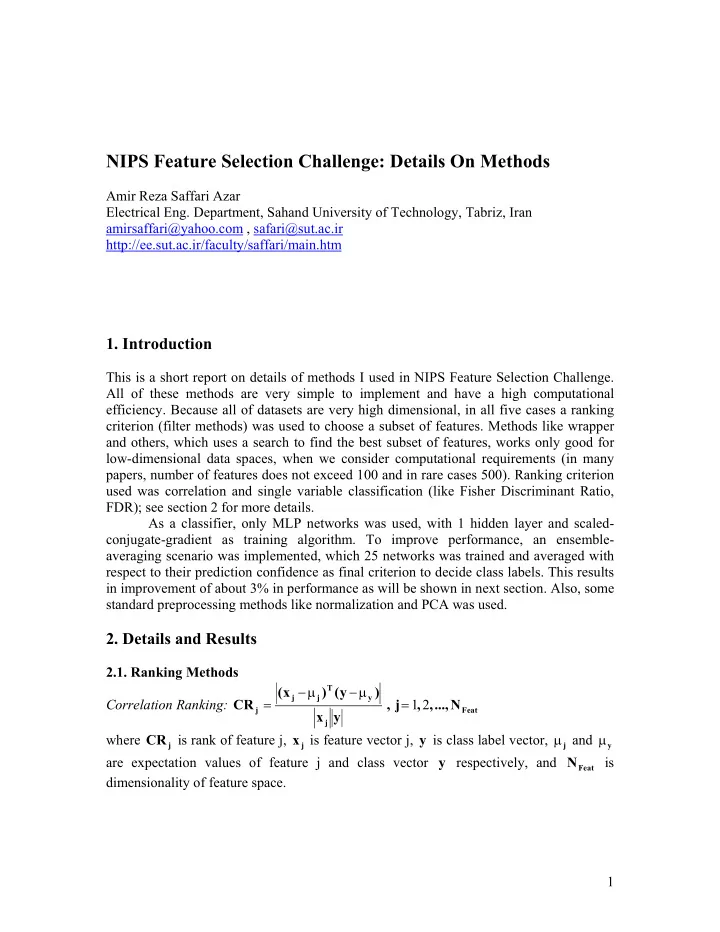
2.1. Ranking Methods Correlation Ranking:
Feat j y T j j j
N ..., , , j , y x ) y ( ) x ( CR 2 1 = µ − µ − = where
j
CR is rank of feature j,
j
x is feature vector j, y is class label vector,
j
µ and
y
µ are expectation values of feature j and class vector y respectively, and
Feat