Next Topic: Software Quality Quality Attributes Weve Already Seen - - PowerPoint PPT Presentation

next topic software quality quality attributes we ve
SMART_READER_LITE
LIVE PREVIEW

Next Topic: Software Quality Quality Attributes Weve Already Seen - - PowerPoint PPT Presentation

Next Topic: Software Quality


slide-1
SLIDE 1

CISC 323, Winter 2004, Software Quality 1

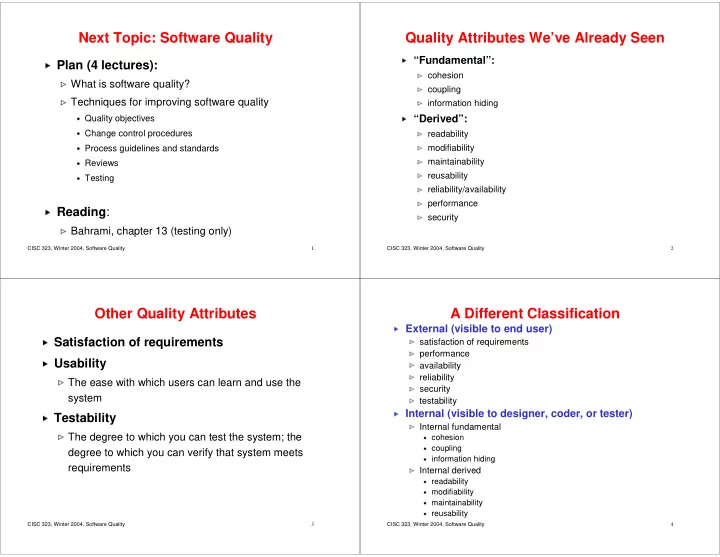
Next Topic: Software Quality

  • Plan (4 lectures):

What is software quality?

Techniques for improving software quality

Quality objectives

Change control procedures

Process guidelines and standards

Reviews

Testing

Reading:

Bahrami, chapter 13 (testing only)

CISC 323, Winter 2004, Software Quality 2

Quality Attributes We’ve Already Seen

“Fundamental”:

cohesion

coupling

information hiding

“Derived”:

readability

modifiability

maintainability

reusability

reliability/availability

performance

security

CISC 323, Winter 2004, Software Quality 3

Other Quality Attributes

Satisfaction of requirements

Usability

The ease with which users can learn and use the system

Testability

The degree to which you can test the system; the degree to which you can verify that system meets requirements

CISC 323, Winter 2004, Software Quality 4

A Different Classification

External (visible to end user)

satisfaction of requirements

performance

availability

reliability

security

testability

Internal (visible to designer, coder, or tester)

Internal fundamental

cohesion

coupling

information hiding

Internal derived

readability

modifiability

maintainability

reusability

slide-2
SLIDE 2

CISC 323, Winter 2004, Software Quality 5

You Can’t Have Them All

  • (direct

access)

  • (direct

access) performa nce

  • +

relia/avail a + + maintaina bility

  • (adapter)

+ (tested)

  • (Ariane)

+ reusability

  • (façade)

+ + + readabilit y

  • (iterator)

+

  • (iterator)

+ + + + + info hiding

  • (layered,

pub/sub) + + + + + low coupling + + + + high cohesion performa nce relia/avail maintaina bility reusability readabilit y info hiding low coupling high cohesion

Lots of this …

… also gives you more (+) or less (-) of this

CISC 323, Winter 2004, Software Quality 6

Techniques for Improving Software Quality

To achieve quality, ensure that T1) quality objectives are

stated explicitly and clearly

measurable (as much as possible)

T2) change control procedures are used T3) software engineering guidelines and standards are used T4) reviews are conducted T5) testing is done

CISC 323, Winter 2004, Software Quality 7

T1: Clear and Measurable Quality Objectives

With clear and measurable objectives,

people know what to look out for

quality is made a primary goal, rather than an afterthought

changes to the quality assurance plan can be evaluated

people more likely to be focused and motivated

CISC 323, Winter 2004, Software Quality 8

T2: Change Control Procedures

Achieving quality is impossible in presence of uncontrolled changes to artifacts (e.g., requirements, design, code, or test suites)

With change control procedures

artifacts more likely to be consistent

changes are traceable (

people are more careful)

changes less likely to result in accidental loss

accidental duplication of work less likely

easier to use time efficiently

Main change control procedure:

Configuration management

slide-3
SLIDE 3

CISC 323, Winter 2004, Software Quality 9

Configuration Management

Can be used to control changes to

design

code

Version control software: Allows coders to

avoid that a artifact is edited by more than one person (cycle: check out, edit, check in; see MS’s “Sync & Save” process)

easily get most recent copies of system artifact

easily backtrack to previous version of a artifact

easily get list of changes performed on a artifact (aka change history)

not have to worry about backups

artifact: source code, requirements, design, etc

CISC 323, Winter 2004, Software Quality 10

T3: SW Engineering Guidelines and Standards

Documentation standards

What to document?

How to document?

Where to put documentation?

Coding standards

Names

layout (indentation, etc)

etc completeness precision traceability readability modifiability readability modifiability

CISC 323, Winter 2004, Software Quality 11

SW Engineering Guidelines and Standards (Cont’d)

Process quality standards

2 kinds

Maturity models

attempt to measure how well developed (mature) the software process in a particular organization is

Example: Capability Maturity Model (CMM)

Certification standards

measure an organization’s software process against a defined standard, and certify organization, if its process meets standard

Example: ISO 9000

Source: Software Quality Assurance (CISC327). Jim Cordy. 2002

CISC 323, Winter 2004, Software Quality 12

SEI’s Capability Maturity Model (CMM)

Assessed using an 85-item questionaire

Used by government agencies and companies mostly in US

Five-level scale of process maturity:

  • 1. CMM Level 1 (Initial)

Characteristics: chaotic; cost, schedule, and quality unpredictable

  • 2. CMM Level 2 (Repeatable)

Characteristics: intuitive; cost and quality highly variable; reasonable control

  • f schedules

Key elements: requirements management; project planning; configuration management; quality assurance procedure

Source: Software Quality Assurance (CISC327). Jim Cordy. 2002

slide-4
SLIDE 4

CISC 323, Winter 2004, Software Quality 13

Capability Maturity Model (Cont’d)

3. CMM Level 3 (Defined)

Characteristics: qualitative; reliable costs and schedules; improving, but unpredictable quality Key elements: process definition and improvement; training program; peer reviews

4. CMM Level 4 (Managed)

Characteristics: quantitative; reasonable statistical control over product quality Key elements: process management and analysis, quality management

5. CMM Level 5 (Optimized)

Characteristics: quantitative basis for continual process automation and improvement Key elements: defect prevention; technology innovation; process change management

Source: Software Quality Assurance (CISC327). Jim Cordy. 2002

CISC 323, Winter 2004, Software Quality 14

ISO 9000 Standard

ISO 9000

Set of standards and guidelines for quality assurance management

Many customers, especially in Europe, require ISO 9000 registration of their suppliers

Companies become “registered” as result of formal audit by the ISO

ISO 9000-3

gives standards for software development, supply and maintenance

specifies 20 elements to be assessed, with detailed requirements for each element

Source: Software Quality Assurance (CISC327). Jim Cordy. 2002

CISC 323, Winter 2004, Software Quality 15

ISO 9000-3 Elements

Management responsibility

Quality system

Contract review

Design control

Document control

Purchasing

Purchaser-supplied product

Product identification and

traceability

Process control

Inspection and testing

Inspection, measuring and test equipment

Inspection and test status

Control of nonconforming products

Corrective action

Handling, packaging, and delivery

Quality records

Internal quality audits

Training

Servicing

Statistics

Source: Software Quality Assurance (CISC327). Jim Cordy. 2002 CISC 323, Winter 2004, Software Quality 16

T4: Reviews

At least 2 kinds:

Inspection

Walkthrough

slide-5
SLIDE 5

CISC 323, Winter 2004, Software Quality 17

Inspection

"...a formal evaluation technique in which software requirements, design, or code are examined in detail by a person or group other than the author to detect faults, violations of development standards, and other problems..."

  • -- IEEE Standard Glossary of

Software Engineering Terminology

CISC 323, Winter 2004, Software Quality 18

Inspection Metrics

To be classified as “inspection”, metrics must be kept

Record:

which defects found in product under inspection

where defect was found in product

time taken to perform inspection

size of product inspected

May also record:

category of defect (e.g., major/minor)

what prompted detection of defect

suggested improvements

CISC 323, Winter 2004, Software Quality 19

People Involved in Inspection

Inspection is a team process: ideally 2-6 people

Inspection leader:

  • rganizes & manages inspection process

moderates meetings

should have special training (multi-day course, certification)

Checkers (inspectors):

spend time reading/analyzing the product

may include author(s), leader

short training: 1-day course or "on the job"

technical knowledge relating to product

CISC 323, Winter 2004, Software Quality 20

Inspection Process

from Software Inspection, Tom Gilb & Dorothy Graham

slide-6
SLIDE 6

CISC 323, Winter 2004, Software Quality 21

Entry

Author offers up product for inspection

Entry criteria set up for products to be inspected

Leader decides if product meets entry criteria through quick examination

If entry criteria not met, product not inspected. E.g.,

too many typing errors

source code does not compile cleanly

Inspections are expensive --- don’t waste inspectors time

CISC 323, Winter 2004, Software Quality 22

Kickoff

Initial meeting for all participants

Organized by leader

Assign roles and tasks

Hand out materials

Set goals, discuss timetable, divide long documents divided into "chunks“

CISC 323, Winter 2004, Software Quality 23

Individual Checking (1)

Checkers work alone using documents handed out in kick-off meeting

Goal: Find maximum number of unique major potential defects

How: By looking for discrepancies between source documents and products being inspected, e.g.,:

requirements to design

design to code

requirements to test plan

code to coding conventions

CISC 323, Winter 2004, Software Quality 24

Individual Checking (2)

Usually uses a checklist

Duration: Typically, 1 hour per document page

Checker keeps notes of issues found

description, location, possibly impact

“Issue” = matter requiring attention. E.g.,

possible defect

"question of intent"

suggestion

slide-7
SLIDE 7

CISC 323, Winter 2004, Software Quality 25

Logging Meeting

3 purposes:

log issues identified by checkers

work as group to find more issues

suggestions for process improvement (inspection process and

  • verall software process)

Controlled by moderator (usually the leader)

must be very skilled in handling people and issues

maintain time discipline and issue discipline

No explaining of issues or suggesting fixes

Management personnel should NOT be in attendance

CISC 323, Winter 2004, Software Quality 26

Edit

Log of issues given to author

Author can

classify or reclassify issues (which are really defects)

voluntarily improve product as per issues raised

request rules or checklist be changed

CISC 323, Winter 2004, Software Quality 27

Follow-up

Inspection leader makes sure satisfactory closure has taken place on all issues

actions to correct all defects (change or change request)

suggestions for process changes reported

If major changes, product may need to be inspected again

CISC 323, Winter 2004, Software Quality 28

Exit

All issues must be “closed” in writing

Record metrics for inspection process (for process improvement)

slide-8
SLIDE 8

CISC 323, Winter 2004, Software Quality 29

Tool Support for Inspection

Static analysis tools can find some types of defects. E.g.,

compilers find undeclared variables, syntax errors

  • ther static analysis tools may check for:

unreachable code

unused variables

memory leaks in languages like C, C++

"unsafe" programming practices

misspelled words, some grammatical errors

Inspection is time-consuming (and therefore expensive) so inspect for things tools can’t find

Not cost-effective to inspect for these if tools exist

CISC 323, Winter 2004, Software Quality 30

Costs of Inspection

Inspection takes time: typically 10-15% of development budget

Also start-up costs:

establishing procedures

training leaders, inspectors

Is it worth it?

CISC 323, Winter 2004, Software Quality 31

Benefits of Inspection

Defects found early result in cost savings and in better product:

cleaner design

better documentation and code

fewer defects (

testing and debugging faster)

defects that remain will be easier to fix when found

Inspections have been shown to

increase productivity

reduce total development time

Management gets valuable feedback about software process

CISC 323, Winter 2004, Software Quality 32

Inspection: Success Stories (1)

IBM Federal Systems Division

kept metrics for similar projects before and after introducing inspection into development process

delivered lines of code per work-month:

144 without inspection

300 with inspection

slide-9
SLIDE 9

CISC 323, Winter 2004, Software Quality 33

Inspection: Success Stories (2)

ICL (in U.K.):

57.7% of defects found by inspection

cost of finding defect by inspection: 1.58 work hours

cost of finding without inspection: 8.47 work hours

  • nly 6% of development time devoted to inspection

CISC 323, Winter 2004, Software Quality 34

Inspection: Success Stories (3)

Large IBM project:

500,000 lines of code (networked operating system)

based on past experience without inspection, expected to find about 800 bugs during tests at trial site

used inspection at 11 stages of development

found 8 bugs at trial site!

CISC 323, Winter 2004, Software Quality 35

Inspection and Testing

Inspection

  • no execution
  • finds defects, i.e., problems in software
  • can be applied earlier than testing; on any artifact

Testing

  • executing software to find faults, i.e., incorrect behaviour
  • fault (symptom) linked to defect (cause) through debugging

Both are complementary

  • difficult to inspect for external attributes such as performance,

timing, load, etc

  • difficult to test for internal attributes such as reusability,

modularity, etc

CISC 323, Winter 2004, Software Quality 36

Walkthroughs

No clear definition

Typically, much less formal, much shorter than inspection

slide-10
SLIDE 10

CISC 323, Winter 2004, Software Quality 37

T5: Testing

What is testing?

“The process of executing a program with the intent of finding errors”

Myers, Glenford J., The Art of Software Testing, Wiley, 1979.

“The process of operating a system or component under specified conditions, observing or recording the results, and making an evaluation of some aspect of the system or component”

IEEE Standard 610.12-1990

CISC 323, Winter 2004, Software Quality 38

Testing and Debugging

Textbook says:

"Precisely speaking, the elimination of the syntactical bug is the process of debugging, whereas the detection and elimination of the logical bug is the process of testing"

We (and others) disagree!

Testing: finding faults (situations in which program’s behaviour is erroneous) through execution

Debugging: fixing faults (tracing a fault to defects in software and fixing them – hopefully without introducing new ones!)

CISC 323, Winter 2004, Software Quality 39

testing debugging

Testing And Debugging

CISC 323, Winter 2004, Software Quality 40

Testing: Pros and Cons

Cons: Testing can typically not

provide a correctness guarantee (more on that later)

be done without substantial effort/cost

especially, for large code bases

Pros: Testing can typically

increase confidence in correctness of code substantially

especially, if done early (in all stages) and often

be made less costly through automation

be used for measurement

slide-11
SLIDE 11

CISC 323, Winter 2004, Software Quality 41

Testing as a Measurement Tool

Testing is used to

find erroneous program behaviour

But also as a measurement tool to

estimate reliability in use by tracking the execution time interval between failures

estimate defects remaining by tracking the defects found per person-hour of testing and debugging time

decide on when to release, e.g., by deciding that the remaining known defects are acceptable in the target market

learn where process problems are by classifying and counting defects found

CISC 323, Winter 2004, Software Quality 42

Stages of Testing (1)

P

Requirements and Design Testing

when requirements and design are written in special languages which permit "execution" to simulate actual system

P

User Interface Testing

  • ften done at prototyping stage
P

Unit/Module Testing

testing unit/module in isolation

P

Integration Testing

Combining units incrementally and testing

Uncover faulty interaction between units

CISC 323, Winter 2004, Software Quality 43

Stages of Testing (2)

System Testing

Test whole system

Make sure that system

satisfies functional requirements

has acceptable performance (Performance Testing)

can handle high “loads” (Load/Stress Testing)

is usable (Usability Testing), but this is a late stage to be doing it!

If System Testing is the only kind of testing you do, it’s called it’s Big Bang Testing

may be ok for small systems, but definitely not for large ones

May be divided into stages:

Alpha Testing: testing full system in-house

Beta Testing: outside users

CISC 323, Winter 2004, Software Quality 44

Stages of Testing (3)

Regression Testing

Debugging may fix a bug, but introduce another, new one

So, things that worked before may not work anymore (system may have regressed to an earlier, more buggy state)

Change may affect: code, design, or requirements

Steps:

Must rerun all previous tests; maybe even those from previous states, if the specification changed

May have to update tests (some tests may be obsolete, other tests may have to be added)

May need configuration management (version control)

needed on everything: code, test suites, data, documentation, level of operating system, compiler, linker, possibly even hardware

slide-12
SLIDE 12

CISC 323, Winter 2004, Software Quality 45

Unit, Integration, and System Testing

As code size increases:

less time spent

  • n unit testing

more time spent

  • n integration

and system testing

(and more time spent on architecture)

CISC 323, Winter 2004, Software Quality 46

Stages of Testing: Summary

These are the stages of testing

They correspond roughly to the development stages of the system

from the requirements

  • ver prototypes

to implementation of individual units

and, finally, the combination of the units to a working whole

Ideally, testing is performed in all stages

But how do we actually do the testing?

CISC 323, Winter 2004, Software Quality 47

Testing Methods

Testing methods can be divided into 3 groups:

Black Box testing methods:

methods are not based on the actual source code

methods are solely based on requirements

Will look at Input Coverage Testing

There also is Output Coverage Testing, but we won’t cover it

White Box (a.k.a. Glass Box) testing methods:

methods are based on actual source code

Will look at 3 kinds: statement, branch, and path coverage

Grey Box testing methods:

combination of black and white box testing methods

CISC 323, Winter 2004, Software Quality 48

Black Box: Input Coverage Testing

Four different methods:

Exhaustive testing

Input Partition testing

Shotgun testing

Boundary testing

slide-13
SLIDE 13

CISC 323, Winter 2004, Software Quality 49

Input Coverage: Exhaustive Testing

Exhaustively enumerate all inputs the unit is supposed to work on, run the unit on each of them, and compare actual

  • utcome with desired outcome

Provides very strong correctness guarantee

Example: Control systems in an elevator or a vending machine

But, often completely impractical:

Example [S. McConnell, Code Complete, 1996]:

Program to store customer info (Name, address: 20 chars; telephone #: 10 digits) in file

Number of possible inputs: (26^20) * (26^20) * (10^10) = 10^66

If Noah had started testing after the flood at rate of one trillion (10^12) tests per second, he’d be less than 1% done today

CISC 323, Winter 2004, Software Quality 50

Input Coverage: Input Partition Testing

Partition input into sets of inputs that have something in common, and test unit on one representative from each partition

More feasible than exhaustive testing, but also less comprehensive

Example:

Specification for factor method: “Given two non-negative integers x, y as input, output all the numbers smaller than or equal to x that are evenly divisible by y. If either x or y is 0, then output 0.”

CISC 323, Winter 2004, Software Quality 51

Input Coverage: Input Partition Testing (Cont’d)

Specification identifies two classes of input: 0 and non- zero

This gives us the following partitions…

Partition x input y input P1 zero zero P2 non-zero zero P3 zero non-zero P4 non-zero non-zero

…and the following four tests:

factor(0,0), factor(10,0), factor(0,10), and factor(10,10)

Note that we’ve chosen same representative each time

CISC 323, Winter 2004, Software Quality 52

Input Coverage: Shotgun Testing

Choose random values for inputs over a large number of test runs

Example:

T1: factor(23, 3876)

T2: factor(2537, 32833)

and so on

Just like input partition testing, shotgun testing also more feasible than exhaustive testing

But not comprehensive…

slide-14
SLIDE 14

CISC 323, Winter 2004, Software Quality 53

A True Story From CISC 121

Fall term, 2002: Margaret thought of an “improvement” to quicksort’s partitioning algorithm

Implemented it, tested it using shotgun testing and it worked

Released it to students for an assignment, immediate complaints that it didn't work!

CISC 323, Winter 2004, Software Quality 54

Margaret's Shotgun Testing Strategy

public static TestSort() { int A[] = new int[20]; for (int i = 0; i < 20; i++) A[i] = <random int between 1 and 100>; // print contents of A sort(A); // print contents of A again } // end TestSort

Ran this test numerous times, no problem.

What did this testing strategy miss?

CISC 323, Winter 2004, Software Quality 55

Flaw in Shotgun Testing Strategy

Method of generating test arrays: for (int i = 0; i < 20; i++) A[i] = <random int between 1 and 100>;

This generates arrays with very low likelihood of duplicates

The bug involved what happens when duplicates occur in certain positions – multiple array elements equal to partition value

Students' assignment involved arrays with duplicates, triggered the bug

CISC 323, Winter 2004, Software Quality 56

Better Shotgun Testing Strategy

Method of generating test arrays: for (int i = 0; i < 20; i++) A[i] = <random int between 1 and 10>;

This generates arrays with duplicates

Would have caught bug

Moral:

Picking test cases is difficult, requires creativity and insight

Here, test harness (code to generate test cases and run the program) contained an unintended bias towards arrays w/o duplicates

slide-15
SLIDE 15

CISC 323, Winter 2004, Software Quality 57

Input Coverage: Boundary Testing

Similar to Input Partition Testing, but also

have partitions for invalid inputs

pick representatives at the “boundaries” of the partitions

See if program checks its inputs for legality

Example: factor(x,y)

4 partitions: zero, non-zero, valid, invalid

representatives: 0, 1, -1

9 Tests:

factor(0,0), factor(1,0), factor(0,1), factor(1,1) factor(-1,-1), factor(-1,0), factor(-1,1) factor(0,-1), factor(1,-1)

CISC 323, Winter 2004, Software Quality 58

Input Coverage: Combinations

Can combine exhaustive, shotgun and boundary testing

Partition input into 3 classes:

valid inputs on which program should run ok and that are not at the “boundary”:

q

partition input testing, or

q

shotgun testing

valid and invalid inputs that are right at the “boundary”:

q

exhaustive testing

invalid input on which program should report an error and that are not at the “boundary”

q

partition input testing, or

q

shotgun testing

CISC 323, Winter 2004, Software Quality 59

Example: Input Coverage Testing

/** * Raises a number to an integral power. * * Parameters: * base: Number to be raised to a power. * pow: Power to which base is to be raised. * Must not be negative. * Return value: base raised to the pow-th power */ static double power(double base, int pow) {…}

r

Valid inputs:

s

pow >= 1, range of values (shotgun)

s

base: negative, 0, positive (shotgun)

t

combinations of these

Invalid inputs: negative values for pow (shotgun)

Boundary inputs: pow = 0, pow = 1, pow = -1

(exhaustive) boundary / partition

CISC 323, Winter 2004, Software Quality 60

Automating Black Box Testing

Ideal:

tool to generate set of test cases and expected results from specifications

Reality:

needs very precise, mathematical specifications which usually are not available

So, usually generate test cases & expected results by hand

However, automated execution is still possible through test harnesses using, e.g., JTest or C++Test

slide-16
SLIDE 16

CISC 323, Winter 2004, Software Quality 61

Test Harness/Test Driver

How it works:

Takes set of test inputs & expected results

Runs program on each test input, compares actual results with expected results

Reports any discrepancies Observations:

Takes lots of drudgery out of testing

Makes testers willing to run and rerun large test suites

Complicated to write for GUIs, embedded systems, but

  • ften possible

CISC 323, Winter 2004, Software Quality 62

Black Box Testing: Summary

Input coverage testing methods

exhaustive testing

comprehensive, but often not practical

input partition testing

practical, but incomplete (to varying degree)

shotgun testing

practical, but incomplete (to varying degree)

boundary testing

practical, but incomplete (to varying degree)

and combinations

practical, but incomplete (to varying degree)

  • ften the best solution

Often, need to pick test cases by hand, but execution can be automated through test harness

CISC 323, Winter 2004, Software Quality 63

White Box Testing

Black box testing:

pick test cases based on specification

White box testing:

pick test cases based on the actual code

White box testing allows finding tests that exercise code more fully/comprehensively

Will talk about 3 white box testing methods:

statement coverage testing

branch coverage testing

path coverage testing

CISC 323, Winter 2004, Software Quality 64

Statement Coverage Testing

A set T of test inputs achieves statement coverage of program C iff for every statement s in C there is at least one test t

T that causes s to be executed

Statements: assignments, conditionals, while/for loops, method calls, etc

Quote from text (Murray):

"Testing less than this for new software is unconscionable and should be criminalized"

NASA story

slide-17
SLIDE 17

CISC 323, Winter 2004, Software Quality 65

Example: Statement Coverage Testing

// calculate numbers less than x // which are divisible by y m(int x, int y) { 1: if (y==0) 2: println(“y is 0”); 3: else if (x==0) 4: println(“x is 0”); 5: else { 6: for (int i=1; i<=x; i++) { 7: if (i%y == 0) 8: println(i); } } }

CISC 323, Winter 2004, Software Quality 66

Example: Statement Coverage Testing (Cont’d)

For each statement, find test input that cause statement to be executed. For example, Statement x input y input Test 1 T1: m(0,0) 2 0 0 3 1 T2: m(0,1) 4 0 1 5 1 1 T3: m(1,1) 6 1 1 7 1 1 8 1 1

CISC 323, Winter 2004, Software Quality 67

Branch Coverage Testing

Set of test inputs T achieves branch coverage of program C iff for branch alternative ba in C there is at least one test t

T that causes ba to be executed

More demanding than statement coverage:

C1; if (x > 3) y = 14; // continue -- no else part C2;

Branch coverage: T needs to contain t1, t2 such that

t1 causes x > 3 to be true

t2 causes x > 3 to be false

Statement coverage: T only needs to contain t1 such that

t1 causes x>3 to be true

CISC 323, Winter 2004, Software Quality 68

Example: Branch Coverage Testing

// calculate numbers less than x // which are divisible by y m(int x, int y) { 1: if (y==0) println(“y is 0”); 2: else if (x==0) println(“x is 0”); else { for (int i=1; i<=x; i++) { 3: if (i%y == 0) println(i); } } }

slide-18
SLIDE 18

CISC 323, Winter 2004, Software Quality 69

Example: Branch Coverage Testing (Cont’d)

For each branch of a decision, we make one test Decision x input y input Test 1: true T1: m(0,0) 1: false 0 1 T2: m(0,1) 2: true 1 2: false 1 1 T3: m(1,1) 3: true 1 1 3: false 2 3 T4: m(2,3)

CISC 323, Winter 2004, Software Quality 70

Path Coverage Testing

A set T of test inputs achieves path coverage of program C iff for every path p through C there is at least

  • ne test t

T that causes p to be executed

Path through C:

Sequence of statements of C starting at the first statement in C and ending with a last statement

Path in flow graph of C

Flow graph: Directed graph in which

nodes: statements

edges: edge (A,B) indicates that control may flow from A directly into B (conditions are not evaluated!)

CISC 323, Winter 2004, Software Quality 71

Example 1: Flow Graphs

Flow graph for

1: if (b) { 2: x=1; 3: x++; } else 4: x=0; 5: x = z; 6: while (x>0) { 7: x--; 8: m=m+x; } 9: s=m; 1 2 4 3 5 6 7 9 8

CISC 323, Winter 2004, Software Quality 72

Example 2: Flow Graphs

// calculate numbers less than x // which are divisible by y m(int x, int y) { 1: if (y==0) 2: println(“y is 0”); 3: else if (x==0) 4: println(“x is 0”); 5: else { 6: i=1; 6: while (i<=x) { 7: if (i%y == 0) 8: println(i); 9: i++; } } }

slide-19
SLIDE 19

CISC 323, Winter 2004, Software Quality 73

Path Coverage Testing

A set T of test inputs achieves path coverage of program C iff for every path p through C there is at least

  • ne test t

T that causes p to be executed

Example:

void test(int x) { if (x > 0) pos = pos+1; if (x % 2 == 0) even = even+1; return; } // test

Needs 4 test cases:

all combinations of alternatives

May get combinatorial explosion

√ √

x is odd

√ √

x is even x <= 0 x > 0

CISC 323, Winter 2004, Software Quality 74

Example: Path Coverage Testing

void test(int x) { if (x > 0) pos = pos+1; if (x%2 == 0) even = even+1; } // test

Find sets of test inputs T1, T2, T3 such that

T1 achieves statement coverage

T2 achieves branch coverage

T3 achieves path coverage

  • f program test

CISC 323, Winter 2004, Software Quality 75

Example: Path Coverage Testing (Cont’d)

void test(int x) { if (x > 0) pos = pos+1; if (x%2 == 0) even = even+1; } // test

Statement coverage: test(2)

Branch coverage: test(2), test(-1)

Path coverage: test(2), test(-1), test(1), test(-2)

Summary:

Path coverage is stronger than Branch coverage

Branch coverage is stronger than Statement coverage

CISC 323, Winter 2004, Software Quality 76

Path Coverage Testing: Loops

Complete path coverage for programs with loops is not practical or even impossible (Why?)

Instead, usually have partial path coverage only: require test cases which make each loop execute

0 times

1 time

many times

For example:

for (int i = 0; i < n; i++) {...} Test cases should include:

n <= 0 (no times around the loop)

n = 1 (one time around the loop)

n > 1 (several times around the loop)

slide-20
SLIDE 20

CISC 323, Winter 2004, Software Quality 77

Path Coverage Testing: Impossible Paths

Might have impossible paths in the flow graph (because boolean conditions are not evaluated)

if (x > 2) ... else ... // x not changed if (x > 4) ... else ...

Impossible to have first condition false, second true

Path in graph, but no test case for that path

CISC 323, Winter 2004, Software Quality 78

Path Coverage Testing: Combinatorial Explosion

Large method with many branches and loops:

many combinations, lots of test cases

difficult to manage

may catch special inputs that trigger an error

Full path coverage only practical for unit testing

CISC 323, Winter 2004, Software Quality 79

Automating White Box Testing

Ideal:

tool to generate set of test cases satisfying coverage requirements

Reality:

In general, can’t determine which input would force a statement in a given program to be executed

Some help: tools to help verify coverage:

which statements were executed by this test case, or this set

  • f test cases?

which branch alternatives were executed?

which paths?

These tools can be integrated into test harness/driver

CISC 323, Winter 2004, Software Quality 80

White Box Testing: Summary

3 methods:

statement coverage testing

test for every statement

branch coverage testing

test for every branch of a decision

path coverage testing

test for every feasible path through the program

limit number of times each loop is executed more comprehensive more expensive

slide-21
SLIDE 21

CISC 323, Winter 2004, Software Quality 81

Power Example: Black Box Testing

/** * Raises a number to an integral power. * * Parameters: * base: Number to be raised to a power. * pow: Power to which base is to be raised. * Must not be negative. * Return value: base raised to the pow-th power */ static double power(double base, int pow) {…}

Valid inputs:

pow >= 1, range of values (shotgun)

base: negative, 0, positive (shotgun)

combinations of these

Invalid inputs: negative values for pow (shotgun)

Boundary inputs: pow = 0, pow = 1, pow = -1

(exhaustive) boundary / partition

CISC 323, Winter 2004, Software Quality 82

Power Example: White Box Testing

static double power(double base, int pow) { double answer = 1; while (pow > 0) { if (pow % 2 == 0) { // pow is even pow = pow / 2; base = base * base; } else { // pow is odd pow = pow - 1; answer = answer * base; } // end if } // end while return answer; } // end power White box testing (path coverage testing) checklist:

  • ?

CISC 323, Winter 2004, Software Quality 83

Power Example: White Box Testing (Cont’d)

static double power(double base, int pow) { double answer = 1; while (pow > 0) { if (pow % 2 == 0) { // pow is even pow = pow / 2; base = base * base; } else { // pow is odd pow = pow - 1; answer = answer * base; } // end if } // end while return answer; } // end power White box testing (path coverage testing) checklist:

  • pow = 0, 1, 2, bigger (so while loop executed 0, 1, many times)
  • even and odd powers to exercise both parts of if statement

CISC 323, Winter 2004, Software Quality 84

Black Box or White Box Alone?

Use Black Box alone?

Use White Box alone?

slide-22
SLIDE 22

CISC 323, Winter 2004, Software Quality 85

Black Box or White Box Alone? (Cont’d)

Black box alone

can cover inputs, but may not cover the code adequately

“tricky parts”/special cases of the code usually not obvious from the specification

Studies examined black box test suites developers considered extremely thorough only exercised 1/3 to 1/2 of code!

White box alone

may not a good way to generate test cases

may lead to focus on less important parts

intrinsically leads to incomplete testing, because if coder

  • verlooked possibilities (e.g., incomplete case studies, or input

checks), test cases will not detect them

CISC 323, Winter 2004, Software Quality 86

Black Box or White Box Alone? (Cont’d)

So, best is to combine both methods

However, source code may not be available

Then, have to do Black Box testing

Example: Combining Black and White Box Testing

Heron’s formula

CISC 323, Winter 2004, Software Quality 87

Heron’s Formula

Heron’s formula for area of triangle T with sides a, b and c:

s =

if a=b=c, then area of T =

Example program takes three sides of triangle as command-line arguments (string form)

Checks to make sure it’s an equilateral triangle

if not, prints error message

if yes, computes and prints area

2 c b a + + c) b)(s a)(s s(s − − −

CISC 323, Winter 2004, Software Quality 88

Example Code with two Branches

public class Triangle { public static void main(String args[]) { int sideA = Integer.parseInt(args[0]); int sideB = Integer.parseInt(args[1]); int sideC = Integer.parseInt(args[1]); if ((sideA == sideB) && (sideA == sideC)) { double s = 0.5 * (sideA + sideB + sideC); double area = Math.sqrt(s / (s - sideA) * (s - sideB) * (s - sideC)); System.out.println("area = " + area); } else System.out.println("not equilateral"); } // end main } // end class

slide-23
SLIDE 23

CISC 323, Winter 2004, Software Quality 89

Branch Coverage Testing

  • ne if statement, so two test cases needed

false case: pick sides that aren't equal

run: Triangle 2 3 4

  • utput: not equilateral

true case: pick equal sides

run: Triangle 2 2 2

  • utput: area = 1.7320508075688772
  • utput is correct, looks like all is well

CISC 323, Winter 2004, Software Quality 90

Two Errors not Caught by Test Cases

public class Triangle { public static void main(String args []) { int sideA = Integer.parseInt(args[0]); int sideB = Integer.parseInt(args[1]); int sideC = Integer.parseInt(args[1]); if ((sideA == sideB) && (sideA == sideC)) { double s = 0.5 * (sideA + sideB + sideC); double area = Math.sqrt(s / (s - sideA) * (s - sideB) * (s - sideC)); System.out.println("area = " + area); } else System.out.println("not equilateral"); } // end main } // end class

should be 2 should be *

CISC 323, Winter 2004, Software Quality 91

Combining Black Box and White Box

  • 1. Pick a set of test cases from the specification (black

box)

  • 2. Then look at code (white box) and see if test cases

cover the code adequately

  • 3. If not, add more to complete coverage

power(double base, int pow) example:

black box alone didn't tell us it was important to make sure we tested both odd and even powers

suggests additional test cases: pow = 16, pow = 15

CISC 323, Winter 2004, Software Quality 92

Which Testing Method at Which Testing Stage?

Unit testing:

level of smallest granularity: want to look at code

best: black box and clear box methods

Above unit testing level: gray box

awareness of structure of code, but not all details

System testing:

test entire system

primarily black box

slide-24
SLIDE 24

CISC 323, Winter 2004, Software Quality 93

Testing: Summary

Most popular quality assurance technique

Can/should be done at various stages (requirements, prototypes, design, unit, system)

2 methods

Black box

input coverage (exhaustive, partition, shotgun, boundary)

White box

statement, branch, path coverage

Testing bigger systems requires automation

CISC 323, Winter 2004, Software Quality 94

Software Quality: Summary

Different techniques

explicit, measurable quality objectives

change control procedures

Configuration Management

software engineering guidelines and standards

CMM, ISO 9000

reviews

inspection, walkthroughs

testing

testing stages

2 methods: black box, white box

Techniques are complementary; use combination of techniques for best results

CISC 323, Winter 2004, Software Quality 95

Software Quality: Summary (Cont’d)

Techniques are complementary

use combination

  • f techniques

for best results

Percentages of defects found by each technique

CISC 323, Winter 2004, Software Quality 96

Software Quality: Acknowledgement

Sources used for the preparation of this set of slides:

Slides:

Software Quality Assurance (CISC327). Queen’s

  • University. Dr. Jim Cordy. 2002.

Verification and Validation. RMC. Dr. Terry Shepard. 2001.

Books:

Object-oriented Systems Development. A. Bahrami. Addison Wesley. 1999.

Code Complete. Steve McConnell. Microsoft Press.1996.