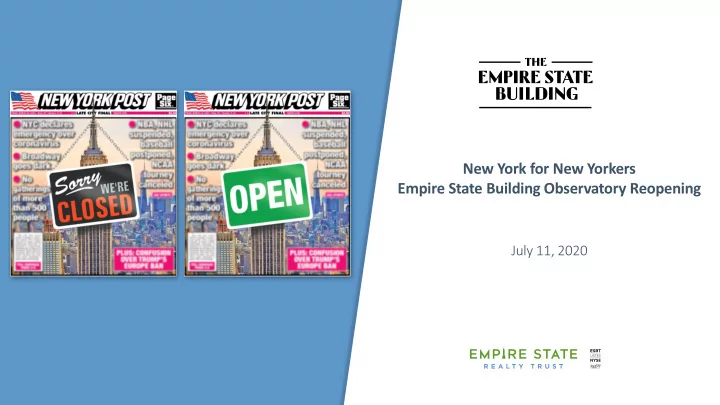
New York for New Yorkers Empire State Building Observatory Reopening - - PowerPoint PPT Presentation

new york for new yorkers empire state building
SMART_READER_LITE
LIVE PREVIEW

New York for New Yorkers Empire State Building Observatory Reopening - - PowerPoint PPT Presentation

New York for New Yorkers Empire State Building Observatory Reopening July 11, 2020 Page 3: Mission Statement Page 5-10: Reopening Executive Summary Table of Contents Page 11: New York State Reopening Checklist Physical


slide-1
SLIDE 1

New York for New Yorkers Empire State Building Observatory Reopening

July 11, 2020

slide-2
SLIDE 2
  • Page 3: Mission Statement
  • Page 5-10: Reopening Executive Summary
  • Page 11: New York State Reopening Checklist – Physical Distancing
  • Page 12: New York State Reopening Checklist – Protective Equipment
  • Page 13: New York State Reopening Checklist – Hygiene & Cleaning
  • Page 14: New York State Reopening Checklist – Screening
  • Page 15: Appendix (Full Breakdown of Training, PPE, Scientific

Studies)

Table of Contents

slide-3
SLIDE 3

Reopening Executive Summary

3

Mission Statement

The Empire State Building is the authentic representation of New York City to billions of people around the world. A marvel when built, it is now fully modernized for the 21st century. No

  • ne building has connected more with New York City, New York State, the

United States, or the world during the Covid-19 pandemic. ESB’s lights and social media engagement have internationally celebrated the enduring New York spirit. From our “Pandemic Siren”; to our fundraiser that featured Billy Joel, ESB has generated more than 33.2 billion media impressions in the United States, Australia, India, and China alone. New York City is not open without the Empire State Building Observatory. We share these plans to reopen under Phase 4, Low-Risk Indoor Arts & Entertainment as a public service to guide others to reopen our great city.

slide-4
SLIDE 4

Reopening Executive Summary

4

slide-5
SLIDE 5

Reopening Executive Summary

  • By Appointment Only
  • Utilize timed ticketing
  • Available on www.esbnyc.com
  • Will prevent crowds outside and inside the Observatory
  • Initially limit to 500 people in facility at any one time
  • Above limit represents more than 80% reduction of the overall capacity – well below

Phase 4 mandate

  • Visitor Protocol
  • Required at Entrance
  • Facial covering
  • Temperature screening
  • Hand sanitization prior to entrance
  • Maintain Separation
  • 70,000 square feet
  • One-way traffic flow
  • More than 18 feet of separation between visitors
  • Staff and CCTV monitor compliance to social distancing
  • Exhibits Protocol
  • Facial contact exhibits disabled and closed
  • Touch screens to run automatically
  • Regular cleaning of all surfaces

5

slide-6
SLIDE 6

Reopening Executive Summary

  • Dedicated Entrance
  • Tenants and Observatory visitors have separate entrances
  • Indoor Environmental Quality
  • New system installed as part of $165 million Observatory redevelopment

completed in December 2019

  • MERV 13 air filters
  • State-of-the-art air purification improves air quality and reduces the risk of

virus transmission1

  • Fresh air ventilation
  • System designed to provide clean air to over 1,600 hourly visitors
  • 70,000 Square Feet Over Five Levels
  • First Floor, Entry
  • Second Floor, Security Screening and Exhibits
  • 80th Floor, Exhibits
  • 86th Floor, Indoor/Outdoor Observatory
  • 102nd Floor, Indoor Observatory
  • 6 High-Speed Elevators In Operation Each Day
  • Controlled Elevator Capacities - Staff Load and Dispatch Each Elevator

6

1 AtmosAir proven in lab tests by Microchem Laboratory to neutralize 99.92% of coronavirus, see appendix for report

slide-7
SLIDE 7

Reopening Executive Summary

7

slide-8
SLIDE 8

Reopening Executive Summary

  • Employee Protocol
  • Training
  • Masks
  • Gloves
  • Face Shields (additionally) for entry screeners
  • Back-of-house procedures
  • Contact tracing
  • Prior Experience
  • Operated through March 16, 2020
  • Demonstrated capability to operate with reduced capacity of 500 visitors prior to closing
  • Took note of Visitor Behavior and built plans to adjust
  • No staff contracted the virus from the workspace

8

slide-9
SLIDE 9

Reopening Executive Summary

9

slide-10
SLIDE 10

Reopening Executive Summary Empire State Building Observatory Total Sq. Ft. 70,000 4 Floors Average Group Size 2.5 Reduced Capacity 500 Total Number of Groups 200 Total Sq. Ft. Per Group 350

10

slide-11
SLIDE 11

Reopening Executive Summary

11

Physical Distancing MANDATORY ESBO

1

Limit the workforce and patron/visitor presence to no more than 25% of maximum occupancy, inclusive of patrons/visitors, who must only be permitted entry into the institution if they wear an acceptable face covering, provided that they are over the age of 2 and medically able to tolerate one.

2

Ensure a distance of at least 6 ft. is maintained among individuals (both patrons/visitors and employees) at all times, with the exception of groups visiting the institution from the same household, unless safety or the core activity requires a shorter distance, in which case individuals must wear acceptable face coverings.

3

Ensure that employees wear face coverings any time they interact with patrons/visitors (e.g. ticket sales), and that all individuals, including employees and patrons/visitors, wear face coverings any time they’re within 6 ft. of another person.

4

For exhibits in a small area, calculate and enforce maximum occupancy limits and social distancing.

5

Monitor/control flow of traffic into and within the institution to adhere to capacity requirements and enhance employee/security presence to enforce limitations on gathering size, as necessary.

6

Only permit group tours for members of the same household or party and with a maximum capacity under social gathering requirements at the time, including employees and patrons/visitors.

7

Close high-risk interactive exhibits (e.g. those requiring patrons/visitors to touch or wear objects).

8

Close children’s play areas or exhibits with play equipment, unless such areas/exhibits can be cleaned, disinfected, and sanitized between each child using the area/equipment who is not a member of the same household or party. N/A

9

Move any picnic areas and benches 6 ft. apart or close them if they can’t be moved.

10

Operate in accordance with industry-specific DOH guidelines where appropriate.

✓ Completed - Phase 4 Low-Risk Indoor Arts & Entertainment Checklist – Physical Distancing

slide-12
SLIDE 12

Reopening Executive Summary

12

Protective Equipment MANDATORY ESBO

11

Ensure patrons/visitors are only permitted entry into the institution if they wear an acceptable face covering; provided they are over age 2 and able to medically tolerate one.

12

Ensure patrons/visitors wear face coverings whenever they are in common areas or scenarios where it may be difficult to maintain 6

  • ft. of distance (e.g. entering/ leaving the facility, traversing an enclosed small exhibit, interacting with employees) and whenever they

are within 6 ft. of individuals who are not members of their household or party.

13

Ensure that any time employees come within six feet of another person, acceptable face coverings are worn. Employees must be prepared to don a face covering if another person unexpectedly comes within 6 ft. Employees also must wear face coverings any time they interact with patrons/visitors.

14

Provide employees with an acceptable face covering at no-cost to the employee and have an adequate supply of coverings in case of need for replacement.

15

Acceptable face coverings include but are not limited to cloth (e.g. homemade sewn, quick cut, bandana), surgical masks, and face shields.

16

Clean, replace, and prohibit sharing of face coverings. Consult CDC guidance for information on PPE, as well as instructions on use and cleaning.

17

Train employees on how to put on, take off, clean (as applicable), and discard PPE.

18

Limit the sharing of objects among employees, as well as the touching of shared surfaces; or, require employees to wear gloves (trade-appropriate or medical) when in contact with shared objects or frequently touched surfaces; or, require employees to perform hand hygiene before and after contact.

✓ Completed - Phase 4 Low-Risk Indoor Arts & Entertainment Checklist – Protective Equipment

slide-13
SLIDE 13

Reopening Executive Summary

13

Hygiene and Cleaning MANDATORY ESBO

19

Adhere to hygiene, cleaning, and disinfection requirements from the Centers for Disease Control and Prevention (CDC) and Department of Health (DOH) and maintain logs on site that document date, time, and scope of cleaning and disinfection.

20

Provide and maintain hand hygiene stations on site, including handwashing with soap, running warm water, and disposable paper towels, as well as an alcohol-based hand sanitizer containing 60% or more alcohol for areas where handwashing is not available/practical

21

Make hand sanitizer available throughout common areas in the building (e.g. near exhibits).

22

Provide appropriate cleaning/disinfection supplies for shared and frequently-touched surfaces (e.g. door handles, ticket counters) and encourages employees to use them before/after use of such surfaces, followed by hand hygiene.

23

Conduct regular cleaning and disinfection of the building and more frequent cleaning and disinfection for high-risk areas used by many individuals and for frequently touched areas. Use Department of Environmental Conservation (DEC) products identified by the Environmental Protection Agency (EPA) as effective against COVID-19.

24

Discontinue headsets/equipment loaned/rented to patrons/visitors unless they can be properly disinfected after each use.

N/A 25

If single-use items (e.g. maps) are not provided, ensure they are cleaned and disinfected after each use.

N/A 26

Provide for cleaning and disinfection of exposed areas in the event an individual is confirmed to have COVID19, with such cleaning and disinfection to include, at a minimum, all heavy transit areas and high-touch surfaces (e.g. badge scanners, restrooms, handrails, door handles, vending machines, communal coffee stations). Follow CDC guidelines on cleaning your facility after a suspected or confirmed case.

✓ Completed - Phase 4 Low-Risk Indoor Arts & Entertainment Checklist - Hygiene and Cleaning

slide-14
SLIDE 14

Reopening Executive Summary

14

Communication / Screening MANDATORY ESBO

27 Affirm you have reviewed and understand the state-issued industry guidelines, and that you will implement them.

28 Post signage inside and outside of the retail location to remind personnel and customers to adhere to proper hygiene, social distancing rules, appropriate use of PPE, and cleaning and disinfecting protocols.

29 Conspicuously post completed safety plans on site.

30 Implement mandatory daily health screenings for employees and, where practicable, contractors and vendors (but do not mandate for patrons/visitors or delivery personnel), including an assessment (e.g. questionnaire, temperature check) asking about (1) COVID-19 symptoms in past 14 days, (2) positive COVID19 test in past 14 days, and/or (3) close or proximate contact with confirmed or suspected COVID-19 case in past 14 days. Responses must be reviewed and documented daily.

31 Immediately notify the state and local health department upon being informed of any positive COVID-19 test results.

32 Designate a site safety monitor whose responsibilities include continuous compliance with all aspects of the site safety plan.

✓ Completed - Phase 4 Low-Risk Indoor Arts & Entertainment Checklist – Communication and Screening

slide-15
SLIDE 15

Reopening Executive Summary

15

Appendix

slide-16
SLIDE 16

Reopening Executive Summary

16

  • Page 17: Temperature Screening
  • Page 18: Personal Protective Equipment
  • Page 19: Transactional Positions--- PPE
  • Page 20: Personal Hygiene
  • Page 21: Indoor Environmental Air Quality
  • Page 22: Cleaning
  • Page 23-24: Communication & Training for Staff
  • Page 25: Contact Tracing (Employee)
  • Page 26: Signage Located Through the Entire Observatory Experience
  • Page 27: Displays to Feature Multiple Languages
  • Page 28-38: Microchem Laboratory Study

Table of Contents

slide-17
SLIDE 17

Appendix

Temperature Screening

  • Will take place before entering the

Empire State Building Observatory

  • 100.4 degrees Fahrenheit or higher will not be permitted
  • All Visitors and Staff will be screened
  • Security team to conduct temperature screening
  • Screeners will wear Gloves, KN95 masks, and face shield

17

slide-18
SLIDE 18

Appendix

Personal Protective Equipment

  • All Visitors and Staff required to wear facial covering at all

times

  • Empire State Building Observatory will provide all 125 daily

Staff members with CDC approved face coverings and gloves

  • Inventory will be maintained on a min/max basis ensuring a

minimum of 5,000 units always on hand and is sourced through an existing vendor with whom the Empire State Building has long history

18

slide-19
SLIDE 19

Appendix

Transactional Positions - PPE

  • Face Shields, KN95 masks and gloves are required at all

transactional posts

  • Temperature Screening
  • Will Call desk
  • Security Screening
  • Cashiers
  • Retail
  • Inventory will be maintained on a min/max basis ensuring a

minimum of 500 units always on hand and is sourced through an existing vendor with whom the Empire State Building has long history

19

slide-20
SLIDE 20

Appendix

Personal Hygiene

  • Staff will be continuously trained

and encouraged to adhere to CDC guidelines for handwashing & preventive measures

  • Hand Sanitizer will be available

throughout the Empire State Building Observatory and back-of- house for Visitors and Staff

20

slide-21
SLIDE 21

Appendix

Indoor Environmental Air Quality

  • The Empire State Building deploys MERV 13 air filters in all of the air

handling units that serve the Observatory space

  • In addition to utilizing MERV 13 filtration, the Empire State Building

Observatory has upgraded its HV/AC system to include AtmosAir

  • AtmosAir is a proven air purification technology that acts as a

continuous disinfectant, actively reducing airborne and surface contaminants such as odors, VOCs, viruses, smoke, bacteria, and germs

  • Continuous ventilation, or the introduction of fresh air and exhaust
  • f indoor air through system designed to handle more than four

times the initial 500 visitor capacity

21

slide-22
SLIDE 22

Appendix

Cleaning

  • Frequent sanitizing of all high touch surfaces (see

appendix)

  • Overnight Electrostatic Disinfectant spray of the

entire Observatory space

  • Shut down exhibits that require close facial

contact

22

slide-23
SLIDE 23

Appendix

Communication & Training for Staff

  • Proper Hygiene Protocols
  • Clear Desk Guidelines
  • Cleaning Procedures & Company-Provided Cleaning Supplies
  • Social Distancing Protocols
  • Guidelines for corridors, elevator banks, inside elevator cabs (signage provided)
  • Guidelines for common areas: restrooms, breakrooms, changing rooms, and at water

refill stations (signage provided)

23

slide-24
SLIDE 24

Appendix

Communication & Training for Staff (Continued)

  • Use of PPE required for access to the building (signage provided)
  • Face coverings
  • Hand sanitation
  • Temperature screening
  • Cleaning & Disinfecting Protocol
  • Enhanced sanitation procedures implemented in all spaces

24

slide-25
SLIDE 25

Appendix

Contact Tracing (Employee)

ESRT has developed a standard operating procedure to cover cleaning, disinfection, and contact tracing.

Implement immediate deep cleaning and disinfection of contaminated area. Notify those in close contact with infected

  • employee. Ask to

self-quarantine at home for 14 days and report if experiencing symptoms. Notify those not in close contact with employee. Ask to self- monitor.

25

slide-26
SLIDE 26

Appendix

26

Signage Located Throughout Entire Observatory Experience

slide-27
SLIDE 27

Appendix

27

Displays to Feature Multiple Languages

slide-28
SLIDE 28

AtmosAir Solutions - Study ID: NG15291

Appendix

28

slide-29
SLIDE 29

AtmosAir Solutions - Study ID: NG15291

29

STUDY REPORT Study Title Virucidal Efficacy of a Test Substance For Use on Inanimate, Nonporous Surfaces Product Identity AtmosAir Matterhorn Series Testing Facility Microchem Laboratory 1304 W. Industrial Blvd. Round Rock, Texas 78681 Study Sponsor AtmosAir Solutions Tony Abate 418 Meadow Street, Suite 204 Fairfield, CT 06824 Test Microorganism Human Coronavirus, Strain 229E, ATCC VR-740 Study Identification Number NG15291 Author Tamisha Smith, B.S. Study Completion Date 04JUN2020

slide-30
SLIDE 30

AtmosAir Solutions - Study ID: NG15291

30

slide-31
SLIDE 31

AtmosAir Solutions - Study ID: NG15291

31

slide-32
SLIDE 32

AtmosAir Solutions - Study ID: NG15291

32

slide-33
SLIDE 33

AtmosAir Solutions - Study ID: NG15291

33

slide-34
SLIDE 34

AtmosAir Solutions - Study ID: NG15291

34

slide-35
SLIDE 35

AtmosAir Solutions - Study ID: NG15291

35

slide-36
SLIDE 36

AtmosAir Solutions - Study ID: NG15291

36

slide-37
SLIDE 37

AtmosAir Solutions - Study ID: NG15291

37

slide-38
SLIDE 38

AtmosAir Solutions - Study ID: NG15291

38