New York City EcoFlora N EW Y ORK B OTANICAL G ARDEN What is an - - PowerPoint PPT Presentation

new york city ecoflora
SMART_READER_LITE
LIVE PREVIEW

New York City EcoFlora N EW Y ORK B OTANICAL G ARDEN What is an - - PowerPoint PPT Presentation

New York City EcoFlora N EW Y ORK B OTANICAL G ARDEN What is an EcoFlora? Flora List of all plant occurring spontaneously in a location Cody Hough Ecology Study of interactions between all organisms and their environment John


slide-1
SLIDE 1

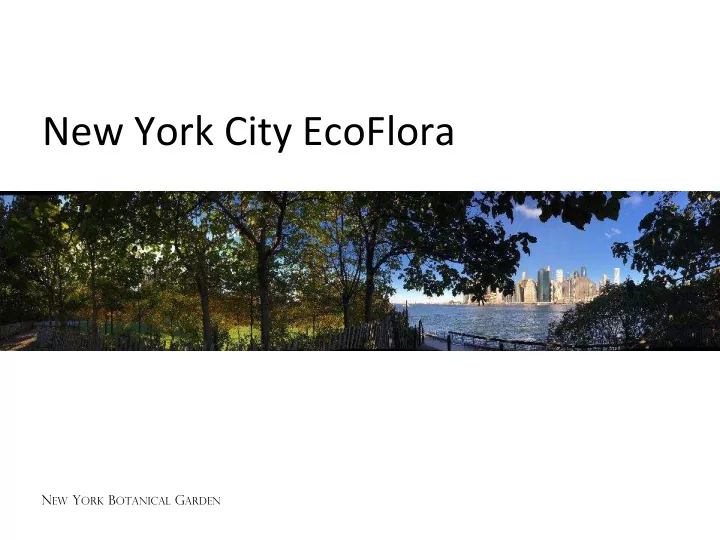
New York City EcoFlora

NEW YORK BOTANICAL GARDEN
slide-2
SLIDE 2

What is an EcoFlora?

  • Flora

–List of all plant occurring spontaneously in a location

  • Ecology

–Study of interactions between all organisms and their environment

NEW YORK BOTANICAL GARDEN

Cody Hough John Flannery

slide-3
SLIDE 3

Plant blindness

  • Bias towards animals

–Education –Policy –Knowledge –Awareness

  • Plants in background
  • Effect on policy

decisions

slide-4
SLIDE 4

Charismatic megafauna Charismatic flora?

Wikimedia Commons

slide-5
SLIDE 5

Goals of the NYC EcoFlora

  • Create list of plant

species in NYC

  • Better understand

role of plants in NYC ecosystems

  • Raise awareness and

interest

  • Engage the community
  • Have fun!
slide-6
SLIDE 6

Goals for the Pilot Year

  • Test volunteer

protocols for….

–Engagement –Entertainment –Validity –Repeatability –Accuracy

  • Narrow down list of
  • bservable traits to

what really matters

  • Gather data on…

–30 test species –Their associates

  • Pollinators
  • Herbivores
  • Parasites
  • Seed dispersers

–Their habitat –Their phenology

slide-7
SLIDE 7

Ecological and Botanical Questions

Scale Population size (number) Population size (area) Habitat type Distance to nearest tree Plant associations Health of plant Leaf litter Cryptogams Bare soil Moisture content of soil Canopy cover Site condition Soil condition (color) Soil condition (firmness) Observer status Identification tool used Change in habitat Slope Aspect Number of nearby species Animal sign Plant traits for ID'ing Anomalous plants Disease presence Substrate (concrete, forest floor, etc) Weather Disturbance measure Insect interaction Egg/larva presence Time spent observing

slide-8
SLIDE 8

Goals for this year

  • We will create

–Protocols for data- gathering –Usable city-wide –Understandable for all New Yorkers

  • We will expand

–Knowledge of plants

  • Locations
  • Associations
  • Interactions
  • We will learn

–What is compelling –What to expect going citywide –How we can advance

  • ur goals
  • We will focus on 30

common species

slide-9
SLIDE 9

Volunteer Role

  • Gather data

–Using iNaturalist –Taking notes

  • Adjust to changing

formats/objectives

  • Provide feedback
  • Learn
  • Have fun!
  • 3 hour shifts
  • 1x a week
  • Will work in small

groups

  • Hoping for commitment

through the summer,

  • ptions for fall/winter

involvement

  • There will be indoor
  • pportunities
slide-10
SLIDE 10

Our support to you

  • I’m on-site during data-

gathering

  • Identification support
  • Regular updates on our

progress

  • Producing species

guides

  • Help with photo and

technical details

slide-11
SLIDE 11

Usual Volunteer Day

  • Welcome and plan for

the day (10 – 20 min)

  • Observe! (60 - 80 min)
  • Break (15 min)
  • Possible interpretive talks

Observe! (60 min)

  • Gather feedback (15

min)

  • End of 3-hour period
slide-12
SLIDE 12

For today

  • Learn about iNaturalist
  • Volunteer forms
  • Sign up for timeslots

–Aiming to max at 15 per timeslot

  • We’ll answer your

questions!