NEW URBANISM 101: What & Why Designing Thriving Places Marina - - PowerPoint PPT Presentation

new urbanism 101 what why
SMART_READER_LITE
LIVE PREVIEW

NEW URBANISM 101: What & Why Designing Thriving Places Marina - - PowerPoint PPT Presentation

NEW URBANISM 101: What & Why Designing Thriving Places Marina Khoury KCF DPZ Partners March 19, 2017 DPZ 35+ years of successful & pioneering practice; including TODs; Designs for over 400 new and existing communities; +120


slide-1
SLIDE 1

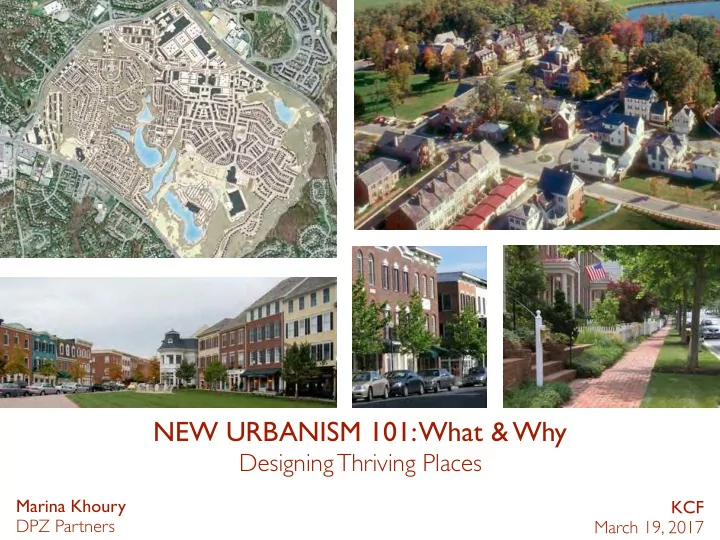
NEW URBANISM 101: What & Why

Designing Thriving Places

Marina Khoury DPZ Partners KCF March 19, 2017
slide-2
SLIDE 2

2017: DPZ Partners

DPZ

  • 35+ years of successful & pioneering

practice; including TODs;

  • Designs for over 400 new and

existing communities;

  • +120 built communities
  • Prominent & influential projects,

locally calibrated, and of their place;

  • Innovative development &

implementation of design codes;

  • Founders and recognized leaders of

New Urbanism & Smart Growth;

  • Educators
slide-3
SLIDE 3

new urbanism:

theory, principles & its evolution

slide-4
SLIDE 4

2017: DPZ Partners

Epidemic of sprawl development patterns: USA

  • Areas dominated by single-use
  • Car dependence
  • Excessive automotive traffic
  • Lack of transportation alternatives
  • Lack of useable open space
  • Excessive land consumption
  • Degraded wilderness & habitat
  • Increased air pollution
  • Increased burden on municipal

infrastructure

  • Diminished quality of life
slide-5
SLIDE 5

2017: DPZ Partners

2 patterns of development since beginning of time

Complete Community: Walkable Urbanism (up to 1940’s) Fragmented Development: Drivable Sprawl (since 1940’s)

+600 new cities, of 10 million each estimated to be built over next century to accommodate new urban dwellers.

slide-6
SLIDE 6

2017: DPZ Partners

The Theory of New Urbanism

slide-7
SLIDE 7

2017: DPZ Partners

Seaside: renaissance of place, 1980

  • Achieve and restore time-tested

forms of urbanism

  • Provide vitality, walkability and

economic resilience to our towns and cities

  • Preserve natural environment and

cultural heritage of areas.

slide-8
SLIDE 8

2017: DPZ Partners

Kentlands: First full-time community,1988

slide-9
SLIDE 9

2017: DPZ Partners

Kentlands: 1988

slide-10
SLIDE 10

2017: DPZ Partners

13-pt Checklist of NU

  • 1. The Neighborhood has a discernible center.

This is often a square or green, and sometimes a busy or memorable street intersection. A transit stop would be located at this center.

slide-11
SLIDE 11

2017: DPZ Partners

13-pt Checklist of NU

  • 2. Most of the dwellings are within a five minute walk of the center.

This distance averages one quarter of a mile.

slide-12
SLIDE 12

2017: DPZ Partners

13-pt Checklist of NU

  • 3. There is a variety of dwelling types within the Neighborhood.

These usually take form of houses, rowhouses and apartments, such that younger and

  • lder people, singles and families, the poor and the wealthy, may find places to live.
slide-13
SLIDE 13

2017: DPZ Partners

13-pt Checklist of NU

  • 4. There are shops and offices at the edge of the neighborhood.

The shops should be sufficiently varied to supply the weekly needs of a household. A convenience store is the most important among them.

slide-14
SLIDE 14

2017: DPZ Partners

13-pt Checklist of NU

  • 5. A small ancillary building is permitted within the backyard of each house.

It may be used as one rental unit, or as a place to work.

slide-15
SLIDE 15

2017: DPZ Partners

13-pt Checklist of NU

  • 6. There is an elementary school close enough so that most children can

walk from their dwelling

This distance should not be more than 1.5 km.

  • 1969: > 41% of children walked or biked to school
  • 2001: < 13% of children walked or biked to school
slide-16
SLIDE 16

2017: DPZ Partners

13-pt Checklist of NU

  • 7. There are small playgrounds quite near every dwelling.

This distance should not be more than one eighth of a mile.

slide-17
SLIDE 17

2017: DPZ Partners

13-pt Checklist of NU

  • 8. The streets within the neighborhood are a connected network.

This provides a variety of itineraries and disperses traffic congestion A B

C

A = vehicular & cycling street B = parking street / court C = pedestrian Street

slide-18
SLIDE 18

2017: DPZ Partners

13-pt Checklist of NU

  • 9. The streets are relatively narrow and shaded by rows of trees.

This slows down the traffic, creating an environment for the pedestrian and the bicycle.

slide-19
SLIDE 19

2017: DPZ Partners

13-pt Checklist of NU

  • 10. Buildings at the neighborhood center are placed close to the street.

This creates a strong sense of place.

slide-20
SLIDE 20

2017: DPZ Partners

13-pt Checklist of NU

  • 11. Parking lots and garage doors rarely front the streets.

Parking is relegated to the rear of buildings, usually accessed by alleys.

slide-21
SLIDE 21

2017: DPZ Partners

13-pt Checklist of NU

  • 12. Certain prominent sites are reserved for civic buildings.

Buildings for meeting, education, religion or culture are located at the termination of street vistas or at the Neighborhood center.

slide-22
SLIDE 22

2017: DPZ Partners

13-pt Checklist of NU

  • 13. The Neighborhood is organized to be self-governing.

A formal association debates and decides on matters of maintenance, security and physical change (but not on taxation which should be the responsibility of the larger community).

slide-23
SLIDE 23

2017: DPZ Partners

Smart Growth Principles

  • 1. Create range of housing
  • 2. Create walkable neighborhoods
  • 3. Encourage community and stakeholder collaboration
  • 4. Foster communities’ sense of place
  • 5. Make development decisions predictable and fair
  • 6. Mix land uses
  • 7. Preserve open space, farmland, natural beauty, critical environmental areas
  • 8. Provide transportation choices
  • 9. Develop existing communities first
  • 10. Encourage compact building design
slide-24
SLIDE 24

Partnerships

HUD + DOT + EPA

slide-25
SLIDE 25

2017: DPZ Partners

Congress for New Urbanism (CNU)

“We stand for the restoration of existing urban centers and towns within coherent metropolitan regions, the reconfiguration of sprawling suburbs into communities of real neighborhoods and diverse districts, the conservation of natural environments, and the preservation of our built legacy.”

slide-26
SLIDE 26

2017: DPZ Partners

Principles of NU: 4 scales

slide-27
SLIDE 27

2017: DPZ Partners

CNU reach

slide-28
SLIDE 28

2017: DPZ Partners

Designing Sustainable Communities

Smart Locations & Linkages Neighborhood Pattern & Design Green Infrastructure & Buildings

  • Include transportation energy intensity of buildings into total

building’s performance.

  • Any green rating system must consider context and pattern of

settlement.

slide-29
SLIDE 29

2017: DPZ Partners

UN: SDGs

slide-30
SLIDE 30

2017: DPZ Partners

UN Award

slide-31
SLIDE 31

understanding the consequences of sprawl vs/ smart growth

slide-32
SLIDE 32

2017: DPZ Partners

Sprawl & Health

Source: Matthre A. Cougan, 2003

Need policies that produce walkable urbanism:

  • reduce exposure to toxins and pollutants;
  • minimize environmental impact;
  • encourage a healthy life-style; and
  • makes people happier!
slide-33
SLIDE 33

2017: DPZ Partners

Economic Success of Smart Growth

“Smart Growth development generates 10 times more tax revenue per acre than conventional suburban development.”

slide-34
SLIDE 34

2017: DPZ Partners

WalkUPs

6 types:

  • 1. Downtown
  • 2. Downtown Adjacent
  • 3. Urban Commercial
  • 4. Suburban Town Center
  • 5. Strip Commercial Redevelopment
  • 6. Greenfields

WalkUPs outperform Drivable Suburbanism

  • Economic ranking
  • Social equity ranking

Source: Christopher Leinburger, 2013

slide-35
SLIDE 35

2017: DPZ Partners

The cost of sprawl - individually

slide-36
SLIDE 36

H+T Index

slide-37
SLIDE 37

2017: DPZ Partners

Climate change

slide-38
SLIDE 38

The cost of sprawl - collectively

Source: Strong Towns, 2015

slide-39
SLIDE 39

Rate of Return of Smart Growth

$0 $125 $250 $375 $500

$402.80 $119.10 $76.80 $14.20 $8.10 $7.20 $1.00

Residential Commercial Mixed-Use

County S-F City S-F Walmart Mall or strip Mixed-Use !

(2 Story)

Mixed-Use !

(3 Story)

Mixed-Use !

(6 Story)

Ratio Difference of 37 City Sample Set, in 11 States + 1 Province

3

Urban

Joseph Minicozzi, AICP

County Property Taxes/Acre

slide-40
SLIDE 40

WalkScore & location efficiencies

slide-41
SLIDE 41

The wants of American households

slide-42
SLIDE 42

2017: DPZ Partners

Social Equity: tangibles & intangibles

People in more compact, connected places are:

  • Happier
  • Safer
  • Live longer
  • Have greater upwards mobility
slide-43
SLIDE 43

2017: DPZ Partners

Paradigm of Scientific Planning

  • Provides for an effective framework for implementation.
  • The TRANSECT as a SCIENTIFIC TOOL, for classifying

sustainable urban development patterns.

  • Calibrated to LOCAL CONTEXT.
slide-44
SLIDE 44

2017: DPZ Partners

Codes Study: FBCs

+584 Codes to date (344 adopted) +105 million ha impacted impacting +45 million people

slide-45
SLIDE 45

“By far the greatest and most admirable form of wisdom, is that needed to plan and beautify cities and human communities.” Socrates

marina@dpz.com