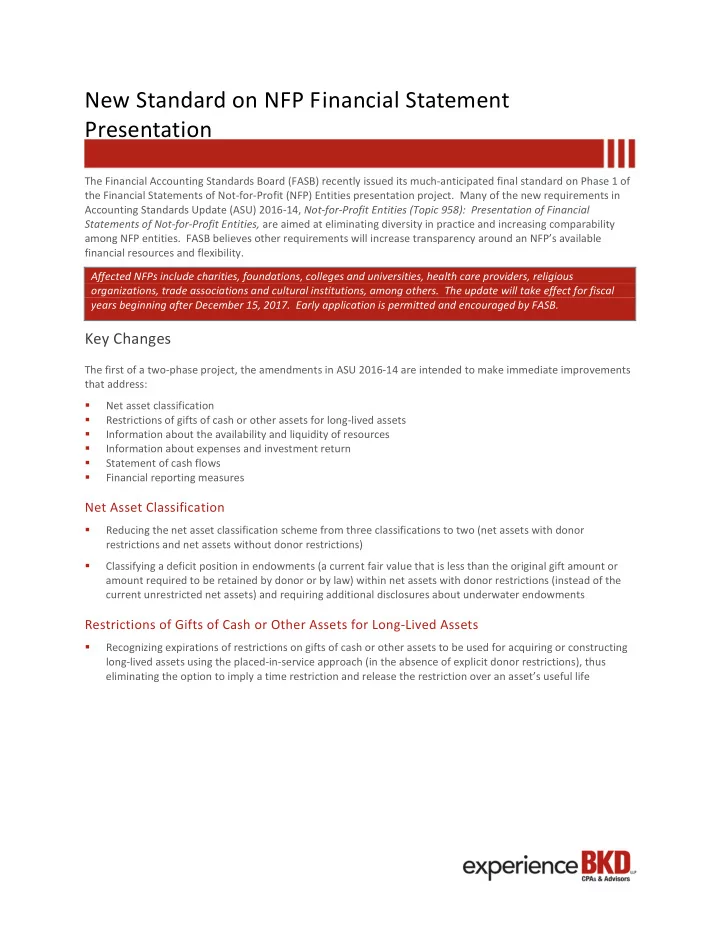
New Standard on NFP Financial Statement Presentation The Financial - - PDF document

new standard on nfp financial statement presentation
SMART_READER_LITE
LIVE PREVIEW

New Standard on NFP Financial Statement Presentation The Financial - - PDF document

New Standard on NFP Financial Statement Presentation The Financial Accounting Standards Board (FASB) recently issued its much-anticipated final standard on Phase 1 of the Financial Statements of Not-for-Profit (NFP) Entities presentation project.


slide-1
SLIDE 1

New Standard on NFP Financial Statement Presentation

The Financial Accounting Standards Board (FASB) recently issued its much-anticipated final standard on Phase 1 of the Financial Statements of Not-for-Profit (NFP) Entities presentation project. Many of the new requirements in Accounting Standards Update (ASU) 2016-14, Not-for-Profit Entities (Topic 958): Presentation of Financial Statements of Not-for-Profit Entities, are aimed at eliminating diversity in practice and increasing comparability among NFP entities. FASB believes other requirements will increase transparency around an NFP’s available financial resources and flexibility.

Key Changes

The first of a two-phase project, the amendments in ASU 2016-14 are intended to make immediate improvements that address:

  • Net asset classification
  • Restrictions of gifts of cash or other assets for long-lived assets
  • Information about the availability and liquidity of resources
  • Information about expenses and investment return
  • Statement of cash flows
  • Financial reporting measures

Net Asset Classification

  • Reducing the net asset classification scheme from three classifications to two (net assets with donor

restrictions and net assets without donor restrictions)

  • Classifying a deficit position in endowments (a current fair value that is less than the original gift amount or

amount required to be retained by donor or by law) within net assets with donor restrictions (instead of the current unrestricted net assets) and requiring additional disclosures about underwater endowments

Restrictions of Gifts of Cash or Other Assets for Long-Lived Assets

  • Recognizing expirations of restrictions on gifts of cash or other assets to be used for acquiring or constructing

long-lived assets using the placed-in-service approach (in the absence of explicit donor restrictions), thus eliminating the option to imply a time restriction and release the restriction over an asset’s useful life Affected NFPs include charities, foundations, colleges and universities, health care providers, religious

  • rganizations, trade associations and cultural institutions, among others. The update will take effect for fiscal

years beginning after December 15, 2017. Early application is permitted and encouraged by FASB.

slide-2
SLIDE 2

New Standard Issued on NFP Financial Statement Presentation 2 Information About the Availability & Liquidity of Resources

  • Retaining the requirements to disclose the composition of donor-restricted net assets at the end of the period,

highlighting how those restrictions affect resource use and liquidity

  • Qualitative disclosures about how an NFP manages its liquid available resources to meet cash needs for

general expenditures within one year of the balance sheet date

  • Quantitative information about an NFP’s financial asset availability at the balance sheet date to meet cash

needs for general expenditures within one year of the balance sheet date either in the notes or on the face of the balance sheet, e.g., presenting a classified balance sheet

  • Enhanced disclosures include information about the amounts and purpose of board-designated net assets at

the end of the period

Information About Expenses & Investment Return

  • Reporting of expenses by both their natural classification and their functional classification in one location,

which could be on the face of the statement of activities, as a separate statement, or in notes to financial

  • statements. Additional disclosures also will be required regarding specific methodologies used to allocate

costs among program and support functions.

  • Presenting investment revenues net of external and direct internal investment expenses and removal of the

requirement to disclose netted investment expenses

  • Investment expenses that have been netted against investment return are not permitted to be included in

that analysis of all expenses by function and nature

Statement of Cash Flows

  • Removal of the requirement to prepare or disclose an indirect reconciliation when an NFP chooses the direct

method to present operating cash flows (NFPs may still choose from the direct or indirect method.)

Financial Performance Measures

  • Those NFPs that voluntarily choose to present an operating measure are required to disclose information

about internal board designations, appropriations and similar actions affecting that measure either on the face

  • f the financial statements or in the notes.

Transition

ASU 2016-14 must be applied on a retrospective basis. However, if presenting comparative financial statements, an NFP would have the option to omit the following information for any periods presented before the period of adoption:

  • 1. Analysis of expenses by both functional and natural classification (the separate presentation of expenses

by functional classification and expenses by natural classification is still required)

  • 2. Disclosures about liquidity and availability of resources
slide-3
SLIDE 3

New Standard Issued on NFP Financial Statement Presentation 3

Next Steps

Issues remaining in Phase 2 involve reconsideration of the proposed changes requiring all NFPs to present an

  • perating measure, whether and how to define such measure(s) and removal of the requirement for business-
  • riented health care NFPs in the scope of ASU 2010-24, Health Care Entities (Topic 954), to present a performance

indicator. FASB will decide in Phase 2 whether to change the indirect method cash flow reconciliation by starting with a measure other than change in total net assets, such as an operating measure (if defined), or the performance indicator. FASB will consider alternatives suggested by stakeholders and progress on related projects for business entities such as the financial performance reporting research project. The second project also will consider cash flow classification. Stay tuned for BKD’s forthcoming in-depth white paper.

Contributor

Connie Spinelli Director 303.861.4545