OBJECTIVES 2013 Edition of NFPA 1582 1. Discuss NFP A 1582 History - - PDF document

objectives
SMART_READER_LITE
LIVE PREVIEW

OBJECTIVES 2013 Edition of NFPA 1582 1. Discuss NFP A 1582 History - - PDF document

American Osteopathic College of Occupational and Preventive Medicine 2013 Mid Year Educational Conference, Phoenix, Arizona February 14-17, 2013 OBJECTIVES 2013 Edition of NFPA 1582 1. Discuss NFP A 1582 History Key Changes in Firefighter


slide-1
SLIDE 1

C-1

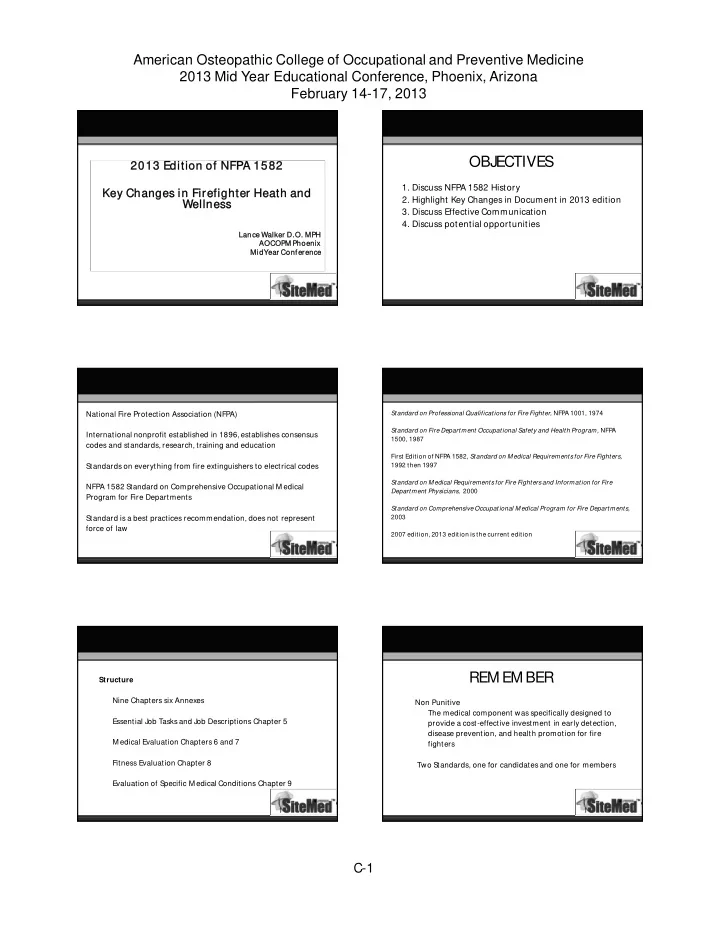
American Osteopathic College of Occupational and Preventive Medicine 2013 Mid Year Educational Conference, Phoenix, Arizona February 14-17, 2013

2013 Edition of NFPA 1582 Key Changes in Firefighter Heath and Wellness

Lance Walker D.O. MPH AOCOPM Phoenix MidYear Conference

OBJECTIVES

  • 1. Discuss NFP

A 1582 History

  • 2. Highlight Key Changes in Document in 2013 edition
  • 3. Discuss Effective Communication
  • 4. Discuss potential opportunities

National Fire Protection Association (NFPA) International nonprofit established in 1896, establishes consensus codes and standards, research, training and education Standards on everything from fire extinguishers to electrical codes NFPA 1582 Standard on Comprehensive Occupational M edical Program for Fire Departments Standard is a best practices recommendation, does not represent force of law

Standard on Professional Qualifications for Fire Fighter, NFP A 1001, 1974 Standard on Fire Department Occupational Safety and Health Program, NFP A 1500, 1987 First Edition of NFP A 1582, Standard on Medical Requirementsfor Fire Fighters, 1992 then 1997 Standard on Medical Requirementsfor Fire Fightersand Information for Fire Department Physicians, 2000 Standard on Comprehensive Occupational Medical Program for Fire Departments, 2003 2007 edition, 2013 edition is the current edition

Structure Nine Chapters six Annexes Essential Job Tasks and Job Descriptions Chapter 5 M edical Evaluation Chapters 6 and 7 Fitness Evaluation Chapter 8 Evaluation of Specific M edical Conditions Chapter 9

REM EM BER

Non Punitive The medical component was specifically designed to provide a cost-effective investment in early detection, disease prevention, and health promotion for fire fighters Two Standards, one for candidates and one for members

slide-2
SLIDE 2

C-2

American Osteopathic College of Occupational and Preventive Medicine 2013 Mid Year Educational Conference, Phoenix, Arizona February 14-17, 2013

DISCUSSION POINTS

  • 1. Immunizationsand Infectious Disease Screening
  • 2. Medical Standard Changes for Candidates and Members
  • 3. Fitness Testing Changes
  • 4. Communication
  • 5. Opportunities

SO WHAT’SNEW?

Still 9 Chapters, now two new annexes

  • One annex on pregnancy
  • One annex with nice reference materials and

forms

IM M UNIZATIONSAND INFECTIOUS DISEASE SCREENINGS

WHAT REM AINSTHESAM E?

  • TB Screening
  • Hep B Vaccinations and Titers
  • Hep CScreening Baseline/after exposure
  • Td every 10 years (no pertussis?)
  • M M R
  • Varicella
  • IPV as indicated
  • HIV Screening Offered

CHANGESTO VACCINESAND INFECTIOUSDISEASE SCREENING

  • Hep A vaccine
  • IGRA option for TB
  • Flu, Seasonal and Novel

OPPORTUNITY

  • Work with your Departments
  • Save M oney Develop Effective Program With Records
slide-3
SLIDE 3

C-3

American Osteopathic College of Occupational and Preventive Medicine 2013 Mid Year Educational Conference, Phoenix, Arizona February 14-17, 2013

M EDICAL STANDARD CHANGESFOR CANDIDATESAND M EM BERS

  • Category A Conditions (shall not be certified)
  • Category B Conditions (may be certified if…

)

  • Remember that M embers are held to a different

standard…

CHANGESTO M EM BER WORDING

For incumbent fire department members, conditions listed in Chapter 9 shall not indicate a blanket prohibition for such Incumbent members from continuing to perform the essential Job tasks, nor shall they require automatic retirement or Separation from the fire department.

FOCUSON NINEAREAS

  • Fitness
  • Asthma
  • Diabetes
  • Seizures
  • M etabolic Syndrome
  • Hypertension
  • Sleep Apnea
  • M edications
  • Cardiovascular Evaluation

FITNESS FITNESS

  • Submaximal Exercise Testing
  • 12 M ETSfor Candidates
  • 8 M ETSor better for M embers
slide-4
SLIDE 4

C-4

American Osteopathic College of Occupational and Preventive Medicine 2013 Mid Year Educational Conference, Phoenix, Arizona February 14-17, 2013

ASTHM A/ LUNG DISORDERS ASTHM A/ LUNG DISORDERS

  • Candidates
  • M ust have FEV1 and FVC>70% absolute cutoff no

matter the diagnosis or condition

  • Asthma is a Category A M edical Condition (defined as

needing 2 consecutive months of meds (BD or CS) at any time in the past two years)

  • “ I used to take medications for Asthma but I don’t have

Asthma anymore”

ASTHM A

  • Pulmonology Evaluation

(1) Asthma has resolved without symptomsoff medicationsfor 2 years. (2) Allergen avoidance or desensitization hasbeen successful (3) Spirometry demonstratesadequate reserve (FVCand FEV, greater than or equal to 90 percent) and no bronchodilator response measured off all bronchodilatorson the day of testing. (4) Normal or negative response to provocative challenge testing [e.g. cold air, exercise (12 METs), methacholine, histamine, mannitol, or hypertonic saline] or negative response to exercise challenge.

ASTHM A

  • M embers
  • 9 Criteria that M UST be M et (Changes from 2007 only) Specialist

Referral Required

  • M ust have mild asthma “step 1” or “step 2” asthma as defined by

National Heart Lung and Blood Institute’s Guidelines for the Diagnosis and M anagement of Asthma

  • Step 1, No control medications, Rescue bronchodilators used less than

twice per week

  • Step 2, Daily control medicine (LI or Low dose inhaled corticosteroids).

Use of rescue bronchodilators less than twice per week

  • Added Exercise Challenge Testing to optionsfor the specialist
  • Still must meet all 9 criteria including FVCand FEV1 >90% of predicted

DIABETES DIABETES

  • Candidates/ M embers Diabetes
  • Type 1 and Type 2 can both qualify
  • Type 1 has 7 criteria candidate/ member must

meet (some sub criteria)

  • Type 2 has 7 criteria candidate/ member must

meet

slide-5
SLIDE 5

C-5

American Osteopathic College of Occupational and Preventive Medicine 2013 Mid Year Educational Conference, Phoenix, Arizona February 14-17, 2013

DIABETES

  • Candidates/ M embers Diabetes
  • Highlights
  • NO TOD
  • Stress Test with Imaging
  • Signed Statement
  • 12 months of diabetic history
  • No Hypoglycemic Episodes
  • New Language about A1C M easurements and Accuracy
  • If insulin 3 months control must be demonstrated

SEIZUREDISORDERS SEIZUREDISORDERS

  • Candidates/ M embers
  • Both can qualify
  • Expansion of Definition
  • Streamlined process same for candidates and

members

  • Five Criteria, one year off meds or five years on

stable regimen, Neurologist consult with specific testing

SEIZUREDISORDERS

  • Qualification Criteria

1. No Seizure for one ear off seizure meds 2. Normal Neuro Exam 3. Normal Imaging Studies 4. Normal EEG (awake, asleep, photic, Hyperventilation) 5. Signed Statement from Neurologist

M ETABOLICS YNDROM E M ETABOLICS YNDROM E

(1) Abdominal obesity, defined as a waist circumference >40 in. (>102 cm) in men, >35 in. (>88 cm) in women (2) Triglycerides >150 mg/ dl (3) HDL cholesterol < 40 mg/ dl for men, < 50 mg/ dl for women (4) Blood pressure > 135/ 85 mmHg (5) Fasting Blood glucose > 110mg/ dl.

slide-6
SLIDE 6

C-6

American Osteopathic College of Occupational and Preventive Medicine 2013 Mid Year Educational Conference, Phoenix, Arizona February 14-17, 2013

M ETABOLICS YNDROM E

  • Candidates
  • Category A M etabolic Syndrome <12 M ETS(DQ

anyway)

  • Category B M etabolic Syndrome > 12 M ETS

M ETABOLICS YNDROM E

  • M embers
  • StressTest with imaging
  • M ust make 12 M ETS

HYPERTENSION HYPERTENSION

  • Candidates
  • Category A
  • Uncontrolled or Poorly Controlled Hypertension
  • Hypertension with End Organ Damage
  • Uncontrolled = Stage 2 Hypertension >160 systolic or

>100 diastolic

  • M ay refer back to PCP for treatment re-eval in one

month

HYPERTENSION

  • M embers
  • Stage 1 referral for evaluation and treatment
  • Stage 2 or TOD will trigger restriction or

disqualification until addressed

SLEEP APNEA

slide-7
SLIDE 7

C-7

American Osteopathic College of Occupational and Preventive Medicine 2013 Mid Year Educational Conference, Phoenix, Arizona February 14-17, 2013

SLEEP APNEA

  • Candidates
  • Category B Condition if unresponsive to treatment
  • M embers
  • M ust be properly treated

SLEEP APNEA

  • Recommendationson Screening
  • Berlin Questionnaire
  • Epworth

M EDICATIONS M EDICATIONS

  • Category A M edications for Candidates

1. Narcoticsincluding Methadone 2. Sedative-Hypnotics 3. Full-Dose or low-dose anticoagulation therapy 4. Bblockers(at dosesthat prevent cardiac response to exercise), high dose diuretics, central acting anti-hypertensives 5. Respiratory Medications 6. High dose corticosteroidsfor chronic disease 7. Anabolic Steroids 8. Any other drug that might interfere with performance of essential job tasks

M EDICATIONS

  • Category B M edications for Candidates

1. Cardiovascular Agents 2. Stimulants 3. Psychiatric Medications 4. Other than high-dose systemic corticosteroids 5. Antihistamines 6. Muscle relaxants 7. Leukotriene receptor antagonists(e.g., Montelukast) used for allergies that do not affect the lower respiratory system

M EDICATIONS

  • M edications in M embers

1. Methadone 2. Anticoagulants 3. Narcotics 4. Muscle Relaxants 5. Sedativesand Hypnotics 6. Psychiatric Medications(might) 7. Anti-Hypertensive agents 8. High Dose Corticosteroids 9. Anabolic Steroids

  • 10. Any other medicationsthat might interfere with performance of

essential job tasks

slide-8
SLIDE 8

C-8

American Osteopathic College of Occupational and Preventive Medicine 2013 Mid Year Educational Conference, Phoenix, Arizona February 14-17, 2013

REAL LIFESCENARIO

1. 8 vials marked Stanozolol 2. 1 vial T estosterone Cypionate 3. 1 vial of Sustanon 4. 1 vial of Drostanolone Propinate 5. 1 vial of Ondansteron 6. Nitroglycerine tablets 7. Ondansteron tablets 8. Flexaril

  • Question from Fire Chief

CARDIOVASCULAR

Who Needs stress testing with imaging?

(1) Fire fighterswith positive or questionably positive changes

  • n screening submaximal stresstests

(2) Fire fighterswith new-onset chest pain, symptomssuggestive

  • f coronary artery disease (CAD), or known coronary

artery disease

Who Needs stress testing with imaging?

(3) Fire fightersover the age of 45 (for men) and 55 (for women) with one or more of the following risk factorsfor CAD: (a) Hypercholesterolemia (total cholesterol greater than 240 mg/ dL) (b) Hypertension (systolic> 140 mmHg or diastolic > 90 mmHg) (c) Diabetes (d) Smoking (e) Family history of premature CAD (heart attack or sudden cardiac death in a first-degree relative less than 60 years of age) (4) Fire fighterswith a Framingham Risk Score > 10

FITNESSTESTING CHANGES FITNESSTESTING CHANGES

1. Gerkin Protocol Out, FDNY Protocol Out 2. WFI ST epM ill or Treadmill may be used 3. New formula for calculation of VO2 max/ M ETS [VO2max = 56.981 + (1.242 x TT) – (0.805 x BM I]

FITNESSTESTING CHANGES

1. Curl Up alternative 2. Leg strength/ power alternative 3. M odification of push=ups 4. Emphasis on caliper testing for body fat percentage (impedance still acceptable)

slide-9
SLIDE 9

C-9

American Osteopathic College of Occupational and Preventive Medicine 2013 Mid Year Educational Conference, Phoenix, Arizona February 14-17, 2013

EFFECTIVE COM M UNICATION

1. Specialists 2. M ember/ Candidate 3. Fire Chief/ Department

OPPORTUNITIES

1. Educate yourself 2. M arketing opportunity 3. Financial opportunities

FIREFIGHTER NEWSLETTER QUESTIONS?

lwalker@sitemed.net 770-378-1003