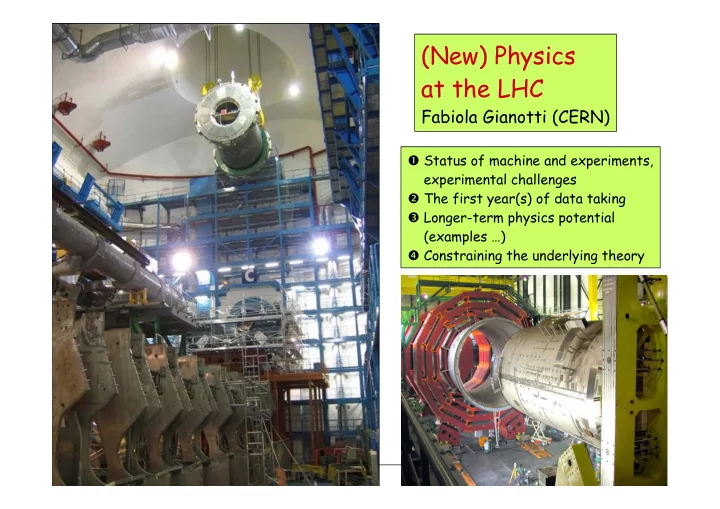
(New) Physics at the LHC Fabiola Gianotti (CERN) Status of machine - - PowerPoint PPT Presentation

new physics at the lhc
SMART_READER_LITE
LIVE PREVIEW

(New) Physics at the LHC Fabiola Gianotti (CERN) Status of machine - - PowerPoint PPT Presentation

(New) Physics at the LHC Fabiola Gianotti (CERN) Status of machine and experiments, experimental challenges The first year(s) of data taking Longer-term physics potential (examples ) Constraining the underlying theory F.


slide-1
SLIDE 1
  • F. Gianotti, GGI Inaugural Conference, Arcetri, 19/09/2005

1

 Status of machine and experiments, experimental challenges  The first year(s) of data taking  Longer-term physics potential (examples …)  Constraining the underlying theory

(New) Physics at the LHC

Fabiola Gianotti (CERN)

slide-2
SLIDE 2
  • F. Gianotti, GGI Inaugural Conference, Arcetri, 19/09/2005

2

LHC

  • pp √s = 14 TeV Ldesign = 1034 cm-2 s-1 (after 2009)

Linitial ≤ 2 x 1033 cm-2 s-1 (until 2009)

  • Heavy ions (e.g. Pb-Pb at √s ~ 1000 TeV)

TOTEM

ALICE : ion-ion, p-ion ATLAS and CMS : pp, general purpose ATLAS and CMS : pp, general purpose 27 km ring (previously used for LEP) Here: ATLAS, CMS TOTEM (integrated with CMS): pp, cross-section, diffractive physics TOTEM (integrated with CMS): pp, cross-section, diffractive physics LHCb : pp, B-physics, CP-violation

First collisions : summer 2007

slide-3
SLIDE 3
  • F. Gianotti, GGI Inaugural Conference, Arcetri, 19/09/2005

3

836 out of 1232 superconducting dipoles (B=8.3 T) produced as of last Friday

 Status of machine and experiments

Magnet quality is very good

slide-4
SLIDE 4
  • F. Gianotti, GGI Inaugural Conference, Arcetri, 19/09/2005

4

110 dipoles installed in the underground tunnel as of last Friday

slide-5
SLIDE 5
  • F. Gianotti, GGI Inaugural Conference, Arcetri, 19/09/2005

5 Dipole installation in the tunnel

Dipole interconnections

Such a high-tech machine requires sophisticated tests … Cryoline successfully cooled down last week

slide-6
SLIDE 6
  • F. Gianotti, GGI Inaugural Conference, Arcetri, 19/09/2005

6

Not only dipoles ….

Inner triplet quads assembly Assembly of Short Straight Session Dipoles 1232 Quadrupoles 400 Sextupoles 2464 Octupoles/decapoles 1568 Orbit correctors 642 Others 376 Total ~ 6700

slide-7
SLIDE 7
  • F. Gianotti, GGI Inaugural Conference, Arcetri, 19/09/2005

7

23/10/2004: first beam injection test from SPS to LHC through TI8 transfer line LHC injection lines: 5.6 km, 700 magnets

slide-8
SLIDE 8
  • F. Gianotti, GGI Inaugural Conference, Arcetri, 19/09/2005

8

LHC physics goals

Search for the Standard Model Higgs boson over ~ 115 < mH < 1000 GeV. Explore the highly-motivated TeV-scale, search for physics beyond the SM (Supersymmetry, Extra-dimensions, q/l compositness, leptoquarks, W’/Z’, heavy q/l, etc.) Precise measurements :

  • - W mass
  • - top mass, couplings and decay properties
  • - Higgs mass, spin, couplings (if Higgs found)
  • - B-physics (mainly LHCb): CP violation, rare decays, B0 oscillations
  • - QCD jet cross-section and as
  • - etc. ….

Study phase transition at high density from hadronic matter to quark-gluon plasma (mainly ALICE).

  • Etc. etc. …..
slide-9
SLIDE 9
  • F. Gianotti, GGI Inaugural Conference, Arcetri, 19/09/2005

9

The environment and the experimental challenges  Don’ t know how New Physics will manifest → detectors must be able to detect

as many particles and signatures as possible: e, µ, τ, ν, γ, jets, b-quarks, …. → ATLAS and CMS are general-purpose experiments. Excellent performance over unprecedented energy range : few GeV → few TeV

e+ ν

Jet 4 (b)

(b) W- W+ b-tagging (secondary vetices) τ(b-hadrons) ~ 1.5 ps → decay at few mm from primary vertex → detected with high-granularity Si detectors

tt → bW bW → blν bjj event from CDF data

slide-10
SLIDE 10
  • F. Gianotti, GGI Inaugural Conference, Arcetri, 19/09/2005

10

 Event rate and pile-up (consequence of high luminosity …)

Event rate in ATLAS, CMS : N = L x σinelastic (pp) ≈ 1034 cm–2 s–1 x 70 mb ≈ 109 interactions/s Proton bunch spacing : 25 ns Protons per bunch : 1011 ~ 20 inelastic (low-pT) events (“minimum bias”) produced simultaneously in the detectors at each bunch crossing → pile-up 2 5 n s

detector

Impact of pile-up on detector requirements and performance:

  • - fast response : ~ 50 ns
  • - granularity : > 108 channels
  • - radiation resistance (up to 1016 n/cm2/year in forward calorimeters)
  • - event reconstruction much more challenging than at previous colliders

p

pT

θ

slide-11
SLIDE 11
  • F. Gianotti, GGI Inaugural Conference, Arcetri, 19/09/2005

11

  • No hope to observe light objects (W, Z, H ?) in fully-hadronic final states → rely on l, γ
  • Fully-hadronic final states (e.g. q* → qg) can be extracted from backgrounds
  • nly with hard O(100 GeV) pT cuts → works only for heavy objects
  • Mass resolutions of ~ 1% (10%) needed for l, γ (jets) to extract tiny signals from

backgrounds

  • Excellent particle identification: e.g. e/jet separation

High-pT QCD jets g

g

q q W, Z q W, Z q Higgs mH=150 GeV H

g g t

TeV 1 ~ m pairs g ~ , q ~

g g

q ~ q ~

q ~

 Huge (QCD) backgrounds (consequence of high energy …)

slide-12
SLIDE 12
  • F. Gianotti, GGI Inaugural Conference, Arcetri, 19/09/2005

12

ATLAS

Length : ~45 m Radius : ~12 m Weight : ~ 7000 tons Electronic channels : ~ 108

  • Tracking (|η|<2.5, B=2T) :
  • - Si pixels and strips
  • - Transition Radiation Detector (e/π separation)
  • Calorimetry (|η|<5) :
  • - EM : Pb-LAr
  • - HAD: Fe/scintillator (central), Cu/W-LAr (fwd)
  • Muon Spectrometer (|η|<2.7) :

air-core toroids with muon chambers … and 3000 km of cables …

slide-13
SLIDE 13
  • F. Gianotti, GGI Inaugural Conference, Arcetri, 19/09/2005

13

CMS

  • Tracking (|η|<2.5, B=4T) : Si pixels and strips
  • Calorimetry (|η|<5) :
  • - EM : PbWO4 crystals
  • - HAD: brass/scintillator (central+ end-cap),

Fe/Quartz (fwd)

  • Muon Spectrometer (|η|<2.5) : return yoke of

solenoid instrumented with muon chambers Length : ~22 m Radius : ~7 m Weight : ~ 12500 tons

slide-14
SLIDE 14
  • F. Gianotti, GGI Inaugural Conference, Arcetri, 19/09/2005

14

August 25 2005: an historical day at Point 1 and Point 5 Point 1: 8th (and last) ATLAS barrel toroid installed in the underground cavern

slide-15
SLIDE 15
  • F. Gianotti, GGI Inaugural Conference, Arcetri, 19/09/2005

15

Point 5: CMS magnet (230 tons, L=12.5 m, R=3m) rotated from vertical to horizontal position before insertion into cryostat (operation at T=4.2 K)

2 5 A u g u s t 2 5

slide-16
SLIDE 16
  • F. Gianotti, GGI Inaugural Conference, Arcetri, 19/09/2005

16

All 400 CSC chambers produced, > 60% installed

CMS end-cap Muon Spectrometer

slide-17
SLIDE 17
  • F. Gianotti, GGI Inaugural Conference, Arcetri, 19/09/2005

17

ATLAS inner tracker: insertion of the third Silicon layer (out of four) into the barrel cylinder

slide-18
SLIDE 18
  • F. Gianotti, GGI Inaugural Conference, Arcetri, 19/09/2005

18

First cosmic muons

  • bserved by ATLAS

in the underground cavern

  • n June 20th

(recorded by hadron Tilecal calorimeter)

Tower energies: ~ 2.5 GeV

slide-19
SLIDE 19
  • F. Gianotti, GGI Inaugural Conference, Arcetri, 19/09/2005

19

Examples of expected performance

Heavy narrow resonances will likely be discovered in the X → ee channel (muon decay useful for couplings, asymmetry, etc.) Mc = 4 TeV m(l+l-) GeV

e+e- µ+µ-

KK resonance in TeV-1 ED

9.4% /√E⊕ 0.1%

Electron E-resolution measured in beam tests

  • f ATLAS EM calorimeter

σ / E

1 TeV e± : σ (E)/E ≈ 0.5% Muon momentum resolution expected in CMS 1 TeV µ± : σ (p)/p ≈ 5%

slide-20
SLIDE 20
  • F. Gianotti, GGI Inaugural Conference, Arcetri, 19/09/2005

20

~ 105 tt W b W b  µ µ ν +X 102 - 103 m = 1 TeV ~ 106 Z  µ µ µ µ 7 x 10⁶ W  µ µ ν Events to tape for 1 fb-1 (per expt: ATLAS, CMS) Channels (examples …)

g g~ ~

First collisions (Summer 2007) : L ~ 5x 1028 Plans to reach L ~ 1033 in/before 2009 Hope to collect few fb-1 per experiment by end 2008 Total statistics from previous Colliders ~ 104 LEP, ~ 106 Tevatron ~ 106 LEP, ~ 105 Tevatron ~ 104 Tevatron With these data:

  • Understand and calibrate detectors in situ using well-known physics samples

e.g. - Z → ee, µµ tracker, ECAL, Muon chambers calibration and alignment, etc.

  • tt → blν bjj jet scale from Wjj, b-tag performance, etc.
  • Measure SM physics at √s = 14 TeV : W, Z, tt, QCD jets … (omnipresent backgrounds

to New Physics)

→ prepare the road to discovery ……. it will take a lot of time …

 The first year(s) of data taking

slide-21
SLIDE 21
  • F. Gianotti, GGI Inaugural Conference, Arcetri, 19/09/2005

21

Example of initial SM measurement : top signal and top mass (relevant to New Physics …..)

2.5% 0.4 1 week 2x10³ 0.4% 0.2 1 month 7x10⁴ 0.2% 0.1 1 year 3x10⁵

  • Stat. error

δσ/σ

  • Stat. error

δMtop(GeV) Time

  • top signal visible pretty soon with

simple selection cuts and no b-tagging

  • cross-section to ~ 20%
  • top mass to ~7 GeV
  • get feedback on detector performance

(jet E-scale, b-tag)

  • tt is background to many searches

Events at 1033

  • Use gold-plated tt → bW bW → blν bjj decay
  • Very simple selection:
  • - isolated lepton (e, µ) pT > 20 GeV
  • - exactly 4 jets pT > 40 GeV
  • - no kinematic fit
  • - no b-tagging required (pessimistic,

assumes trackers not yet understood)

  • Plot invariant mass of 3 jets with highest pT

M (jjj) GeV ATLAS 150 pb-1 ( < 20 days at 1032)

B=W+4 jets (ALPGEN MC) Bentvelsen et al.

Ultimate LHC measurement precision: mtop to ~ 1 GeV (and mW to ~ 15 MeV)

slide-22
SLIDE 22
  • F. Gianotti, GGI Inaugural Conference, Arcetri, 19/09/2005

22

What about early discoveries ? Three examples ….

An easy case : a new (narrow) resonance of mass ~ 1 TeV decaying into e+e-,

e.g. a Z’ or a Graviton → e+e- of mass ~ 1 TeV

An intermediate case : SUSY A difficult case : a light Higgs (mH ~ 115 GeV)

slide-23
SLIDE 23
  • F. Gianotti, GGI Inaugural Conference, Arcetri, 19/09/2005

23

An “easy case” : G → e+e- resonance with m ~ 1 TeV

predicted in Randall-Sundrum Extra-dimensions

BR (G → ee ≈ 2%), c = 0.01 (small/conservative coupling to SM particles)

  • large enough signal for discovery

with ~ 1 fb-1 for m → 1 TeV

  • dominant Drell-Yan background small
  • signal is mass peak above background

Mass Events for 10 fb-1 ∫L dt for discovery

(TeV) (after all cuts) (≥ 10 observed events)

0.9 ~ 80 ~ 1.2 fb-1 1.1 ~ 25 ~ 4 fb-1 1.25 ~ 13 ~ 8 fb-1

  • C. Collard

Graviton (s=2)

  • r Z’ (s=1) ?

→ look at e± angular distributions

CMS

ATLAS, 100 fb-1, mG=1.5 TeV

→ G → G spin 1 “data” spin 2 spin 2

slide-24
SLIDE 24
  • F. Gianotti, GGI Inaugural Conference, Arcetri, 19/09/2005

24

An “intermediate case” : SUPERSYMMETRY χ0

1

Z

q q

χ0

2

q ~

g ~

5σ discovery curves

~ one year at 1034: up to ~2.5 TeV ~ one year at 1033 : up to ~2 TeV ~ one month at 1033 : up to ~1.5 TeV

cosmologically favoured region Tevatron reach : < 500 GeV

Using multijet + ET

miss (most model-independent

signature if R-parity conserved)

g g g q q q ~ ~ , ~ ~ , ~ ~

  • large cross-section → ≈ 100 events/day at 1033 for
  • spectacular signatures from cascade decays of heavy objects

TeV 1 ~ ) g ~ , q ~ ( m

If SUSY stabilizes mH → at TeV scale → could be found quickly …. thanks to:

slide-25
SLIDE 25
  • F. Gianotti, GGI Inaugural Conference, Arcetri, 19/09/2005

25

1999 2005

Meff = Σi=1,5 ETi (jets) + ET

miss

Example: Parton shower MC underestimate high-pT region, signal less clear today with Matrix Element → importance of adequate MC tools to describe backgrounds At LHC will use a combination of MC and data : e.g. Z → ee + jets events to measure Z → νν + jets (dominant) background Will also look for SUSY events with ≥ 1 lepton (cleaner signature)

Why is SUSY more difficult than the previous case ?

Because of larger (and less well known) detector-related and physics backgrounds Alpgen MC

slide-26
SLIDE 26
  • F. Gianotti, GGI Inaugural Conference, Arcetri, 19/09/2005

26

  • Higgs can be discovered over full allowed mass range

→ LHC will say final word about SM Higgs mechanism

  • Most difficult region (especially at the beginnning) : mH ~ 115 GeV
  • close-to-optimal detector performance needed

to detect H → γγ γγ, ttH → bb, qqH→ ττ ττ

  • knowledge of (huge) backgrounds to few percent required

→ it will take a lot of time … Expected Higgs signal significance (S/√B) in ATLAS (combining both experiments significance increases by ~ √2)

LEP limit: mH > 114.4

5σ ≡ discovery ~1 year at 1033 ~3 years at 1033

A difficult case: a light Higgs (mH ~ 115 GeV) …

slide-27
SLIDE 27
  • F. Gianotti, GGI Inaugural Conference, Arcetri, 19/09/2005

27

If mH > 180 GeV : early discovery easier with gold-plated H → 4l channel

H → 4l (l=e,µ) Signal Backgr .

Events / 0.5 GeV

CMS , 10 fb-1 m (4l) H → 4l : low-rate but very clean (narrow mass peak, small background) May be observed with 3-4 fb-1 (end 2008 ?)

slide-28
SLIDE 28
  • F. Gianotti, GGI Inaugural Conference, Arcetri, 19/09/2005

28

G q q g

→ topology is jet(s) + missing ET Look for a continuum of Graviton KK states :

Extra-dimensions (ADD models)

6 TeV 7 TeV 9 TeV MD

max

δ = 4 δ = 3 δ = 2 MD = gravity scale δ = number of extra-dimensions

2 D

M 1

+

δ

σ

Cross-section

σ(10 TeV) / σ(14 TeV)

Solution may be to run at different √s : To characterize the model need to measure MD and δ Measurement of cross-section gives ambiguous results: e.g. δ=2, MD= 5 TeV very similar to δ=4, MD= 4 TeV Good discrimination between various solutions possible with expected <5% accuracy on σ(10)/σ(14) for 50 fb-1 Discriminating between models:

  • - SUSY : multijets plus ET

miss (+ leptons, …)

  • - ADD : monojet plus ET

miss

ATLAS, 100 fb-1 ATLAS

 Examples of longer-term potential

slide-29
SLIDE 29
  • F. Gianotti, GGI Inaugural Conference, Arcetri, 19/09/2005

29

m (VH) (TeV)

VH → V h

mh=120 GeV ATLAS 300 fb-1

Little Higgs models

Alternative approach to the hierarchy problem predicting heavy top T (EW singlet), new gauge bosons WH, ZH, AH and Higgs triplet Φ0, Φ+, Φ++ Observation of T → Zt, Wb discriminates from 4th family quarks Observation of VH → Vh discriminates from W’, Z’ T → Zt →ll blν

q

W

b

T

q’

300 fb-1

ll blν mass (GeV)

slide-30
SLIDE 30
  • F. Gianotti, GGI Inaugural Conference, Arcetri, 19/09/2005

30

Other scenarios …..

Leptoquarks : lq lq → lj lj CMS

100 fb-1

Large number of scenarios studied: ⇒ demonstrated detector sensitivity to many signatures → robustness, ability to cope with unexpected scenarios ⇒ LHC direct discovery reach up to m ≈ 5-6 TeV Excited leptons ; e*e, e* → Wν →jj ν ATLAS

300 fb-1

LFV: W → τν, τ→ 3µ CMS, 10 fb-1

BR=1.9 x 10⁻⁶ Reach (30 fb-1): BR < 4 x 10⁻⁸

slide-31
SLIDE 31
  • F. Gianotti, GGI Inaugural Conference, Arcetri, 19/09/2005

31

Measurements of the SM Higgs parameters

Lot of useful information to constrain the theory (though not competitive with LC precision of e.g. ≈ % on couplings)

ATLAS + CMS 2x300 fb-1

Courtesy M. Duehrssen

 Constraining the underlying theory …

slide-32
SLIDE 32
  • F. Gianotti, GGI Inaugural Conference, Arcetri, 19/09/2005

32

~ λv mH

2 = 2 λ v2

Higgs self-coupling λ

  • not accessible at LHC
  • may be constrained to ≈ 20%

at Super-LHC (L=1035)

Higgs spin and CP

Promising for mH > 180 GeV (H → ZZ → 4l), difficult at lower masses

ATLAS + CMS, 2 x 300 fb-1

mH (GeV) JCP = 1+ JCP = 1- JCP=0- 200 6.5 σ 4.8 σ 40 σ 250 20 σ 19 σ 80 σ 300 23 σ 22 σ 70 σ

Significance for exclusion of JCP=0+

Buszello et al. SN-ATLAS-2003-025

slide-33
SLIDE 33
  • F. Gianotti, GGI Inaugural Conference, Arcetri, 19/09/2005

33

Mass peaks cannot be directly reconstructed (χ0

1 undetectable) → measure invariant mass

spectra (end-points, edges,..) of visible particles → deduce constraints on combinations

  • f sparticle masses

Precise SUSY measurements

ATLAS, 100 fb-1

mSUGRA Point “SPS1A”

Courtesy B. Gjelsten

GeV 121 157, 232, 690, ) ÷ , ~ , ÷ , q ~ ( m

1 2

R L

= l

χ0

2

χ0

1

540, 177,143,96 GeV

m (l+l-) spectrum end-point : 77 GeV

  • experim. precision ~0.1%

m (llj)min spectrum end-point: 431 GeV

  • experim. precision ~1 %

l q q l g ~

qL ~ lR ~ χ0

2

~ χ0

1

~

p p

slide-34
SLIDE 34
  • F. Gianotti, GGI Inaugural Conference, Arcetri, 19/09/2005

34

Putting all measurements together:

  • deduce several sparticle masses: typical precision 1%-20%

Model-indep. (just kinematics), but interpretation is model-dep.

  • from fit of model to all experimental measurements derive
  • - sparticle masses with higher accuracy
  • - fundamental parameters of theory to 1-30%
  • - dark matter (χ0

1) relic density and σ (χ0 1 - nucleon)

demonstrated so far in mSUGRA (5 param.) and in more general MSSM (14 param.)

Ωχh2

δ(Ωχh2) ≈ 3%

ATLAS, 300 fb-1

mSUGRA, Point “SPS1A”

Direct Dark Matter searches

DAMA

LHC data Zepelin, CDMS, Edelweiss present limit

  • -- projected
slide-35
SLIDE 35
  • F. Gianotti, GGI Inaugural Conference, Arcetri, 19/09/2005

35

General strategy toward understanding the underlying theory

(SUSY as an example …) Discovery phase: inclusive searches … as model-independent as possible First characterization of model: from general features: Large ET

miss ? Many leptons ?

Exotic signatures (heavy stable charged particles, many γ’s, etc.) ? Excess of b-jets or τ’s ? … Interpretation phase:

  • reconstruct/look for semi-inclusive topologies, eg.:
  • - h → bb peaks (can be abundantly produced in sparticle decays)
  • - di-lepton edges
  • - Higgs sector: e.g. A/H → µµ, ττ ⇒ indication about tanβ, measure masses
  • - tt pairs and their spectra ⇒ stop or sbottom production, gluino → stop-top
  • determine (combinations of) masses from kinematic measurements (e.g. edges …)
  • measure observables sensitive to parameters of theory (e.g. mass hierarchy)

At each step narrow landscape of possible models and get guidance to go on:

  • lot of information from LHC data (masses, cross-sections, topologies, etc.)
  • consistency with other data (astrophysics, rare decays, etc.)
  • joint effort theorists/experimentalists will be crucial
slide-36
SLIDE 36
  • F. Gianotti, GGI Inaugural Conference, Arcetri, 19/09/2005

36

Conclusions Past year achievements in the LHC machine construction are impressive,

giving robustness to the schedule (CERN fully committed to it !). Main objectives: -- complete installation by end of 2006

  • - deliver first collisions by summer 2007

The experiments are generally on track for ready-for-beam in middle 2007 Emphasis is now on integration, installation, commissioning of machine and detectors of unprecedented complexity, technology and performance

so, hopefully …

slide-37
SLIDE 37
  • F. Gianotti, GGI Inaugural Conference, Arcetri, 19/09/2005

37

In ~ 2 years from now, particle physics will enter a new epoch,

hopefully the most glorious and fruitful of its history. The LHC will explore in detail the highly-motivated TeV-scale with a direct discovery potential up to m ≈ 5-6 TeV → if New Physics is there, the LHC will find it (*) → it will say the final word about the SM Higgs mechanism and many TeV-scale predictions → it may add crucial pieces to our knowledge of fundamental physics → impact also on astroparticle physics and cosmology → most importantly: it will likely tell us which are the right questions to ask, and how to go on

(*) Early determination of scale of New Physics would be crucial for the future of

  • ur discipline and for the planning of future facilities

(ILC ? CLIC ? Underground Dark Matter searches ? …. )

slide-38
SLIDE 38
  • F. Gianotti, GGI Inaugural Conference, Arcetri, 19/09/2005

38

Spare slides

slide-39
SLIDE 39
  • F. Gianotti, GGI Inaugural Conference, Arcetri, 19/09/2005

39

LHC potential for ~all these scenarios demonstrated since long time. Here:

 What can be done at the beginning ?  Signal interpretation and constraints

  • f underlying theory ?

Extra-dimensions

Additional dimensions → Mgravity~ MEW New states at TeV scale

Little Higgs

SM embedded in larger gauge group New particles at TeV scale, stable mH

Technicolour

New strong interactions break EW symmetry → Higgs (elementary scalar) removed New particles at TeV scale

SUSY

New particles at TeV scale stabilize mH

Split SUSY

Accept fine-tuning of mH (and of cosm. constant) by anthropic arguments Part of SUSY spectrum at TeV scale (for couplings unification and dark matter)

M EW / M Planck ~ 10-17 δmH ~ Λ (scale up to which SM is valid) ⇒ New Physics at TeV scale to stabilize mH

slide-40
SLIDE 40
  • F. Gianotti, GGI Inaugural Conference, Arcetri, 19/09/2005

40

“ Difficult to speculate further on what the performance might be in the first year. As always, CERN accelerators departments will do their best !” Lyn Evans, LHC Project Leader

L=3x1028 - 2x1031

Stage 1

Initial commissioning 43x43 to 156x156, N=3x10¹⁰ Zero to partial squeeze

Stage 2

75 ns operation 936x936, N=3-4x10¹⁰ partial squeeze L=1032 - 4x1032

Stage 3

25 ns operation 2808x2808, N=3-5x10¹⁰ partial to near full squeeze L=7x1032 - 2x1033

Stage 4

25 ns operation Push to nominal per bunch partial to full squeeze

L=1034

LHC start-up scenario

slide-41
SLIDE 41
  • F. Gianotti, GGI Inaugural Conference, Arcetri, 19/09/2005

41

・ Now : detectors being commissioned with cosmic rays also in large chunks, addressing system issues. ・ Q1 06, cosmic challenge: slice test of CMS during the Magnet Test ・ Test with cosmic rays will continue in the pit after installation and re-cabling ・ Pilot run: Assume that we get a reasonable amount of collision data which are completed by Beam Gas/Beam Halo Muon datasets ・LVL1/HLT/DAQ: Timing-in, data coherence, sub-system synchronization, calibration, debug algorithms, … ・ECAL and HCAL calibration :Intercalibrate barrel crystals - “Phi Symmetry Method” ̃2% and Cross check and complete source calibration for HCAL channels ̃2% ・Tracker and Muon alignment : Align the tracker strip detector significantly below the 100 µm level, Align the muon chambers at the 100 µm level

CMS Commissioning

slide-42
SLIDE 42
  • F. Gianotti, GGI Inaugural Conference, Arcetri, 19/09/2005

42

  • Civil Engineering is off the Critical Path
  • Magnet: Coil connected. Start swivelling preparations in June 2005. Q1-06 end magnet

test and cosmic challenge & start heavy lowering April 06

  • HCAL, Muons : construction on schedule and well advanced.
  • TO WATCH:
  • ECAL: Crystals production, new contracts signed with two vendors.
  • TRACKER: Hybrid production and tracker integration at CERN.

*ECAL endcaps and pixels (even though ready) will be installed during winter 2007 shutdown in time for physics run in 2008.

CMS Status

Initial CMS* detector will be ready and closed for beam on 30 June 2007.

slide-43
SLIDE 43
  • F. Gianotti, GGI Inaugural Conference, Arcetri, 19/09/2005

43

p

pT θ η = -ln tg θ/2 Impact of pile-up on detector requirements and performance:

  • - fast response : ~ 50 ns
  • - granularity : > 108 channels
  • - radiation resistance (up to 1016 n/cm2/year in forward calorimeters)
  • - event reconstruction much more challenging than at previous colliders

At each crossing : ~1000 charged particles

produced over |η| < 2.5 (100 < θ < 1700) However : < pT > ≈ 500 MeV → applying pT cut allows extraction

  • f interesting events

Simulation of CMS tracking detector p p

slide-44
SLIDE 44
  • F. Gianotti, GGI Inaugural Conference, Arcetri, 19/09/2005

44

1 fb-1 (10 fb-1) ≡ 6 months at 1032 (1033) cm-2s-1 at 50% efficiency → may collect few fb-1 per experiment by end 2008 ~ 105 tt W b W b  µ µ ν +X 102 - 103 m = 1 TeV ~ 106 Z  µ µ µ µ 7 x 10⁶ W  µ µ ν Events to tape for 1 fb-1 (per expt: ATLAS, CMS) Channels (examples …)

g g~ ~

The first LHC data : from Summer 2007... Total statistics from previous Colliders ~ 104 LEP, ~ 106 Tevatron ~ 106 LEP, ~ 105 Tevatron ~ 104 Tevatron With these data:

  • Understand and calibrate detectors in situ using well-known physics samples

e.g. - Z → ee, µµ tracker, ECAL, Muon chambers calibration and alignment, etc.

  • tt → blν bjj jet scale from Wjj, b-tag performance, etc.
  • Measure SM physics at √s = 14 TeV : W, Z, tt, QCD jets … (omnipresent backgrounds

to New Physics) → prepare the road to discovery ……. it will take a lot of time …

 The first year(s) of data taling

slide-45
SLIDE 45
  • F. Gianotti, GGI Inaugural Conference, Arcetri, 19/09/2005

45

A difficult case: a light Higgs (mH ~ 115 GeV) …

Full GEANT simulation, simple cut-based analyses

mH > 114.4 GeV

here discovery easier with H → 4l

mH ~ 115 GeV 10 fb-1 total S/ √B ≈

2 . 2 3 . 1

4

+ −

H → γγ ttH → ttbb qqH → qqττ

(ll + l-had) S 130 15 ~ 10 B 4300 45 ~ 10 S/ √B 2.0 2.2 ~ 2.7

ATLAS K-factors ≡ σ(NLO)/σ(LO) ≈ 2 not included

slide-46
SLIDE 46
  • F. Gianotti, GGI Inaugural Conference, Arcetri, 19/09/2005

46

Each channel contributes ~ 2σ to total significance → observation of all channels important to extract convincing signal in first year(s) The 3 channels are complementary → robustness:

Remarks:

Note : -- all require “low” trigger thresholds E.g. ttH analysis cuts : pT (l) > 20 GeV, pT (jets) > 15-30 GeV

  • - all require very good understanding (1-10%) of backgrounds

H → γγ γγ b b ttH → tt bb → blν bjj bb

H

τ τ qqH → qqττ ττ

  • different production and decay modes
  • different backgrounds
  • different detector/performance requirements:
  • - ECAL crucial for H → γγ (in particular response uniformity) : σ/m ~ 1% needed
  • - b-tagging crucial for ttH : 4 b-tagged jets needed to reduce combinatorics
  • - efficient jet reconstruction over |η| < 5 crucial for qqH → qqττ :

forward jet tag and central jet veto needed against background

slide-47
SLIDE 47
  • F. Gianotti, GGI Inaugural Conference, Arcetri, 19/09/2005

47

If mH > 180 GeV : early discovery may be easier with H → 4l channel

H → 4l (l=e,µ) Signal Backgr .

Events / 0.5 GeV

CMS , 10 fb-1 m (4l) Luminosity needed for 5σ discovery (ATLAS+CMS)

  • H → WW → lν lν : high rate (~ 100 evts/expt) but no mass peak

→ not ideal for early discovery …

  • H → 4l : low-rate but very clean : narrow mass peak, small background
slide-48
SLIDE 48
  • F. Gianotti, GGI Inaugural Conference, Arcetri, 19/09/2005

48

SUSY Higgs sector : h, H, A, H±

5σ contours

4 Higgs observable 3 Higgs observable 2 Higgs observable 1 Higgs observable H, A → µµ, ττ H± → τν , tb Assuming decays to SM particles only

h

Here only h (SM - like) observable at LHC, unless A, H, H± → SUSY → LHC may miss part of the MSSM Higgs spectrum Observation of full spectrum may require high-E (√s ≈ 2 TeV) Lepton Collider mh < 135 GeV , mA≈ mH ≈ mH±

slide-49
SLIDE 49
  • F. Gianotti, GGI Inaugural Conference, Arcetri, 19/09/2005

49

Most of MSSM Higgs plane already covered after 1 year at L= 1033 … A, H, H± cross-section ~ tg2β

5σ discovery curves

Measurement of tg β

10% L L = Δ

Large variety of channels and signatures accessible

slide-50
SLIDE 50
  • F. Gianotti, GGI Inaugural Conference, Arcetri, 19/09/2005

50

Extended gauge groups : Z’ → l+l-

CMS

  • Reach in 1 year at 1034 : 4-5 TeV
  • Discriminating between models possible up to m ~ 2.5 TeV by measuring:
  • - σxΓ of resonance
  • - lepton F-B asymmetry
  • - Z’ rapidity
slide-51
SLIDE 51
  • F. Gianotti, GGI Inaugural Conference, Arcetri, 19/09/2005

51

Mini black holes production at LHC ?

… quite speculative for the time being … many big theoretical uncertainties 4-dim., Mgravity= MPlanck :

2 BH 2 Pl S

c M M 2 ~ R 4 + δ-dim., Mgravity= MD ~ TeV : M M M 1 ~ R

1 1 D BH D S +

       

δ

  • Schwarzschild radius (i.e. within which nothing escapes gravitational force):

Since MD is low, tiny black holes

  • f MBH ~ TeV can be produced if

partons ij with √sij = MBH pass at a distance smaller than RS

RS

  • Large partonic cross-section : σ (ij → BH) ~ π RS

2

e.g. For MD ~3 TeV and δ = 4, σ (pp → BH) ~ 100 fb → 1000 events in 1 year at low L

  • Black holes decay immediately (τ ~ 10-26 s) by Hawking radiation (democratic evaporation) :
  • - large multiplicity
  • - small missing E
  • - jets/leptons ~ 5

expected signature (quite spectacular …)

slide-52
SLIDE 52
  • F. Gianotti, GGI Inaugural Conference, Arcetri, 19/09/2005

52

A black hole event with MBH ~ 8 TeV in ATLAS Note: mini-BH should also be produced by ultra-high-energy cosmic neutrinos and

  • bserved by Auger

From preliminary studies : reach is MD ~ 6 TeV for any δ in one year at low luminosity.

) , (M f M log 1 1

  • T

log

D BH H

δ δ + + =

By testing Hawking formula  proof that it is BH + measurement of MD, δ precise measurements of MBH and TH needed (TH from lepton and photon spectra)

slide-53
SLIDE 53
  • F. Gianotti, GGI Inaugural Conference, Arcetri, 19/09/2005

53

Other examples of reach for Physics beyond SM …

Excited quarks q*→ γq: up to m ≈ 6 TeV Leptoquarks: up to m ≈ 1.5 TeV Monopoles pp → γγpp: up to m ≈ 20 TeV Compositeness: up to Λ ≈ 40 TeV Z’ → λλ, jj: up to m ≈ 5 TeV W’ → λν : up to m ≈ 6 TeV etc.... etc…. ATLAS 100 fb-1

slide-54
SLIDE 54
  • F. Gianotti, GGI Inaugural Conference, Arcetri, 19/09/2005

54

√s = 14 TeV

corresponds to E ~ 100 PeV fixed target proton beam

The LHC will be the first machine able to explore the high-E part of the cosmic ray spectrum

Links with astrophysics and cosmology ?

LHC studies most relevant to HECR:

  • - most energetic particles from pp collisions
  • - pp (and pA, AA) cross-sections

both require detection in the forward region

slide-55
SLIDE 55
  • F. Gianotti, GGI Inaugural Conference, Arcetri, 19/09/2005

55

√s = 14 TeV

corresponds to E ~ 100 PeV fixed target proton beam LHC studies most relevant to HECR:

  • - most energetic particles from the collisions
  • - pp (and pA, AA) cross-sections

both require detection in the forward region

LHC and high-energy cosmic rays

Charged particle multiplicity and energy in pp inelastic events at √s = 14 TeV

slide-56
SLIDE 56
  • F. Gianotti, GGI Inaugural Conference, Arcetri, 19/09/2005

56

Measurement of σtot (pp)

Curves are ~ (log s)γ

Goal of TOTEM: ~ 1 % precision ?

CMS

TOTEM : 3 stations of detectors ( “Roman Pots” RP1, RP2, RP3) at both sides of IP5 (integrated with beam pipe) to measure scattered proton in elastic interactions down to θscat ≈ 20 µrad