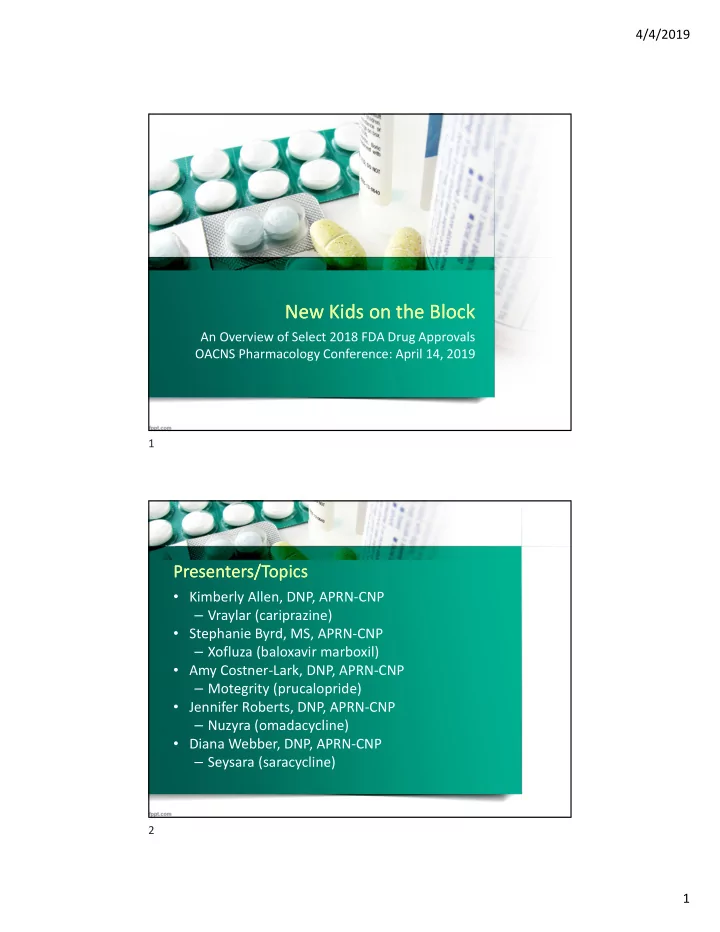
New Kids on the Block New Kids on the Block An Overview of Select - - PDF document

new kids on the block new kids on the block
SMART_READER_LITE
LIVE PREVIEW

New Kids on the Block New Kids on the Block An Overview of Select - - PDF document

4/4/2019 New Kids on the Block New Kids on the Block An Overview of Select 2018 FDA Drug Approvals OACNS Pharmacology Conference: April 14, 2019 1 Presenters/Topics Presenters/Topics Kimberly Allen, DNP, APRN-CNP Vraylar (cariprazine)


slide-1
SLIDE 1

4/4/2019 1

New Kids on the Block New Kids on the Block

An Overview of Select 2018 FDA Drug Approvals OACNS Pharmacology Conference: April 14, 2019

Presenters/Topics Presenters/Topics

  • Kimberly Allen, DNP, APRN-CNP

– Vraylar (cariprazine)

  • Stephanie Byrd, MS, APRN-CNP

– Xofluza (baloxavir marboxil)

  • Amy Costner-Lark, DNP, APRN-CNP

– Motegrity (prucalopride)

  • Jennifer Roberts, DNP, APRN-CNP

– Nuzyra (omadacycline)

  • Diana Webber, DNP, APRN-CNP

– Seysara (saracycline)

1 2

slide-2
SLIDE 2

4/4/2019 2

Objectives Objectives

By the end of this presentation, the learner will be able to:

  • Discuss the clinical indications and common adverse effects
  • f select new drugs approved by the FDA in 2018
  • Outline the approved dosing guidelines and recommended

dosage adjustments for select new drugs approved by the FDA in 2018

  • Discuss common adverse effects of select new drugs

approved by the FDA in 2018

  • Compare/contrast advantages/disadvantages of select new

drugs approved by the FDA in 2018 with older approved pharmacotherapeutic choices with similar clinical indications.

Vraylar (cariprazine) “Step by Step” Vraylar (cariprazine) “Step by Step”

3 4

slide-3
SLIDE 3

4/4/2019 3

Vraylar (cariprazine)

  • Approved by FDA September 17, 2018
  • Oral, atypical antipsychotic
  • Indication

– Treatment of bi-polar 1 and schizophrenia – Patients ages 18-65 – Acute treatment of manic or mixed episodes associated with bi-polar 1 disorders – Treatment of schizophrenia

  • Three positive, 6-week, randomized controlled

trials in acute schizophrenia – Demonstrated superiority of cariprazine over placebo

Vraylar (cariprazine)

  • Pharmacodynamics

– Partial agonist at:

  • D2 receptors
  • D3 receptors
  • 5-HT1A receptors

– Antagonist at:

  • 5-HT2B receptors
  • 5-HT2A receptors

– Antagonist at (moderate to low infinity):

  • H1 receptors
  • 5-HT2C receptors

5 6

slide-4
SLIDE 4

4/4/2019 4

Vraylar (cariprazine)

  • Dosing

– Available as an oral capsule only

  • Capsules: 1.5mg, 3mg, 4.5mg, 6mg

– Treatment of schizophrenia

  • Starting dose: 1.5 mg/day
  • Recommended dose: 1.5 mg to 6 mg/day

– Acute treatment of manic or mixed episodes associated with bipolar disorder

  • Starting dose: 1.5 mg/day
  • Recommended dose: 3 mg – 6 mg/day

Vraylar (cariprazine)

  • Dose Adjustment

– Concurrent CYP 3A4 Inducer or inhibitor – Inducer

  • Use is not recommended

– Inhibitor

  • New start of inhibitor
  • Reduce cariprazine dose by 50%

– Already on strong inhibitor

  • Max dose 3mg

7 8

slide-5
SLIDE 5

4/4/2019 5

Vraylar (cariprazine)

  • Dose Adjustment

– Renal impairment

  • CrCl ≥30ml/min

– no dose adjustment necessary

  • CrCl ≤ 30ml/min

– use not recommended

– Hepatic impairment – Mild-moderate (Child-Pugh class A or B)

  • no dose adjustment necessary

– Severe impairment (Child –Pugh class C)

  • use not recommended

Vraylar (cariprazine)

  • Drug interactions

– Metabolized by CYP3A4

  • Strong CYP3A4 inhibitors: reduce dosage by half
  • CYP3A4 inducers: do not recommend use with

cariprazine

  • Adverse reactions

– Schizophrenia trials: extrapyramidal symptoms and akathisia – Bipolar mania trials: extrapyramidal symptoms, akathisia, dyspepsia, somnolence, restlessness

9 10

slide-6
SLIDE 6

4/4/2019 6

Vraylar (cariprazine)

  • Active metabolites

– Two active metabolites

  • Desmethyl cariprazine
  • Didesmethyl cariprazine

– Cariprazine has a half life of 2-4 days – Metabolites have a half life of 1-3 weeks – When stopping cariprazine it will takes weeks for the medication to leave the system – Could be a benefit for patients with compliance issues

Vraylar (cariprazine)

  • Adverse Reactions

– >10%

  • GI

– Nausea

  • CNS

– Akathisia – Parkinsonism

– 1-10%

  • GI

– Vomiting, constipation, decreased appetite, dry mouth

  • Weight gain

– 2lb

  • CNS

– Drowsiness, dizziness, anxiety, agitation

  • CV

– HTN, tachycardia

11 12

slide-7
SLIDE 7

4/4/2019 7

Vraylar (cariprazine)

  • Advantages

– Once a day dosing – Long half life assist with non-compliant patients – Studies indicate superior to placebo – Does not affect prolactin level – Minimal anticholinergic side effects

  • Disadvantages

– High cost – EPS side effects – May increase metabolic syndrome – Clinically significant CYP3A4 drug-drug interactions – Has not been adequately studied In pregnant women

Vraylar (cariprazine)

  • Black box warning for increased mortality in

elderly patients with dementia-related psychosis

13 14

slide-8
SLIDE 8

4/4/2019 8

Xofluza (baloxavir marboxil) “Let’s Try it Again” Xofluza (baloxavir marboxil) “Let’s Try it Again” Xofluza (baloxavir marboxil)

  • Approved by FDA October 24, 2018
  • Oral, antiviral
  • Indication

– Acute uncomplicated influenza – Patients ages 12 years and older – Symptomatic no longer than 48 hours

  • Approval based on two RCTs comparing it with

placebo and oseltamivir for symptoms present less than 48 hours – Significantly reduced time of symptoms when compared with placebo – No difference in time of symptoms when compared with oseltamivir

15 16

slide-9
SLIDE 9

4/4/2019 9

Xofluza (baloxavir marboxil)

  • Influenza Oct 2018-Feb 2019 (CDC)

– 15.4-17.8 million illnesses – 184,000-221,000 hospitalizations – 11,600-19,100 deaths

  • Caused by influenza virus

– May be self-limiting – May develop complications

  • Sinus and ear infections most common
  • Others: pneumonia, death
  • Vaccination is the best prevention

Xofluza (baloxavir marboxil)

  • Influenza Symptoms

– Fever or chills (not always) – Cough – Sore throat – Runny or stuffy nose – Muscle or body aches – Headaches – Fatigue – Vomiting and diarrhea (children)

17 18

slide-10
SLIDE 10

4/4/2019 10

Xofluza (baloxavir marboxil)

Xofluza

  • Polymerase acidic

endonuclease inhibitor

  • Prevents replication of

the virus

  • One-time dose

– Improve compliance – May lead to

  • verprescribing

– Not approved for all groups

  • seltamivir, zanamivir,

peramivir

  • Neuraminidase inhibitor
  • Inhibits spread of virus

particles within the host cell

  • 5-day dosing
  • Oseltamivir approved for

more groups

  • >98% circulating flu virus

in U.S. susceptible to

  • seltamivir

Xofluza (baloxavir marboxil)

  • Dosing (Epocrates)

– Adults and adolescents 12 years and older – Available in 20 mg and 40 mg tablets

  • 40-79.9 kg: 40 mg PO x 1
  • >80 kg: 80 mg PO x 1

– Separate from dairy/ calcium-fortified products

  • Price: about $150 (wellrx.com)
  • Contraindications: hypersensitivity to drug/ingredients
  • Drug interactions

– Polyvalent cation containing laxatives, antacids or supplements – Includes: iron, zinc, selenium, calcium, or magnesium.

19 20

slide-11
SLIDE 11

4/4/2019 11

Xofluza (baloxavir marboxil)

  • Side effects (<1%)

– diarrhea – bronchitis – nasopharyngitis – headache – Nausea

  • Safety/ efficacy has not been established for:

– Pregnancy/lactation (no human data) – Children <12 or adults >65 – Those weighing <40 kg – Severe renal or hepatic impairment – Avoid in these populations until more data become available

Montegrity (prucalopride) “Hangin’ Tough” Montegrity (prucalopride) “Hangin’ Tough”

21 22

slide-12
SLIDE 12

4/4/2019 12

Motegrity (prucalopride) Motegrity (prucalopride)

  • Indications: Chronic idiopathic constipation

(CIC) for adults

  • Dosage & Administration: Oral tablet
  • Adults 2 mg daily
  • Severe renal impairment 1 mg daily

Clinical Trial Data Clinical Trial Data

  • 6 double-blind, placebo controlled
  • 2530 patients (half received Motegrity 2 mg

and have received placebo) for 12-24 weeks

  • 76% female
  • 76% White, 19% Asian, 3% Black
  • Mean age 47
  • Mean duration of CIC 16 years with 28%

having it more than 20 years

23 24

slide-13
SLIDE 13

4/4/2019 13

CIC defined CIC defined

  • Having fewer than 3 spontaneous bowel

movements per week that resulted in a feeling

  • f complete evacuation and 1 or more of the

following:

  • Lumpy or hard stool
  • Sensation of incomplete evacuation
  • Straining at defecation

Results Results

  • Primary efficacy endpoint defined as:
  • Patient with an average of 3 more complete

spontaneous bowel movements (CSBM) per week over the 12-24 weeks

  • All studies showed improvement in

CSBM/week by week 1

  • Median time to first CSBM after first dosing

was 1.4-4.7 days as compared to 9-20 days in placebo.

25 26

slide-14
SLIDE 14

4/4/2019 14

Description & Pharmacology Description & Pharmacology

  • Selective Serotonin Type 4 (5-HT4) receptor

agonist

  • Gastrointestinal prokinetic agent that

stimulates colonic peristalsis that increase bowel motility

  • Mean colonic transit time was reduced by 12

hours from a baseline of 65 hours for the 2 mg group compared to an increase of 0.5 hours from a baseline of 66 hours in placebo group

Pharmacokinetics Pharmacokinetics

  • Steady state in 3-4 days
  • Half-life 24 hours
  • Peak plasma concentration in 3 hours
  • Excretion – 60% unchanged in urine 5% in

feces

27 28

slide-15
SLIDE 15

4/4/2019 15

Side Effects Side Effects

  • Headache (19%) (9%)
  • Abdominal pain (16%) (11%)
  • Nausea (14%) (7%)
  • Diarrhea (13%) (5%)
  • Abdominal distension (5%) (4%)
  • 5% of patients discontinued due to side effects

in the clinical trials

  • Red denotes placebo side effects

Suicidal Ideation Suicidal Ideation

  • One patient attempted 7 days after the end of

trial

  • No attempts in placebo group
  • 2 patients completed suicide that were

previously treated with Motegrity – both had been off the drug for 30 days at time of death

29 30

slide-16
SLIDE 16

4/4/2019 16

Use in Special Populations Use in Special Populations

  • Pregnancy - Available data from case reports with

use in pregnant women are insufficient to identify any drug-associated risks of miscarriage, major birth defects, or adverse maternal or fetal

  • utcomes
  • Lactation – is present in milk – assess risk vs

benefit

  • Geriatric – No overall differences in safety or

efficacy

  • Renal impairment – dose adjustment to 1 mg daily

Drug Interactions Drug Interactions

  • Erythromycin concentrations increased 40%
  • No interaction with warfarin, digoxin, paxil,

OCP’s

  • No impact on fertility

31 32

slide-17
SLIDE 17

4/4/2019 17

Nuzyra (Omadacyine) “You Got It” Nuzyra (Omadacyine) “You Got It”

Nuzyra (Omadacyine)

  • Approved by FDA October 2, 2018
  • Modernized tetracycline
  • Oral IV and Oral antibiotic
  • Indications:
  • Antibacterial for Community Acquired

Bacterial pneumonia (CABP)

  • Acute Bacterial Skin and Skin Structure

Infections (ABSSI)

33 34

slide-18
SLIDE 18

4/4/2019 18

CABP

  • Most common leading infection leading to

infection in all age groups

  • Economic effect is approximately $17 billion

in the United States

  • CABP population 18 years older:
  • Symptoms 3 or more of the following: cough,

purulent sputum production, dyspnea, or pleuritic chest pain

  • And at least 2 abnormal vital signs
  • Laboratory confirmed pneumonia

Nuzyra (Omadacyine)

CABP ABSSSI GRAM-POSITIVE BACTERIA Streptococcus pneumoniae Staphylococcus aureus (methicillin- susceptible isolates) GRAM-NEGATIVE BACTERIA Haemophilus influenzae Haemophilus parainfluenzae Klebsiella pneumonia OTHER MICROORGANISMS Chlamydophila pneumoniae Legionella pneumophila Mycoplasma pneumoniae GRAM-POSITIVE BACTERIA Enterococcus faecalis

  • S. aureus (methicillin-susceptible and-

resistant isolates) Staphylococcus lugdunensis Streptococcus anginosus grp. (includes S. anginosus, Streptococcus intermedius, and Streptococcus constellatus) Streptococcus pyogenes GRAM-NEGATIVE BACTERIA Enterobacter cloacae

  • K. pneumoniae

35 36

slide-19
SLIDE 19

4/4/2019 19

Nuzyra (Omadacyine)

  • Approval by several multinational double-

blind, double-dummy, randomized, non- inferiority trials

  • Compared omadacycline with moxifloxacin
  • Primary end point was early clinical response
  • Conclusions of study: omadacyline was

noninferior to moxifloxacin Dosing

  • Once per day oral & IV

Nuzyra (Omadacyine)

Adverse Reactions

  • Most common nausea, vomiting, diarrhea
  • IV infusion site reaction

Contraindications

  • known hypersensitivity to omadacycline or tetracycline

class antibacterial drugs Drug interactions

  • Patients who are on anticoagulant therapy may require

downward adjustment of their anticoagulant dosage while taking NUZYRA.

  • Absorption of tetracyclines, including NUZYRA is impaired

by antacids containing aluminum, calcium, or magnesium, bismuth subsalicylate and iron containing preparations.

37 38

slide-20
SLIDE 20

4/4/2019 20

Seysara (sarecycline) “I’ll Be Loving You Forever” Seysara (sarecycline) “I’ll Be Loving You Forever”

Seysara (sarecycline)

  • Approved by FDA October 2018
  • Oral, narrow-spectrum, tetracycline-derived

antibiotic – Targets P. acnes; S. aureus – Anti-inflammatory properties

  • Indication

– Moderate to severe acne vulgaris – Patients ages 9 years and older

  • Approval based on two large Phase III RCTs

– Significantly reduced inflammatory lesion count at 12 weeks compared to placebo (p<0.004)

39 40

slide-21
SLIDE 21

4/4/2019 21

Seysara (sarecycline)

  • Acne overview

– Affects ~90% of world’s population – Chronic inflammation of pilosebaceous glands – Onset typically during puberty

  • Four major factors produce acne lesions

– Elevated sebum secretion – Abnormal keratinization – Bacterial colonization by Propionibacterium acnes – Inflammation

Seysara (sarecycline)

  • Current anti-acne drugs (topical and oral)

– Retinoids – Anti-androgens – Antibiotics – Benzoyl peroxide

  • Advantages of sarecycline

– Effective if resistance to clindamycin or erythromycin – Once-daily vs 2-4x daily improves adherence – Fewer adverse effects compared to retinoids, anti-androgens – More effective than benzoyl peroxide

41 42

slide-22
SLIDE 22

4/4/2019 22

Seysara (sarecycline)

  • Cautions/possible adverse effects

– GI irritation (“pill esophagitis”) – Photosensitivity – Risk for C-diff associated diarrhea – Possible CNS effects – Overgrowth non-susceptible organisms

  • Can cause fetal harm in pregnancy
  • Use in children up to age 8 yrs may cause

tooth discoloration

Seysara (sarecycline)

  • Patient education

– Dosing: tablets 60, 100, 150 mg

  • Weight-based from 33 kg-136 kg

– Price: GoodRx $850 for 30 tablets – Evaluate efficacy at 12 weeks; safety beyond 12 mos not established – Take with or without food; not with milk – Take with enough fluids to reduce esophageal irritation – Drug interactions

  • Beta-lactams
  • Tretinoins/oral retinoids
  • Oral iron products

Body Weight (kg) Tablet Strength 33 to 54 kg 60 mg tablet 55 to 84 kg 100 mg tablet 85 to 136 kg 150 mg tablet

43 44